
鸿蒙(HarmonyOS)

Search documents
QuestMobile 2025-2026年度核心趋势报告
Sou Hu Wang· 2026-01-27 08:09
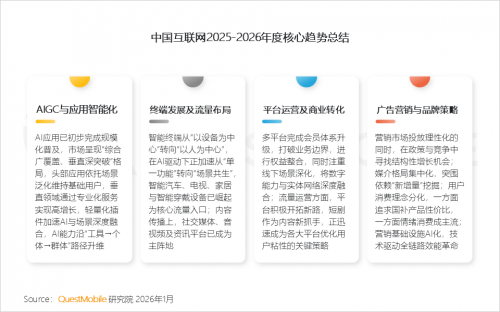
Core Insights - The article emphasizes the transition of China's digital economy from "quantitative change" to "qualitative change" by 2025, with the digital economy expected to exceed 65 trillion yuan, accounting for over 50% of GDP, thus becoming a core engine of the national economy [1] - The shift from a "traffic-centric" model to a "user-centric" value cultivation model is highlighted, indicating a new competitive landscape in the next decade [1] - Internet giants are focusing on "cost reduction and efficiency enhancement," moving their strategic focus from "traffic acquisition" to "user value cultivation" [1] Group 1: Digital Economy and User Value - By 2025, the digital economy in China is projected to surpass 65 trillion yuan, representing over 50% of GDP, marking a significant shift in its role within the national economy [1] - The transition from a "traffic-centric" to a "user-centric" model signifies the end of the "traffic is king" era in mobile internet, leading to a new competitive landscape [1] - Internet platforms are breaking boundaries and adopting a "data-technology-scenario" ecosystem to better serve users [1] Group 2: Key Strategies of Internet Giants - Major companies are integrating membership systems and deepening offline scenarios to enhance user engagement, as seen with Alibaba's Taobao and JD's PLUS service [2] - The rise of HarmonyOS and other distributed architectures is breaking the boundaries of single hardware, marking a shift towards a "super terminal ecosystem" [2] - The competition in the smartphone market is evolving with AI features becoming standard, pushing brands like Huawei to innovate [2] Group 3: AI and Application Trends - The AI industry is transitioning from technical breakthroughs to large-scale commercial applications, driven by policy, technology, and industry integration [7] - AI applications are experiencing rapid growth, with mobile AI assistant users reaching 7.29 billion by September 2025 [18] - The focus in the AI sector is shifting from model size to cost efficiency and speed of implementation, leading to a surge in "In-App AI" applications [18] Group 4: Market Environment and Trends - The overall macroeconomic environment in China is stable, with the digital economy being a significant driving force [5] - The internet advertising market is expected to maintain moderate growth, with mobile platforms remaining the core entry point for marketing [5] - The market is witnessing a shift from high-growth sectors to a focus on AIGC (AI-Generated Content) and the rapid proliferation of intelligent applications [11] Group 5: User Engagement and Content Strategy - The shift from "traffic hunting" to "user value cultivation" reflects a change in market dynamics, with a focus on deep user engagement [93] - Platforms are evolving from mere transaction sites to essential service providers in users' digital lives, integrating various services to enhance user experience [97] - The rise of short video content is becoming a new growth engine, with significant increases in user engagement across platforms [107]

QuestMobile 2025-2026年度核心趋势报告(精华版):智变重构用户价值,流量红利跃迁为服务红利,“产业红海”中新机涌动!
QuestMobile· 2026-01-27 02:12
Core Insights - The article emphasizes the transition of China's digital economy from "quantitative change" to "qualitative change" by 2025, with the digital economy expected to exceed 65 trillion yuan, accounting for over 50% of GDP, marking it as a core engine of the national economy [4][5]. - The shift in focus from "traffic acquisition" to "user value cultivation" is highlighted, indicating a new competitive landscape where internet giants are prioritizing efficiency and user engagement over mere user growth [5][6]. Digital Economy Trends - By 2025, the digital economy will become a standardized service base, leading to a refined user acquisition strategy across hardware and internet platforms [5]. - Major internet companies are expected to adopt cost-cutting measures and enhance user value through integrated membership systems and deeper offline engagement [5][6]. Hardware and AI Developments - The rise of distributed operating systems like HarmonyOS is breaking the boundaries of single hardware, transitioning the smart terminal industry to a user-centered model [6]. - AI-driven applications are expected to proliferate, with a focus on reducing operational costs and enhancing user experience, particularly in the automotive and smart home sectors [6][7]. AI Application Insights - The AI industry is moving towards practical applications, with a focus on reducing costs and increasing deployment speed, leading to a surge in "In-App AI" applications [6][27]. - The competitive landscape in AI is shifting from model size to practical implementation, with a dual oligopoly emerging in the "search + service" sector [27][31]. User Engagement and Content Consumption - Video content, particularly short dramas, is becoming a significant driver of user engagement, with active users of short drama apps reaching 263 million, a year-on-year increase of 85.5% [119]. - Platforms like Taobao and JD.com are integrating short dramas to enhance user interaction and drive conversion rates [121]. Marketing and Advertising Trends - The internet advertising market is expected to maintain moderate growth, with a shift towards more cautious and targeted marketing strategies [135][137]. - Brands are increasingly focusing on emotional and interest-based consumption, reflecting a trend towards personalized marketing approaches [144][146]. User Behavior and Ecosystem Integration - The user base for mobile AI assistants has grown significantly, with a 13.9% year-on-year increase, indicating a strong market presence [45]. - Companies are integrating AI capabilities into their core business processes, enhancing user experience and operational efficiency [54][56]. Conclusion - The article outlines a transformative period for the digital economy in China, driven by advancements in AI, user engagement strategies, and a shift towards a more integrated and user-centric approach across various platforms and industries [5][6][54].


余承东致员工信:鸿蒙生态要想走得远,必须快速转变思维
Guan Cha Zhe Wang· 2025-11-03 05:35
Core Insights - Huawei's HarmonyOS 5 has surpassed 23 million devices, marking a critical milestone in its ecosystem development [1][2] - The company acknowledges that while progress has been made, significant challenges remain ahead for the ecosystem to thrive [1][2] Ecosystem Development - The number of devices running HarmonyOS 5 has crossed 23 million, indicating the beginning of a stable growth phase for the ecosystem [1][2] - The company emphasizes the need for a mindset shift among partners and developers to foster a genuine ecosystem culture [2] Future Goals - Huawei aims to quickly expand the user base to 40 million, 60 million, and eventually over 100 million, striving for a significant market presence [1][2] - The company is focused on enhancing consumer experience and deepening developer engagement to build a robust ecosystem [1][2] Cultural Orientation - Huawei has introduced a cultural directive emphasizing "openness, altruism, user experience, and long-termism" as foundational principles for its ecosystem [2] - The company encourages employees to adopt a humble approach and consider the perspectives of partners and developers in their work [2]

裁员9000人,互联网龙头也扛不住了
商业洞察· 2025-07-13 03:49
Core Viewpoint - Microsoft is facing significant challenges with its Windows operating system, leading to a substantial user loss and a shift towards AI investments, while a new competitor, HarmonyOS, is emerging in the market [2][3][20]. Group 1: Microsoft and Windows Challenges - Windows has lost 400 million users over the past three years, representing a decline of over 30% [3]. - The operating system has been criticized for various issues, including a chaotic interface, high memory usage, and forced updates that can lead to system failures [2][3]. - Microsoft is undergoing massive layoffs, with approximately 9,000 employees affected, marking its largest round of layoffs in recent months [9][10]. Group 2: AI Investment and Workforce Changes - Microsoft plans to invest $80 billion in AI infrastructure by the 2025 fiscal year, with 20% to 30% of its code now generated by AI [14][12]. - The company is restructuring its workforce to align with AI advancements, indicating a shift in human resource needs due to AI's impact on job functions [12][13]. - Other tech giants like Google, Meta, and Amazon are also reducing their workforce while focusing on AI, with a cumulative layoff of over 100,000 employees in the past two years [18][19]. Group 3: Emergence of HarmonyOS - HarmonyOS, developed by Huawei, is gaining traction as a new operating system, having surpassed 1 billion users across smartphones and IoT devices [22]. - The system has evolved to no longer rely on Unix or Linux, marking a significant shift in its architecture [22]. - HarmonyOS is seen as a potential disruptor in the PC market, with its recent launch of Harmony computers aiming to redefine personal computing [25][26]. Group 4: Market Dynamics and Future Outlook - Windows' market share in the PC sector has fallen below 90%, with a notable decline in active devices running the OS [20]. - The rise of HarmonyOS and other competitors poses a significant threat to Microsoft's dominance in the operating system market [20][26]. - The ongoing evolution of HarmonyOS reflects a broader trend of domestic operating systems gaining independence and strength in the tech landscape [26].


华为余承东:鸿蒙注册开发者数量突破800万人
第一财经· 2025-06-20 08:25
Core Viewpoint - Huawei's HarmonyOS ecosystem is rapidly expanding, with significant growth in developer engagement and community contributions [1] Group 1 - As of June 20, the number of registered developers for HarmonyOS has surpassed 8 million [1] - The code base for OpenHarmony has exceeded 130 million lines [1] - The number of community contributors is approaching 9,000 [1] - Huawei has announced the launch of developer Beta testing for HarmonyOS 6 [1]

2025年鸿蒙生态全场景流量分析报告
艾瑞咨询· 2025-06-15 03:51
Core Insights - The article discusses the evolution of the internet traffic ecosystem and the development trends of the HarmonyOS ecosystem, highlighting the challenges faced by the mobile internet and the transformative potential of HarmonyOS as a key player in the next-generation traffic ecosystem [5][7][19]. Internet Traffic Ecosystem - The mobile internet is experiencing a growth bottleneck, with a compound annual growth rate of only 0.08% in the number of independent devices over the past five years, indicating a saturation of the market and a decline in user dividends [7]. - The current traffic distribution model is limited by ecological fragmentation and technological bottlenecks, necessitating a shift towards a more integrated and efficient traffic ecosystem [10][11]. HarmonyOS Development Trends - HarmonyOS is positioned as a major builder of the next-generation traffic ecosystem, leveraging its distributed architecture to connect multiple devices and provide seamless user experiences across various scenarios [19][22]. - The ecosystem's core capabilities include full-scene coverage across multiple devices and AI-driven efficiency improvements, which enhance user experience and operational efficiency [25][30]. Advantages of HarmonyOS Ecosystem - HarmonyOS has become the third-largest mobile operating system globally, creating a competitive landscape alongside Android and iOS [28]. - The ecosystem serves as a core entry point for the Internet of Things (IoT), facilitating commercial monetization and forming a complete business loop [30]. - The system's lightweight application model and high-level security certifications enhance user trust and experience [34][37]. User Insights - The typical Huawei user is predominantly male, aged 25-45, with a high income and education level, primarily located in tier-one and new tier-one cities [60][62]. - Users exhibit a strong preference for Huawei's own applications, showing higher acceptance of online advertisements and a significant potential for consumption in categories such as automobiles, luxury goods, and 3C products [75][81][87]. Marketing Solutions - The "Whale Harmony Dynamics" platform integrates HarmonyOS resources to enhance marketing effectiveness across various industries, including automotive, luxury goods, and health [96][99][103]. - The platform utilizes AI and big data to create personalized marketing strategies, ensuring efficient customer engagement and conversion [103][105].

2024年鸿蒙生态全场景流量分析报告
艾瑞股份· 2025-02-28 02:25
Investment Rating - The report does not explicitly state an investment rating for the industry Core Insights - The mobile internet is facing a growth bottleneck and user dividend decline, with the need for technological innovation and ecological restructuring to unlock flow value [5][14] - The HarmonyOS ecosystem is positioned as a key builder of the next-generation flow ecology, leveraging full-scene intelligent collaboration and data integration to drive value leaps [5][24] - The report highlights the six advantages of the Harmony ecosystem, including being the third-largest mobile operating system globally and forming a commercial monetization closed loop [34][51] Summary by Sections Internet Traffic Ecology and Harmony Ecosystem Development Trends - The mobile internet is experiencing a slowdown in growth, with the total effective usage time averaging around 161.28 billion hours per month, and the number of independent devices showing a compound growth rate of only 0.08% [16][18] - The fragmentation of traffic entry points and technological bottlenecks are hindering the release of flow value, necessitating a full-scene integration approach to overcome these challenges [20][22] - The Harmony ecosystem is continuously innovating, with its core capabilities being full-scene multi-terminal coverage and AI-enhanced service efficiency [34][39] Whale Hong Momentum Value Insights: Flow - Whale Hong Momentum's self-owned media matrix achieved a peak MAU of 373 million in 2024, with a flow growth rate of 5.9%, indicating strong user engagement and retention [80][81] - The user demographic is primarily high-net-worth individuals aged 25-45, with a significant portion residing in first- and new-first-tier cities [8][80] - The advertising acceptance rate among users is 71.8%, with a strong conversion intention post-advertisement, providing brands with a comprehensive marketing capability [8][80] Whale Hong Momentum Value Insights: User - The user base shows a significant preference for using proprietary apps, with a high acceptance of online advertisements, particularly in categories like luxury goods and automobiles [5][8] - The report emphasizes the need to fully explore the marketing value of time-segmented scenarios, as user activity peaks at different times throughout the day [89][90] Whale Hong Momentum Industry Solutions - The Whale Hong Momentum integrates various media resources to create a unified traffic entry point, addressing the inefficiencies of fragmented mobile internet traffic [76][77] - The report outlines the importance of breaking down ecological barriers and enhancing cross-platform user behavior tracking to improve flow utilization [77][80] - The AI-driven intent framework enables efficient integration and precise distribution of traffic across devices, enhancing the overall user experience [76][77]