03式中程地对空导弹

Search documents
日本正为出口护卫舰和导弹铺路
日经中文网· 2026-02-27 01:16
Core Viewpoint - The Japanese Liberal Democratic Party (LDP) has proposed to abolish the current restrictions on defense equipment exports, which only allow the export of non-lethal equipment, aiming to enhance Japan's defense industry and export capabilities [1][5]. Group 1: Proposal Details - The proposal suggests removing the five-category restriction on defense equipment exports, which currently limits exports to non-lethal items such as rescue, transport, surveillance, and mine-sweeping equipment [3][5]. - The LDP plans to coordinate with the Japan Innovation Party and submit the proposal to the government by early March, with potential modifications to the "Three Principles on Defense Equipment Transfer" expected by spring 2026 [1][5]. Group 2: Export Opportunities - The proposal allows for the export of lethal equipment, including fighter jets and destroyers, to countries that have signed defense equipment and technology transfer agreements with Japan [5]. - Japan aims to deepen defense cooperation with allied nations through increased defense equipment exports, responding to high demand from other countries for Japanese-produced equipment [5][6]. Group 3: Industry Implications - The expansion of defense exports is intended to cultivate Japan's domestic defense industry, which currently faces challenges such as low profit margins and high production costs due to a lack of competition [6]. - The Japanese defense industry primarily serves the Self-Defense Forces, producing only as needed, which has led to a high-cost structure and equipment prices that are higher than those of other countries [6].

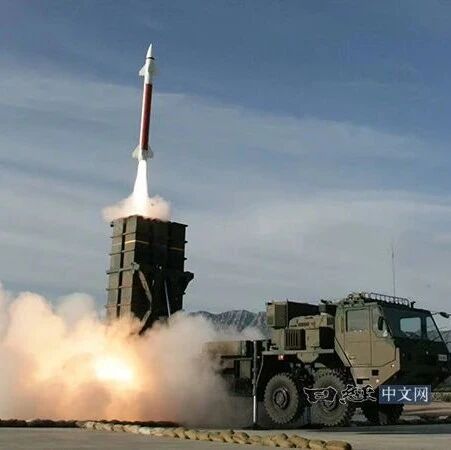
“日本开始军事介入南海,非常负面”
Zhong Guo Ji Jin Bao· 2025-12-15 00:55
Core Viewpoint - The article discusses the increasing provocations by the Philippines in the South China Sea, supported by the U.S. and Japan, and emphasizes that resolving the South China Sea disputes may take generations due to the complexity and number of involved parties [1][3]. Group 1: Philippines' Actions - Multiple Philippine vessels have been sent to the Spratly Islands under the guise of fishing, prompting the Chinese Coast Guard to take necessary control measures [1]. - The Philippines is intensifying unilateral provocative actions in the South China Sea, influenced by U.S. support and Japan's involvement [2]. Group 2: Japan's Involvement - Japan has been increasingly involved in South China Sea affairs, including informal discussions with the Philippines regarding military equipment and establishing a munitions depot on Palawan Island, only 200 kilometers from Huangyan Island [2]. - Japan's South China Sea policy has shifted significantly over the past decade, moving from a neutral stance to active military engagement alongside the U.S. and the Philippines [2]. Group 3: Future Outlook - The overall peace and stability in the South China Sea is not expected to undergo significant changes in the next five to ten years, primarily due to China's presence as the largest coastal state [3]. - The resolution of the South China Sea disputes is anticipated to require several generations of effort, given the complexity of the territorial claims and the number of countries involved [3].
“日本开始军事介入南海”
第一财经· 2025-12-14 07:41
Core Viewpoint - The article discusses the increasing provocations by the Philippines in the South China Sea, influenced by the United States and Japan, and emphasizes that resolving the South China Sea disputes may take generations of effort [1][10][11]. Group 1: Philippines' Actions and Regional Dynamics - Multiple Philippine vessels have been reported to provoke tensions in the Spratly Islands, prompting necessary control measures from the Chinese Coast Guard [1]. - The Philippines is facing internal political challenges, including corruption scandals and electoral outcomes that may affect the stability of the current administration [4]. Group 2: U.S. and Japan's Role - The U.S. has shifted from a neutral stance to supporting any claimant that provokes China in the South China Sea, a policy that has continued from the Trump administration through to Biden [3]. - Japan's involvement in South China Sea affairs has become increasingly negative and destructive, with recent agreements facilitating military cooperation with the Philippines [6][8]. Group 3: Future Outlook - The overall stability of the South China Sea is not expected to change dramatically in the next five to ten years, largely due to China's presence as the dominant coastal state [10]. - A comprehensive resolution of the South China Sea disputes is anticipated to require several generations, given the complexity and number of involved parties [11].

日本军备扩张按下“加速键”(环球热点)
Ren Min Ri Bao Hai Wai Ban· 2025-12-10 23:01
Core Viewpoint - The Japanese government has approved a supplementary budget for the fiscal year 2025, allocating 847.2 billion yen to the Ministry of Defense, leading to a record total defense spending of approximately 11 trillion yen for the current fiscal year, marking the 13th consecutive year of defense budget increases [1][2]. Group 1: Defense Spending Increase - Japan's defense budget is set to reach about 11 trillion yen for the fiscal year 2025, with a GDP ratio of 2% [2]. - The supplementary budget includes 1.1 trillion yen for defense-related expenses, with 847.2 billion yen specifically allocated for military equipment purchases, including 122.2 billion yen for frigates and submarines, and 56.6 billion yen for missiles [2]. - The defense spending as a percentage of GDP is projected to rise from 1.19% in fiscal year 2023 to 2% by fiscal year 2025, indicating a rapid increase [2]. Group 2: Strategic Motivations - The increase in defense spending is part of a broader strategy initiated by former Prime Minister Shinzo Abe, aimed at breaking through previous security policies and aligning with U.S. military objectives to strengthen the Japan-U.S. alliance [2][3]. - The Japanese government aims to achieve a "normal military power" status, moving away from the post-World War II principle of "defensive defense" [3][9]. Group 3: Regional Security Implications - Japan's military expansion poses significant risks to regional security, challenging the outcomes of World War II and the post-war international order [5][9]. - The government's actions, including the potential for arms exports and participation in international military exercises, indicate a shift towards a more aggressive military posture [7][8]. Group 4: Domestic Concerns - The rising defense budget has sparked public protests, with citizens expressing concerns over the neglect of social welfare in favor of military spending [10][11]. - The government’s plan to finance increased defense spending through personal income tax hikes raises concerns about the economic burden on the Japanese populace amid ongoing economic challenges [12].
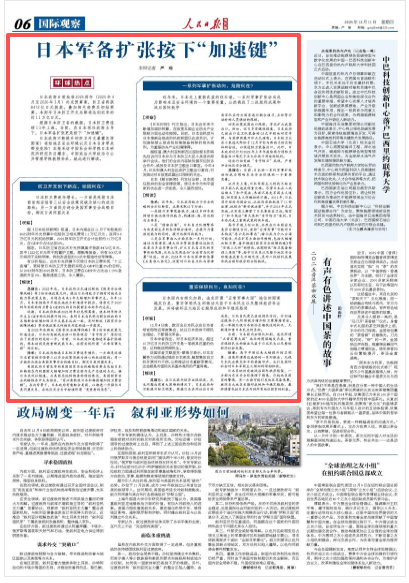
日本开始露出獠牙,军费连续13年暴涨,还要继续加税备战
Sou Hu Cai Jing· 2025-12-06 05:10
Group 1 - The Japanese government is considering increasing domestic income tax starting in 2027 to cover rising defense spending, impacting corporate tax, tobacco tax, and personal income tax [1] - The total defense budget for the current fiscal year has reached 11 trillion yen (approximately 498.2 billion RMB), combining a supplementary budget of 1.1 trillion yen with a previously approved preliminary defense budget of 9.9 trillion yen [1][3] - The defense spending as a percentage of GDP has reached 2%, two years ahead of the original target for 2027, indicating a significant shift in Japan's military spending policy [3][6] Group 2 - The Japanese Ministry of Defense has allocated 847.2 billion yen (approximately 39.8 billion RMB) for key equipment procurement in the fiscal year 2025, including 122.2 billion yen for purchasing destroyers and submarines [5] - Japan is increasing its military capabilities by investing in new operational capabilities, including drone attack and reconnaissance systems, to enhance its combat readiness [8] - The country plans to develop long-range cruise missiles with a range of 1,000 kilometers and is actively pursuing aircraft carrier modifications and nuclear submarine development, indicating a move towards offensive military capabilities [10] Group 3 - Japan's military spending has been on a continuous rise for 13 years, particularly since 2012, reflecting a shift from its historical constraints on defense spending [6] - The increase in defense spending is seen as a step towards Japan seeking regional military dominance, which may provoke an arms race in East Asia and disrupt regional peace [11]

国防部:日方若执迷不悟必犯众怒
Zheng Quan Shi Bao Wang· 2025-12-05 07:23
Core Viewpoint - Japan's government has approved a supplementary budget for the fiscal year 2025, increasing its defense spending to 11 trillion yen, achieving its goal of 2% of GDP ahead of schedule [1] Group 1: Japan's Defense Spending - Japan's defense budget has significantly increased, breaking the constraints of its "peace constitution" [1] - The country is pushing for the export of lethal weapons, including discussions with the Philippines regarding the "03 type medium-range surface-to-air missile" [1] Group 2: International Relations and Obligations - The spokesperson emphasized the need for Japan to adhere to international laws and its obligations as a defeated nation, urging it to stop challenging the post-war international order [1] - There is a warning that if Japan continues its current path, it may face widespread discontent and historical reckoning [1]
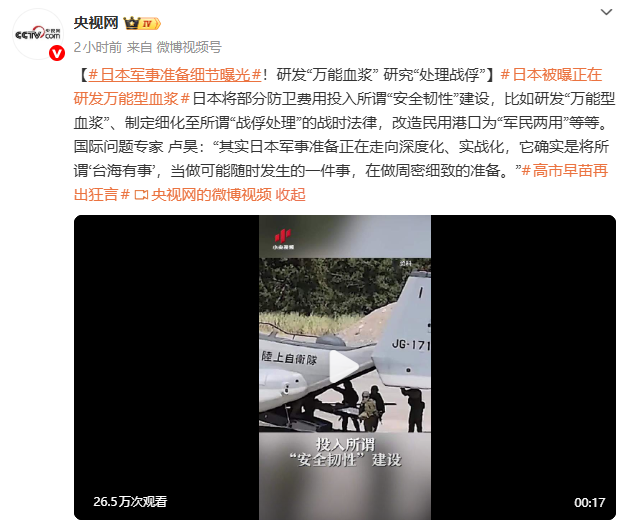
研发“万能型血浆”、改造民用港口为“军民两用”……日本战争准备细节曝光!
Xin Lang Cai Jing· 2025-12-02 11:44
Core Viewpoint - Japan is significantly increasing its defense budget, which raises concerns about its military expansion ambitions and potential geopolitical implications in the region [4][18][32] Defense Budget Increase - Japan's defense spending has been approved to reach approximately 11 trillion yen (about 498.2 billion RMB) for the fiscal year 2025, marking a 2% share of GDP [6][20] - This marks the 13th consecutive year of defense budget increases, with a total of 1.1 trillion yen (approximately 49.8 billion RMB) allocated in the supplementary budget [21][22] Military Expansion and Capabilities - The budget includes 847.2 billion yen (around 39.8 billion RMB) for acquiring new military assets such as destroyers, submarines, and missiles, including the improved Type 03 medium-range surface-to-air missile [22][24] - The Type 03 missile system is designed to have an extended range of up to 100 kilometers and can track multiple targets simultaneously, enhancing Japan's air defense capabilities [24] Geopolitical Implications - Analysts express concerns that Japan's military expansion is part of a broader geopolitical strategy, potentially aimed at countering China and enhancing military cooperation with the U.S. and regional allies [16][32] - Japan's plans to export military equipment, including the Type 03 missile to the Philippines, could further complicate regional security dynamics and contribute to an arms race in the South China Sea [30][32] Domestic Concerns - There is significant public opposition to the rising defense budget, with critics arguing that it diverts funds from essential services such as healthcare and education [10][26] - The government's military expansion strategy is seen as a departure from Japan's post-war pacifism, raising fears about the implications for regional stability and Japan's role as a peace-oriented nation [12][28]
日本防卫费13连增,本财年防卫开支占GDP的比例提升到2%!加速部署中程地对空导弹,或大幅增加杀伤性武器出口
Ge Long Hui· 2025-12-02 03:40
Group 1 - The Japanese government has approved a supplementary budget for the fiscal year 2025, increasing defense spending to 2% of GDP, raising concerns among various sectors in Japan [1] - Japan's defense budget has been increasing for 13 consecutive years, indicating a growing ambition for military expansion with geopolitical implications [1] - Analysts suggest that Japan's military expansion should raise alarms among neighboring countries due to its multifaceted geopolitical calculations [1] Group 2 - The supplementary budget includes 847.2 billion yen (approximately 39.8 billion RMB) for the acquisition of destroyers, submarines, and missiles, including the upgraded Type 03 medium-range surface-to-air missile [3] - Japan's Defense Minister, Kono Taro, has announced plans to deploy Type 03 missiles to Yonaguni Island, with progress being made on this initiative [3] - The Japanese government is also promoting the export of lethal weapons, having engaged in informal discussions with the Philippines regarding the export of the Type 03 missile, and has recently exported Patriot surface-to-air missiles to the United States for the first time [3]

日本与菲律宾就出口导弹展开非正式磋商
Yang Shi Xin Wen· 2025-12-01 15:17
Core Viewpoint - Japan and the Philippines are in informal discussions regarding the export of the "Type 03 Medium-Range Surface-to-Air Missile" as Japan plans to abolish its current defense export principles by mid-2026, indicating a shift towards a more proactive defense export policy [1] Group 1 - Japan's government intends to eliminate the existing "Three Principles on Transfer of Defense Equipment" which currently restricts exports to five categories: rescue, transport, surveillance, and mine clearance [1] - The move reflects Japan's urgent desire to promote defense equipment exports, signaling a significant policy shift in its defense strategy [1]
“高市早苗政府有新动作”
券商中国· 2025-12-01 13:01
Core Points - The Japanese government is in informal discussions with the Philippines regarding the export of the "03 type medium-range surface-to-air missile" [1] - The Philippines has expressed interest in acquiring this missile, which is designed to intercept aircraft and cruise missiles [1] - Japan aims to complete the development of an upgraded version of the missile by the fiscal year 2028, capable of intercepting ballistic missiles and hypersonic glide weapons [1] - Discussions are also ongoing regarding the export of "Abukuma" class frigates, with the Philippine Navy expressing a desire to acquire at least three [1] - The Japanese government plans to abolish current restrictions on defense equipment exports, which are limited to five non-combat purposes, indicating a strong push for defense exports [1] - Japan's defense spending is set to reach approximately 11 trillion yen (about 498.3 billion RMB) in the fiscal year 2025, achieving the goal of 2% of GDP ahead of schedule [1] - The supplementary budget includes 847.2 billion yen allocated for the purchase of frigates, submarines, and surface-to-air missiles, with total defense-related expenses exceeding 1 trillion yen (about 45.3 billion RMB) [2] - Concerns have been raised by the Chinese Foreign Ministry regarding Japan's increasing defense budget and the loosening of weapon export restrictions, questioning Japan's commitment to peaceful development [2]