
7纳米制程芯片

Search documents
台积电,还能走多远
新财富· 2026-02-03 08:06
Core Viewpoint - TSMC expresses strong confidence in the long-term demand for AI, emphasizing that current capacity constraints are internal rather than external, and is determined to face competition head-on [2][3]. Group 1: Investment and Growth Plans - TSMC plans a capital expenditure of $56 billion for 2026, with 70%-80% allocated to advanced processes and 10%-20% to advanced packaging, significantly exceeding the $100 billion spent over the past three years [4]. - The company expects its revenue to reach $122 billion in 2025, a 36% year-on-year increase, driven by high demand for advanced process technologies [4]. - Advanced process technologies contributed 77% of total wafer revenue, with 3nm, 5nm, and 7nm processes accounting for 28%, 35%, and 14% respectively in Q4 [5]. Group 2: Profitability and Cost Pressures - TSMC's gross margin for 2026 is projected to be influenced by high capacity utilization and improved manufacturing efficiency, but may face a 2%-3% dilution from overseas expansions [7][10]. - The introduction of 2nm technology is expected to begin mass production in late 2026, which may dilute gross margins by approximately 1% [8]. - TSMC's advanced process roadmap includes the rollout of 2nm and enhanced N2P technologies, which are crucial for maintaining its market position [8]. Group 3: Competitive Landscape - TSMC remains confident in its ability to maintain its market position despite competition from Intel, which is also advancing its 2nm technology [14][15]. - The upcoming three years (2026-2028) will be critical for both TSMC and Intel as they compete in the advanced process technology space [17]. - TSMC's long-standing focus on foundry services and deep customer relationships provide a significant competitive advantage over Intel, which is still establishing its external foundry capabilities [16][23]. Group 4: Geopolitical and Market Dynamics - TSMC's global expansion strategy, including facilities in the US, Japan, and Germany, aims to mitigate geopolitical risks while addressing local production demands [10][26]. - The semiconductor industry is becoming a focal point of national strategy, with both TSMC and Intel navigating the complexities of local production and supply chain security [26][27]. - The global wafer market is expected to grow significantly from 2023 to 2026, driven by structural demand, marking a super cycle rather than a typical recovery [27].



台积电:硅基话语权的巅峰
格隆汇APP· 2026-01-16 09:29
Core Viewpoint - TSMC's recent financial report signifies not just growth but a transformative era driven by AI, marking the onset of the fourth industrial revolution [5][21]. Financial Performance - TSMC reported a net profit of NT$505.7 billion, exceeding expectations of NT$467 billion, with a year-on-year increase of 35% [7]. - The gross margin reached 62.3%, surpassing the anticipated ceiling of 60.6% [8]. - For Q1 2026, TSMC's revenue guidance is set between $34.6 billion and $35.8 billion, significantly above the expected $33.22 billion [15]. - The gross margin guidance for Q1 2026 is projected at 63%-65%, outpacing market expectations of 59.6% [16]. - Capital expenditures for 2026 are expected to reach $52 billion to $56 billion, far exceeding the previous year's $40.9 billion and market expectations of $46 billion [17]. AI and Technology Leadership - TSMC's advanced 3nm, 5nm, and 7nm processes contributed 77% of total revenue, with 3nm and 5nm alone accounting for 63% [12]. - The company anticipates a nearly 30% growth in revenue in 2026, surpassing the 25% market expectation, with a five-year compound annual growth rate (CAGR) of 25% starting in 2024 [24]. - TSMC has raised its CAGR forecast for AI accelerators from 45% to a range of 55%-59% for 2024-2029, indicating a robust growth trajectory [26]. Advanced Packaging Technologies - CoWoS (Chip-on-Wafer-on-Substrate) is TSMC's proprietary advanced packaging technology, with expected monthly production capacity reaching 115,000 pieces by the end of 2026 [30]. - The demand for CoWoS is so high that it has created an overflow capacity of approximately 15,000 pieces per month, benefiting other packaging companies [32]. - CoWoP (Chip-on-Wafer-on-PCB) is a revolutionary technology that bypasses the capacity constraints of ABF substrates, simplifying structure and reducing costs [37][38]. Global Expansion Strategy - TSMC is executing an unprecedented global factory expansion plan, with key sites in Taiwan, the USA, Japan, and Germany, to meet demand and strategically position itself in the geopolitical landscape [58][59][60][61]. - The company is establishing a 2nm core base in Hsinchu and Kaohsiung, which will serve as the heart of its operations [59]. Conclusion - TSMC is not merely a semiconductor company; it is a pivotal player in the evolution of technology and the AI revolution, shaping the future of the global digital economy [63].

台积电:硅基话语权的巅峰
Ge Long Hui· 2026-01-16 07:21
Core Insights - TSMC's Q4 2025 financial report and Q1 2026 guidance significantly exceeded Wall Street's most optimistic forecasts, indicating a powerful growth driven by AI technology [1][3][10] - The company is positioned as a central player in the AI-driven fourth industrial revolution, with its advanced manufacturing processes and strategic investments shaping the future of the semiconductor industry [1][15] Financial Performance - Q4 2025 revenue reached NT$1.046 trillion, a year-on-year increase of 20.5% [3] - Net profit was NT$505.7 billion, surpassing the expected NT$467 billion, with a year-on-year growth of 35% [3] - Gross margin stood at 62.3%, exceeding the anticipated 60.6% [3] Q1 2026 Guidance - Revenue guidance for Q1 2026 is projected between $34.6 billion and $35.8 billion, significantly above the expected $33.22 billion [10] - Gross margin guidance is set at 63%-65%, well above the market expectation of 59.6% [11] - Capital expenditure for 2026 is expected to reach $52 billion to $56 billion, far exceeding the previous year's $40.9 billion and market expectations of $46 billion [12][13] AI and Technology Leadership - TSMC's growth narrative is fundamentally tied to its dominance in the AI sector, with projected revenue growth of nearly 30% in 2026, surpassing the 25% forecast [18] - The company has raised its compound annual growth rate (CAGR) forecast for AI accelerator business from 45% to a range of 55%-59% for 2024-2029 [20] - TSMC's AI business revenue is expected to reach at least $90 billion by 2029, potentially challenging the total revenue of many current tech giants [21][22] Advanced Packaging Technologies - TSMC's CoWoS (Chip-on-Wafer-on-Substrate) technology is in high demand, with expected monthly production capacity reaching 115,000 units by the end of 2026 [24] - The introduction of CoWoP (Chip-on-Wafer-on-PCB) technology aims to bypass bottlenecks in the supply chain, significantly enhancing value and reducing costs [30][32] - CPO (Chip-on-Photonic) technology is set to address the communication challenges posed by AI's data demands, integrating optical communication capabilities into chip designs [41][44] Global Expansion Strategy - TSMC is aggressively expanding its manufacturing footprint globally, with key facilities in Taiwan, the United States, and Japan to meet rising demand and geopolitical considerations [49][51] - The company is establishing a significant presence in Europe with a new facility in Dresden, Germany, marking its strategic expansion into the European market [51] Conclusion - TSMC is not merely a semiconductor company but a pivotal force in defining the future of technology and the global digital economy, with its strategic decisions shaping the landscape for years to come [52]

【招商电子】台积电25Q4跟踪报告:26年资本开支指引大超预期,上修24-29年AI芯片增速
招商电子· 2026-01-15 15:58
Core Viewpoint - TSMC's Q4 2025 financial results exceeded guidance, driven by improved capacity utilization and cost optimization, indicating strong demand for advanced process technologies [1][11]. Financial Performance - Q4 2025 revenue reached $33.73 billion, surpassing the guidance range of $32.2-33.4 billion, with a year-over-year increase of 25.5% and a quarter-over-quarter increase of 1.9% [1]. - Gross margin was 62.3%, up 3.3 percentage points year-over-year and 2.8 percentage points quarter-over-quarter, attributed to cost optimization and favorable exchange rates [1][11]. - GAAP net profit was $16.37 billion, reflecting a year-over-year increase of 34.98% and a quarter-over-quarter increase of 11.82% [1]. - For the full year 2025, revenue was $122 billion, a 35.9% year-over-year increase, with a gross margin of 59.9% [1][12]. Advanced Process Technology - Advanced process nodes (3nm, 5nm, 7nm) accounted for 77% of revenue, with 3nm contributing 28%, 5nm 35%, and 7nm 14% [2][11]. - High-Performance Computing (HPC) revenue was $18.55 billion, slightly down 1.67% quarter-over-quarter, while smartphone revenue increased by 8.7% to $10.79 billion [2][12]. Future Guidance - For Q1 2026, TSMC expects revenue between $34.6 billion and $35.8 billion, with a year-over-year increase of 38.6% and a quarter-over-quarter increase of 7.3% [3]. - Gross margin is projected to be between 63% and 65%, with potential dilution from overseas expansion and the ramp-up of 2nm technology expected to impact margins by 2-3% [3][16]. Capital Expenditure and AI Growth - Q4 2025 capital expenditure was $11.51 billion, with a full-year capex of $40.9 billion, and 2026 capex is expected to be between $52 billion and $56 billion [4][17]. - AI-related revenue is projected to account for 15% of total revenue in 2025, with a compound annual growth rate (CAGR) for AI accelerator business expected to be 55-59% from 2024 to 2029 [4][19]. Global Manufacturing Expansion - TSMC is expanding its manufacturing footprint in Arizona, with plans for multiple fabs to meet strong demand, particularly in AI and HPC applications [20][21]. - The company is also establishing special process fabs in Japan and Germany, with ongoing investments in Taiwan to enhance advanced process capabilities [22][23]. Technology Development - The 2nm process is set to begin volume production in late 2026, with expectations for significant revenue contributions [23][33]. - TSMC is also introducing N2P technology, an extension of the 2nm series, aimed at optimizing performance and power consumption [23]. Customer Demand and Market Outlook - TSMC's customers, particularly in AI, are signaling strong demand for increased capacity, with ongoing efforts to address supply constraints [24][30]. - The company remains confident in the sustainability of semiconductor demand driven by AI and other high-performance applications [19][34].
台积电25Q4跟踪报告:26年资本开支指引大超预期,上修24-29年AI芯片增速
CMS· 2026-01-15 15:40
Investment Rating - The report maintains a positive outlook on the semiconductor industry, particularly for TSMC, with expectations of strong revenue growth and profitability in the coming years [4][23]. Core Insights - TSMC's Q4 2025 revenue reached $33.73 billion, exceeding guidance, with a year-over-year growth of 25.5% and a gross margin of 62.3% [1][19]. - The company anticipates Q1 2026 revenue between $34.6 billion and $35.8 billion, reflecting a year-over-year increase of 38.6% [3][23]. - TSMC's capital expenditure for 2026 is projected to be between $52 billion and $56 billion, with a significant portion allocated to advanced process technologies [4][25]. - The AI market is expected to drive substantial growth, with AI accelerator revenue projected to account for 15% of total revenue in 2025 [4][26]. Summary by Sections Financial Performance - TSMC's Q4 2025 revenue was $33.73 billion, with a gross margin of 62.3%, driven by improved capacity utilization and cost optimization [1][19]. - The company reported a net profit of $16.37 billion for Q4 2025, a year-over-year increase of 34.98% [1][19]. - For the full year 2025, TSMC's revenue was $122 billion, reflecting a 35.9% year-over-year growth [1][22]. Advanced Technology and Market Segmentation - Advanced process technologies (3nm, 5nm, and 7nm) accounted for 77% of TSMC's revenue, with 3nm technology representing 28% [2][20]. - The high-performance computing (HPC) segment generated $18.55 billion in revenue, while smartphone revenue was $10.79 billion [2][20]. Capital Expenditure and Growth Projections - TSMC's capital expenditure for 2025 was $40.9 billion, with 70%-80% allocated to advanced process technologies [4][25]. - The company has raised its CAGR forecast for AI-related revenue from 2024 to 2029 to 55%-59% [4][26]. Future Outlook - TSMC expects Q1 2026 gross margin to be between 63% and 65%, with potential dilution from overseas expansion and new technology ramp-up [3][24]. - The company plans to enhance production efficiency and expand capacity to meet growing demand, particularly in AI and HPC sectors [26][27].
AI需求引爆业绩新高,台积电Q3净利大增39%!
Ge Long Hui· 2025-10-16 07:34
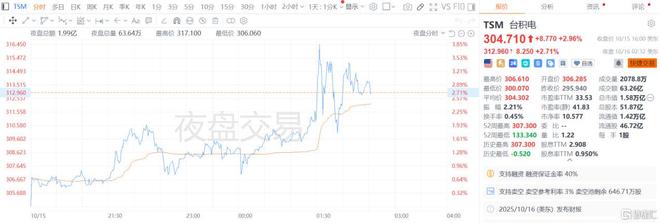
Core Viewpoint - TSMC reported strong Q3 2025 earnings driven by robust demand for AI chips, with net profit increasing by 39.1% year-over-year, exceeding market expectations and setting a new record [1][4]. Financial Performance - Q3 2025 revenue reached NT$989.92 billion, a year-over-year increase of 30.3% and a quarter-over-quarter increase of 6% [4]. - Net profit for Q3 2025 was NT$452.3 billion, surpassing the expected NT$405.47 billion, marking a record high with a year-over-year increase of 39.1% and a quarter-over-quarter increase of 13.6% [4][6]. - In USD terms, Q3 2025 revenue was $33.1 billion, reflecting a 40.8% increase year-over-year and a 10.1% increase quarter-over-quarter [5][8]. - Gross margin for Q3 2025 was 59.5%, with operating margin at 50.6% and net profit margin at 45.7% [6][8]. Earnings Per Share - Earnings per share (EPS) for Q3 2025 was NT$17.44, equivalent to $2.92 per American Depositary Share [7][8]. Product and Market Insights - Advanced process nodes contributed significantly to revenue, with 3nm process accounting for 23% and 5nm for 37% of wafer sales [8]. - High-Performance Computing (HPC) represented 57% of revenue, surpassing the smartphone segment at 30%, indicating strong demand for AI chips [11]. Future Outlook - TSMC raised its revenue growth forecast for 2025 to approximately 30% due to increasing demand for AI and semiconductor products [14]. - For Q4 2025, TSMC expects consolidated revenue between $32.2 billion and $33.4 billion, with a gross margin forecast of 59% to 61% [16][17]. - Capital expenditures for 2025 are projected to be between $40 billion and $42 billion, up from previous estimates [16].
AI芯片需求激增!台积电Q3净利润飙升39%创纪录
Ge Long Hui· 2025-10-16 07:24
Core Viewpoint - TSMC reported strong Q3 2025 earnings driven by robust demand for AI chips, with net profit increasing by 39.1% year-over-year, exceeding market expectations and reaching a record high [1][4]. Financial Performance - Q3 2025 revenue was NT$989.92 billion, a year-over-year increase of 30.3% and a quarter-over-quarter increase of 6% [4]. - Net profit for Q3 2025 was NT$452.30 billion, surpassing the expected NT$405.47 billion, marking a record high with a year-over-year increase of 39.1% and a quarter-over-quarter increase of 13.6% [4][8]. - In USD terms, Q3 2025 revenue was $33.10 billion, reflecting a 40.8% increase year-over-year and a 10.1% increase quarter-over-quarter [5][14]. - Gross margin for Q3 2025 was 59.5%, operating margin was 50.6%, and net profit margin was 45.7% [6][8]. Earnings Per Share - Earnings per share for Q3 2025 was NT$17.44, equivalent to $2.92 per American Depositary Share [7][8]. Product and Market Insights - Advanced process nodes contributed significantly to revenue, with 3nm process accounting for 23%, 5nm for 37%, and 7nm for 14% of wafer sales [8]. - High-Performance Computing (HPC) represented 57% of revenue, surpassing the smartphone segment at 30%, indicating strong demand for AI chips [9]. Future Outlook - TSMC raised its revenue growth forecast for 2025 to approximately 30%, up from earlier estimates [12]. - Q4 2025 revenue is projected to be between $32.2 billion and $33.4 billion, with a gross margin forecast of 59% to 61% [12][14]. - Capital expenditures for 2025 are expected to be between $40 billion and $42 billion, an increase from previous forecasts [12].
台积电二季度净利大增超60%,期权市场押注上涨空间仍大
Jin Shi Shu Ju· 2025-07-17 05:59
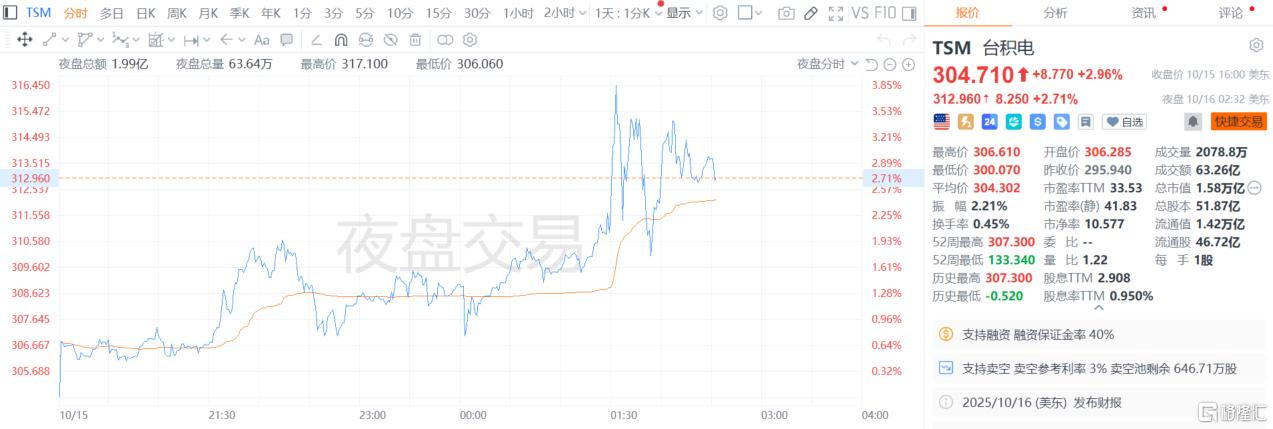
Core Insights - TSMC reported a record net profit increase of 60.7% year-on-year for Q2 2025, driven by surging semiconductor demand in the AI sector [1][2] - The company's Q2 revenue reached NT$933.79 billion, with a net profit of NT$398.27 billion, translating to an earnings per share of NT$15.36 (US$2.47) [1] - Revenue growth was 38.6% year-on-year and 11.3% quarter-on-quarter, while net profit and earnings per share also saw significant increases [1] Financial Performance - Q2 gross margin was 58.6%, operating margin was 49.6%, and net margin was 42.7% [2] - Advanced process technologies (7nm and below) accounted for 74% of total wafer revenue, with 3nm, 5nm, and 7nm processes contributing 24%, 36%, and 14% respectively [2] Market Sentiment - TSMC's stock has gained significant attention, with a 44% increase since April and nearly 70% rise in its US Depositary Receipts [2][3] - Analysts expect TSMC to raise its full-year guidance and hint at further price increases for its products due to strong market demand [2][3] - Six brokerages, including HSBC and Deutsche Bank, have raised their price targets for TSMC following the recent sales data [3] Future Outlook - Analysts predict TSMC's revenue growth guidance for 2025 could exceed 20% due to ongoing AI demand [3] - Despite potential pressure from currency appreciation on profit margins, TSMC's strong market position and global recognition support its stock price [3] - The market remains favorable towards AI-related stocks, which bodes well for TSMC's future performance [3]