5年期定存

Search documents
岁末揽储战升温!部分银行逆势上调存款利率,行业净息差压力犹在
Xin Lang Cai Jing· 2025-12-10 01:15
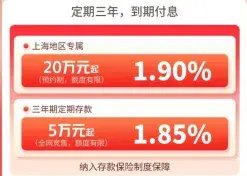
Group 1 - The banking deposit market is experiencing a "polarized" situation, with some banks raising deposit rates while national banks are generally lowering them [1][2] - Hangzhou Bank has increased its 3-year fixed deposit rate for new funds to 1.9% for deposits starting at 200,000 yuan, while Jilin Bank has launched a similar product with a rate 25 basis points higher than its standard rate [3][5] - Despite some banks raising rates, the overall trend in the banking sector is a decline in deposit rates, with many small and medium-sized banks reducing rates significantly since October [1][9] Group 2 - The pressure to attract deposits is particularly acute for smaller banks, which are using rate increases as a strategy to compete with larger banks [7][9] - Many of the high-rate products are region-specific and have conditions such as "new funds" or "specific customers," with minimum deposit amounts ranging from 1,000 yuan to 500,000 yuan [7][9] - The overall trend indicates that while some banks are temporarily raising rates, many are still engaged in a broader trend of lowering rates, particularly for long-term deposits [11][12] Group 3 - The net interest margin for commercial banks is under pressure, with the current average at 1.42%, indicating a need for banks to manage costs and stabilize margins [14][15] - Banks are expected to continue reducing deposit costs, but the pace of rate cuts may slow as rates are already low [16] - The adjustment of deposit products reflects a shift towards more sustainable and refined banking operations, with banks focusing on asset-liability management and differentiated services [16][17]


超长债收益率行至年内高位,央行买债低于预期还是另有隐忧?
第一财经网· 2025-12-03 13:04
Group 1 - The bond market is under pressure, with long-term bond yields approaching their highest levels of the year, indicating a weakening "see-saw" effect between stocks and bonds as year-end approaches [2][4] - The People's Bank of China (PBOC) announced a net bond purchase of 50 billion yuan in November, which is higher than the previous month but still below market expectations, leading to increased market divergence [2][3] - The yield on the 30-year special treasury bond has risen to approximately 2.24%, reflecting a significant increase from earlier levels, indicating a widening yield spread [4][5] Group 2 - The bond market has seen a continuous decline, particularly in long-term bonds, with the yield on the 10-year treasury bond rising from 1.79% to around 1.84% since November [4][5] - Market sentiment has shifted, with some analysts suggesting that the recent bond purchases by the PBOC may not significantly benefit the bond market, as the focus should be on the underlying monetary policy rather than the quantity of bonds purchased [4][5] - The supply of long-term bonds has been notably high this year, which, combined with banks' profit requirements and the impact of new redemption fee regulations, may lead to increased volatility in the 30-year treasury bond market [7][8]
5.26犀牛财经早报:1年期存款利率正式跌破1% 港股仓位成基金业绩排名关键
Xi Niu Cai Jing· 2025-05-26 02:01
Group 1: Banking Sector Developments - The one-year deposit rate has officially dropped below 1%, reaching 0.95% as of May 20, with state-owned banks leading the reduction [1] - The five-year fixed deposit rate has decreased by 135 basis points over the past two years, with many banks reducing rates across various terms [1] - The net interest margin for commercial banks is nearing a critical threshold, recorded at 1.43% in Q1 2025, prompting banks to lower interest rates to save costs [1] Group 2: ESG Fund Growth - The number of ESG funds in China has continued to increase, with a total scale surpassing 820 billion yuan, reaching 824.23 billion yuan as of May 23 [2] - The China Securities Regulatory Commission has emphasized the importance of ESG funds in promoting green finance and has proposed measures to enhance the product system for green financial products [2] Group 3: Hong Kong Stock Market Insights - The Hong Kong stock market has shown strong upward trends in both traditional and emerging sectors, becoming a key factor for A-share fund managers in achieving performance rankings [2] - New technology, new consumption, and pharmaceuticals are identified as the three core investment themes in the Hong Kong market, with expectations of continued foreign capital inflow [2] Group 4: Convertible Bonds Market - The banking sector's convertible bonds may face a new wave of early redemption, with several bonds nearing their redemption thresholds due to strong bank stock performance [3] - The scarcity of blue-chip convertible bonds is becoming more pronounced as a result of the upcoming exits of certain bank varieties from the market [3] Group 5: Robotics Industry Developments - Human-shaped robots are accelerating the "competition promotes production" initiative, with various competitions planned to enhance the industrial application of humanoid robots [4] - Events like the "World Humanoid Robot Sports Conference" are expected to foster talent and technological advancements in the robotics sector [4] Group 6: Financial Regulatory Actions - Chongqing Haier Small Loan Company has been penalized for violating credit information management regulations, incurring fines totaling 551,000 yuan [6] - Huaxi Securities has received penalties for improper client solicitation practices, highlighting ongoing regulatory scrutiny in the financial sector [6]
存款利率跌至1%时代!温彬揭秘低利率背后的经济逻辑
Sou Hu Cai Jing· 2025-05-22 09:44
Core Viewpoint - The recent collective decision by nine joint-stock banks to lower deposit rates marks China's official entry into a low-interest-rate era, with significant implications for the banking sector and the economy as a whole [1]. Group 1: Interest Rate Trends - The deposit interest rates have seen a dramatic decline from 4% in 2014 to as low as 0.05% for current deposits and below 1% for one-year fixed deposits [1]. - Since 2022, commercial banks have implemented seven rounds of interest rate cuts, totaling a reduction of over 300 basis points [1]. - The one-year Loan Prime Rate (LPR) has decreased by 35 basis points, while the five-year LPR has dropped by 60 basis points in 2024 alone, indicating a rapid decline in interest rates [1]. Group 2: Banking Sector Implications - The net interest margin for banks has fallen below the critical threshold of 1.8%, with a current figure of 1.43%, raising concerns within the industry [4]. - The significant drop in deposit rates (up to 25 basis points) has outpaced the LPR reduction (10 basis points), reflecting a strategic choice by banks to alleviate operational pressures while ensuring lower financing costs for enterprises [4]. - This adjustment is projected to relieve the banking system of over 200 billion yuan annually, which can be redirected to support manufacturing and small enterprises [4]. Group 3: Investment Strategies - With the decline in deposit rates, there is a suggestion for depositors to consider alternative investment options, such as government bonds, cash management products, and long-term fixed-rate insurance products [5]. - Financial experts recommend diversifying investments, with allocations suggested for large-denomination certificates of deposit, money market funds, and bond funds, while maintaining some liquidity [5]. - The transition to a low-interest-rate environment necessitates a shift in investment strategies, encouraging investors to accept moderate risks to adapt to the new financial landscape [5]. Group 4: Economic Context - The trend of declining interest rates is not unique to China, as similar patterns have been observed in Japan and Europe, where low or negative interest rates have persisted for years [1]. - The capital return rate in China has decreased from 15% in 2007 to 5.8% in 2023, which is a key factor driving the downward trend in interest rates [1]. - The shift towards lower interest rates is viewed as a necessary phase in economic transformation rather than a regression of the financial system [7].