
AI绘画工具

Search documents
自主研发大模型,AI成“学习搭子”
Qi Lu Wan Bao· 2026-02-10 01:59
Core Insights - The article discusses the transformative impact of AI on classroom education at Shandong Tourism Vocational College, highlighting the development of the first domestic tourism vocational education model, "Bai Ze" [3][6]. Group 1: Classroom Transformation - Traditional lecture formats have been replaced by project-based learning environments, where students collaborate on real-world tasks, such as developing an AI tourism guide for an upcoming industry conference [4]. - The role of teachers has shifted from knowledge transmitters to project designers and facilitators, focusing on practical problem-solving using AI [4][5]. Group 2: Personalized Learning - Students now complete a "learning situation template" before classes, allowing AI to generate personalized pre-study videos and quizzes tailored to individual knowledge and preferences [5]. - This approach mimics one-on-one tutoring, enhancing the learning experience by addressing specific student needs [5]. Group 3: Skill Development - The focus of education has shifted to three core competencies: AI proficiency, information integration, and service design, encouraging students to critically evaluate AI outputs [6]. - In culinary classes, AI assists in creative design, but students must still apply hands-on skills to produce tangible results, evolving from traditional chefs to "smart culinary artists" [6]. Group 4: Evaluation Standards - Traditional grading methods are being replaced by assessments that evaluate the clarity of thought and communication skills in human-AI collaboration [7]. - The college has developed an "intelligent assistant" to provide feedback on student submissions, enhancing the evaluation process [7]. Group 5: Student Empowerment - The educational revolution has led to a "threefold awakening" in students: rebuilding self-confidence, fostering a sense of pride in their work, and deepening aspirations for careers in the smart tourism industry [8]. - Approximately 70% of students express a stronger desire to pursue careers in the integration of culture, technology, and AI within the tourism sector [8]. Group 6: Institutional Advancements - The "Bai Ze" model supports 302 courses and 27 industry-education integration projects, improving teacher preparation efficiency by 40% and reducing course resource development time by 60% [6][7].


当Agent平台接管漫画创作,千万漫画人该往哪走?
3 6 Ke· 2026-02-02 00:22
Core Insights - The emergence of Agent platforms is revolutionizing the content creation landscape, particularly in the film and comic industries, by leveraging automation and intelligent creation capabilities [1] - Traditional comic markets are facing challenges, with original authors experiencing squeezed profit margins, while AI technology is becoming more accessible, reshaping the creative process [2][9] - The integration of AI tools is seen as a critical choice for top creators to balance costs and quality, enabling them to overcome creative bottlenecks [3][12] Industry Challenges - The traditional comic market is struggling, with platforms reducing budgets for content procurement and author royalties, leading to increased financial pressure on original creators [2] - The demand for higher quality visuals and storytelling from platforms is raising human creation costs, putting additional strain on authors [2][9] - Many smaller creators find AI tools to be unaffordable and ineffective, exacerbating the divide between top and emerging authors [7] AI Integration and Evolution - By late 2025, the landscape shifted as AI tool manufacturers engaged in intense competition, leading to significant improvements in the quality and affordability of AI tools [8] - The democratization of AI tools allows both established and new creators to access and utilize these technologies, breaking down previous barriers to entry [8][15] - The role of AI in the creative process is evolving, allowing creators to focus on storytelling while AI handles repetitive tasks, leading to a more specialized workforce [15][17] Future of Content Creation - The rise of Agent platforms is facilitating a shift from traditional large-scale studios to smaller, more agile creative teams, enhancing collaboration and efficiency [17] - The industry is witnessing a redefinition of talent value, where core creative abilities are amplified, while those lacking originality may be phased out [17] - The transformation driven by Agent platforms is seen as an opportunity for creators to explore new formats and find sustainable paths in a changing market [12][13]

AI助教行走在运河畔
Xin Lang Cai Jing· 2026-01-14 22:46
Core Insights - The article highlights the systematic transformation of education in Tongzhou District, Beijing, focusing on the integration of artificial intelligence (AI) into the curriculum across over 1,400 primary and secondary schools [1][3][12] - The initiative aims to cultivate a new generation with AI literacy, emphasizing the importance of understanding AI principles and fostering critical thinking about technology [13][14] Group 1: AI Education Implementation - AI education has been introduced in various forms, such as AI general education courses and hands-on projects like designing an "intelligent parking system" [1][2] - The district has established a comprehensive framework for AI education, known as the "134" implementation framework, which includes district-level coordination, school-level empowerment, and teacher quality enhancement [3][4] Group 2: Teacher Training and Development - A four-tier training system has been developed to prepare teachers for AI education, focusing on theoretical knowledge, technical application, innovation, and leadership [4][10] - Training programs have successfully reached a diverse group of teachers, with 94% of participants finding the content relevant to their teaching needs [10][11] Group 3: Classroom Integration and Student Engagement - AI tools are being used to enhance personalized learning experiences, such as AI-assisted writing platforms that provide data-driven insights for teachers [7][8] - Students engage with AI through interactive projects, fostering curiosity and creativity while learning about technology's practical applications [6][9] Group 4: Evaluation and Management Innovations - The introduction of AI-assisted evaluation systems is transforming classroom assessment by providing objective data on student engagement and teaching effectiveness [12] - The district is developing a smart education governance model that integrates various educational data systems to enhance management and collaboration [12] Group 5: Future Vision and Goals - The ultimate goal of the AI education initiative is to cultivate individuals who possess AI literacy and can critically assess technology's impact on society [13][14] - The district plans to expand successful AI teaching models to more schools and promote quality resources through collaborative programs [14]
不会被AI淘汰的,是有产品思维的人
虎嗅APP· 2025-09-01 13:53
Core Viewpoint - The article discusses the transformative impact of AI on the job market, particularly in the tech industry, highlighting the shift in roles and the emergence of new skill sets required for future employment. Group 1: AI's Impact on Employment - The role of software engineers is diminishing as AI tools like vibe coding allow non-programmers to create software without coding skills [9][11][12] - AI can replace junior software engineers, leading to a significant change in the job landscape for new graduates [11][17] - The demand for top-tier AI experts is increasing, while traditional programming roles are being automated [16][21] Group 2: Skills for the Future - There is a growing need for individuals with product thinking who can effectively communicate with AI to develop products [12][13] - New roles termed "builders" are emerging, requiring a combination of product design, AI collaboration, and business acumen [21][22] - Soft skills, such as interpersonal communication and understanding market needs, are becoming increasingly valuable in the AI era [30][41] Group 3: Economic and Social Implications - The article suggests that AI will lead to greater wealth disparity, with top technical experts and hybrid talent becoming more sought after [25][26] - A potential future scenario is proposed where AI handles most productive work, leading to a reevaluation of wealth distribution [27][29] - The traditional notion of work may change, with fewer people needing to engage in conventional jobs as AI takes over repetitive tasks [28][29] Group 4: Education and Personal Development - The article emphasizes the importance of adapting educational philosophies to focus on soft skills and emotional intelligence for children [51][54] - Parents are encouraged to foster curiosity and a love for learning in their children, rather than strictly adhering to traditional educational methods [57][62] - The future workforce will require individuals who can navigate and lead in a society increasingly influenced by AI [56][60] Group 5: Entrepreneurial Opportunities - AI is creating new business opportunities by optimizing traditional processes, such as recruitment, through automation [66][70] - Successful AI projects often focus on replacing inefficient manual tasks with automated solutions [69][70] - Entrepreneurs are advised to seek out pain points in existing workflows that AI can address, presenting significant opportunities for innovation [70][71]

不会被AI淘汰的,是有产品思维的人
Hu Xiu· 2025-08-31 12:19
Core Insights - The conversation highlights the transformative impact of AI on the job market, particularly in programming roles, and emphasizes the need for individuals to adapt by developing product thinking and soft skills [2][3][4]. Group 1: AI's Impact on Employment - AI is reshaping the employment landscape, with traditional programming roles being increasingly replaced by AI-driven solutions like vibe coding, which allows non-programmers to create software [7][9][10]. - The demand for software engineers is polarizing, with top AI experts becoming more valuable while entry-level positions are diminishing, leading graduates from prestigious institutions to seek unpaid internships for experience [23][24][25]. - The trend of companies preferring AI over training new employees is growing, particularly in the context of economic downturns and layoffs in large firms [25][27][28]. Group 2: Skills for the Future - The future job market will favor individuals with a combination of technical and soft skills, termed "builders," who can design products and collaborate effectively with AI [33][35]. - The traditional notion of "working for a living" may be challenged as AI takes over repetitive tasks, allowing humans to focus on more meaningful pursuits [38][40]. - The importance of personal branding and unique human experiences is emphasized, as these qualities cannot be replicated by AI [55][56]. Group 3: Education and Development - The educational approach should shift towards fostering soft skills, emotional intelligence, and adaptability, rather than solely technical skills [76][78]. - Parents are encouraged to prioritize their own development to create a supportive environment for their children, focusing on cultural literacy and social skills [84][88]. - The integration of AI tools in education can enhance creativity and curiosity in children, preparing them for a future where AI plays a significant role [101][104]. Group 4: Entrepreneurial Opportunities - There are significant opportunities for startups to leverage AI in traditional sectors, such as recruitment, by automating processes that were previously labor-intensive [106][110]. - Successful AI projects often focus on simplifying and optimizing existing workflows, making previously unfeasible business models viable [116][118]. - Entrepreneurs are advised to seek out pain points in current processes where AI can provide efficiency and cost savings, identifying lucrative opportunities for innovation [119].

“温柔”AI让你不再独行
Jing Ji Ri Bao· 2025-06-27 22:10
Group 1 - Starbucks has partnered with Microsoft's Azure OpenAI platform to develop a generative AI assistant called "Green Dot Assist," which aims to reduce the workload of baristas and improve service speed, potentially shortening order service time to 4 minutes [1] - The collaboration highlights the growing capabilities of general artificial intelligence, which now possesses autonomous perception, recognition, decision-making, execution, and social collaboration skills, along with exponential learning capabilities that align more closely with human emotions, ethics, and moral values [1] Group 2 - AI is increasingly exhibiting "human-like" qualities, particularly in the arts, where it is transforming the landscape of artistic creation [2] - In the field of painting, AI tools can generate artworks in various styles based on input keywords, evolving from being mere assistants to becoming collaborators with human artists [2] - In music creation, AI analyzes vast amounts of data to generate melodies that express specific emotions and styles, allowing enthusiasts to create personalized songs with minimal adjustments [2] Group 3 - AI has made significant advancements in literary creation, providing not only basic writing assistance but also inspiration for creative ideas, as noted by several renowned science fiction authors who have incorporated AI-generated concepts into their works [3] - The emergence of "human-like" AI is enhancing productivity across various industries while expanding the creative potential for human creators, indicating a collaborative future between AI and human creativity [3]
选专业就是选赛道!AI重塑职业版图,这些新兴产业值得关注
Di Yi Cai Jing· 2025-06-20 09:08
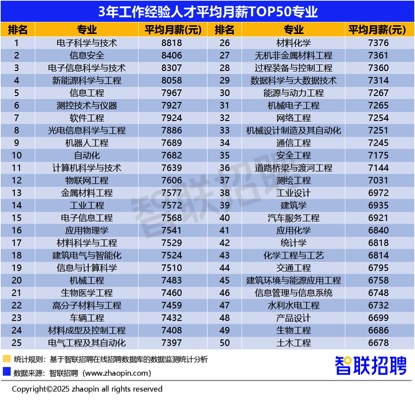
Group 1 - "Robotics Engineering" has emerged as a new professional field, ranking in the top ten of the "Salary Attraction" list, reflecting the growing demand for technical talent in emerging industries such as artificial intelligence and semiconductors [1][6] - The number of college graduates has reached 12.22 million this year, intensifying employment competition and creating differentiated opportunities for students in various majors [1][3] - Emerging industries like AI, low-altitude economy, and semiconductor sectors are experiencing explosive growth in demand for technical talent, reshaping the employment market [1][4] Group 2 - In 2023, high-potential industries such as electronics, semiconductors, industrial automation, and AI are projected to have significant recruitment growth, with semiconductor engineering graduates seeing over 200% increase in hiring [3][4] - By 2024, the number of graduates is expected to rise to 11.79 million, with new energy science and engineering reaching a monthly salary of 8,116 yuan, while software engineering has dropped out of the top five salary rankings [3][4] - The recruitment growth for positions in low-altitude economy, embodied intelligence, and smart manufacturing is expected to exceed 30% by 2025, indicating a strong demand for skilled professionals in these fields [4][11] Group 3 - The average monthly salary for graduates with three years of experience shows a clear advantage for engineering and technical majors, with "Robotics Engineering" entering the top ten for the first time [5][6] - The top three majors in terms of average monthly salary are "Electronic Science and Technology" (8,818 yuan), "Information Security" (8,406 yuan), and "Electronic Information Science and Technology" (8,307 yuan) [7] - The internet industry is experiencing a decline in recruitment, impacting the salaries of graduates from "Software Engineering" and "Computer Science and Technology," which have seen a drop in rankings [6][8] Group 4 - AI's rapid development is influencing employment, with certain professions facing high risks of replacement by AI technologies, particularly in editing, finance, and customer service [8][9] - The demand for traditional roles in manufacturing, education, and logistics remains strong, with significant recruitment needs in these sectors [11][12] - Graduates from majors such as mechanical engineering, logistics management, and education are well-positioned to meet the ongoing demand in these foundational industries [11][14]
不断描绘人机协同新图景
Guang Zhou Ri Bao· 2025-05-11 21:12
Group 1: AI Integration in Daily Life - The core viewpoint emphasizes the integration of artificial intelligence (AI) with the goal of improving and safeguarding people's livelihoods, enhancing daily work, learning, and living experiences [1] - AI is described as a close partner in human life, redefining how individuals perceive the world and connect with others, creating a new landscape of human-machine collaboration [1] Group 2: Cognitive Evolution and Learning - AI is reshaping human cognitive boundaries, acting as a "cognitive accelerator" that reconstructs learning paradigms by overcoming traditional limitations of memory and time [2] - The collaboration between human inquiry and AI computation allows for a deeper understanding of complex concepts, enabling individuals to reach cognitive depths at lower costs [2] - AI fosters "algorithmic thinking," which helps individuals break down complex problems into computable steps, enhancing decision-making processes through data analysis [2] Group 3: Enhancing Quality of Life - AI is positioned as a tool for efficiency and life care, liberating individuals from mundane tasks and allowing for a more meaningful pursuit of life [3] - The technology provides multidimensional care, such as companionship robots for the elderly and personalized education for students, marking a shift from being mere efficiency tools to becoming life partners [3] Group 4: Emotional Connection in the Digital Age - Concerns about AI diminishing human emotional connections are addressed, highlighting that technology is neutral and its impact depends on usage [4] - AI creates new channels for emotional expression, such as generating digital illustrations from user descriptions and providing emotional support through chatbots, thus expanding the dimensions of emotional communication [4] - The collaboration between humans and AI in emotional contexts is seen as a beneficial supplement rather than a replacement for human relationships [4] Group 5: Philosophical Reflections on Human Existence - The rise of AI prompts a modern inquiry into the essence of being human, emphasizing that while AI can perform various tasks, it cannot replicate the unique depth of human experience [5] - The focus is on constructing a new framework for existence that leverages AI to extend capabilities while ensuring human values and dignity remain central [5] - The narrative suggests that the evolution of civilization is a history of co-evolution with tools, and the emergence of AI signifies a more intelligent, warm, and creative form of life rather than a retreat of humanity [5]