CIS(图像传感器)

Search documents
豪威集团:高价值CIS混合扩张支持利润弹性-20260331
Zhao Yin Guo Ji· 2026-03-31 12:24
Investment Rating - The report maintains a "Buy" rating for OmniVision with a target price adjusted to RMB 136, based on a forecasted P/E ratio of 33.0x for FY26, consistent with the company's historical average P/E ratio over the past two years [1][3]. Core Insights - OmniVision reported a revenue increase of 12.1% year-on-year to RMB 28.9 billion for FY25, which was below both the report's estimates and Bloomberg consensus by 5%. Net profit grew by 21.7% year-on-year to RMB 4.0 billion, also falling short of expectations by 2% and 9% respectively. The gross margin improved to 30.6% from 29.4% in FY24, primarily due to a richer CIS product mix and increased contributions from automotive CIS [1][2][3]. - The core CIS business continues to achieve structural mixed upgrades, with growth increasingly driven by high-value automotive, emerging/IoT, and medical applications rather than solely mobile devices. Core CIS revenue grew by 10.7% year-on-year, with automotive, emerging, and IoT/medical contributing 35%, 11%, and 5% respectively to departmental sales, up from 31%, 4%, and 3.5% in FY24 [2][3]. - The management anticipates a revenue range of RMB 6.2 billion to RMB 6.5 billion for Q1 FY26, indicating a year-on-year decline of 2.3% and a quarter-on-quarter decline of 11%. The expected gross margin is projected to be between 28.7% and 29.6%, impacted by rising component costs, particularly related to memory inflation [1][2]. Financial Summary - For FY25, OmniVision's revenue was RMB 28.9 billion, with a year-on-year growth of 12.1%. The projected revenues for FY26, FY27, and FY28 are RMB 34.1 billion, RMB 40.1 billion, and RMB 47.1 billion respectively, reflecting growth rates of 18.0%, 17.7%, and 17.6% [4][17]. - The net profit for FY25 was RMB 4.0 billion, with a year-on-year growth of 21.7%. The projected net profits for FY26, FY27, and FY28 are RMB 4.98 billion, RMB 6.75 billion, and RMB 8.86 billion respectively, indicating growth rates of 23.1%, 35.6%, and 31.3% [4][17]. - The gross margin is expected to improve from 30.6% in FY25 to 31.8% in FY26, and further to 34.6% by FY28 [4][17].

中芯国际CEO:存储涨价对逻辑代工有两大致命影响
2 1 Shi Ji Jing Ji Bao Dao· 2025-11-15 14:41
Core Viewpoint - SMIC (Semiconductor Manufacturing International Corporation) has reported strong financial results for Q3, driven by the domestic supply chain shift and AI computing power expansion, but has provided cautious guidance for Q4 and next year, indicating potential challenges ahead [1][2][9]. Group 1: Financial Performance - In Q3, SMIC achieved revenue of $2.382 billion, a year-on-year increase of 9.7% and a quarter-on-quarter increase of 7.8% [1]. - The net profit for Q3 was approximately $192 million, reflecting a year-on-year growth of 28.9% [1]. - The monthly capacity for 8-inch standard logic wafers surpassed one million for the first time, with a capacity utilization rate reaching 95.8% [1][7]. Group 2: Domestic Supply Chain Shift - The growth in Q3 was primarily attributed to the shift of customers to the domestic supply chain, with revenue from Chinese customers accounting for 86.2% of total revenue, up from 84.1% in Q2 [4]. - Revenue from Chinese customers increased by 11% quarter-on-quarter, particularly driven by domestic consumer electronics clients replacing overseas suppliers [4]. Group 3: Inventory Replenishment - Customers are replenishing inventory due to previous understocking caused by tariff concerns, particularly in the analog, power, and high-current product categories [5]. - The automotive and industrial sectors are also reversing their previous low inventory levels, leading to increased demand for replenishment [6]. Group 4: Operational Metrics - The overall capacity utilization rate reached 95.8%, a 3.3 percentage point increase from the previous quarter, marking the highest level since Q2 2022 [7]. - The gross margin for Q3 was 22.0%, up 1.6 percentage points quarter-on-quarter, supported by high capacity utilization offsetting depreciation pressures [7][11]. Group 5: Cautious Outlook - Despite strong Q3 performance, SMIC's guidance for Q4 is conservative, expecting revenue to be flat or grow by 2% quarter-on-quarter, with gross margin projected to decline to 18%-20% [9][10]. - The anticipated "super cycle" in memory chips, driven by AI demand, poses risks for SMIC, as it may lead to supply chain mismatches and cost pressures [10][11]. Group 6: Competitive Landscape - The rising prices of memory chips could squeeze profit margins for terminal products, leading to pressure on SMIC's customers to reduce prices for other chips, which may impact SMIC's profitability [10][11]. - The company acknowledges that competition within the industry will remain intense, despite the high demand for its services [12].


中芯国际CEO:存储涨价对逻辑代工有两大致命影响
21世纪经济报道· 2025-11-15 14:34
Core Viewpoint - SMIC (Semiconductor Manufacturing International Corporation) has reported strong Q3 results, driven by the domestic supply chain shift and increasing AI computing power, but has provided cautious guidance for Q4 and next year, indicating concerns about future demand and profitability [1][8]. Group 1: Q3 Performance Highlights - In Q3, SMIC achieved revenue of $2.382 billion, a year-on-year increase of 9.7% and a quarter-on-quarter increase of 7.8%, with a net profit of approximately $192 million, up 28.9% year-on-year [1]. - The monthly capacity for 8-inch standard logic wafers exceeded one million for the first time, with a capacity utilization rate reaching 95.8%, close to full capacity [1][4]. - Revenue from domestic customers accounted for 86.2% of total revenue, up from 84.1% in Q2, with a significant 11% quarter-on-quarter increase in absolute terms [4]. Group 2: Factors Driving Growth - The primary driver of growth is the shift to domestic supply chains, particularly in the consumer electronics sector, which has created opportunities for SMIC [4]. - Customer inventory replenishment has also contributed to the strong performance, as many clients are restocking to compete in the domestic market after previously depleting their inventories [5]. - The automotive and industrial sectors are showing signs of recovery, leading to increased inventory replenishment from suppliers [5]. Group 3: Cautious Outlook for Q4 - Despite strong Q3 results, SMIC's guidance for Q4 is conservative, expecting revenue to remain flat or grow by 2% quarter-on-quarter, with gross margin projected to decline to 18%-20% [9]. - The cautious outlook is attributed to the ongoing "super cycle" in memory chips, which may impact demand for logic chips and create supply chain risks for SMIC's customers [9][10]. - Rising memory chip prices could pressure profit margins for downstream manufacturers, leading to reduced orders for SMIC's key products [10]. Group 4: Internal and External Cost Pressures - SMIC's capital expenditure for Q3 was $2.394 billion, with a total of $5.7 billion for the first three quarters, indicating ongoing investment in capacity expansion [11]. - Increased depreciation costs from new equipment, which will be deployed in Q4 and Q1 of next year, are expected to further pressure gross margins [11]. - The company acknowledges that competition in the industry will remain intense, necessitating a focus on performance, quality, and cost efficiency [11].
国产供应链切换红利劲爆 中芯国际四季度指引谨慎乐观
2 1 Shi Ji Jing Ji Bao Dao· 2025-11-14 23:14
Core Viewpoint - SMIC (Semiconductor Manufacturing International Corporation) has emerged as a market focus amid a new semiconductor cycle driven by domestic supply chain shifts and AI computing power expansion, reporting strong Q3 financial results but providing cautious guidance for Q4 and next year [1][2]. Group 1: Financial Performance - In Q3, SMIC reported revenue of $2.382 billion, a year-on-year increase of 9.7% and a quarter-on-quarter increase of 7.8%, with a net profit of approximately $192 million, up 28.9% year-on-year [1]. - The monthly capacity for 8-inch standard logic wafers exceeded one million for the first time, with a capacity utilization rate reaching 95.8%, close to full capacity [1][4]. - Despite strong performance, the company expects Q4 revenue to be flat to a 2% increase, with gross margin guidance lowered to 18%-20% [1][8]. Group 2: Drivers of Growth - The primary driver of growth in Q3 was the shift to domestic supply chains, with revenue from Chinese customers accounting for 86.2% of total revenue, up from 84.1% in Q2 [2]. - Customer inventory replenishment also contributed to Q3 performance, as many clients previously moved products overseas due to tariff concerns and are now restocking to compete in the domestic market [3]. Group 3: Operational Metrics - SMIC's overall capacity utilization rate reached 95.8%, a 3.3 percentage point increase from the previous quarter, marking the highest level since Q2 2022 [4]. - The increase in capacity utilization helped offset the pressure from new capacity depreciation, contributing to a gross margin of 22.0%, up 1.6 percentage points quarter-on-quarter [4][8]. Group 4: Market Dynamics and Challenges - The ongoing "super cycle" in memory chips, driven by AI demand, poses risks for SMIC, as rising memory prices could lead to supply chain mismatches and cost pressures for its clients [7][8]. - The company faces increased competition and cost pressures, with capital expenditures for Q3 at $2.394 billion, and total capital expenditures for the year expected to be similar to last year's $7.3 billion [8][9]. - SMIC's management emphasizes the need to focus on performance, quality, and customized product platforms to navigate the competitive landscape [9].
国产供应链切换红利劲爆,中芯国际四季度指引谨慎乐观
2 1 Shi Ji Jing Ji Bao Dao· 2025-11-14 10:25
Core Insights - SMIC (Semiconductor Manufacturing International Corporation) has reported strong Q3 results, with revenue of $2.382 billion, a year-on-year increase of 9.7% and a quarter-on-quarter increase of 7.8%, alongside a net profit of approximately $192 million, up 28.9% year-on-year [1][3] - Despite strong performance, SMIC's guidance for Q4 is conservative, expecting revenue to remain flat or grow by only 2%, with gross margin projected to decline to 18%-20% [1][6] Group 1: Domestic Supply Chain Shift - The growth in Q3 is primarily attributed to the shift towards domestic supply chains, with revenue from Chinese customers rising to 86.2%, up from 84.1% in Q2 [3][4] - SMIC's CEO highlighted that domestic consumer electronics clients are accelerating the replacement of overseas supply chains, creating growth opportunities [3][4] - Customer inventory replenishment has also contributed to the Q3 performance, as many clients are restocking to compete in the domestic market [4][5] Group 2: Capacity Utilization and Product Mix - SMIC achieved a capacity utilization rate of 95.8% in Q3, a 3.3 percentage point increase from the previous quarter, indicating strong demand [4][5] - The revenue share from consumer electronics increased from 41.0% in Q2 to 43.4% in Q3, while the share from smartphones decreased from 25.2% to 21.5% [5] - This shift in product mix reflects SMIC's proactive adjustment to prioritize high-demand products amid supply constraints [5] Group 3: Cautious Outlook Amid Storage Chip Supercycle - The anticipated supercycle in storage chips, driven by AI demand, poses risks for SMIC, as it may lead to supply chain mismatches and cost pressures [6][7] - Major players like SK Hynix and Samsung are raising contract prices for DRAM and NAND by 20%-30%, which could impact the pricing strategies of SMIC's clients [6][7] - The rising storage chip prices may force clients to reduce orders for other chips, including those produced by SMIC, leading to potential revenue pressures [7][8] Group 4: Internal Cost Pressures and Capital Expenditure - SMIC's capital expenditure for Q3 was $2.394 billion, with a total of $5.7 billion for the first three quarters, indicating ongoing investment in capacity expansion [8][9] - The company anticipates that increased depreciation from new equipment will further pressure gross margins in Q4 [9] - Despite the challenges, SMIC's management remains focused on enhancing performance, quality, and customization in their product offerings to maintain competitiveness [9]
【华龙电子】豪威集团2025年三季报点评报告:主业稳健增长,业绩符合预期
Xin Lang Cai Jing· 2025-11-06 05:02
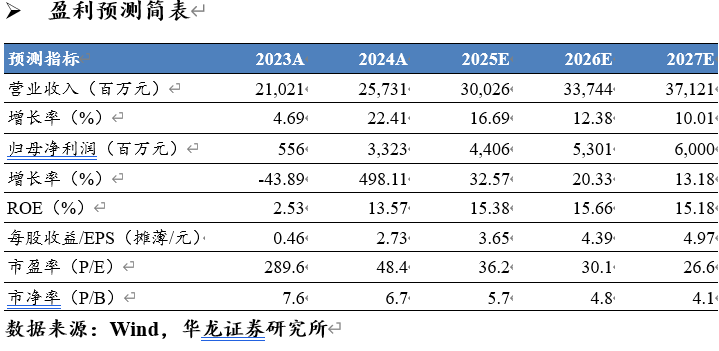
Core Viewpoint - The company reported a strong performance in the first three quarters of 2025, with significant growth in both revenue and net profit, driven by demand in the smartphone and automotive sectors [1][2]. Financial Performance - For the first three quarters of 2025, the company achieved revenue of 21.783 billion yuan, a year-on-year increase of 15.2% - The net profit attributable to shareholders reached 3.21 billion yuan, reflecting a year-on-year growth of 35.15% - In Q3 alone, the company reported revenue of 7.827 billion yuan, up 14.81% year-on-year, and a net profit of 1.182 billion yuan, which is a 17.26% increase year-on-year [1][2]. Business Segments - The image sensor (CIS) business constitutes over 70% of the company's main revenue, with stable demand in the smartphone sector and rapid growth in automotive smart driving and emerging markets [2]. - The company expects continued strong performance in its CIS business, supported by robust downstream demand in both smartphones and automotive sectors [2]. Cash Flow and Inventory - As of the end of Q3, the company's inventory and contract liabilities were 8.07 billion yuan and 245 million yuan, respectively, showing growth compared to the end of 2024 [2]. - The net operating cash flow for Q3 was 2.676 billion yuan, indicating a high proportion relative to net profit, which suggests improving operational quality [2]. Profit Forecast and Investment Rating - The company is projected to achieve net profits of 4.406 billion yuan, 5.301 billion yuan, and 6 billion yuan for 2025, 2026, and 2027, respectively, with corresponding P/E ratios of 36.2, 30.1, and 26.6 times [2][4]. - The investment rating is maintained at "Accumulate" based on the expected growth trajectory [2].
豪威集团(603501):25年三季报业绩点评:25Q3业绩创新高,车载与新兴市场引领成长
Guoyuan Securities· 2025-10-30 08:12
Investment Rating - The report maintains a "Buy" rating for the company, with a target price of 136.58 CNY per share [5]. Core Insights - The company reported record high performance in Q3 2025, with revenue reaching 21.783 billion CNY (YoY +15.20%) and net profit attributable to shareholders at 3.210 billion CNY (YoY +35.15%) for the first three quarters of 2025 [2]. - In Q3 2025 alone, revenue was 7.827 billion CNY (YoY +14.81%, QoQ +4.58%), and net profit was 1.182 billion CNY (YoY +17.26%, QoQ +1.76%) [2]. - The gross margin and net margin for Q3 2025 were 30.34% and 15.06%, respectively [2]. Summary by Relevant Sections Mobile Sector - The company is facing short-term pressure in mobile CIS performance due to the lifecycle nearing its end for older models like OV50H. However, it has successfully launched the 50MP one-inch high dynamic range OV50X and a 200MP CIS, which are expected to drive growth [3]. Automotive Sector - The automotive CIS revenue reached 3.789 billion CNY in H1 2025, a year-on-year increase of 30.04%. The company is introducing new models and accelerating customer integration, positioning itself for significant growth as the automotive electronics supply chain stabilizes [3]. Emerging Markets - The company is actively expanding into emerging markets such as panoramic cameras, smart glasses, and machine vision, leveraging its CIS products' performance advantages. The demand for high-performance CIS in these areas is expected to significantly boost the company's revenue [4]. Financial Projections - Revenue forecasts for 2025 and 2026 are 30.031 billion CNY and 35.996 billion CNY, respectively, with net profits projected at 4.451 billion CNY and 5.579 billion CNY. The corresponding P/E ratios are 37 and 30 times [4].
豪威集团(603501):上半年业绩稳健;维持“买入”评级
Xin Lang Cai Jing· 2025-09-03 00:39
Core Insights - The company reported a 15% year-on-year revenue growth to 14 billion RMB for the first half of 2025, driven by double-digit growth in simulation solutions (up 21%) and distribution business (up 42%) [1] - Gross margin remained stable at 30.5%, an increase of 1.3 percentage points year-on-year [1] - Net profit surged by 48% to 2 billion RMB, with net profit margin rising to 14.5% from 11.3% in the same period last year, attributed to operational leverage and cost control [1] CIS Business Performance - The core business, CIS (Image Sensor), achieved record sales of 10.3 billion RMB, an 11% year-on-year increase, with automotive, security, emerging IoT, and medical CIS growing by 30%, 17%, 249%, and 68% respectively, offsetting a 19% decline in mobile CIS [1] - Automotive CIS remains a key growth driver, generating 3.8 billion RMB in revenue, a 30% increase, accounting for 37% of CIS segment revenue, driven by increased ADAS penetration and strong cabin imaging demand [2] - Mobile CIS faced challenges with a 19% year-on-year revenue decline due to a product demand cycle shift and slow recovery in the Chinese smartphone market [2] Emerging Markets and Future Projections - Emerging IoT and medical CIS experienced explosive growth, with IoT CIS revenue up 249% to 1.2 billion RMB and medical CIS up 68% to 443 million RMB [3] - Security CIS revenue grew by 17% to 827 million RMB, benefiting from the acceptance of high-end products and a recovering market [3] - Projections for 2025 indicate that emerging IoT and medical CIS will maintain high growth rates of 230% and 50% respectively [3] Valuation and Outlook - The company maintains a "buy" rating with a target price of 173 RMB, based on a 33.6 times 2026 price-to-earnings ratio, consistent with the two-year historical average [3] - The previous target price was 176 RMB, based on a 41 times 2025 price-to-earnings ratio, with net profit forecasts for 2025/26 adjusted down by 19% and 15% respectively due to slowing mobile CIS growth and margin pressure [3] - Despite challenges, the outlook remains optimistic for next year, considering the gradual ramp-up of new mobile CIS products and margin improvements, with a projected 50% net profit growth in 2026 [3]
豪威集团(603501):上半年业绩稳健,维持“买入”评级
Zhao Yin Guo Ji· 2025-09-03 00:27
Investment Rating - The report maintains a "Buy" rating for the company with a target price of 173 RMB, down from the previous target of 176 RMB, indicating a potential upside of 19.1% from the current price of 145.20 RMB [1][2][17]. Core Insights - The company reported a robust performance in the first half of 2025, with revenue increasing by 15% year-on-year to 14 billion RMB, driven by double-digit growth in simulation solutions (+21%) and distribution business (+42%) [1]. - Gross margin remained stable at 30.5%, up 1.3 percentage points year-on-year, while net profit surged by 48% to 2 billion RMB, leading to a net profit margin increase to 14.5% from 11.3% in the same period last year [1]. - The core business, CIS (image sensors), achieved record sales of 10.3 billion RMB, growing 11% year-on-year, with significant growth in automotive (+30%), security (+17%), emerging IoT (+249%), and medical CIS (+68%), offsetting a decline in mobile CIS (-19%) [1][6]. - The company is expected to maintain a favorable position in the CIS market, particularly in automotive and medical sectors, with projected revenue growth of 18% and 25% for FY25 and FY26, respectively, and net profit growth of 24% and 50% [1][6]. Financial Summary - The company’s market capitalization is approximately 172.79 billion RMB, with an average trading volume of 2.1 million RMB [2]. - The financial outlook includes projected sales revenue of 30.3 billion RMB for FY25, with a year-on-year growth of 17.8%, and net profit expected to reach 4.13 billion RMB, reflecting a 24.3% increase [7][11]. - The report indicates a decrease in profit forecasts for FY25 and FY26 by 19% and 15%, respectively, due to slower growth in mobile CIS and pressure on gross margins [6][11].
三星将内存工厂,转为封装厂
半导体芯闻· 2025-05-28 10:17
Group 1 - Samsung Electronics is restructuring its Hwaseong factory's old memory production line into a packaging production line, with the transfer of facilities expected to begin in the second half of this year [1][2] - The H1 factory, which houses the 12th and 13th production lines, is transitioning due to declining shipments of older NAND and DRAM products in the domestic memory market [1][2] - The plan to convert the 13th line to CIS (image sensors) has been delayed due to the downturn in the CIS industry, prompting Samsung to focus on packaging capabilities instead [1][2] Group 2 - The H1 factory's manufacturing environment is outdated, making it difficult to upgrade to the latest generation of memory, unlike the more advanced 15th and 16th lines [2] - The lower technical difficulty of post-processing technology allows for easier conversion, and consolidating small packaging equipment nearby can enhance management and investment efficiency [2] - Industry insiders indicate that Samsung is looking to introduce relevant equipment to the H1 factory to reorganize its old memory business while expanding packaging capacity [2]