Claude Opus

Search documents
X @Decrypt
Decrypt· 2026-04-14 18:31
Google's Gemma Already Acts Like Gemini—Someone Made It Think Like Claude Opus Toohttps://t.co/SVwwQFkOcP ...
X @Tesla Owners Silicon Valley
Tesla Owners Silicon Valley· 2026-04-12 18:18
Anthropic’s Claude Opus is FALLING. https://t.co/RKRCC1cPaC ...
深度|木头姐:Robotaxi五年内主导特斯拉盈利,Optimus将于28年达到人类水平,接力下一个十万亿市场
Z Potentials· 2026-03-24 03:40
Core Insights - ARK Investment Management focuses on disruptive innovation, with a strong emphasis on sectors like AI, robotics, gene editing, blockchain, and autonomous driving [3][4] - The current market sentiment is characterized by significant concerns, particularly regarding geopolitical tensions and economic conditions, which may present both challenges and opportunities for investors [4][6][7] Market Trends - The rise of low-cost autonomous solutions in defense, driven by the Ukraine conflict, is leading to the emergence of venture-backed defense companies [5][12] - Tesla's Robotaxi is expected to dominate its overall story and valuation logic in the next five years, potentially generating substantial cash flow per vehicle [5][14] - The oncology sector is poised for growth as more diagnostic tests gain commercial reimbursement, enhancing pricing power for related companies [5][26] AI and Technology - OpenAI and Anthropic are leading in the AI space, with OpenAI's annual revenue estimated at $25 billion and Anthropic's rapidly growing to $19 billion [19] - Microsoft is lagging in the AI competition, with its productivity applications growing at a low double-digit rate compared to the explosive growth of AI companies [20][21] - The integration of AI with multi-omics is accelerating the commercialization of gene therapies, driven by advancements in AI and regulatory support [24][30] Gene Therapy and Biotech - The market for gene therapies is expanding, with CRISPR Therapeutics showing significant potential in treating common diseases, with a projected total addressable market of $2.8 trillion [35] - Regulatory changes are facilitating the development of innovative therapies, with the FDA streamlining approval processes for rare diseases [31] - The increasing reimbursement for gene therapies is expected to drive market growth, as seen with the CRISPR therapy CasGevi achieving a 90% reimbursement rate for eligible patients [32] Bitcoin and Cryptocurrency - Bitcoin has experienced a significant pullback of approximately 52% since its peak last October, but there are positive signals from regulatory developments and technical analysis indicating a potential rebound [38][39] - The Clarity Act is anticipated to drive new demand for Bitcoin, with regulatory clarity expected to emerge in 2026 [38] - On-chain data suggests a bullish sentiment in the market, with indicators showing a favorable supply-demand balance [39][40]



速递|Anthropic内部研究员项目:“失控智能体”“LLM思维病毒”等,AI安全风险从理论走向现实
Z Potentials· 2026-02-25 02:55
Core Insights - The article discusses the potential risks associated with AI agents, particularly focusing on the concerns raised by Anthropic regarding "rogue agents" that could leak sensitive information [1][2] - Anthropic has proposed 49 research projects aimed at enhancing AI safety and understanding the internal mechanisms of AI models, with a significant focus on security issues [2][3] Research Focus - Anthropic's research team is working under the guidance of senior researchers to address critical topics in AI safety, with about half of the proposed projects being completed [2][3] - Among the 49 proposed projects, 15 are specifically focused on security, including understanding the safety issues that AI agents may encounter and developing solutions [3][6] Financial Performance - Anthropic's coding assistant, Claude Code, has achieved an annualized revenue of $2.5 billion since its launch in February last year, contributing to the company's valuation of $350 billion following a recent $30 billion investment [5] AI Model Understanding - Nine research projects are dedicated to understanding the internal workings of AI models, which is a key area of focus for Anthropic as it rapidly recruits talent [6] - One project aims to investigate the phenomenon of "LLM thought viruses," where AI models exhibit peculiar behaviors that could influence human actions on social media [6] Recruitment and Compensation - The research program not only supports core research areas but also allows Anthropic to explore innovative ideas that may become significant research directions [7] - Research assistants in the program can earn approximately $3,850 per week, translating to an annual salary of over $200,000, reflecting the competitive compensation in the AI research field [6]

MiniMax发布M2.5模型:1美元运行1小时,价格仅为GPT-5的1/20,性能比肩Claude Opus
硬AI· 2026-02-13 13:25
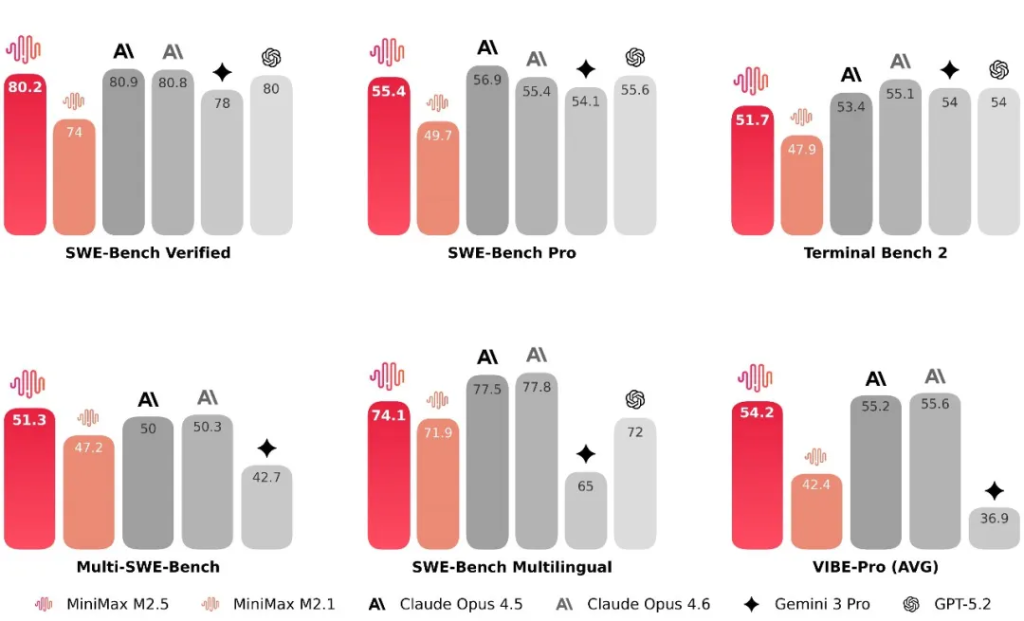
Core Viewpoint - MiniMax has launched its latest M2.5 model series, achieving a significant breakthrough in both performance and cost, aiming to address the economic feasibility of complex agent applications while claiming to have reached or refreshed the industry SOTA (state-of-the-art) levels in programming, tool invocation, and office scenarios [3][4]. Cost Efficiency - The M2.5 model demonstrates a substantial price advantage, costing only 1/10 to 1/20 of mainstream models like Claude Opus, Gemini 3 Pro, and GPT-5 when outputting 50 tokens per second [3][4]. - In a high-speed environment of 100 tokens per second, the cost for continuous operation for one hour is just $1, and it can drop to $0.3 at 50 tokens per second, allowing a budget of $10,000 to support four agents working continuously for a year [3][4]. Performance Metrics - M2.5 has shown strong performance in core programming tests, winning first place in the Multi-SWE-Bench multi-language task, with overall performance comparable to the Claude Opus series [4]. - The model has improved task completion speed by 37% compared to the previous generation M2.1, with an end-to-end runtime reduced to 22.8 minutes, matching Claude Opus 4.6 [4]. Internal Validation - Internally, MiniMax has validated the M2.5 model's capabilities, with 30% of overall tasks autonomously completed by M2.5, covering core functions such as R&D, product, and sales [4]. - In programming scenarios, M2.5-generated code accounts for 80% of newly submitted code, indicating high penetration and usability in real production environments [4]. Task Efficiency - M2.5 aims to eliminate cost constraints for running complex agents by optimizing inference speed and token efficiency, achieving a processing speed of 100 TPS (transactions per second), approximately double that of current mainstream models [7]. - The model has reduced the total token consumption per task to an average of 3.52 million tokens in SWE-Bench Verified evaluations, down from 3.72 million in M2.1, allowing for nearly unlimited agent construction and operation economically [9]. Programming Capability - M2.5 emphasizes not only code generation but also system design capabilities, evolving a native specification behavior that allows it to decompose functions, structures, and UI designs from an architect's perspective before coding [11]. - The model has been trained in over 10 programming languages, including GO, C++, Rust, and Python, across tens of thousands of real environments [12]. Testing and Validation - M2.5 has been tested on programming scaffolds like Droid and OpenCode, achieving pass rates of 79.7% and 76.1%, respectively, outperforming previous models and Claude Opus 4.6 [14]. Advanced Task Handling - In search and tool invocation, M2.5 exhibits higher decision maturity, seeking more streamlined solutions rather than merely achieving correctness, saving approximately 20% in rounds consumed compared to previous generations [16]. - For office scenarios, M2.5 integrates industry-specific knowledge through collaboration with professionals in finance and law, achieving an average win rate of 59.0% in comparisons with mainstream models, capable of producing industry-standard reports, presentations, and complex financial models [18]. Technical Foundation - The performance enhancement of M2.5 is driven by large-scale reinforcement learning (RL) through a native Agent RL framework named Forge, which decouples the underlying training engine from the agent, supporting integration with any scaffold [23]. - The engineering team has optimized asynchronous scheduling and tree-structured sample merging strategies, achieving approximately 40 times training acceleration, validating a near-linear improvement in model capabilities with increased computational power and task numbers [23]. Deployment - M2.5 is fully deployed in MiniMax Agent, API, and Coding Plan, with model weights to be open-sourced on HuggingFace, supporting local deployment [25].

Meta、OpenAI 争抢收购 OpenClaw!创始人艰难抉择:月入不到2万刀赔钱养项目,Offer拿到手软,对几十亿融资没兴趣
AI前线· 2026-02-13 08:08
Core Insights - The article discusses the challenges faced by Peter Steinberger, founder of OpenClaw, after the project's sudden rise to fame, including name changes and harassment from the crypto community [1][2] - OpenClaw is currently operating at a loss, relying on donations and limited corporate support, and is considering acquisition offers from major companies like OpenAI and Meta, with a focus on maintaining open-source status [1][2] Name Change Challenges - The project initially named Wa-Relay faced pressure from Anthropic to change its name, leading to a stressful and chaotic renaming process [4][6] - The renaming involved securing various domain names and social media handles, which proved to be a complex and time-consuming task [6][10] - The crypto community's aggressive behavior added to the pressure, resulting in account hijacking and the spread of malicious software [7][8] Technical Insights - Steinberger expressed concerns about the AI industry's exaggerated safety fears, suggesting that incidents like MoltBot are more about entertainment than real privacy threats [2][17] - He highlighted the importance of efficient collaboration in AI development, warning against overly complex agent orchestration [2][21] Security Concerns - The article addresses the security challenges faced by AI systems, emphasizing that many reported vulnerabilities stem from user misconfigurations rather than inherent system flaws [22][23] - Collaboration with VirusTotal aims to enhance security by scanning skills before deployment, although no solution can guarantee complete safety [22][23] Development Philosophy - Steinberger advocates for a shift in mindset when working with AI agents, suggesting that developers should design projects to be easily understood by agents rather than solely based on personal preferences [32][35] - The article emphasizes the importance of iterative development, where learning and adaptation occur through hands-on experience with AI tools [36][37] Future Directions - The future of AI interaction is expected to evolve towards more integrated systems that combine personal assistance with development capabilities, moving beyond current chat-based interfaces [54][56] - The article suggests that the current state of AI development is still in its early stages, with significant potential for improvement in user interaction and system integration [56][57]

未知机构:前两天市场热议的Pony终于官宣并非DeepSeekV4而是智-20260213
未知机构· 2026-02-13 02:30
Summary of Key Points from the Conference Call Company Overview - The document discusses Zhipu Technology, a Chinese AI company, which is set to launch its flagship large language model, GLM-5. This model has double the parameters of its predecessor and is designed to handle complex coding and agent tasks. [1] Core Insights and Arguments - Zhipu's GLM-5 is positioned to compete directly with Anthropic's Claude Opus series, indicating a strategic move to enhance its competitive edge in the AI market. [1] - The launch of GLM-5 is timed to precede DeepSeek's next-generation architecture release during the Lunar New Year, highlighting the urgency to capture market share. [1] - Following its IPO earlier this year, Zhipu's stock price has surged over 50% this week, reflecting strong market interest and investor confidence in its AI solutions. [1] - The company is shifting its focus from providing customized AI solutions for Chinese enterprises to offering services to a global user base, indicating a strategic expansion. [1] Additional Important Content - The increase in parameters for GLM-5 suggests a significant enhancement in the model's capabilities, which may lead to improved performance in AI applications. [1] - The competitive landscape in the AI sector is intensifying, with Zhipu's proactive measures to launch GLM-5 before its competitors, indicating a fast-paced innovation environment. [1]
MiniMax发布M2.5模型:1美元运行1小时,价格仅为GPT-5的1/20,性能比肩Claude Opus
Hua Er Jie Jian Wen· 2026-02-13 02:15
Core Insights - MiniMax has launched its latest M2.5 series model, significantly reducing inference costs while maintaining industry-leading performance, aiming to address the economic feasibility of complex agent applications [1] - The M2.5 model demonstrates a substantial price advantage, costing only 1/10 to 1/20 of mainstream models like Claude Opus and GPT-5 at a throughput of 50 tokens per second [1][2] - The model has shown strong performance in programming tasks and has achieved first place in the Multi-SWE-Bench multilingual task, with a 37% improvement in task completion speed compared to its predecessor M2.1 [2] Cost Efficiency - M2.5 is designed to eliminate cost constraints for running complex agents, achieving a processing speed of 100 TPS, which is approximately double that of current mainstream models [3] - The model reduces the total token consumption for tasks, averaging 3.52 million tokens per task in SWE-Bench Verified evaluations, down from 3.72 million tokens in M2.1 [3] Programming Capabilities - M2.5 emphasizes system design capabilities in addition to code generation, demonstrating a native specification behavior that allows it to decompose functions and structures from an architect's perspective [4] - The model has been trained in over 10 programming languages and has shown a pass rate of 79.7% on the Droid platform and 76.1% on OpenCode, outperforming previous models [5] Task Handling Efficiency - In search and tool invocation, M2.5 exhibits higher decision maturity, achieving approximately 20% fewer rounds of consumption compared to previous versions while maintaining token efficiency [8] Office Applications - MiniMax has integrated industry-specific knowledge into M2.5's training, resulting in an average win rate of 59.0% in the Cowork Agent evaluation framework against mainstream models, capable of producing industry-standard reports and financial models [10] Technical Foundation - The performance improvements of M2.5 are driven by a large-scale reinforcement learning framework named Forge, which decouples the underlying training engine from the agent [14] - The engineering team has optimized asynchronous scheduling and tree-structured sample merging strategies, achieving approximately 40 times training acceleration [14] Deployment - M2.5 is fully deployed in MiniMax Agent, API, and Coding Plan, with model weights set to be open-sourced on HuggingFace for local deployment [15]
倒反天罡,Claude“反向”操控人类,公司估值冲2万亿跃居全球第二
3 6 Ke· 2026-01-19 12:45
Core Insights - The article discusses the rapid rise of Anthropic, the company behind Claude, as a major player in the AI industry, following OpenAI. It highlights a viral video showcasing AI directing human tasks, which has sparked significant interest and investment in Anthropic [1][5][18]. Investment Trends - Sequoia Capital is participating in a new funding round for Anthropic, which is notable as it has previously invested in both OpenAI and xAI, making this a rare case of investing in direct competitors [16][18][21]. - Anthropic is targeting a funding goal of $25 billion, with a valuation expected to reach $350 billion, doubling from $170 billion just four months prior [22][21]. AI Development and Market Dynamics - The article emphasizes the shift in the relationship between humans and AI, where AI is beginning to take on more autonomous roles, acting as an "agent" rather than just a tool [15][14]. - Claude's capabilities allow it to understand code structures and execute multi-step tasks, which is changing the role of developers from code writers to code reviewers [15][26]. Competitive Landscape - The AI model competition is described as an arms race, with significant investments being made to ensure participation in this rapidly evolving field [25][27]. - Anthropic's focus on being a "reliable colleague" rather than an all-powerful entity has garnered trust in the enterprise market, contrasting with OpenAI's broader ambitions [25][26]. Historical Context and Future Outlook - The article draws parallels between the current AI landscape and past technological shifts, suggesting that the stakes are higher and the pace of change is faster than ever before [41][44]. - Anthropic is preparing for an IPO, which could position it as the second AI startup to exceed a $100 billion valuation, following OpenAI [45][46].
Manus和它的“8000万名员工”
虎嗅APP· 2026-01-13 00:49
Core Viewpoint - Manus represents a significant paradigm shift in AI applications, transitioning from merely generating content to autonomously completing tasks, marking a "DeepSeek moment" in the industry [6][7]. Group 1: Manus's Unique Model - Manus has created over 80 million virtual computer instances, which are crucial to its operational model, allowing AI to autonomously handle complex tasks [9][10]. - This model signifies a shift in core operators from humans to AI, establishing Manus as an "artificial intelligence operating system" [11]. - The Manus model is expected to lead to a 0.5-level leap in human civilization, as AI takes over digital economy-related jobs [12]. Group 2: AI Application's "DeepSeek Moment" - Manus achieved an annual recurring revenue (ARR) of over $100 million within a year, indicating its strong market performance [20]. - The introduction of multi-agent systems has shown a 90.2% performance improvement in handling complex tasks compared to single-agent systems, emphasizing the importance of collaboration among AI [14][17]. - The transition from AI as a tool to AI as a worker signifies a major evolution in AI applications, moving beyond the "toy" and "assistant" phases [20]. Group 3: Technological Foundations of Multi-Agent Systems - Manus's multi-agent system relies on several core technologies, including virtual machines for secure execution environments and resource pooling for efficient resource utilization [22][24]. - The virtual machine architecture allows for independent task execution, addressing safety and reliability issues in AI applications [25]. - Intelligent orchestration ensures optimal resource allocation and task management, enhancing overall system efficiency [26][27]. Group 4: Competitive Landscape and Industry Dynamics - Major tech companies are rapidly advancing in multi-agent systems, with Meta, Google, Microsoft, and Amazon all integrating these capabilities into their platforms [30][32]. - In the domestic market, companies like Alibaba, Tencent, and Baidu are also making significant strides in developing multi-agent technologies [31]. - The emergence of new players like Kimi, which has raised $500 million for multi-agent system development, indicates a growing competitive landscape [33]. Group 5: Evolution of Human Roles - The relationship between humans and AI is shifting from operator-tool dynamics to manager-team dynamics, where humans define tasks while AI executes them [35]. - This evolution will likely reduce the demand for lower and mid-level creative jobs while amplifying the value of high-level creative work [37]. - The traditional hierarchical structure of organizations may flatten as multi-agent systems can handle the entire workflow from strategy to execution [38]. Group 6: Underestimated Risks - Data ownership and system security are critical concerns in multi-agent systems, as data becomes a currency for AI collaboration and system evolution [40][41]. - The complexity of multi-agent systems introduces new security challenges, including process safety, collaboration safety, and evolution safety [42][43]. - Balancing security and efficiency remains a fundamental challenge, as overly secure systems may hinder performance while efficient systems may expose vulnerabilities [44]. Group 7: Irreversible Development Path - The proliferation of Manus's 80 million virtual machines signals a new era of productivity, redefining the nature of work itself [47]. - In the short term, vertical applications of multi-agent systems are expected to explode across various industries, leading to intense market competition [48]. - Over the long term, human-AI collaboration will evolve into a more integrated system, blurring the lines between human and machine contributions [49].