
Claude Sonnet 4.6

Search documents
国产大模型周调用量再超美国
第一财经· 2026-03-16 10:19
Core Insights - The article highlights that domestic AI models in China have surpassed U.S. models in weekly usage for two consecutive weeks, indicating a significant shift in the AI landscape [5][6]. Group 1: Domestic Model Performance - The weekly usage of domestic AI models reached approximately 4.69 trillion tokens, an increase of 11.82% from the previous week [6]. - The top three domestic models by usage are MiniMax M2.5 (1.75T tokens), Step 3.5 Flash (1.34T tokens), and DeepSeek V3.2 (1.04T tokens) [5][6]. - In contrast, U.S. AI models had a weekly usage of 3.294 trillion tokens, which represents a decline of 9.33% [6]. Group 2: Emergence of New Models - The newly launched Hunter Alpha model, with 1 trillion parameters and support for 1 million tokens context, has gained attention for its capabilities in long-term planning and complex reasoning [6][7]. - Hunter Alpha topped the daily ranking on OpenRouter shortly after its release, alongside another model, Healer Alpha, which also made it to the top ten [7]. Group 3: Market Dynamics and Pricing - The increasing demand for domestic models is driven by the rise of intelligent agent scenarios, which require high token consumption, making cost-effective domestic models appealing to overseas developers [7]. - For instance, MiniMax M2.5 offers a competitive pricing structure at $0.3 per million tokens for input and $1.1 for output, significantly lower than the prices of U.S. models like Claude Opus 4.6 [7]. Group 4: Commercialization Challenges - While domestic models are gaining traction in international markets, U.S. models are focusing on pragmatic commercialization, such as discontinuing lower-priced versions and tightening usage limits [8]. - The departure of a key figure from Alibaba's AI division highlights the tension between revenue pressures and open-source strategies [8]. - MiniMax's first financial report indicates a revenue of approximately $79.04 million for 2025, a year-on-year increase of 159%, but also reveals a significant loss of $1.87 billion, up 302% year-on-year [8].


人工智能模型:智能拐点推动盈利预测上调-Artificial Intelligence Model Intelligence Inflection Drives Upward Estimate Revisions
2026-03-11 08:12
Summary of Key Points from the Conference Call Industry Overview - **Industry Focus**: The discussion centers around the **Artificial Intelligence (AI)** industry, particularly the infrastructure and enterprise adoption of AI technologies [1][2][3]. Core Insights and Arguments - **Revenue and CapEx Forecasts**: The AI Industry Model forecasts for revenues and capital expenditures (CapEx) have been raised due to accelerating enterprise demand and higher planned investments. The CapEx estimates for 2026-2030 have increased from **$8.0 trillion to $8.9 trillion**, while AI revenue projections for the same period have risen from **$2.8 trillion to $3.3 trillion** [2]. - **Inflection Point in AI Adoption**: Recent advancements in AI models from companies like OpenAI, Anthropic, and Google are driving rapid improvements in capabilities, leading to increased enterprise adoption and a broader diffusion of AI technologies [3]. - **Market Disruption Anticipation**: Investors are recognizing the potential for significant disruption across various industries, including software and information services, as AI technologies replace traditional methods with more efficient, scalable solutions [4][33]. - **Execution Risks**: There are concerns regarding the execution risks associated with hyperscalers attempting to increase CapEx by approximately **70% in 2026 compared to 2025**. Factors contributing to this risk include rising prices for memory and storage, as well as labor and equipment constraints [5]. Additional Important Insights - **AI Service Revenue Growth**: The AI service revenue estimates have been updated to reflect accelerating enterprise adoption, with global systems integrators playing a crucial role in driving this growth. Notably, Anthropic's annualized revenue run-rate recently surpassed **$19 billion**, indicating rapid growth [8]. - **Infrastructure Bottlenecks**: The market is underestimating the scale of investment required for AI infrastructure, with significant bottlenecks in IT hardware and rising costs for powering data centers potentially impacting enterprise adoption [28][29]. - **Backlog Growth**: There has been a **100% growth in backlogs** for major hyperscalers like AWS, GCP, and Azure, indicating strong demand despite concerns about backlog quality [27]. - **Token Pricing Trends**: The pricing for AI models is increasing, with models like Gemini 3.1 Pro maintaining the same price per token while significantly improving in intelligence, suggesting a complex relationship between model performance and cost [19]. Conclusion The AI industry is at a pivotal moment, with significant investments and advancements driving rapid adoption across enterprises. However, execution risks and infrastructure challenges remain critical factors that could influence future growth and profitability in this sector.
想了一个token出海路径
小熊跑的快· 2026-03-09 00:28
Core Insights - The article suggests that data centers should be located in China due to lower costs for chips, electricity, and land, particularly in Inner Mongolia [1] - It proposes a strategy of renting some computing power overseas for marketing purposes while utilizing domestic computing resources for inference tasks, which are time-consuming [1] - The expansion of undersea cables and increased bandwidth are emphasized as necessary steps, with a focus on maintaining data security through local data virtualization and isolation solutions [1] Summary by Sections - **Data Center Location**: The article argues for establishing data centers in China, highlighting the cost advantages of chips, electricity, and land [1] - **Inference Strategy**: It discusses the approach of using overseas computing power for marketing while relying on domestic resources for inference, which can take 1-4 minutes for tasks [1] - **Infrastructure Development**: The need to expand undersea cables and bandwidth is mentioned, along with a commitment to data security through local solutions [1] - **AI Model Utilization**: The article notes that domestic models are significantly cheaper, costing only one-sixth of their overseas counterparts, which could facilitate global AI application proliferation [1]

一只龙虾,成了MiniMax、月暗、智谱的财神爷
投中网· 2026-03-04 06:46
Core Insights - The article discusses the rapid rise of AI model companies like MiniMax, Zhipu, and Moonlight, which have significantly benefited from their integration with the OpenClaw ecosystem, leading to substantial increases in their market valuations and API usage [6][20]. Group 1: Market Dynamics - In February, MiniMax and Moonlight dominated the API usage rankings on OpenRouter, with MiniMax's M2.5 model leading in usage for three consecutive weeks [6]. - Both MiniMax and Zhipu AI have surpassed a market capitalization of 300 billion HKD, while Moonlight's API revenue has exceeded its total for the entire year of 2025 within just 20 days of launching its K2.5 model [6]. - The OpenClaw platform has become a significant driver of token consumption, with Chinese models accounting for 61% of the total token usage on the platform [8]. Group 2: Competitive Advantages - Chinese model companies are benefiting from their competitive pricing and performance, with Kimi K2.5 being used for 80% of daily inference tasks by a European studio, showcasing its cost-effectiveness compared to alternatives like Claude [7]. - The article highlights the importance of model adaptability and commercial efficiency as key competitive factors in the evolving AI landscape, moving beyond traditional metrics like model parameters [8]. Group 3: Financial Performance - MiniMax reported a sixfold increase in daily token consumption for its M2 series models in February 2026 compared to December 2025, indicating a strong growth trajectory [16]. - Moonlight's shift to a token-based pricing model has led to a significant increase in daily token consumption and user engagement [17]. Group 4: Challenges and Responses - Despite the success, companies like Zhipu have faced challenges with service stability due to surging demand, leading to service delays and a temporary drop in stock prices [18]. - The article emphasizes the need for model companies to ensure stable computing power and token services to maintain their competitive edge in the market [20]. Group 5: Future Outlook - Major tech firms like Alibaba, Tencent, and Baidu are entering the market with their own desktop agent tools, indicating a growing competitive landscape [22]. - The long-term success of AI model companies will depend on their ability to enhance model capabilities and user retention, as the market continues to evolve [23].

数字经济双周报(2026年第4期):中国AI模型应用量首超美国,竞争进入新阶段-20260302
Yin He Zheng Quan· 2026-03-02 11:16
Group 1: AI Model Application Growth - China's AI model application volume reached 5.16 trillion tokens, surpassing the U.S. for the first time, with a 127% increase over three weeks[1] - During the same period, U.S. model application volume decreased to 2.7 trillion tokens[1] - In the top ten global models, four are from China, indicating a rapid rise in China's AI capabilities[3] Group 2: Regional Dynamics - In China, AI applications are deepening alongside institutional improvements, marking a shift to large-scale implementation[1] - The U.S. is experiencing intensified competition in AI infrastructure, driven by the synergy of computing power, capital, and energy[1] - Europe is focusing on governance and research investment, shaping a differentiated AI development path[1] Group 3: Technological Advancements - AI intelligent agents and open-source models are accelerating application deployment, significantly enhancing industry capabilities[1] - Breakthroughs in low-power ferroelectric transistors are improving AI chip energy efficiency[17] Group 4: Supply Chain Insights - The Bank for International Settlements (BIS) highlights a trend of AI supply chains concentrating towards "full-stack giants," posing new challenges for competition and macroeconomic stability[1]
英伟达高靓财报,重点在哪?基金经理热评:市场分化等待核心催化,当前紧抓这一确定性逻辑!
Xin Lang Cai Jing· 2026-02-26 10:17
Group 1: Nvidia Financial Performance - Nvidia reported record revenue for Q4 and the full fiscal year 2026, with Q4 revenue at $68.1 billion, a 20% quarter-over-quarter increase and a 73% year-over-year increase [1] - The total revenue for fiscal year 2026 reached $215.94 billion, representing a 65% year-over-year growth [1] - The net profit for Q4 was $42.96 billion, showing a 94% year-over-year increase [1] Group 2: Future Guidance and Market Implications - Nvidia expects a gross margin of 75% for Q1 of fiscal year 2027, exceeding market expectations of 74.6%, indicating strong profitability [1] - The stable gross margin suggests that price increases from suppliers like SK Hynix for HBM have not significantly impacted Nvidia, and overall investment in overseas data centers remains manageable despite commodity price fluctuations [1] Group 3: AI Hardware and Software Market Dynamics - The release of new AI models has led to significant stock declines for SaaS companies, particularly those represented by Microsoft, and has negatively impacted the Hong Kong internet sector [2] - The focus on performance and speed in AI hardware investments, such as chips from Nvidia and TSMC, is seen as a primary investment opportunity, while storage and cooling technologies are viewed as secondary investments with higher volatility [3] - The software sector is expected to face challenges, with smaller SaaS companies likely to be outcompeted by larger platform-based companies that are developing their own AI models [4] Group 4: Investment Strategies and Market Trends - The electric power sector is viewed as a defensive investment amid the rise of AI, as it is expected to see increased demand due to AI developments [5] - The market is experiencing widening disparities between sectors, with significant declines in consumer, software, and financial sectors, while the entrepreneurial AI ETF remains a promising investment direction [5]

AI资本开支持续超预期,关注通信ETF(515880)
Sou Hu Cai Jing· 2026-02-25 06:14
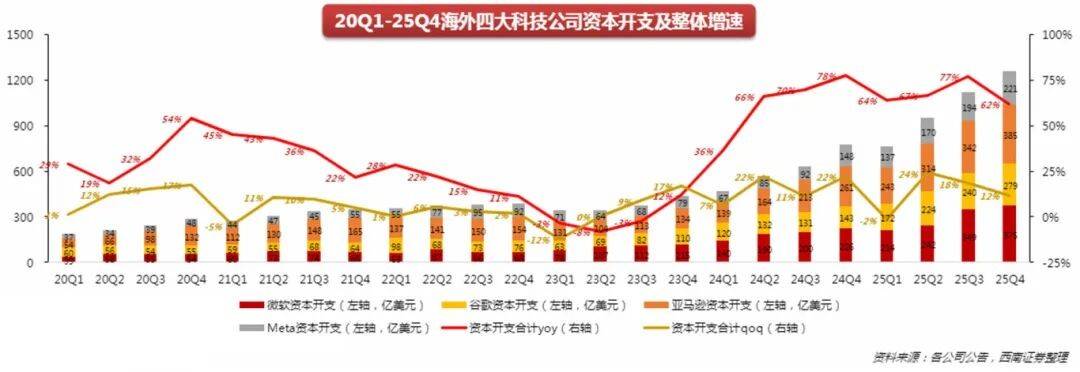
Group 1 - The core viewpoint is that AI capital expenditure continues to exceed expectations, with ongoing catalysts in the application sector, suggesting that the high prosperity of AI may persist. Investors are encouraged to pay attention to communication ETFs (515880), semiconductor equipment ETFs (159516), and technology innovation AI ETFs (589110) [1] - Major global AI model updates are frequent, with significant advancements from companies like Anthropic, Google, and domestic firms such as Zhipu AI and Alibaba, indicating a shift towards differentiated competition and potential for long-term profitability improvement [1] - The leading companies in large models are moving towards a differentiated competition route, with some firms raising prices alongside new model releases, suggesting a transition from "land grab" to a phase of "paying for quality" [1] Group 2 - Capital expenditure from overseas cloud providers for 2025 is projected to reach $410 billion, a 67% year-on-year increase, indicating strong demand for AI infrastructure and benefiting upstream related companies [2] - Guidance for capital expenditure from major tech companies like Google, Amazon, and Meta for 2026 exceeds market expectations, reinforcing the ongoing investment in AI infrastructure [2] - The long-term outlook for domestic alternatives in the AI infrastructure sector is positive, supported by technological competition and policy backing [2]
中信建投:国内外大模型密集迭代,持续推荐AI板块
Xin Lang Cai Jing· 2026-02-24 23:57
Group 1 - The AI industry is experiencing rapid advancements, with large models continuously iterating and increasing demand for computing power [3][18][29] - Major AI companies are transitioning from a "low-cost/free user acquisition" phase to a "high-quality paid" phase, significantly boosting computing power demand [4][9][24] - During the holiday period, US AI computing stocks performed exceptionally well, with companies like Lumentum, Corning, and Coherent reaching historical highs [12][28][29] Group 2 - Anthropic launched the Claude Sonnet 4.6 model, which shows significant improvements in programming and reasoning capabilities, becoming the default model for its platforms [4][19] - Google's Gemini 3.1 Pro model outperformed several competitors in benchmark tests, achieving a score of 77.1% on the challenging ARC-AGI-2 test, doubling its predecessor's performance [6][21] - Zhizhu AI released the GLM-5 model, featuring a parameter scale of 744 billion and training data of 28.5 trillion tokens, achieving top scores in open-source model benchmarks [7][22] Group 3 - MiniMax introduced the M2.5 model, designed for agent scenarios, demonstrating significant improvements in programming tasks and cost efficiency [9][24] - Alibaba's Qwen3.5-Plus model outperformed similar open-source models, offering competitive pricing and extensive language support [10][25] - The domestic AI market saw a surge in user engagement during the Spring Festival, with significant increases in active users for various AI applications [12][27]





ETF日报:AI资本开支持续超预期,热点催化不断,应用端落地兑现有望加速,关注通信ETF、半导体设备ETF
Xin Lang Cai Jing· 2026-02-24 11:40
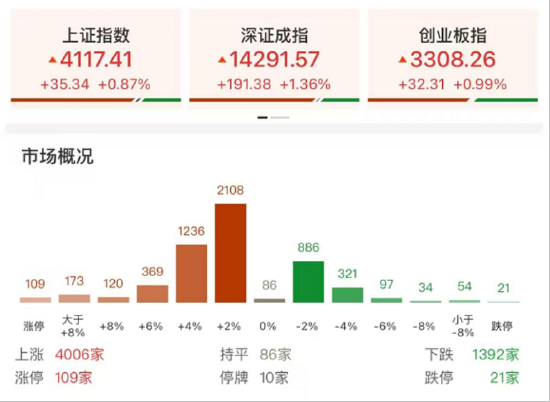
Market Performance - The market experienced a high opening followed by a pullback, with the ChiNext index rising over 2% at one point. The total trading volume in the Shanghai and Shenzhen markets reached 2.2 trillion, an increase of 219.4 billion compared to the last trading day before the holiday [1] - By the end of the trading day, the Shanghai Composite Index rose by 0.87%, the Shenzhen Component Index by 1.36%, the ChiNext Index by 0.99%, and the CSI A500 Index by 1.20% [1] Consumer Trends - During the recent Spring Festival holiday, consumer activity and travel saw a steady increase, supported by consumption promotion policies. The average daily sales of key retail and catering enterprises increased by 8.6% compared to the same period in 2025 [3][19] - Foot traffic and sales in monitored pedestrian streets increased by 4.5% and 4.8% respectively during the first three days of the holiday compared to last year [3][19] - The focus of economic work for 2026 includes "maintaining domestic demand as the main driver" and "coordinating consumption promotion and investment expansion" [3][19] AI Sector Developments - The AI sector continues to see significant capital expenditure and frequent updates to large models, indicating a sustained high level of activity. Companies like Zhiyuan, ByteDance, Alibaba, and MiniMax have released new AI models, with a focus on application and performance improvements [6][22][23] - The global AI model landscape is evolving, with notable releases such as Anthropic's Claude Sonnet 4.6 and Google's Gemini 3.1 Pro, which enhance capabilities in various tasks [7][23] - Domestic companies are also advancing, with Zhiyuan AI launching its GLM-5 model, which ranks first among open-source models in multiple tests [7][23][24] Infrastructure Investment - The North American AI sector is facing electricity shortages, prompting increased investment in grid infrastructure. The PJM, responsible for the largest regional electricity market in the U.S., plans to enhance its grid to support data centers [10][27] - China's State Grid Corporation is expected to invest 4 trillion yuan during the 14th Five-Year Plan, a 40% increase from the previous plan, focusing on main grid construction and improving cross-province transmission capacity [10][28] - The global energy transition is driving demand for grid construction to accommodate renewable energy, with significant potential in underdeveloped regions [10][28] Robotics Sector Insights - The robotics sector saw high expectations during the Spring Festival, but recent performance has been mixed, with the robotics ETF down by 0.71% [14][30] - Companies showcased advanced capabilities during the Spring Festival, with performances highlighting improvements in motion control and stability [31][32] - Future developments, particularly Tesla's V3 release, are anticipated to impact the robotics market significantly, with varying expectations for its success [32]
未知机构:2026春节期间AI行业动态汇总一国内模型与产品发布-20260224
未知机构· 2026-02-24 04:05
Summary of AI Industry Dynamics During the 2026 Spring Festival Domestic Model and Product Releases 1. **Zhiyuan AI** (February 11): Released GLM-5 with a HumanEval code pass rate of 96.2%, ranking first in global open source and fourth overall; focuses on programming and intelligent capabilities [1] 2. **ByteDance** (February 14): Launched Doubao Model 2.0 (Pro/Lite/Mini/Code), achieving top rankings in math/programming benchmarks and reducing inference costs by an order of magnitude; simultaneously launched Seedance 2.0, capable of generating movie-quality multi-shot audio and video in 60 seconds, becoming a key visual creation tool for the Spring Festival Gala [1] 3. **Alibaba** (February 16): Open-sourced Qwen3.5-Plus with a total parameter count of 397 billion and only 17 billion activated, achieving a 60% reduction in memory usage and a 19-fold increase in inference efficiency; API priced at 0.8 yuan per million tokens, which is 1/18 of Gemini 3 Pro [1] Additional Domestic Releases 4. **DeepSeek** (February 17): Upgraded context window from 128K to 1M tokens, capable of processing ultra-long texts equivalent to the "Three-Body Problem" trilogy [2] 5. **MiniMax** (February 18): Released M2.5 model with native agent design, achieving a 37% speed increase for complex tasks [2] 6. **Tencent** (February 19): AI creation reached 1 billion instances over 16 days during the Spring Festival [2] Overseas Model and Product Releases 7. **Google** (February 19): Released Gemini 3.1 Pro, significantly enhancing inference capabilities and setting a new technical benchmark [3] 8. **OpenAI** (February 18): Launched a proprietary model based on Cerebras chips, achieving a training efficiency increase of 5-10 times and a cost reduction of 70% [3] 9. **Anthropic** (February 18): Released Claude Sonnet 4.6, priced at 1/5 of flagship models, with performance approaching Opus, offering excellent cost-performance for enterprise applications [3] 10. **xAI** (February 20): Updated Grok 4.2, with simultaneous upgrades in multimodal and inference capabilities [3] Financing and Capital Dynamics 11. **Moon's Dark Side (Kimi)** (February 20): Completed a $700 million financing round led by Alibaba, Tencent, and Wuyuan, with a valuation exceeding $10 billion; cumulative financing in January and February surpassed $1.2 billion [4] 12. **Zhiyuan AI/MiniMax** (February 20): Market capitalization on the first trading day after the Hong Kong holiday exceeded 300 billion HKD each, totaling over 580 billion HKD [4] 13. **Anthropic** (February 21): Completed a $30 billion Series G round, with a valuation reaching $380 billion, led by GIC and Coatue [4] 14. **OpenAI** (February 21): Nearing completion of the first phase of over $100 billion in financing, with a valuation expected to exceed $850 billion [4] 15. **Runway** (February 21): AI video company completed a $315 million Series E round, with a valuation of $5.3 billion, focusing on world model development [4]