
NAND存储芯片

Search documents
突发!存储巨头遭美国调查!
国芯网· 2026-03-27 15:26
Core Viewpoint - The article discusses the investigation initiated by the U.S. International Trade Commission (ITC) into NAND and DRAM memory chips, focusing on potential patent infringements by major companies such as Japan's Kioxia and South Korea's SK Hynix [2][4]. Group 1: Investigation Details - The investigation is based on a complaint filed by U.S. MonolithIC 3D on February 17, 2026, alleging violations of Section 337 of the Tariff Act of 1930 regarding the import and sale of certain NAND and DRAM memory chips [4]. - MonolithIC 3D is requesting the ITC to issue a limited exclusion order and a cease-and-desist order against the accused companies [4]. Group 2: ITC Process and Timeline - The ITC will determine the end date of the investigation within 45 days after the case is officially filed [6]. - Unless the U.S. Trade Representative vetoes the decision for policy reasons, any relief order issued by the ITC in Section 337 cases will take effect on the date of issuance and will be final 60 days after that date [6].

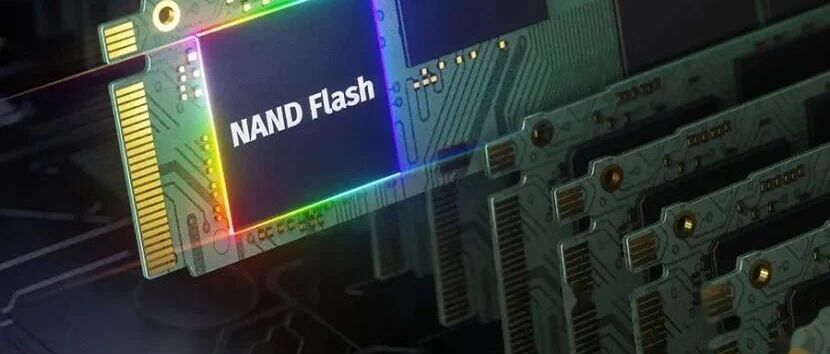
电子行业周报:AMAT携手SK hynix、Micron合作开发新一代存储芯片
Shanghai Aijian Securities· 2026-03-16 10:24
Investment Rating - The electronic industry is rated as "Outperform" compared to the market [1]. Core Insights - The report highlights significant collaborations in the semiconductor sector, including AMAT's partnership with SK hynix and Micron to develop next-generation AI storage chips, with a total investment of up to $5 billion [21]. - The demand for AI computing power is driving the global storage industry towards AI-specific technologies, indicating a trend of collaborative innovation between equipment and manufacturing sectors [22]. - The report emphasizes the explosive growth of companies like Cambricon, which reported a revenue increase of 453.21% year-on-year, driven by the rising demand for AI computing power [25]. Market Performance Summary - The SW electronic industry index decreased by 1.23%, ranking 20th out of 31 sectors, while the CSI 300 index increased by 0.19% [2][3]. - The top-performing sub-sectors within the electronic industry included printed circuit boards (+2.95%), LEDs (+2.19%), and discrete devices (+1.84%), while passive components (-5.13%), semiconductor equipment (-4.86%), and integrated circuit packaging (-3.82%) lagged behind [8]. - Notable stock performances included Nanya Technology (+20.96%), Zhongying Technology (+19.87%), and Demingli (+18.05%), while stocks like Canxin Technology (-15.82%) and Igor (-15.01%) faced significant declines [11]. Global Industry Dynamics - AMAT's strategic partnership with SK hynix and Micron focuses on core technologies and process innovation for DRAM, HBM, and NAND AI storage chips [21]. - Samsung and NVIDIA are collaborating to accelerate the development of next-generation NAND Flash storage chips, significantly enhancing performance analysis speeds [22]. - The upcoming NVIDIA GTC 2026 conference will showcase advancements in AI infrastructure, including the Feynman architecture, which aims to reduce data center energy consumption [24]. - Broadcom has launched the first single-channel 400G optical DSP chip, designed for next-generation AI data centers, demonstrating advancements in bandwidth and energy efficiency [26].
霍尔木兹海峡卡住的还有芯片!
国芯网· 2026-03-06 14:25AI Processing
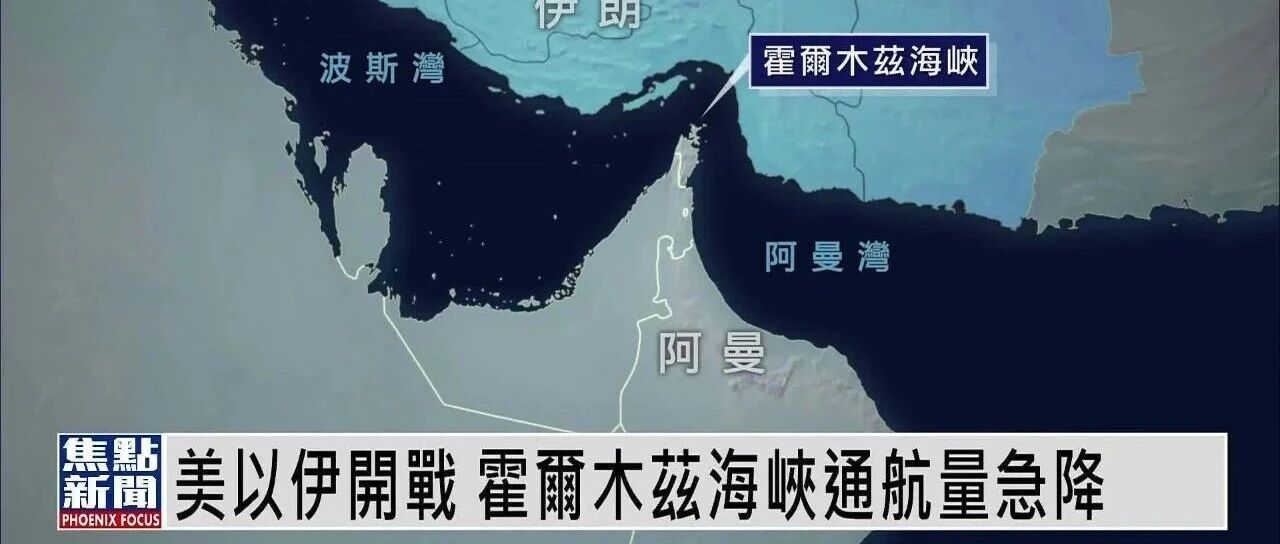
国芯网[原:中国半导体论坛] 振兴国产半导体产业! 不拘中国、 放眼世界 ! 关注 世界半导体论坛 ↓ ↓ ↓ 近日,美伊冲突引爆霍尔木兹海峡危机,全球芯片产业链正面临一场被严重低估的能源冲击。全球逾半数存储芯片产自韩国、七成先进逻辑芯片产自中国 台湾,两地对卡塔尔LNG高度依赖。目前韩国储备仅剩不足两个月,四月或成供应断崖关键节点,对于电力消耗巨大的芯片晶圆厂而言,将是直接的生 产威胁。 美伊冲突引发的霍尔木兹海峡危机,正在将全球科技产业链拖入一场意料之外的能源冲击。这条承载全球石油贸易命脉的海峡,同时也是支撑全球芯片制 造的天然气供应通道——而这一隐性风险,尚未被市场充分定价。 周五,据彭博社专栏文章,全球超过一半的DRAM和NAND存储芯片在韩国生产,全球约70%的先进逻辑芯片在中国台湾生产。这两个芯片制造重镇,对 卡塔尔LNG依赖程度较高。 据央视新闻,当地时间3月5日上午,伊朗伊斯兰革命卫队发表声明称,当天凌晨,一艘美国油轮在波斯湾北部被其海军发射的导弹击中,目前该油轮仍在 起火燃烧。声明还称,美国、以色列以及欧洲国家及其支持者所属的军用和商用船只,均严禁在该海域通行,一旦被发现,将遭到打击。 与此 ...

霍尔木兹海峡卡住的不只是“原油”,或许还有“芯片”
是说芯语· 2026-03-06 03:24
Core Viewpoint - The crisis in the Strait of Hormuz, triggered by the US-Iran conflict, poses an unexpected energy shock to the global technology supply chain, particularly affecting chip manufacturing due to high reliance on Qatari LNG [1]. Group 1: Impact on Chip Manufacturing - Over half of the global DRAM and NAND storage chips are produced in South Korea, while about 70% of advanced logic chips are manufactured in Taiwan, both of which are highly dependent on Qatari LNG [3]. - Samsung Electronics and SK Hynix together account for approximately 40% of the Kospi index, while TSMC alone represents 45% of the Taiwan Weighted Index [3]. Group 2: Energy Supply Concerns - Qatar's Ras Laffan LNG facility has announced a production halt due to military attacks, which supplies about 20% of the global LNG market, leading to significant sell-offs in Asian energy-related stocks [1]. - South Korea's LNG reserves can only support less than two months of import demand, raising concerns about power supply if the Strait remains blocked [4]. Group 3: Market Reactions and Alternatives - The Kospi index fell by 12% in a single day, marking its largest daily drop in history, while the Taiwan Weighted Index decreased by 4.4% on the same day [1][2]. - The South Korean government is urgently seeking alternative LNG supplies, with Australia and the US potentially increasing their market share through flexible contract terms [7].
霍尔木兹海峡卡住的不只是“原油”,或许还有“芯片”
华尔街见闻· 2026-03-06 03:14
Core Viewpoint - The crisis in the Strait of Hormuz, triggered by the US-Iran conflict, is unexpectedly impacting the global technology supply chain through energy disruptions [1] Group 1: Impact on Chip Manufacturing - The Strait of Hormuz is crucial not only for global oil trade but also for the natural gas supply that supports chip manufacturing [2] - Over half of the world's DRAM and NAND storage chips are produced in South Korea, while about 70% of advanced logic chips are manufactured in Taiwan, both of which heavily rely on Qatari LNG [6][7] - The recent military actions have led to the shutdown of Qatar's Ras Laffan gas plant, which supplies about 20% of global LNG, causing significant market reactions [4] Group 2: Market Reactions and Vulnerabilities - The shutdown of the gas plant has resulted in severe sell-offs in Asian energy-related stock markets, with the South Korean KOSPI index dropping 12% in a single day, marking its largest daily decline in history [4][5] - The stock market volatility reflects the unusual vulnerability of these regions in the current crisis [5] Group 3: LNG Supply Concerns - South Korea's LNG reserves are critically low, sufficient for less than two months of import needs, raising concerns about power supply if disruptions continue [9] - The semiconductor manufacturing sector, which consumes significant electricity, faces direct production threats due to potential power shortages [10] - In contrast, the EU has a more substantial buffer with LNG reserves covering about one-third of its annual consumption [11] Group 4: Alternative Supply Strategies - The South Korean government is urgently seeking alternative LNG supplies, with the spot market still available but at significantly higher prices [12] - Australia and the US, as top LNG exporters, may take this opportunity to expand spot sales and capture market share [13]

台积电营收创历史新高,T-glass供不应求
Huaxin Securities· 2026-03-03 08:26
Investment Rating - The investment rating for the semiconductor industry is maintained as "Recommended" [2] Core Insights - TSMC's revenue is projected to exceed NT$3.8 trillion (approximately RMB 850 billion) in 2025, marking a historical high. The company has received NT$151.422 billion in subsidies from various governments, enhancing its capacity and supply chain security [3] - The demand for T-glass is outpacing supply, which is becoming a critical factor limiting the production of AI hardware. Major companies like NVIDIA have pre-ordered T-glass capacity well in advance, leading to fierce competition among tech giants [4] - The report suggests focusing on companies such as SMIC, Hua Hong Semiconductor, China National Materials, and Honghe Technology for potential investment opportunities [5] Industry Dynamics - The semiconductor sector experienced an overall upward trend in stock prices during the week of February 23-27, with notable gains in the semiconductor materials sector, which rose by 7.47% [16] - The semiconductor index reached 8091.38 on February 27, reflecting a weekly increase of 2.19% [13] - The Philadelphia Semiconductor Index showed a fluctuating downward trend during the same week, indicating volatility in the market [28] Company Performance and Earnings Forecast - SMIC is rated as "Buy" with an estimated EPS of 0.46, 0.63, and 0.77 for 2024, 2025E, and 2026E respectively, with corresponding PE ratios of 250.00, 182.54, and 148.93 [7] - Other companies such as China National Materials and Honghe Technology have not been rated but have earnings forecasts available [7] Global Semiconductor Sales - Global semiconductor sales saw a significant increase in December 2025, reaching USD 78.88 billion, a year-on-year growth of 37.1%. China accounted for USD 21.29 billion of this total, representing 26.99% of the global market [39] Semiconductor Equipment Sales - The sales of semiconductor equipment in China reached USD 14.56 billion in Q3 2025, marking a year-on-year increase of 12.61% and a quarter-on-quarter increase of 28.17% [43] Market Trends - The report highlights that the demand for AI and 5G applications is driving the semiconductor market, with expectations of a gradual recovery in demand starting in 2024 [36]

日韩股市狂飙创历史新高!三星电子市值逼近万亿美元,存储芯片涨价周期引爆韩股狂欢
Jin Rong Jie· 2026-02-25 01:48
Market Performance - The Asia-Pacific stock market experienced a rally, with major indices in Japan and South Korea showing strong gains, continuing the rebound seen in US stocks [1] - The Nikkei 225 index in Japan reached a historic high of 58,000 points, with an intraday increase of approximately 1.2%, although the Tokyo Stock Exchange index lagged due to significant declines in bank stocks [1] - The KOSPI index in South Korea opened with a 1% increase, surpassing the 6,000-point mark for the first time, setting a new historical record [1] Company Highlights - Samsung Electronics saw its stock rise by about 1%, reaching a historical high with a market capitalization nearing $1 trillion. Several international institutions, including Morgan Stanley, Citigroup, and Macquarie, have raised their target prices, anticipating a strong cycle for DRAM and NAND storage chips that could last at least two years, with net profits expected to increase tenfold between 2025 and 2028 [1] - SK Hynix, another major player in the storage sector, also performed well, reaching a historical high with a current market value of approximately $480 billion and a slight increase of about 0.2% [1] Automotive Sector - The automotive sector in South Korea emerged as a highlight, with Kia Motors surging over 12% and Hyundai Motors increasing nearly 6%, positively impacting related industry stocks [1]
当“智能马桶”成为“AI存储”标的
Hua Er Jie Jian Wen· 2026-02-18 06:41
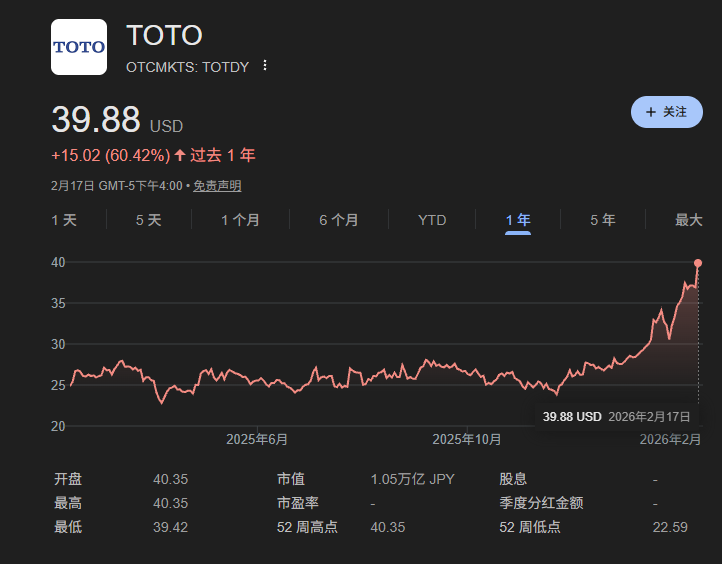
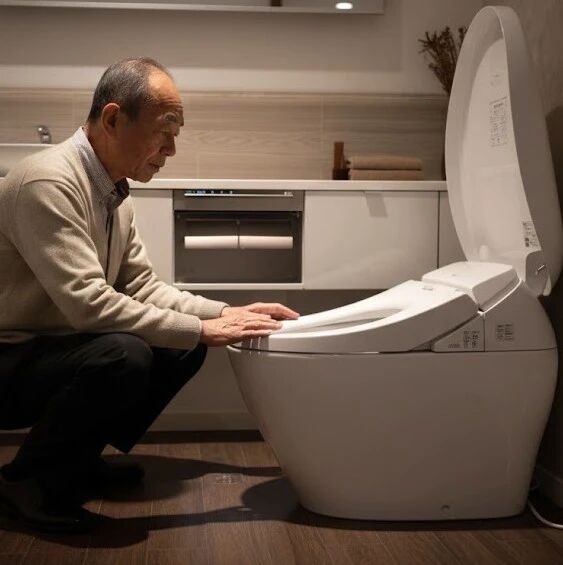
Core Viewpoint - TOTO, traditionally seen as a defensive asset in the bathroom industry, is viewed by Palliser Capital as a significantly misunderstood and undervalued player in the AI storage chip sector [1] Group 1: Business Insights - TOTO's advanced ceramics business plays a critical role in the semiconductor supply chain, contributing 40% of the company's operating profit [1] - The company has a competitive advantage in producing electrostatic chucks, essential for semiconductor manufacturing, due to its precision ceramic technology developed since the 1980s [2] - The demand for low-temperature etching in NAND storage chip manufacturing has surged, positioning TOTO as an "invisible champion" in the semiconductor precision ceramics field [2] Group 2: Investor Activism - Palliser Capital, with a background in activist investing, believes TOTO's current valuation does not reflect its true value as a beneficiary of AI storage [3] - The firm anticipates over 30% revenue growth for TOTO's advanced ceramics business in the next two years, driven by the NAND chip upgrade cycle [3] - Palliser has identified three main issues: a lack of effective communication regarding the ceramics business, misallocation of resources, and low capital efficiency [4] Group 3: Market Performance - TOTO's stock price has increased by over 60% in the past year, with Goldman Sachs recently upgrading its rating to "buy" based on the positive outlook for the advanced ceramics business driven by global AI data center investments [3]
当「智能马桶」成为「AI存储」标的
硬AI· 2026-02-18 06:41
Core Viewpoint - TOTO, traditionally viewed as a defensive asset in the bathroom industry, is being recognized as an undervalued player in the AI storage chip sector due to its advanced ceramic technology, which has become crucial in NAND chip manufacturing, contributing 40% to the company's operating profit [2][3]. Group 1: TOTO's Business Transformation - TOTO has evolved from a traditional toilet manufacturer to a key player in semiconductor precision ceramics, particularly through its development of electrostatic chucks used in silicon wafer production [6][7]. - The demand for low-temperature etching in NAND chip manufacturing has surged, highlighting TOTO's competitive advantage in this area, with a five-year lead over competitors [7]. Group 2: Investor Insights - Activist investor Palliser Capital urges TOTO to expand its precision ceramics business and divest non-core holdings, arguing that the current valuation does not reflect its potential as a beneficiary of AI storage demand [10][11]. - Palliser anticipates over 30% revenue growth for TOTO's precision ceramics business in the next two years, driven by the NAND chip upgrade cycle and stable replacement demand [10]. Group 3: Management Challenges - The root causes of TOTO's undervaluation include ineffective communication of its precision ceramics business's importance, misallocation of resources, and low capital efficiency, with 76 billion yen (approximately $496 million) in net cash sitting idle [11][13]. - TOTO's stock price has increased by over 60% in the past year, with Goldman Sachs recently upgrading its rating to "buy" based on the expected growth from global AI data center investments [11].
铠侠针对北美客户提价50%
Jin Rong Jie· 2026-02-15 12:38
Group 1 - Kioxia, a major storage giant in Japan, is expected to implement a revised pricing policy for North American customers starting in Q1 2026, with an average sales price anticipated to increase by approximately 50% quarter-on-quarter [1] - Morgan Stanley estimates that Kioxia's adjusted gross margin for Q1 will reach 66% [1] - Analysts suggest that Kioxia's price increase signals positive developments for the entire NAND industry, indicating a significant improvement in the profitability of the storage chip sector [1] Group 2 - Goldman Sachs forecasts that Samsung Electronics' NAND business operating profit margin will significantly rise to 37% in Q1 2026 [1] - SK Hynix is projected to see its operating profit margin jump to 42% in the same period [1]