
DeepSeekR1

Search documents
洲明科技:公司客户遍及海内外,包括众多世界500强企业、政府部门、国际性专业组织等
Zheng Quan Ri Bao Wang· 2025-12-02 11:13
Group 1 - The core viewpoint of the article highlights that Zhouming Technology (300232) has a diverse client base that includes numerous Fortune 500 companies, government departments, and international professional organizations [1] - The company has successfully integrated its Agent platform with several mainstream models, including Microsoft AzureGPT5, Google CloudVertexGemini2.5, DeepSeekR1, and KimiK2, enabling comprehensive AI capability design through multi-model intelligent scheduling [1]

企业如何控制AI大模型的应用风险
经济观察报· 2025-11-25 13:11
Core Viewpoint - The invention of AI large models presents unprecedented opportunities and risks for enterprises, necessitating a collaborative approach between humans and AI to leverage strengths and mitigate weaknesses [3][17][18]. Group 1: AI Development and Adoption Challenges - The rapid development of AI large models has led to capabilities that match or exceed human intelligence, yet over 95% of enterprises fail in pilot applications of AI [3][4]. - The difficulty in utilizing AI large models stems from the need to balance the benefits of efficiency with the costs and risks associated with their application [4]. Group 2: Types of Risks - AI risks can be categorized into macro risks, which involve broader societal implications, and micro risks, which are specific to enterprise deployment [4]. - Micro risks include: - Hallucination issues, where models generate plausible but incorrect or fabricated content due to inherent characteristics of their statistical mechanisms [5]. - Output safety and value alignment challenges, where models may produce inappropriate or harmful content that could damage brand reputation [6]. - Privacy and data compliance risks, where sensitive information may be inadvertently shared or leaked during interactions with third-party models [6]. - Explainability challenges, as the decision-making processes of large models are often opaque, complicating accountability in high-stakes environments [6]. Group 3: Mitigation Strategies - Enterprises can address these risks through two main approaches: - Developers should enhance model performance to reduce hallucinations, ensure value alignment, protect privacy, and improve explainability [8]. - Enterprises should implement governance at the application level, utilizing tools like prompt engineering, retrieval-augmented generation (RAG), content filters, and explainable AI (XAI) [8]. Group 4: Practical Applications and Management - Enterprises can treat AI models as new digital employees, applying management strategies similar to those used for human staff to mitigate risks [11]. - For hallucination issues, enterprises should ensure that AI has access to reliable data and establish clear task boundaries [12]. - To manage output safety, enterprises can create guidelines and training for AI, similar to employee handbooks, and implement content filters [12]. - For privacy risks, enterprises should enforce strict data access protocols and consider private deployment options for sensitive data [13]. - To enhance explainability, enterprises can require models to outline their reasoning processes, aiding in understanding decision-making [14]. Group 5: Accountability and Responsibility - Unlike human employees, AI models cannot be held accountable for errors, placing responsibility on human operators and decision-makers [16]. - Clear accountability frameworks should be established to ensure that the deployment and outcomes of AI applications are linked to specific individuals or teams [16].


企业如何控制AI大模型的应用风险
Jing Ji Guan Cha Wang· 2025-11-23 03:18
Core Insights - The rapid development of AI large models has revolutionized capabilities, yet over 95% of enterprises fail in pilot applications of AI, indicating significant challenges in leveraging AI effectively [2][3] - The article focuses on the micro risks associated with deploying AI large models in enterprises, including issues like poor business outcomes, customer experience degradation, brand reputation damage, data security threats, intellectual property erosion, and legal compliance problems [3][5] Micro Risks of AI - The phenomenon of "hallucination" in large models leads to the generation of content that appears logical but is actually incorrect or fabricated, posing a significant challenge in high-precision operational scenarios [5][6] - Output safety and value alignment challenges arise from the model's training data, which may include biases and harmful information, potentially damaging brand reputation and public trust [5][6] - Privacy and data compliance risks are present when sensitive information is input into third-party AI services, which may lead to unintentional data leaks [6][11] - The lack of explainability in decision-making processes of large models creates challenges in high-risk sectors, as the "black box" nature of these models makes it difficult to audit and trust their outputs [6][12] Strategies to Mitigate Risks - Companies can enhance model performance through technical improvements, such as reducing hallucination rates and ensuring better value alignment [7][8] - Enterprises should implement governance measures at the application level, utilizing tools like prompt engineering, retrieval-augmented generation (RAG), content filters, and explainable AI (XAI) to manage risks effectively [7][9] - Training and operational protocols for AI should mirror those for human employees, including setting clear guidelines and conducting regular audits to minimize errors [9][10] Accountability in AI Deployment - Responsibility for errors made by AI models ultimately lies with human operators, necessitating clear accountability frameworks within organizations [15] - Companies must adapt their organizational processes to leverage the strengths of both AI and human employees, ensuring a collaborative approach to maximize efficiency and minimize risks [15][16]

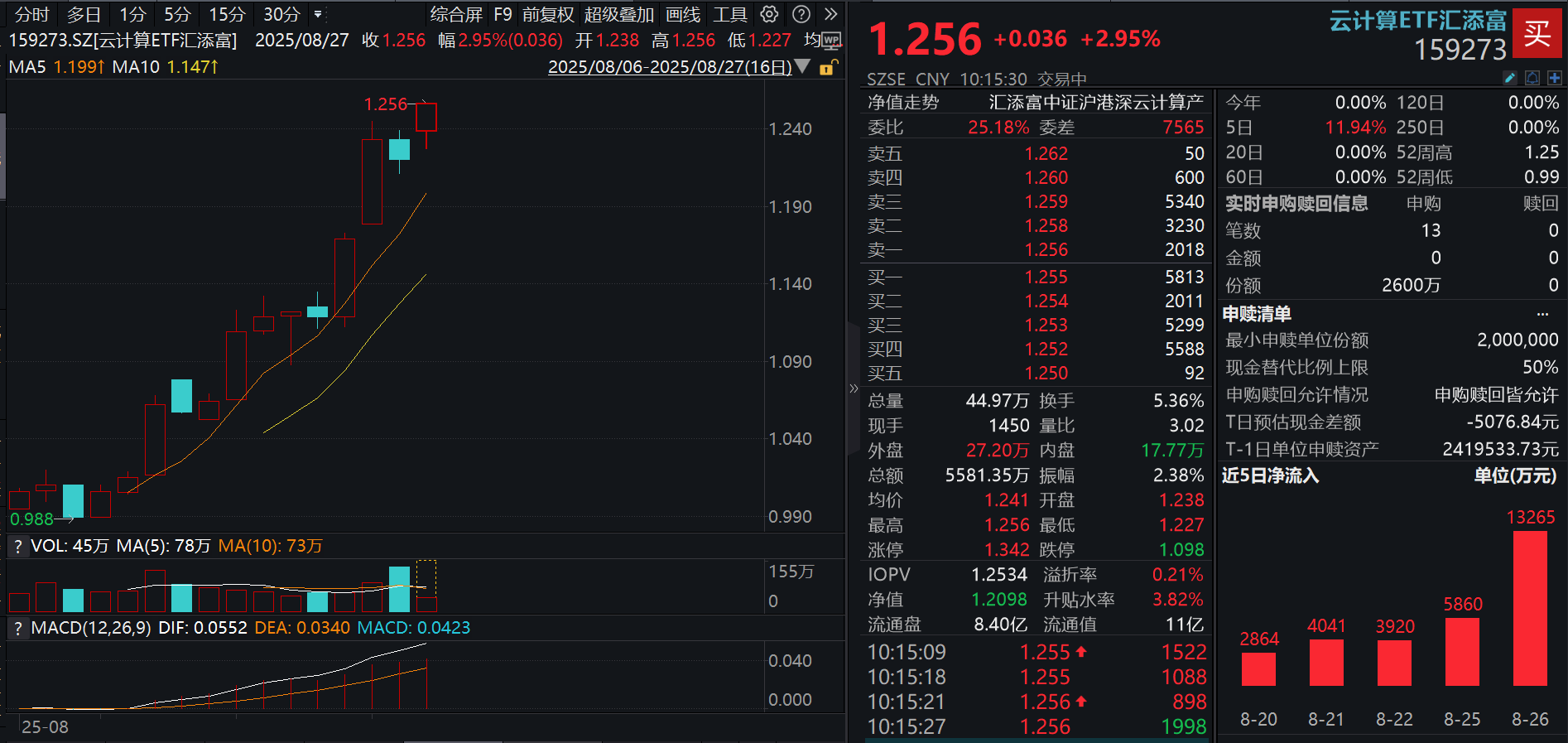
深入实施“人工智能+”行动意见发布!新易盛、中际旭创中报业绩暴增!云计算ETF汇添富(159273)大涨3%,昨日大举揽金超1.3亿元!
Xin Lang Cai Jing· 2025-08-27 03:13
Group 1 - The technology sector is experiencing significant growth, with the cloud computing ETF Huatai (159273) rising by 3% and achieving a trading volume exceeding 600 million yuan [1] - The cloud computing ETF has seen a premium of 0.3% and has attracted over 320 million yuan in net inflows over 13 out of 15 days since its listing, totaling over 500 million yuan [1] - Major component stocks of the cloud computing ETF have mostly performed well, with notable increases such as Xinyi Sheng rising over 8% and Kingsoft Office rising over 4% [1][2] Group 2 - The Chinese government has released an action plan to deeply implement "Artificial Intelligence +", aiming for widespread integration of AI in six key areas by 2027, with a target application penetration rate exceeding 70% for new intelligent terminals [2][3] - By 2030, the plan envisions AI fully empowering high-quality development, with application penetration rates exceeding 90% [2][3] - The policy shift from large-scale infrastructure to industrial application is expected to accelerate the development of new business models and innovation in the AI sector [3][5] Group 3 - The release of the action plan highlights the government's strong emphasis on AI development, with a focus on enhancing AI computing power and supporting innovation in AI chips [5][6] - The domestic AI chip market is projected to grow from approximately 18.4 billion yuan in 2020 to 153 billion yuan by 2025, reflecting a compound annual growth rate (CAGR) of about 52.7% [6] - The increasing penetration of intelligent terminals is expected to drive upgrades in core hardware, enhancing computing power and optimizing energy consumption [6][7]


拥抱AI!证券业82位CIO掌舵数字化转型,“拼烧钱”转向“算效益”
Xin Lang Cai Jing· 2025-07-11 07:14
Group 1 - Financial technology has become a significant driving force for the development of the securities industry [1] - The recent recruitment announcements for Chief Information Officers (CIOs) at various securities firms highlight the importance of this role [1][2] - Since 2025, there have been frequent changes in the CIO positions across at least 10 securities firms, indicating a trend of internal promotions to enhance the integration of technology and business management [1][4] Group 2 - Mergers and acquisitions have also led to new CIO appointments, with examples including the hiring of five executives from Minsheng Securities by Guolian Minsheng [2] - The ongoing mergers among major securities firms are expected to result in further CIO adjustments to ensure continuity and integration of technology frameworks [4] Group 3 - There are currently at least 82 CIOs in the securities industry, characterized by a highly educated and experienced demographic [4][8] - The average age of CIOs is approximately 52 years, with a significant concentration between 50 and 55 years old [8] - Nearly 70% of CIOs hold advanced degrees, with 38 having master's degrees and 18 holding doctoral degrees [8] Group 4 - Major securities firms are leading in technology investment, with Huatai Securities investing 2.448 billion yuan, followed by Guotai Junan with 2.2 billion yuan [8][9] - Smaller firms are also increasing their technology investments, with Dongbei Securities allocating 19.45% of its previous year's revenue to technology [9] Group 5 - The integration of AI and financial services is becoming a consensus in the industry, with significant increases in technology investments driven by policy guidance, technological advancements, and business upgrades [9][10] - The digital transformation of the industry is entering a phase focused on quality improvement and efficiency enhancement [10] Group 6 - The application of AI technologies is being rapidly adopted by smaller firms to enhance service quality, with examples of local deployments in compliance consulting and advisory services [10] - The competition among securities firms is shifting towards optimizing the cost and business value of AI technologies, rather than merely increasing technology spending [11]







兴业证券张忆东:全球动荡,如何抓住配置机遇?
3 6 Ke· 2025-05-23 07:53
Group 1 - The global economic and technological landscape is undergoing unprecedented changes by 2025, influenced by the US's tariff policies, leading to significant shifts in global capital markets [1][2] - There are three major investment opportunities identified: gold, military industry, and digital assets; opportunities related to technological innovation; and Chinese assets [3][4] - The revaluation of Chinese assets is just beginning, and the core logic of asset valuation in China remains unchanged despite tariff impacts [1][3] Group 2 - The current era is characterized by uncertainty, with the greatest certainty being the prevalence of uncertainty in the coming years [2][3] - The Chinese capital market is expected to thrive in the long term, with a stable A-share index and structural bull market anticipated [4][5] - China's economy is seen as a stabilizing anchor in the global economy amidst international turmoil, benefiting from a positive feedback loop between the stock market and economic expectations [4][5] Group 3 - Technological breakthroughs in China are boosting national confidence and enhancing global investor sentiment towards Chinese assets [5] - The service consumption sector in China has significant potential, with new consumption trends emerging that focus on emotional resonance and identity recognition [5] - The Hong Kong market is poised for a long-term bull run, driven by the revaluation of Chinese assets and a changing market ecology [6][7] Group 4 - Investment strategies should focus on strategically increasing exposure to Chinese assets while maintaining a balanced approach to market fluctuations [6][7] - The Hong Kong market is expected to experience a two-phase recovery, with initial volatility followed by improvements in fundamentals and risk appetite [6][7]