
Eloralintide

Search documents
速递|礼来把下一代减重药推入中国Ⅲ期,Eloralintide不只是又一个GLP-1故事
GLP1减重宝典· 2026-03-30 08:26
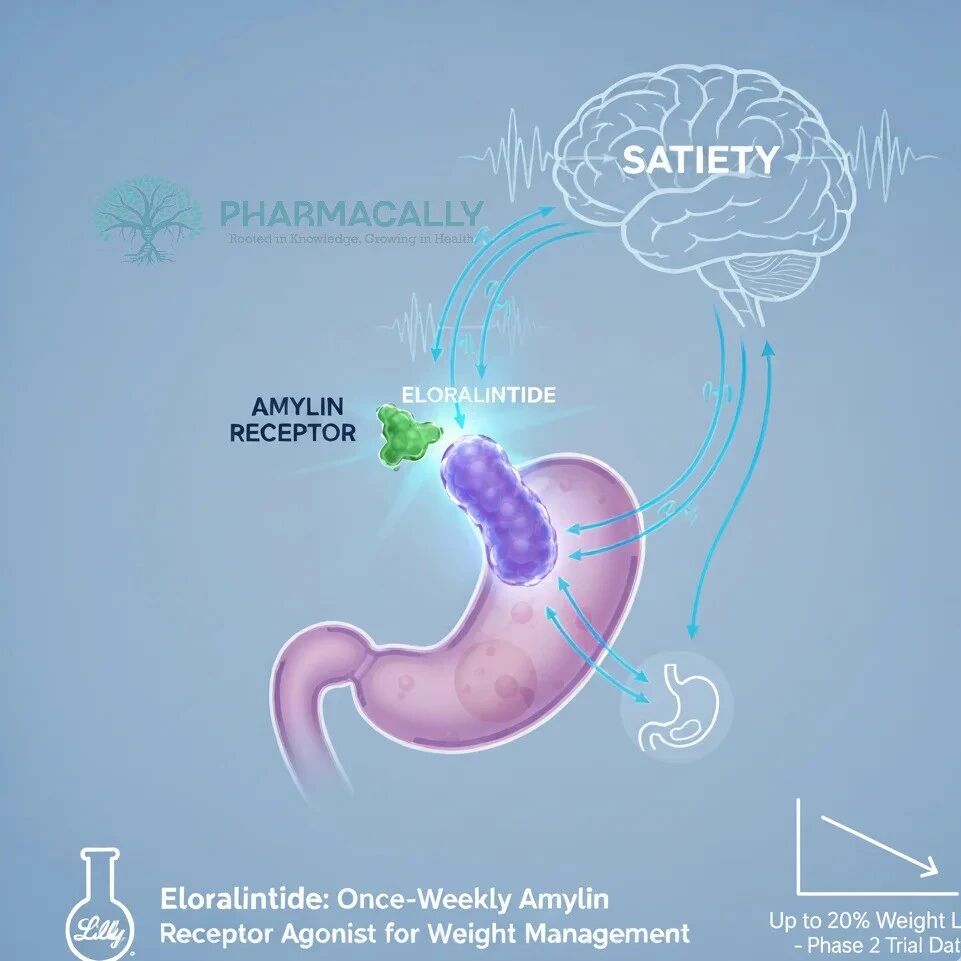
Core Viewpoint - Eli Lilly's new long-acting weight loss candidate Eloralintide has received approval from China's National Medical Products Administration to enter Phase III clinical trials, targeting the adult weight management market, although it is still under research and not yet approved for sale in China or the U.S. [4] Group 1: Product Overview - Eloralintide is not a new GLP-1 drug but a selective glucagon-like peptide-1 receptor agonist administered weekly, reflecting a renewed interest in the glucagon pathway in the weight loss drug market [5] - The drug aims to selectively activate glucagon receptor pathways to influence appetite, satiety, and energy intake regulation, focusing on long-term management rather than just short-term weight loss [7] Group 2: Clinical Data and Efficacy - Early data from Eli Lilly indicates that Eloralintide has shown promising weight loss results, with some dosage groups achieving an average weight reduction of nearly 20% over 48 weeks, while the placebo group showed minimal change [7] - Improvements were also observed in waist circumference, blood pressure, blood lipids, blood glucose control, and certain inflammation-related indicators [7] Group 3: Safety and Tolerability - Common adverse reactions reported in early studies include decreased appetite, headaches, fatigue, and gastrointestinal issues, but overall tolerability is considered sufficient for continued development [8] - A slower dose escalation strategy may further improve the adverse reaction profile, which is crucial for long-term patient adherence to treatment [8] Group 4: Strategic Importance for Eli Lilly - The introduction of Eloralintide signifies Eli Lilly's strategy to build a comprehensive weight loss product matrix, incorporating injection, oral, single-target, multi-target, and new mechanism drugs [9] - The Chinese market is increasingly recognized as a core area for global clinical research and commercialization strategies, with Eloralintide's Phase III entry highlighting its significance in Eli Lilly's global weight loss strategy [9] Group 5: Industry Competition Dynamics - The competition in the weight loss drug market is evolving, with a shift from merely proving market potential to focusing on covering more subpopulations and enhancing long-term tolerability [10] - The success of Eloralintide in Phase III trials will be critical in determining its future value, as efficacy, safety, adherence, and commercialization positioning are all pivotal factors [10]


礼来(LLY):借助替而泊肽的高增长,礼来26年仍将增长迅速
First Shanghai Securities· 2026-03-09 09:28
Investment Rating - The report maintains a "Buy" rating for the company with a target price of $1184, indicating a potential upside of 20.4% from the current price of $983.26 [3][4]. Core Insights - The company is expected to experience rapid growth in 2026, driven primarily by the high growth of its drug, Tirzepatide, despite anticipated pricing pressures and stagnation or decline in sales of some mature products [2]. - The revenue for Q4 2025 increased by 42.6% year-over-year to $19.29 billion, with total sales up 46%, although partially offset by a 5% decrease in prices [2]. - The company forecasts a revenue growth of 23%-27% in 2026, reaching $80-83 billion, and an EPS increase of 46%-53% to $33.5-$35.0 [2]. Segment Performance - **Metabolic Segment**: Q4 2025 revenue grew by 59.1% to $14.49 billion, accounting for 75% of total revenue. Tirzepatide's revenue surged by 115% to $11.67 billion, with a 48% market share in prescriptions in the U.S. [3]. - **Neuroscience Segment**: Revenue increased by 17% to $460 million, driven by heightened awareness of Alzheimer's disease and strong sales of Kisunla, which reached $110 million [3]. - **Immunology Segment**: Revenue rose by 19.4% to $1.54 billion, with TALTZ sales nearing peak levels [3]. - **Oncology Segment**: Revenue grew by 2.2% to $2.61 billion, with Verzenio's sales slightly increasing [3]. - **Other Segments**: Revenue increased by 0.7% to $190 million [3]. Financial Summary - The company reported a GAAP net profit of $6.64 billion for Q4 2025, a 50.5% increase year-over-year, with an EPS of $7.39, up 51.4% [2]. - For the fiscal year ending December 31, 2023, the company reported revenues of $34.12 billion, with a projected increase to $81.60 billion by 2026, reflecting a growth rate of 25.2% [5][6]. - The net profit margin is expected to improve from 15.4% in 2023 to 37.5% in 2026 [6].
速递|减重20.1%!礼来新型创新药Eloralintide落地中国临床
GLP1减重宝典· 2026-03-08 09:06
Core Viewpoint - Eli Lilly's new long-acting insulin receptor agonist, Eloralintide, has received approval from China's CDE and will initiate three global pivotal Phase III clinical studies, marking a significant advancement in metabolic health [4]. Clinical Research Results and Advantages - Eloralintide has a plasma half-life of approximately 14 days, allowing for weekly subcutaneous injections, enhancing patient convenience [6]. - In Phase II clinical trials, Eloralintide demonstrated a significant dose-dependent weight loss effect, with the highest dose group achieving a weight reduction of 20.1% and an average waist circumference reduction of 17.1 cm, far exceeding the placebo group [6]. - The drug not only aids in weight loss but also improves multiple cardiovascular risk indicators, including blood pressure, blood lipids, and blood glucose, while showing good safety across all dosage groups [6]. - A dose escalation scheme further reduces gastrointestinal discomfort, ensuring patients can continue treatment [6]. Global Phase III Clinical Studies - The three Phase III clinical studies launched in China address the treatment needs of different obesity populations, including studies on obese/overweight patients without type 2 diabetes, obese patients with diabetes, and combination therapy for patients with poor response to incretin drugs [7]. - Eli Lilly's Vice President and General Manager for China stated that the launch of Eloralintide in China is a significant expansion of the company's research footprint in metabolic diseases, aiming for global simultaneous market entry [7]. - The company is building a multi-dimensional obesity treatment solution, incorporating various drug types to meet individual patient needs and drive innovation in obesity treatment [7].
全球制药业洞察 | 减肥药赛道白热化,辉瑞加速追赶诺和诺德、礼来
彭博Bloomberg· 2026-03-04 06:05
Core Viewpoint - The article discusses the competitive landscape of obesity drug development, highlighting that over 190 clinical projects are currently underway, with major contributions from companies like Pfizer, Eli Lilly, and Novo Nordisk, and emphasizes the need for new mechanisms to address the limitations of existing GLP-1 therapies [3][4]. Group 1: Current Landscape of Obesity Drug Development - More than 120 companies are engaged in obesity drug research, with at least 190 drugs in clinical development, primarily targeting GLP-1 [4][6]. - Approximately 40% of these projects are in or about to enter Phase II clinical trials, with at least 36 projects in late-stage development or submitted for market approval [4]. - Injectable drugs dominate the research pipeline, while oral medications account for one-third of the pipeline, with two-thirds being small molecules, which are easier to produce and have lower patient burden [4][6]. Group 2: Role of China in Drug Development - China contributes significantly to the global obesity drug pipeline, with just over one-third of projects being developed or co-developed by Chinese companies, and 25% in Phase III testing or submitted for approval [6]. - Key drugs from Chinese companies include Hengrui Medicine's HRS-9531 (GLP-1/GIP dual receptor agonist) and Innovent Biologics' Enogratide (GLP-1 agonist), which are expected to enter the market soon [6]. Group 3: Mechanisms and Efficacy of GLP-1 Drugs - Over 50% of the drugs in development target GLP-1, either as monotherapy or in combination with GIP, glucagon, and amylin [8][10]. - There is a need to explore new mechanisms due to the gastrointestinal side effects of GLP-1 drugs, which may not be suitable for all patients [8]. - Current GLP-1 drugs can lead to weight loss, but up to 40% of this weight loss may come from lean body mass loss, indicating a need for improved efficacy and differentiation in a competitive market [10]. Group 4: Emerging Therapies and Combination Approaches - Amylin, produced in pancreatic beta cells, may offer benefits similar to GLP-1 drugs while potentially improving tolerability [11][12]. - Dual-action drugs targeting both amylin and calcitonin receptors may provide enhanced weight loss effects and better patient tolerance [11][12]. - The combination of amylin with GLP-1 drugs may yield additive effects, enhancing overall treatment efficacy [12].
Can LLY's Next-Gen Obesity Pipeline Sustain Growth Amid Competition?
ZACKS· 2026-02-18 13:26
Core Insights - Eli Lilly and Company (LLY) is a leader in the diabetes and obesity treatment market, driven by the success of its GLP-1 therapies, Mounjaro and Zepbound, which utilize tirzepatide for effective treatment [1][2] Industry Overview - The global obesity drug market is expected to grow significantly, reaching nearly $95 billion by 2030 and potentially $125 billion by 2035, according to Goldman Sachs estimates [3] - Both Lilly and Novo Nordisk are competing to develop next-generation GLP-1 treatments, including oral options, to maintain their market leadership [3] Product Pipeline - Lilly is investing in obesity treatments with several new molecules in clinical development, including oral and injectable medications [4] - A key candidate in Lilly's obesity pipeline is orforglipron, a once-daily oral GLP-1 small molecule, which could lower treatment burden and broaden patient adoption [5] - Positive data from six studies on orforglipron has led to regulatory applications in the U.S., EU, and other countries, with a U.S. launch expected in Q2 2026 [6][11] - Lilly is also evaluating orforglipron in late-stage studies for other conditions, expanding its revenue potential beyond obesity and type II diabetes [7] - Another candidate, retatrutide, is being studied for obesity and knee osteoarthritis pain, with plans for approval in 2026 [8][9] Competitive Landscape - Competition in the obesity market is intensifying, with Novo Nordisk set to launch an oral version of Wegovy in January 2026, potentially impacting Lilly's market share [12] - Smaller biotech companies are also developing oral GLP-1 drugs, such as Viking Therapeutics and Structure Therapeutics, which may further increase competition [13][14] Financial Performance - Lilly's stock has increased by 19.5% over the past year, compared to the industry's 18.2% rise [15] - The stock is currently trading at a price/earnings ratio of 29.70, higher than the industry average of 18.82, but below its 5-year mean of 34.57 [17] - The Zacks Consensus Estimate for 2026 has risen from $33.15 to $33.80 per share, indicating positive revisions in earnings expectations [20]

速递|礼来再开新战线:偏向性Amylin三期直指GLP-1无效人群
GLP1减重宝典· 2026-02-08 14:20
在GLP-1减重药物逐步覆盖主流肥胖人群之后,制药巨头开始将目光投向一个更棘手、也更具商业价值的细分领域——对GLP-1治疗反应不足 的顽固性肥胖患者。 整理 | GLP1减重宝典内容团队 2026年2月6日,礼来在 ClinicalTrials.gov 上注册了一项新的三期临床试验ENLIGHTEN-6,评估其偏向性Amylin类似物Eloralintide在顽固性 肥胖人群中的疗效与安全性。 根据注册信息,该研究计划入组约900例患者,预计于2028年6月完成。与传统肥胖研究不同,ENLIGHTEN-6的核心入组标准明确锁定一类"被 GLP-1遗漏的人群"——患者需在稳定接受GLP-1类药物治疗的情况下,仍未达到预期减重效果。这一设计,标志着礼来正式将顽固性肥胖 从"疗效尾部问题"提升为独立开发方向。 第五项三期临床,ELoralintide进入加速期 ENLIGHTEN-6并非孤立项目,而是ELoralintide整体开发计划中的关键一环。这也是该药物启动的第五项三期临床试验。在此之前,礼来已围 绕ELoralintide布局了覆盖多个肥胖相关适应症的后期研究,包括单纯肥胖(ENLIGHTEN-1、EN ...
东方证券:替尔泊肽加冕新“药王” 未来减重药物商业价值将快速释放
智通财经网· 2026-02-05 05:53
Group 1 - The core point of the article is that Eli Lilly's drug Tirzepatide is projected to achieve sales of $36.507 billion in 2025, marking it as the "king of drugs" for that year, with expectations to maintain this position for several years [1] - According to Evaluate, approximately half of the top ten global drugs by sales in 2030 are expected to be GLP-1 class drugs [2] - The weight loss sector has become a strategic focus for major pharmaceutical companies (MNCs), with significant business development (BD) and mergers and acquisitions (M&A) activity anticipated this year [3] Group 2 - Major pharmaceutical companies are heavily investing in the weight loss sector, with Eli Lilly expecting Orforglipron to receive approval in Q2 2026 and ongoing clinical trials for other drugs [3] - Recent transactions in the weight loss sector include a $100 million upfront payment from Roche for a specific oral GLP-1 agonist patent and a strategic collaboration between CSPC and AstraZeneca worth up to $18.5 billion [4] - New directions in the weight loss market, such as oral small molecules and ultra-long-acting GLP-1 drugs, present potential investment opportunities, with companies like Singlomd, Hengrui Medicine, and others identified as relevant targets [4]

——海外消费周报(20251212-20251218):海外教育:景气与困境反转交织,投资机会纷呈——教育行业26年投资策略-20251219
Shenwan Hongyuan Securities· 2025-12-19 09:29
Group 1: Higher Education Sector - The higher education sector is expected to see a reversal of difficulties due to a combination of bottoming fundamentals and policy advancements, with a focus on improving educational quality and encouraging the expansion of high-quality private colleges [5][6] - The reintroduction of profit-oriented classification management in Hunan Province in 2025 may serve as a pilot for nationwide implementation, providing a stable policy environment for private colleges to expand and meet the growing demand for higher education [5][6] - Key indicators of educational quality, such as student-to-teacher ratios and per-student funding, have met standards after five years of increased investment, suggesting that the investment cycle is peaking and operational efficiency in higher education companies is likely to recover [5][6] - Companies to watch in this sector include Yuhua Education, Zhongjiao Holdings, New Higher Education, China Kepei, Neusoft Ruixin, Xijiao International Holdings, and Zhonghui Group [5][6] Group 2: Vocational Education Sector - The demand for vocational training is surging, driven by an increasing number of university graduates and high school students entering the labor market, leading to a projected market size of 80 billion yuan in 2025 with a penetration rate of only 5% [6][7] - The youth unemployment rate, particularly among those aged 16 to 24, is higher than the urban average, indicating a growing need for vocational skills training [6][7] - Companies to focus on in the vocational education sector include China Oriental Education and Fenbi [6][7] Group 3: Education Industry Trends - The education industry has undergone significant changes due to the "double reduction" policy, resulting in a 96% reduction in capacity in the academic training sector, with a limited number of operational licenses being redistributed [7] - The shift towards competency-based training is gaining momentum, with institutions leveraging their operational qualifications to expand their market share through non-academic training services [7] - The industry is moving towards a "franchise" model, which is expected to enhance revenue and profit growth for compliant institutions [7] Group 4: Investment Recommendations - The report recommends focusing on Hong Kong-listed vocational education companies, particularly China Oriental Education, which is adapting its operational strategy to cater to the needs of high school graduates [9] - In the higher education sector, the potential reintroduction of profit-oriented options is expected to enhance the revenue-sharing certainty for private colleges, with companies like Yuhua Education, Zhongjiao Holdings, and China Kepei being highlighted for their growth potential [9] - The report also suggests monitoring Chinese education companies listed in the US, such as New Oriental, TAL Education, and others, which are showing strong enrollment data [9]

礼来(LLY.US)胰淀素受体激动剂启动III期临床
智通财经网· 2025-12-16 13:22
Group 1 - The core point of the article is that Eli Lilly (LLY.US) has initiated its first Phase III clinical trial (ENLIGHTEN-2) for Eloralintide (LY3841136) on December 15, focusing on its efficacy and safety in treating obese or overweight patients with type 2 diabetes [1] - The Phase III study aims to evaluate the effectiveness of Eloralintide, administered in four doses via subcutaneous injection, compared to a placebo [1] - The primary endpoint of the study is the percentage change in body weight from baseline at week 64 [1] Group 2 - Eloralintide is an AMYR receptor agonist developed by Eli Lilly, which may reduce caloric intake by influencing appetite or increasing satiety [1]
礼来公司 - 肥胖药物:领域拓展-未来走向何方
2025-11-24 01:46
Summary of Eli Lilly & Co. Conference Call Company Overview - **Company**: Eli Lilly & Co. (LLY.N) - **Market Cap**: Approximately $952.463 billion [6] - **Current Stock Price**: $1,059.70 [6] - **Price Target**: Increased from $1,171.00 to $1,290.00 [1][2] Industry Insights - **Industry**: Major Pharmaceuticals, specifically focusing on obesity medications and GLP-1 market expansion [6][10] - **Market Dynamics**: The GLP-1 market is experiencing significant growth driven by various factors, including new agreements and product launches [2][3] Key Developments 1. **GLP-1 Market Expansion**: - Eli Lilly is positioned to gain market share in the obesity and Type 2 Diabetes (T2D) segments, with ongoing growth projected [4]. - A recent agreement with the US government is expected to unlock substantial volume opportunities in the Medicare obesity segment [3]. 2. **New Product Launches**: - Eli Lilly's Orfor (oral GLP-1) is projected to capture approximately 30% of the total GLP-1 mix [4]. - The company is also preparing for the launch of Eloralintide, which targets patients who discontinue GLP-1 drugs due to tolerability issues [10]. 3. **Sales Projections**: - For 2026, Eli Lilly's Orfor is expected to generate worldwide sales of $757 million, with projections increasing to $4.4 billion by 2027 [9]. - Zepbound and Mounjaro are also expected to contribute significantly to sales, with Zepbound TRx projected at approximately 72 million by 2027 [9]. 4. **Market Access Initiatives**: - Waltz Health is launching a direct-to-employer model for obesity medications, which Eli Lilly will participate in, potentially enhancing commercial access [3]. Financial Projections - **Earnings Per Share (EPS)**: - Projected EPS for 2025 is $25.38, increasing to $35.96 in 2026 and $43.00 in 2027 [6]. - The company anticipates significant operating margin expansion, projecting a margin of 56% by 2030 [11]. Risks and Challenges - **Competitive Landscape**: Eli Lilly faces competition from companies like Amgen, AstraZeneca, and Novo Nordisk, among others [13]. - **Regulatory Risks**: Potential delays in FDA approvals for Orfor and Eloralintide could impact sales projections [13]. - **Market Adoption**: Lower-than-expected uptake of obesity medications in Medicare could pose a risk to revenue forecasts [13]. Upcoming Catalysts - Key upcoming events include Phase 3 data releases for Retatrutide and Orforglipron, as well as initial 2026 guidance expected in early 2026 [12][27]. Conclusion Eli Lilly & Co. is positioned for significant growth in the obesity medication market, supported by new product launches and strategic agreements. However, the company must navigate competitive pressures and regulatory challenges to achieve its ambitious financial targets.