
恒生医疗保健指数

Search documents
恒生指数公司9条港股指数被纳入公募基金业绩比较基准要素库
Zhi Tong Cai Jing· 2026-01-28 10:57
Core Viewpoint - The China Securities Investment Fund Industry Association has officially released an announcement regarding the performance benchmark element library for public funds, which includes a total of 155 indices in its first batch [1] Group 1: Index Inclusion - Among the 155 indices included in the first batch of the element library, 9 indices belong to the Hang Seng Index Company [1] - Out of the 6 broad-based indices in the Hong Kong market included in the library, 4 are under the Hang Seng Index Company [1] Group 2: Index Categories - Category One includes the Hang Seng Index, Hang Seng Composite Index, Hang Seng Technology Index, Hang Seng Consumer Index, and Hang Seng Healthcare Index [1] - Category Two includes the Hang Seng China Enterprises Index, Hang Seng Stock Connect Index, Hang Seng High Dividend Yield Index, and Hang Seng Stock Connect Low Volatility Dividend Index [1]
港股科技ETF(513020)回调超1.6%,港股科技或将迎来“戴维斯三击”
Mei Ri Jing Ji Xin Wen· 2026-01-19 07:01
Core Viewpoint - The Hong Kong technology sector is expected to experience a "Davis Triple Play" by 2026, becoming one of the most elastic investment directions [1] Valuation and Investment Potential - Current valuations of the Hong Kong technology sector are lower than those of the A-share market, with the PE valuation nearing historical lower limits, indicating limited downside and potential for upside [1] - The sector is seen as having a high odds space for investment returns in the medium to long term [1] Shift in Capital Expenditure - As the return on investment for AI computing power declines, capital expenditure is anticipated to shift from upstream computing infrastructure to downstream AI applications, which are expected to have significantly higher elasticity in future market conditions [1] ETF and Index Performance - The Hong Kong Technology ETF (513020) tracks the Hong Kong Stock Connect Technology Index (931573), which includes core assets in sectors such as internet, innovative pharmaceuticals, and new energy vehicles [1] - The Hong Kong Stock Connect Technology Index has outperformed the Hang Seng Technology Index, with a cumulative return of 224.25% from the end of 2014 to the end of 2025, exceeding the Hang Seng Technology Index's return of 83.87% by over 140% [1]
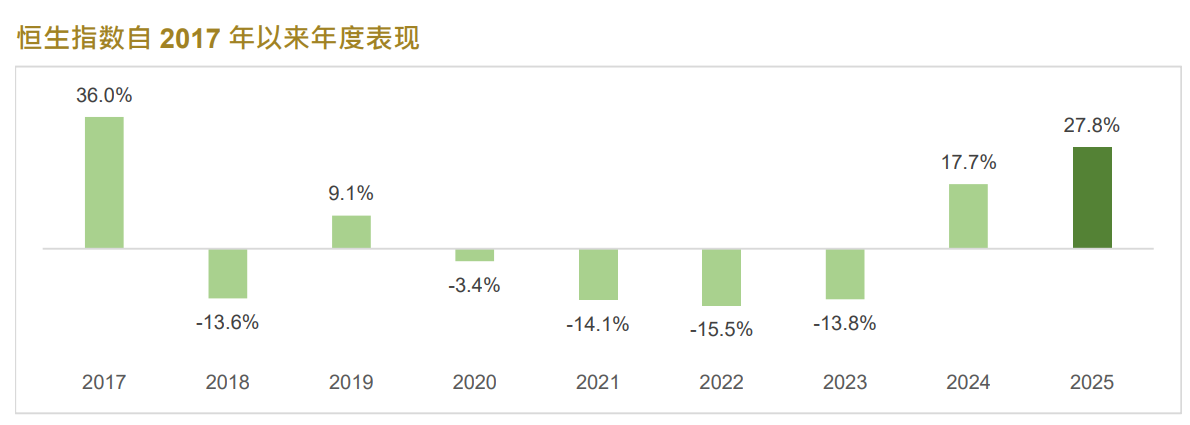
恒指公司:2025年恒指上升27.8% 为2017年以来最佳表现
智通财经网· 2025-12-31 12:07
Group 1 - The Hang Seng Index (HSI) rose by 27.8% in 2025, marking its best performance since 2017, following a 17.7% increase in 2024 [1] - The rise in the HSI was driven by record capital inflows from the Hong Kong Stock Connect, optimism about the future of artificial intelligence, and interest rate cuts [1] - The HSI outperformed two other flagship indices: the Hang Seng China Enterprises Index (up 22.3%) and the Hang Seng Tech Index (up 23.5%) [1] Group 2 - The Hang Seng Composite Index (HSCI) increased by 31.0% in 2025, with mid-cap stocks leading the gains at 31.6%, followed by large-cap stocks at 30.8% and small-cap stocks at 28.8% [2] - Among industry indices in the HSCI, the materials sector had the best performance, rising by 161.3%, while utilities had the worst performance with a 5.7% increase [2] - The Hang Seng High Dividend Yield 30 Index led the high dividend indices with a rise of 38.1% in 2025 [2] Group 3 - The Hang Seng Climate Change 1.5°C Target Index performed well, with an annual increase of 31.2% [3]

港股科技ETF(513020)涨超1.3%,近20日净流入超3.4亿元,“蚂蚁阿福”爆款引市场关注
Mei Ri Jing Ji Xin Wen· 2025-12-19 02:31
Group 1 - Ant Group's AI health application "Ant Aifu" saw a significant increase in downloads, reaching the third position on the Apple App Store on December 16, with over 15 million monthly active users and more than 5 million health inquiries answered daily [1] - Dongwu Securities believes that the competition among major companies in model and entry points is far from over, suggesting that vertical agents focused on specific industries or scenarios are more likely to establish business models and industry barriers compared to general agents [1] - Huachuang Securities highlights the positive outlook for low-position asset recovery following the central economic work conference and the Hong Kong Monetary Authority's interest rate cut, alongside advancements in AI technology, such as OpenAI's release of GPT-5.2 and its strategic partnership with Disney [1] Group 2 - The Hong Kong Stock Connect Technology Index has outperformed the Hang Seng Technology Index in sectors like new energy vehicles and innovative pharmaceuticals, with a cumulative return of 256.46% from the end of 2014 to October 2025, significantly exceeding the Hang Seng Technology Index's return of 96.94% [2] - The Hong Kong Stock Connect Technology ETF (513020) tracks the Hong Kong Stock Connect Technology Index (931573), reflecting the diversified characteristics of the technology industry and the overall performance of core technology companies in the Hong Kong market [1][2]
港股医药:回调之后,机会浮现?
Quan Jing Wang· 2025-12-02 14:02
Core Insights - The article discusses the recent developments in the Hong Kong pharmaceutical sector, particularly focusing on the innovative drug industry, which is experiencing a shift from traditional financing to becoming a showcase for new economy enterprises [3][4][5] - The article emphasizes the importance of external factors such as U.S. Federal Reserve monetary policy, international trade environment, and competition dynamics in influencing the performance of the Hong Kong pharmaceutical sector [6][7][8] Industry Overview - The Hong Kong stock market is transitioning to showcase high-quality companies in sectors like technology, innovative drugs, and new consumption, attracting global capital [3] - Recent adjustments in the Hong Kong pharmaceutical sector are attributed to short-term market sentiment fluctuations and profit-taking, rather than fundamental changes in the industry [4][5] Market Dynamics - The Hang Seng Healthcare Index and the Hong Kong Stock Connect Innovative Drug Select Index are highlighted for their differing coverage and focus, with the former being broader and the latter concentrating on high R&D investment and liquidity companies [2][20] - The innovative drug sector is seeing a significant increase in attention from investors, driven by strong performance in CXO and life sciences services, with profits in these areas growing over 50% year-on-year [19] Policy Environment - Domestic policies are shifting towards supporting genuine innovation, with measures like the establishment of a new drug pricing mechanism and the integration of commercial insurance with the medical insurance directory [7][8] - The article notes that the regulatory environment is improving, which is expected to stabilize profit expectations for pharmaceutical companies [7][8] Investment Strategies - The article advocates for ETF investments in the innovative drug sector due to their diversification, low entry barriers, cost advantages, and high liquidity [21][22] - Suggested investment strategies include dollar-cost averaging and phased investments to manage volatility in the high-risk pharmaceutical sector [24][25] Future Outlook - The long-term growth of the innovative drug sector is supported by a combination of favorable policies, improving industry fundamentals, and the ongoing internationalization of Chinese pharmaceutical companies [15][16] - The article concludes that the current market adjustments provide an opportunity for investors to reassess the long-term value of companies in the innovative drug sector [15][16]

港股医药:回调之后,机会浮现
2025-11-20 02:16
Summary of the Conference Call on Hong Kong Pharmaceutical Sector Industry Overview - The Hong Kong pharmaceutical sector, particularly the innovative drug index, has experienced a correction of over 10% due to valuation digestion, profit-taking, and external policy disturbances. However, the trend of upgrading China's innovative drug industry remains unchanged, with CXO performance exceeding expectations, indicating that the long-term growth logic of the industry is intact [1][3][4]. Key Points and Arguments - **External Variables Impacting the Sector**: Key external variables include the Federal Reserve's monetary policy, international trade environment, and global competition landscape. These factors significantly influence the capital costs and risk preferences of global investors in the Hong Kong innovative drug sector [5][6]. - **Domestic Policy Environment**: The domestic policy environment has shifted from the impacts of medical corruption and healthcare cost control to clearer support for genuine innovation. Reforms in payment and approval processes are expected to provide higher valuation premiums for companies with core R&D capabilities and differentiated pipelines [6][7]. - **Valuation Logic Similar to Tech Stocks**: The valuation logic of the innovative drug sector is similar to that of technology stocks, relying on technological advancements, high R&D investments, and future growth assessments. Investor sentiment tends to be consistent across both sectors [8][9]. - **Shift from Theme Investment to Performance-Driven Investment**: The Hong Kong pharmaceutical sector is transitioning from theme-based investments to performance-driven investments. By the first half of 2025, 36 innovative drug companies are expected to turn around their overall losses, shifting market focus from R&D teams to product commercialization revenue and profit improvement [11][12]. - **Impact of Overseas Expansion**: Domestic innovative drugs are monetizing technology through overseas licensing, reshaping market valuation logic based on global product competitiveness and actual cash flow, rather than mere concept speculation [13][14]. Additional Important Insights - **Market Rotation Phenomenon**: There is a rotation phenomenon within the Hong Kong pharmaceutical sector, with market attention shifting from downstream innovative drug companies to CROs, life sciences services, and high-end medical devices, driven by improvements in fundamentals [2][16]. - **Profitability Turning Point**: The profitability turning point in the Hong Kong pharmaceutical sector is attributed to commercial maturity, accelerated overseas expansion, and internal management optimization. Leading companies are establishing a positive cycle from R&D to commercialization and profitability [12][15]. - **Systematic Revaluation of Chinese Innovative Drugs**: The systematic revaluation of Chinese innovative drugs is supported by multiple long-term industry trends, including improved R&D efficiency and quality, as well as a favorable policy environment that encourages innovation [15]. - **Investor Strategies**: Investors are advised to adopt a phased investment strategy when investing in the Hong Kong pharmaceutical sector, particularly in innovative drug ETFs, to mitigate risks associated with high volatility and to ensure a diversified portfolio [22][23]. - **Future Outlook**: Despite recent corrections driven by technical and emotional factors, the long-term outlook for the Hong Kong pharmaceutical sector remains optimistic, particularly in the context of a declining interest rate environment and ample liquidity [24][25].
每经记者专访恒生指数公司行政总裁巫婉雯:我们是如何吸引海外资金流入香港的?
Mei Ri Jing Ji Xin Wen· 2025-11-19 14:31
Core Insights - The Hang Seng Index Company has evolved from a small service company to an international index provider, reflecting the growth of Hong Kong's financial market over more than half a century [1][2] - In 2025, the Hong Kong stock market is expected to rebound strongly, with IPO fundraising returning to the top globally and the Hang Seng Index experiencing a year-to-date increase of over 30% [1][2] Market Performance - The Hang Seng Index is projected to have an upward potential of approximately 7000 points in 2025, with the information technology sector contributing the most at around 2000 points, followed by finance and consumer sectors each contributing about 1900 points [2] - The healthcare sector, despite its 3% weight, is expected to contribute over 400 points, with the Hang Seng Healthcare Index showing a year-to-date increase of over 73% [2] Index Reform and Composition - The Hang Seng Index has undergone significant reforms since its inception in 1969, expanding its constituent stocks from 33 to 88, with a market capitalization coverage of 66% [3][4] - The weight of the consumer sector in the index has increased by 15 percentage points to approximately 30%, while the financial sector's weight has decreased by 13 percentage points to around 30% [3] Product Development and Market Demand - There is a growing demand for thematic indices, particularly in technology and high-yield sectors, with the company launching 15 new indices in 2025, seven of which focus on yield and strategy [6] - The Hang Seng Technology Index has seen significant growth in overseas markets, with assets under management (AUM) in Europe and the US increasing threefold and fourfold, respectively [6] Global Market Engagement - The company has expanded its business to cover 37 markets globally, with a notable presence in Malaysia, where products tracking the Hang Seng Index account for 70% of the local market's turnover [8] - The company aims to enhance Hong Kong's role as a "super connector" by continuously seeking opportunities to launch index products that attract foreign investment [8] Investor Trends - The biotechnology sector has seen a surge in interest, driven by the mainland market, with the number of ETFs tracking this sector increasing from 8 to 13 and AUM doubling to 28 billion RMB [10][11] - There is a notable difference in investment focus between domestic and foreign investors, with overseas investors particularly interested in technology indices [13]
国内创新药龙头企业基本面持续改善,恒生医疗ETF(513060)回调蓄势,盘中交投活跃,近1周日均成交额同类居首
Xin Lang Cai Jing· 2025-08-04 07:36
Group 1 - The Hang Seng Healthcare Index (HSHCI) increased by 0.37% as of August 4, 2025, with notable gains from companies such as Cloudmed (01952) up 8.70% and Crystal Technology (02228) up 7.19% [3] - The Hang Seng Healthcare ETF (513060) experienced a decline of 0.59%, with a latest price of 0.67 yuan, but showed a 3.36% increase over the past week as of August 1, 2025 [3] - The liquidity of the Hang Seng Healthcare ETF was active, with a turnover rate of 25.84% and a trading volume of 1.911 billion yuan [3] Group 2 - Global advancements in the weight loss sector are gaining attention, with multinational pharmaceutical companies like AbbVie, Roche, and Eli Lilly accelerating their amylin-related pipelines [4] - Eli Lilly's Eloralintide showed promising weight loss results in Phase 1 clinical trials, achieving a maximum weight loss of 11.3% over 12 weeks with a low incidence of gastrointestinal adverse effects [4] - The amylin molecules in development have half-lives ranging from 10 to 18 days, potentially allowing for monthly dosing and improving patient compliance [4] Group 3 - The latest financing buy-in amount for the Hang Seng Healthcare ETF reached 164 million yuan, with a financing balance of 209 million yuan [5] - Over the past two years, the net value of the Hang Seng Healthcare ETF has increased by 28.35%, with a maximum single-month return of 28.34% since inception [5] - The ETF has a Sharpe ratio of 2.39 for the past year, indicating strong risk-adjusted returns [5] Group 4 - The management fee for the Hang Seng Healthcare ETF is 0.50%, and the custody fee is 0.15% [6] - The ETF's tracking error over the past year is 0.060%, the highest tracking precision among comparable funds [6] - The latest P/E ratio for the Hang Seng Healthcare Index is 31.37, indicating it is at a historical low compared to the past three years [6] Group 5 - The top ten weighted stocks in the Hang Seng Healthcare Index account for 62.03% of the index, including companies like BeiGene (06160) and WuXi Biologics (02269) [6]

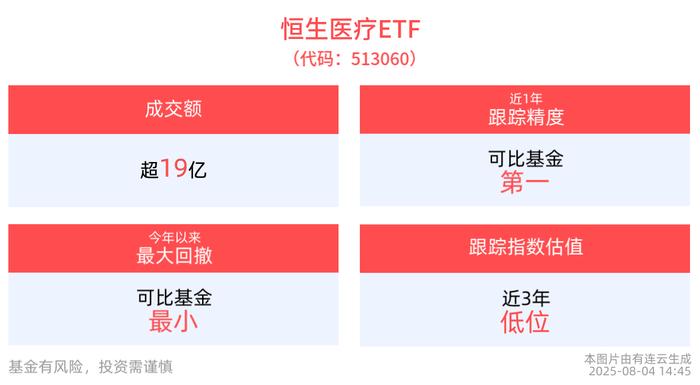
[8月1日]指数估值数据(港股医疗和A股医疗有啥区别;港股指数估值表;抽奖福利)
银行螺丝钉· 2025-08-01 13:47
Core Viewpoint - The article discusses the performance of the Hong Kong and A-share markets, highlighting the differences in sector indices, particularly in the healthcare sector, and the implications for investment strategies. Group 1: Market Performance - The overall market experienced a slight decline, remaining at 4.7 stars [1] - Large-cap stocks dipped slightly while small-cap stocks saw a minor increase [2] - The value style showed minimal volatility, whereas the growth style declined [3] - Hong Kong stocks also faced a downturn today [4] - Since the Chinese New Year, Hong Kong stocks have outperformed A-shares by 20-30% [5] - Recently, Hong Kong stocks have retraced to around 4.0 stars after reaching highs of approximately 3.9 stars [6] - Market movements are expected to include fluctuations of 10-20% during upward trends [7] - Despite market fluctuations, corporate earnings continue to grow, suggesting potential for index increases [8] Group 2: Sector Analysis - There are notable differences between Hong Kong and A-share healthcare sectors, with Hong Kong's healthcare index showing greater gains this year [9] - The Hong Kong Hang Seng Healthcare index includes biotechnology and innovative drugs, differing from A-share indices that also encompass medical devices and services [10][12][14] - A-share healthcare indices are currently undervalued, sitting at historical lows of 10-20% [44] Group 3: Performance Comparison - From the beginning of the year, Hong Kong's innovative drug and biotechnology indices have outperformed their A-share counterparts by 50-60% [22] - The decline in Hong Kong stocks was more pronounced in 2021-2022, with some indices dropping by 60-70% [27] - Hong Kong technology stocks have recently shown significant earnings recovery, with projections for substantial growth in 2024 and 2025 [30] - The recovery in Hong Kong's innovative drug sector is expected to mirror this trend, with earnings projected to increase by over 100% [33] - A-shares are anticipated to experience a decline in overall earnings in 2024, with recovery expected in early 2025 [36][37] Group 4: Valuation Insights - The article provides a valuation summary for various Hong Kong indices, indicating current price-to-earnings (P/E) ratios and other financial metrics [42] - The Hang Seng Healthcare index has a P/E ratio of 37.04, while the Hang Seng Index stands at 13.44 [43] - The article emphasizes the importance of monitoring valuation levels, especially in the healthcare sector, which may be approaching overvaluation [41]
纳指新高引爆中概狂欢!恒生医疗ETF(513060)飙涨3%成交破10亿,创新药“深V”行情下机构喊话回调即买点
Sou Hu Cai Jing· 2025-06-10 02:20
Group 1 - The core viewpoint is that the pharmaceutical sector is experiencing a phase of revaluation, particularly in innovative drugs, which is expected to continue in the long term [2][3][4] - The market has fully recognized the pessimistic expectations for the pharmaceutical sector, influenced by economic downturns and regulatory pressures, but it overlooks the innovation and technological aspects of the industry [3][4] - The Hang Seng Medical ETF (513060) tracks the Hang Seng Healthcare Index, which consists of 70% innovative drugs and their supply chain, indicating a focus on the recovery of innovative drug valuations and cyclical recovery [4] Group 2 - In the short term (1-3 months), the pharmaceutical index is expected to enter a phase of volatility, with a consensus on the revaluation of innovative drugs [2] - In the medium term (3-12 months), the outlook for the pharmaceutical index remains optimistic, as it is currently at a low valuation compared to historical levels [2][3] - The recovery potential for cyclical aspects of the pharmaceutical sector, such as medical devices and consumer healthcare, is significant as the economy stabilizes [3][4]