
Engram模块

Search documents
DeepSeek——少即是多
2026-01-26 02:49
Summary of DeepSeek Conference Call Company and Industry Overview - **Company**: DeepSeek - **Industry**: Artificial Intelligence (AI) and Semiconductor Equipment in China Key Points and Arguments 1. **Engram Module Launch**: DeepSeek has introduced the Engram module, which decouples storage from computation, reducing reliance on High Bandwidth Memory (HBM) and lowering infrastructure costs. This innovation aims to alleviate bottlenecks in AI computing in China and suggests that future AI competition may focus on more efficient hybrid architectures rather than larger models [1][2][3] 2. **Efficiency Improvements**: The Engram module enhances the efficiency of large language models by implementing "conditional memory," which allows for better utilization of GPU resources. This decoupling of static memory from computation is expected to improve the performance of AI systems while reducing the need for expensive HBM [1][9][10] 3. **Infrastructure Cost Dynamics**: The findings indicate that infrastructure costs may shift from GPU to storage, as medium computational configurations may offer better cost-effectiveness than pure GPU expansions. The AI inference capability is expected to improve beyond knowledge growth, highlighting the importance of storage value beyond just computation [2][3][10] 4. **Next Generation Model**: DeepSeek's upcoming V4 model will utilize the Engram memory architecture, potentially achieving significant advancements in code generation and inference. The model is expected to run on consumer-grade hardware, such as the RTX 5090, and will be closely monitored for its performance against key benchmarks [2][3][10] 5. **Investment Opportunities**: The report highlights potential investment opportunities in the Chinese semiconductor equipment sector, particularly focusing on companies like Northern Huachuang (target price: RMB 514.2), Zhongwei Company (target price: RMB 364.32), and Changdian Technology (target price: RMB 49.49) [3][24][25] Additional Important Insights 1. **Performance Comparison**: Despite facing stricter constraints in advanced computing and hardware acquisition, Chinese AI models have rapidly closed the performance gap with leading models like ChatGPT 5.2. This progress is attributed to a focus on efficiency-driven innovations rather than sheer computational expansion [8][14] 2. **Long-term Implications**: The architecture developed by DeepSeek may lead to a more cost-effective, scalable, and adaptable AI ecosystem in China, potentially impacting global competitors by reducing the marginal costs of high-level intelligence and decreasing reliance on unlimited computational expansion [14][16] 3. **Engram's Unique Approach**: Engram's design allows for a more efficient memory usage model, significantly lowering the demand for HBM. This approach enhances the core transformer model without increasing FLOP or parameter scale, thereby improving overall system efficiency [11][18] 4. **Testing Results**: Tests on a 27 billion parameter model have shown that Engram outperforms in several benchmark tests, particularly in long-context processing, which is crucial for enhancing AI practicality [16][18] 5. **Strategic Positioning**: DeepSeek's advancements represent a strategic response to geopolitical and supply chain constraints, emphasizing algorithmic and system-level innovations over direct hardware competition [16][18] This summary encapsulates the critical insights from the conference call regarding DeepSeek's innovations, market positioning, and the broader implications for the AI and semiconductor industries in China.

大摩眼中的DeepSeek:以存代算、以少胜多
3 6 Ke· 2026-01-22 09:09
Core Insights - DeepSeek is revolutionizing AI scalability by utilizing a hybrid architecture that replaces scarce high-bandwidth memory (HBM) with more cost-effective DRAM through an innovative module called "Engram" [1][3][5] Group 1: Engram Module and Conditional Memory - The Engram module introduces "Conditional Memory," separating static knowledge storage from dynamic reasoning, which significantly reduces reliance on expensive HBM [3][5] - This architecture allows for efficient retrieval of basic information without overloading HBM, thus freeing up capacity for more complex reasoning tasks [3][5] Group 2: Economic Impact on Infrastructure - The Engram architecture reshapes hardware cost structures by minimizing HBM dependency, potentially shifting infrastructure costs from GPUs to more affordable DRAM [5][6] - A 100 billion parameter Engram model requires approximately 200GB of system DRAM, indicating a 13% increase in the use of commodity DRAM per system [5][6] Group 3: Innovation Driven by Constraints - Despite limitations in advanced computing power and hardware access, Chinese AI models have rapidly closed the performance gap with global leaders, demonstrating "constraint-induced innovation" [6][7] - DeepSeek's advancements suggest that future AI capabilities may rely more on algorithmic and system-level innovations rather than merely increasing hardware resources [6][7] Group 4: Future Outlook - The upcoming DeepSeek V4 model is expected to achieve significant advancements in encoding and reasoning, potentially running on consumer-grade hardware like the RTX 5090 [7] - This development could lower the marginal costs of high-level AI inference, enabling broader deployment of AI applications without the need for expensive data center-grade GPU clusters [7]

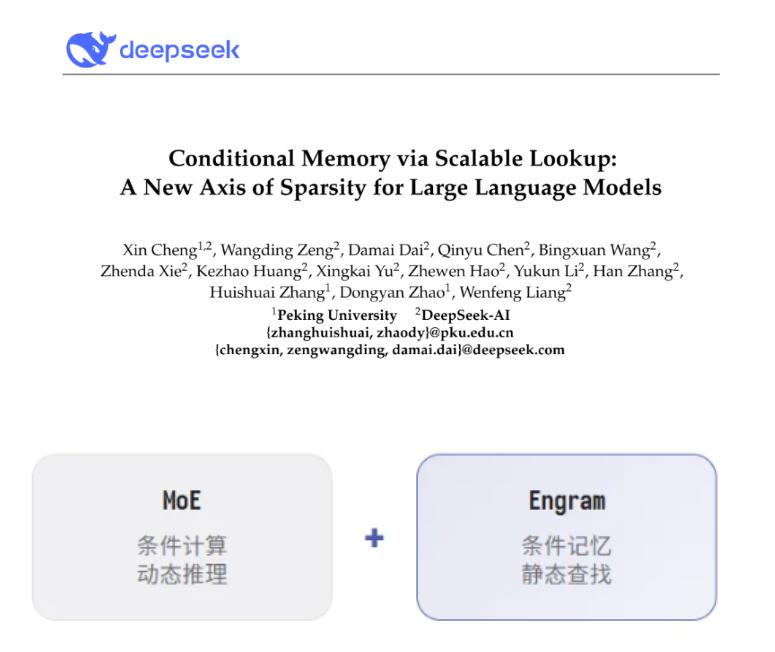
大摩眼中的DeepSeek:以存代算、以少胜多!
硬AI· 2026-01-22 07:34
Core Viewpoint - DeepSeek is redefining the AI scaling paradigm by emphasizing a "doing more with less" philosophy, where the next generation of AI success relies on efficient hybrid architectures rather than merely stacking more GPUs [2][3][4]. Group 1: Engram Module and Conditional Memory - DeepSeek's innovative Engram module separates storage from computation, significantly reducing the need for expensive high-bandwidth memory (HBM) by utilizing cost-effective DRAM for complex reasoning tasks [3][9]. - The introduction of "Conditional Memory" allows for efficient retrieval of static knowledge stored in DRAM, enhancing the performance of large language models (LLMs) without overloading HBM [9][12]. Group 2: Economic Impact on Infrastructure - The Engram architecture reshapes the hardware cost structure by minimizing reliance on HBM, suggesting a shift in infrastructure costs from GPUs to more affordable memory solutions [12][13]. - The analysis indicates that a 100 billion parameter Engram model would require approximately 200GB of system DRAM, highlighting a 13% increase in the use of commodity DRAM per system [12][13]. Group 3: Innovation Driven by Constraints - Despite limitations in advanced computing power and hardware access, Chinese AI models have rapidly closed the performance gap with global leaders, demonstrating a shift towards algorithmic efficiency and practical system design [17][18]. - This phenomenon is termed "constraint-induced innovation," indicating that future AI advancements may stem from innovative thinking under resource constraints rather than merely increasing hardware capabilities [17][18]. Group 4: Future Outlook - Predictions for DeepSeek's next-generation model V4 suggest significant advancements in coding and reasoning capabilities, with the potential to run on consumer-grade hardware, thereby lowering the marginal costs of high-level AI inference [20][21]. - The report emphasizes optimism regarding the localization of memory and semiconductor equipment in China, as the decoupling of memory from computation is expected to lead to smarter and more efficient LLMs [21].

DeepSeek新模型曝光?
新华网财经· 2026-01-22 05:00
Core Insights - DeepSeek has released a new model "MODEL1" in the open-source community, coinciding with the one-year anniversary of the DeepSeek-R1 model launch [1] - The company plans to gradually unveil five code repositories during the "Open Source Week" starting in February 2025, with Flash MLA being the first project [3] - Industry analysts suggest that "MODEL1" may represent a new architecture distinct from the existing "V32" model, potentially indicating the next-generation model (R2 or V4) that has not yet been publicly released [4] Group 1 - Flash MLA optimizes memory access and computation processes on Hopper GPUs, significantly enhancing the efficiency of variable-length sequence processing [3] - The core design of Flash MLA includes a dynamic memory allocation mechanism and parallel decoding strategy, which reduces redundant computations and increases throughput, particularly for large language model inference tasks [3] - DeepSeek has been active since January 2026, releasing two technical papers on a new training method called "optimized residual connections (mHC)" and a biologically inspired "AI memory module (Engram)" [4] Group 2 - On January 12, DeepSeek published a new paper in collaboration with Peking University, introducing a conditional memory mechanism to address the inefficiencies of the Transformer architecture in knowledge retrieval [5] - The Engram module proposed by DeepSeek is said to enhance knowledge retrieval and improve performance in reasoning and code/mathematics tasks [5] - The private equity firm managed by Liang Wenfeng, known for high returns, has provided substantial support for DeepSeek's research and development efforts [5]
大摩眼中的DeepSeek:以存代算、以少胜多!
Hua Er Jie Jian Wen· 2026-01-22 02:48
Core Insights - DeepSeek is revolutionizing AI scalability by utilizing a hybrid architecture that replaces scarce HBM resources with more cost-effective DRAM, focusing on smarter design rather than merely increasing GPU clusters [1][5] Group 1: Technological Innovation - DeepSeek's innovative module, "Engram," separates storage from computation, significantly reducing the need for expensive HBM by employing a "Conditional Memory" mechanism [1][3] - The Engram architecture allows for efficient retrieval of static knowledge stored in DRAM, freeing up HBM for more complex reasoning tasks, thus enhancing overall efficiency [3][5] Group 2: Cost Structure and Economic Impact - The shift from reliance on HBM to DRAM is expected to reshape the hardware cost structure, making AI infrastructure more affordable [5][7] - A 100 billion parameter Engram model requires approximately 200GB of system DRAM, indicating a 13% increase in the use of commercial DRAM per system compared to existing setups [5][7] Group 3: Competitive Landscape - Despite hardware limitations, Chinese AI models have rapidly closed the performance gap with leading global models, demonstrating strong competitive capabilities [6][8] - DeepSeek V3.2 achieved an MMLU score of approximately 88.5% and coding capability of around 72%, showcasing its efficiency in reasoning and performance [6][8] Group 4: Future Outlook - The upcoming DeepSeek V4 model is anticipated to leverage the Engram architecture for significant advancements in coding and reasoning, potentially running on consumer-grade hardware [8] - This development could lower the marginal costs of high-level AI inference, facilitating broader deployment of AI applications without reliance on expensive data center GPUs [8]
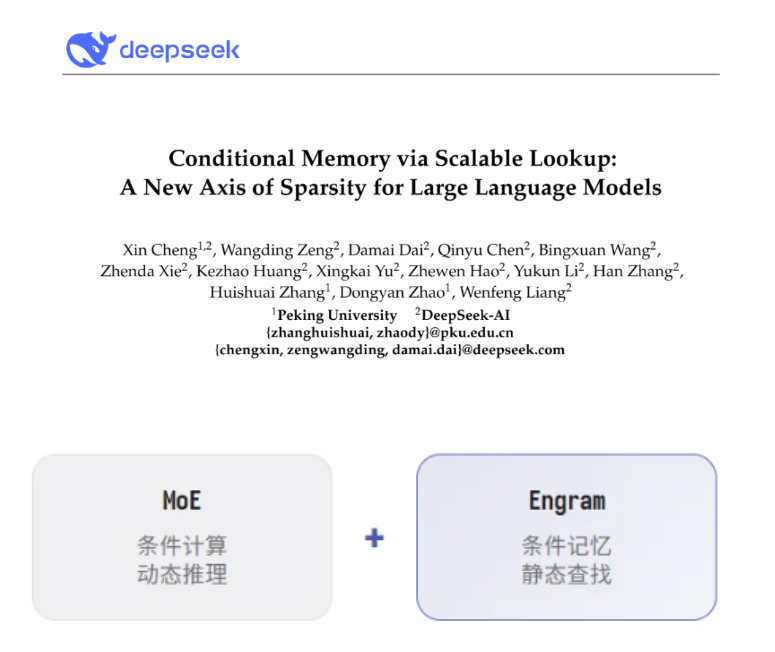
计算机行业周报DeepSeek开源含Engram模块,千问助理重塑人机交互
Huaxin Securities· 2026-01-20 00:30
Investment Rating - The report maintains a "Buy" rating for the following companies: Weike Technology (301196.SZ), Nengke Technology (603859.SH), Hehe Information (688615.SH), and Maixinlin (688685.SH) [6][50]. Core Insights - The AI application landscape is evolving, with the launch of the new "Task Assistant" feature in the Qianwen app, which integrates over 400 services from Alibaba's ecosystem, marking a significant shift from information processing to task execution [3][27]. - DeepSeek has released an open-source Engram module that enhances memory retrieval and reasoning efficiency in large models, addressing traditional architecture challenges [2][20]. - SkildAI has completed a $1.4 billion Series C funding round, indicating strong market interest in general AI models for robotics, with a valuation exceeding $14 billion [36][38]. Summary by Sections Computing Power Dynamics - The rental prices for computing power remain stable, with specific configurations like Tencent Cloud's A100-40G priced at 28.64 CNY/hour and Alibaba Cloud's A100-40G at 31.58 CNY/hour [17][19]. - DeepSeek's Engram module introduces a "lookup-computation separation" mechanism, significantly improving model efficiency in memory retrieval and reasoning tasks [2][20]. AI Application Dynamics - QuillBot's weekly traffic increased by 13.20%, indicating growing user engagement in AI tools [25][26]. - The Qianwen app's upgrade allows users to complete complex tasks such as ordering food and booking travel through natural language commands, showcasing the practical application of AI in daily life [3][28]. AI Financing Trends - SkildAI's recent funding round attracted major investors, including SoftBank and NVIDIA, highlighting the increasing capital flow into AI robotics [36][39]. - The company's innovative "hardware-agnostic" architecture aims to address the scarcity of training data in robotics, positioning it as a leader in the emerging market for general AI models [38][39]. Investment Recommendations - The report suggests focusing on companies like Maixinlin (688685.SH), Weike Technology (301196.SZ), Hehe Information (688615.SH), and Nengke Technology (603859.SH) for their growth potential in AI applications and computing power [48][50].


计算机行业周报:DeepSeek开源含Engram模块,千问助理重塑人机交互-20260119
Huaxin Securities· 2026-01-19 14:32
Investment Rating - The report maintains a "Buy" rating for the following companies: Weike Technology (301196.SZ), Nengke Technology (603859.SH), Hehe Information (688615.SH), and Maixinlin (688685.SH) [6][50]. Core Insights - The AI application landscape is evolving, with the launch of the new "Task Assistant" feature in the Qianwen app, which integrates over 400 services from Alibaba's ecosystem, marking a significant shift from information processing to task execution [3][27]. - DeepSeek has released an open-source Engram module that enhances memory retrieval and reasoning efficiency in large models, addressing traditional architecture challenges [2][20]. - SkildAI has completed a $1.4 billion Series C funding round, indicating strong market potential for general AI models in robotics, with a valuation exceeding $14 billion [36][38]. Summary by Sections Computing Power Dynamics - The rental prices for computing power remain stable, with specific configurations priced at 28.64 CNY/hour for Tencent Cloud and 31.58 CNY/hour for Alibaba Cloud [17][19]. - DeepSeek's Engram module introduces a "lookup-computation separation" mechanism, significantly improving model efficiency in knowledge retrieval and reasoning tasks [2][20]. AI Application Dynamics - QuillBot's weekly traffic increased by 13.20%, indicating growing user engagement in AI applications [25][26]. - The Qianwen app's upgrade allows users to complete complex tasks like ordering food and booking travel through natural language commands, showcasing the practical application of AI in daily life [3][28]. AI Financing Trends - SkildAI's recent funding round attracted major investors, including SoftBank and Bezos Expeditions, highlighting the increasing interest in AI robotics and its potential across various industries [36][39]. Investment Recommendations - The report suggests focusing on companies like Maixinlin (688685.SH), Weike Technology (301196.SZ), Hehe Information (688615.SH), and Nengke Technology (603859.SH) for their growth potential in AI applications and computing power [48].
软件ETF易方达(562930)连续3日获资金净流入,阿里“千问任务助理1.0”上线,AI应用商业化节奏有望提速
Xin Lang Cai Jing· 2026-01-15 03:58
Group 1 - The software ETF E Fund (562930) has seen an active trading session with a turnover of 15.53% and a transaction volume of 1.74 billion yuan as of January 15, 2026 [1] - As of January 14, 2026, the latest scale of the software ETF E Fund reached 11.25 billion yuan, with a total share of 10.39 billion, marking a new high in nearly one year [1] - The software ETF E Fund has experienced continuous net inflows over the past three days, with a maximum single-day net inflow of 397 million yuan, totaling 810 million yuan [1] Group 2 - Recent innovations in large language model architecture have been highlighted, with DeepSeek's Engram module significantly improving knowledge storage and retrieval efficiency [2] - Long-term forecasts suggest that AI applications are expected to achieve breakthroughs in both consumer and business sectors by 2026, with a focus on model and industry leader movements [2] - The "Artificial Intelligence + Manufacturing" initiative aims to launch 1,000 industrial intelligent bodies and create 500 typical application scenarios by 2027, promoting AI technology integration into production control and process optimization [2] Group 3 - The software ETF E Fund (562930) closely tracks the CSI Software Service Index, which selects 30 listed companies involved in software development and services to reflect the overall performance of the software service industry [3]

AI“开启办事时代”!千万资金逆市加仓软件龙头ETF(159899),石基信息、广联达强势封板!
Sou Hu Cai Jing· 2026-01-15 03:22
Group 1 - The stock market experienced fluctuations on January 15, with the software leading ETF (159899) declining by 1.46%, while companies like Shiji Information and Guanglianda saw strong performance [1] - The net inflow of funds into the software leading ETF exceeded 13 million, marking four consecutive days of net inflow [1] Group 2 - Alibaba held a product iteration release event for its Qianwen AI, aiming to integrate various life scenarios such as maps, food delivery, ticket booking, office work, learning, shopping, and health into the platform [3] - Qianwen's monthly active users (MAU) surpassed 100 million within two months of its launch, with significant growth among students and white-collar workers [3] - The cumulative download of Alibaba Cloud's Tongyi Qianwen series models is expected to exceed 700 million by January 2026, making it the highest downloaded open-source AI series on the HuggingFace platform [3] - According to Shenwan Hongyuan Securities, the flow of traffic is shifting towards AI applications with better user experiences, positioning Alibaba favorably due to its top-tier large model capabilities and extensive consumer ecosystem [3] Group 3 - DeepSeek released a significant research paper focusing on a conditional memory module for large models, which enhances performance in knowledge retrieval, reasoning, coding, and mathematical tasks [4] - The Engram module introduced by DeepSeek shows notable score improvements in various authoritative evaluations, indicating a promising direction for the next generation of efficient large models [4] - The advancements in AI foundational architecture highlight the potential for ongoing optimization, presenting long-term development opportunities for related computational infrastructure and application ecosystems [4]

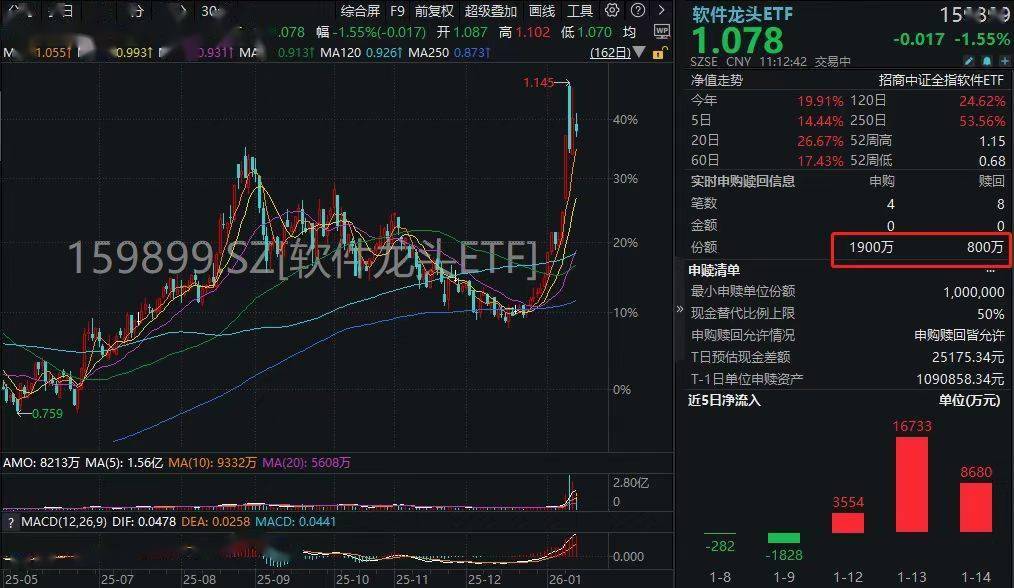
20cm速递|创业板人工智能ETF国泰(159388)涨近4%,科技主线与AI创新成焦点
Mei Ri Jing Ji Xin Wen· 2026-01-14 06:11
Group 1 - The core viewpoint of the article highlights the significant rise of the ChiNext AI ETF Guotai (159388), which increased by nearly 4%, with a focus on technology and AI innovation [1] - West Securities points out that DeepSeek's conditional memory module Engram complements the MoE (Mixture of Experts) model, enhancing knowledge retrieval efficiency and significantly improving model performance in reasoning and coding tasks [1] - The Engram module is positioned in the early layers of the Transformer architecture, allowing subsequent layers to focus on complex reasoning, addressing the existing lack of native retrieval mechanisms in Transformers [1] Group 2 - The ChiNext AI ETF Guotai (159388) tracks the ChiNext AI Index (970070), which has a daily price fluctuation limit of 20%, and selects companies involved in AI technology research and application from the ChiNext market [1] - The index covers cutting-edge technology fields such as machine learning and natural language processing, reflecting the overall performance of publicly listed companies related to AI [1] - The constituent stocks of the index are primarily concentrated in the information technology and intelligent manufacturing sectors, showcasing significant technological attributes and growth characteristics [1]
