
JoyInside

Search documents
京东2025“成绩单”出炉!营收增长13%、利润大降,员工总数已超90万
证券时报· 2026-03-05 13:25
Core Viewpoint - JD Group reported a revenue of 352.3 billion yuan for Q4 2025 and a total annual revenue of 1,309.1 billion yuan, reflecting a growth of approximately 13.0% compared to 2024. However, due to investments in new businesses, profits declined significantly [1]. Group 1: Financial Performance - In 2025, JD Group's non-GAAP net profit was 27 billion yuan, down from 47.8 billion yuan in 2024. The non-GAAP operating profit for 2025 was 9.6 billion yuan, compared to 44 billion yuan in 2024, with an operating profit margin of 0.7% in 2025 versus 3.8% in 2024 [1]. - JD Retail achieved a revenue of 1,126.4 billion yuan in 2025, up from 1,015.9 billion yuan in 2024, with an operating profit of 51.4 billion yuan in 2025, compared to 41.1 billion yuan in 2024. The operating profit margin for JD Retail was 4.6% in 2025, compared to 4.0% in 2024 [1]. Group 2: Business Expansion and User Growth - JD Group's CEO highlighted strong user growth and increased shopping frequency, with the core retail business showing resilience despite intense competition. The new business segments, including JD Delivery and JD X, are expanding steadily, with losses narrowing each quarter [2]. - JD Delivery has gained over 240 million users in its first year, achieving a market share of over 15%. The company aims to increase this share to 30% by the end of 2026 [3]. Group 3: Technological Investment - JD's R&D expenditure reached 6.7 billion yuan in Q4 2025, a 52.0% increase from 4.4 billion yuan in Q4 2024. The total R&D spending for 2025 was 22.2 billion yuan, up 30.5% from 17 billion yuan in 2024 [6]. - The company has implemented AI across over 2,000 business scenarios, enhancing operational efficiency and user experience [6][7]. Group 4: International Expansion - JD's European online retail business, Joybuy, began trial operations in several countries and is set to officially launch in March 2026. The logistics network includes nearly 200 overseas warehouses covering 25 countries [9]. - JD Express has launched services in multiple European countries, offering same-day and next-day delivery options, along with diverse services for consumers [9]. Group 5: Human Resources and Employee Welfare - JD's total human resources expenditure reached 157.2 billion yuan in 2025, an increase of 33.7 billion yuan from 2024. The company has provided housing for frontline employees and plans to invest 22 billion yuan over the next five years to improve living conditions [11].


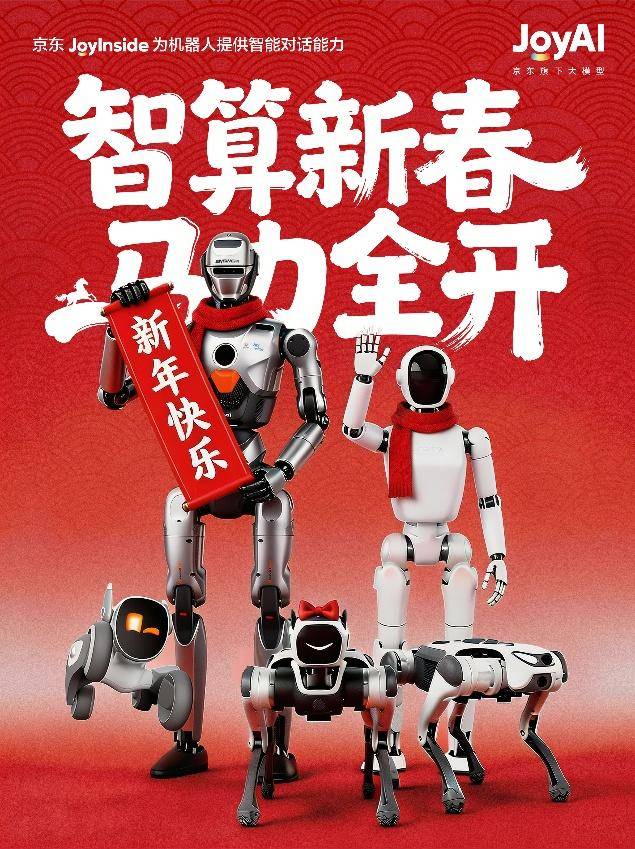
机器人天团炸场!京东 JoyInside 生态伙伴实力亮相春晚舞台
Yang Zi Wan Bao Wang· 2026-02-13 08:23
Core Insights - The 2026 Spring Festival Gala will feature multiple intelligent robots, showcasing cutting-edge technology to enhance the festive experience for audiences nationwide [1] - JD's JoyInside has partnered with two key players, Magic Atom and Songyan Power, to present their robots at the gala, merging advanced technology with traditional New Year celebrations [1] Group 1: Robot Highlights - Songyan Power's humanoid robot "Bumi" is the world's first high-performance humanoid robot priced at around 10,000 yuan, equipped with JD's JoyInside for enhanced interactive capabilities [3] - JoyInside utilizes the JoyAI model, enabling Bumi to provide companionship across all age groups, with significant improvements in interaction frequency and advanced features like voice recognition and situational awareness [3][4] - Magic Atom's four-legged robot, MagicDog Pro, is the first in its category to express emotions autonomously, integrating advanced voice control and multi-modal perception for comprehensive user interaction [4] Group 2: Ecosystem Expansion - JD's JoyInside ecosystem has expanded to include over 40 partners in the robotics and AI toy sectors, enhancing its capabilities in intelligent interaction technology [5] - The company provides comprehensive support to its partners, including logistics and after-sales services, facilitating the transition from "product intelligence" to "service intelligence" [5] - During the 2026 goods festival, robots and AI toys integrated with JoyInside saw nearly a threefold increase in sales on JD's platform, indicating strong market acceptance and growth potential [5]

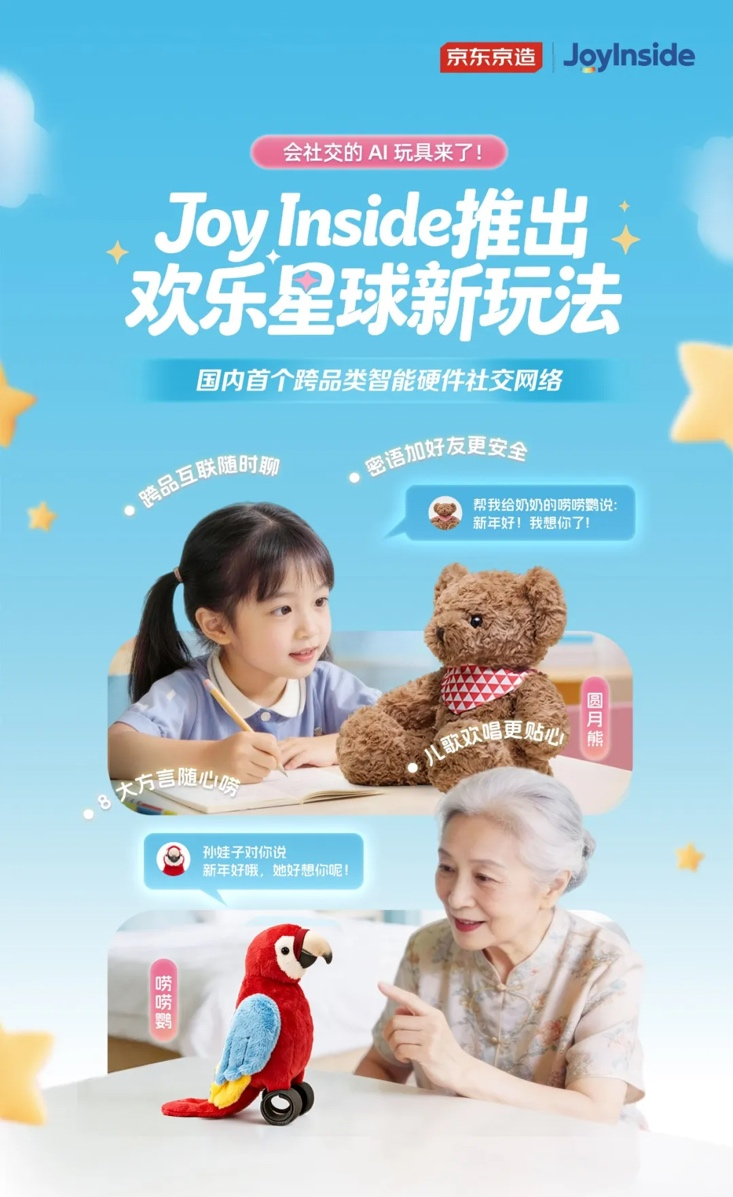
搭载JoyInside的京东京造AI玩具 新增“社交”功能
Zhong Jin Zai Xian· 2026-02-04 08:33
Core Insights - The article highlights the rising popularity of AI toys in the New Year market, emphasizing their value in family companionship and emotional connection [1] - JD's JoyInside has launched two key features, "Joyful Planet Social Play" and upgraded TTS voice synthesis, to enhance user experience and engagement during the Spring Festival [1][4] Group 1: Product Features - The "Joyful Planet Social Play" introduces a cross-category smart hardware social network, allowing various JD products to connect and interact, addressing the "brand island" issue in the smart hardware market [3] - The upgraded TTS function supports eight regional dialects, enhancing personalized interaction and catering to users of all ages and regions, particularly during family gatherings [4] - The new features aim to create a safe social environment for children, allowing them to connect with friends through voice messages and holiday greetings [3][4] Group 2: Market Positioning - The dual feature upgrade positions JoyInside as a differentiated New Year gift that addresses the pain points of intergenerational companionship, making it appealing to both children and elderly family members [5] - The products serve as emotional carriers for families, facilitating social connections and shared experiences during the festive season [5] - JoyInside aims to continuously improve its offerings, focusing on maintaining family emotional connections through technology [5] Group 3: Promotional Strategies - JD has introduced various themed product bundles, such as the "Chatting Parrot + Round Moon Bear" combination, to enhance cross-generational interaction and create a festive atmosphere [6] - The promotional strategy includes engaging social play elements, such as blind box social interactions and themed combinations, to attract diverse consumer groups [6] - The campaign encourages families to experience the joy of technology together, positioning the AI toys as more than just products but as companions for the New Year celebrations [6]
刘强东给光明村送“科技年货” 老少乡亲喜提AI新伙伴
Zhong Jin Zai Xian· 2026-01-29 10:34
Group 1 - JD Group's founder Liu Qiangdong delivered over 10,000 New Year goods to villagers in Jiangsu, including essential items and practical appliances, highlighting the company's commitment to community support [1] - The "Tech New Year Goods" included an AI smartphone for seniors, equipped with a dialect-recognizing AI application called "Dongdong," aimed at making technology accessible for the elderly [1][3] - The AI classroom created for children features various smart devices powered by JD's JoyAI model, providing an interactive learning experience with AI toys that can engage in conversations and offer knowledge [7][8] Group 2 - The "Dongdong" AI assistant, designed for elderly users, can understand multiple dialects and assist with daily tasks such as health advice, shopping, and news interpretation, enhancing the quality of life for seniors [3][5] - The AI classroom for children includes interactive devices like the JoyInside chess robot, which not only plays chess but also engages in meaningful dialogue, enriching children's learning experiences [7] - JD's innovative AI toy social features allow children to connect with each other safely, creating a controlled social environment that fosters interaction among different AI devices [8]

刘强东给光明村送“科技年货”,老少乡亲喜提AI新伙伴
Sou Hu Cai Jing· 2026-01-29 06:30
Group 1 - JD Group's founder Liu Qiangdong delivered over 10,000 New Year goods to villagers in Jiangsu, including essential items and practical appliances [1] - The "technology New Year goods" included an AI smartphone for the elderly, equipped with a dialect-recognizing AI application called "Dongdong" [1][3] - An AI classroom was established for children in the village, featuring AI toys and devices powered by JD's JoyAI model to enhance learning experiences [6] Group 2 - "Dongdong" serves as an AI assistant tailored for elderly users, capable of engaging in conversations and providing health advice [3][4] - The AI assistant can perform various tasks such as online shopping, food ordering, and health consultations through voice commands [4] - JD's innovative AI toys allow children to connect and interact with different devices, creating a safe social environment for them [8]
京东达沃斯公布数据:“AI”搜索量去年激增超百倍
2 1 Shi Ji Jing Ji Bao Dao· 2026-01-23 00:44
Group 1 - The World Economic Forum 2026 Annual Meeting is taking place in Davos, Switzerland, where JD Group's CEO Xu Ran stated that 2025 will be the "explosion year" for AI consumption, with related search volume increasing over 100 times year-on-year [1] - JD's consumer insights indicate that in 2025, sales of smart products on JD's platform will grow by over 200% year-on-year, with sales of smart robots and smart glasses increasing by over 300% and 1000% respectively [3] - Nearly 50% of surveyed consumers (46.8%) believe that products must integrate AI capabilities, indicating that AI functionality is becoming a necessary feature [3] Group 2 - JD has developed its AI business through the JoyInside brand, collaborating with over 40 hardware brands to launch various AI products, with sales of JoyInside ecosystem products during the 2025 Double 11 shopping festival increasing by over 2000% compared to the 618 shopping festival [3] - AI technology is also being integrated into applications such as AI shopping assistants and digital human live streaming, with total transaction volume from digital human live streaming on JD's platform exceeding 2.4 billion yuan during the 2025 Double 11 [3] - JD has become the first Chinese company to join the WEF's "Reskilling Initiative" project to train employees in new skills to meet AI demands [4]
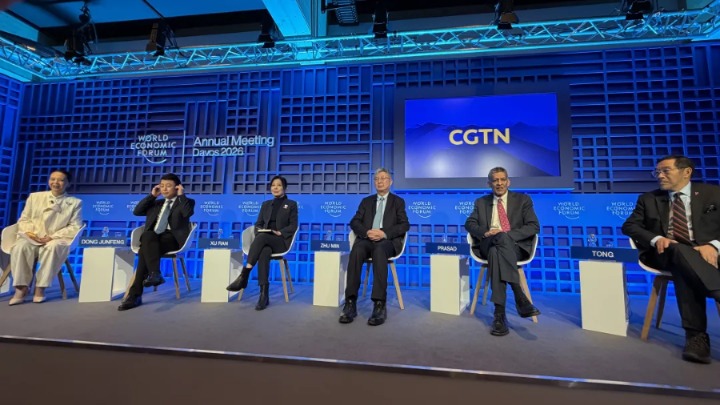
京东CEO许冉冬季达沃斯年会谈“AI”:2025年是AI消费“爆发元年” 相关搜索量同比增长超百倍
Mei Ri Jing Ji Xin Wen· 2026-01-22 16:51
Core Insights - The World Economic Forum 2026 Annual Meeting opened in Davos, Switzerland, with key participation from JD Group's founder Liu Qiangdong and CEO Xu Ran [1] - Xu Ran highlighted that 2025 will be the "explosion year" for AI consumption, with related search volumes expected to increase over 100 times year-on-year [2][3] - JD Group is intensifying its focus on AI consumption, launching a second batch of self-developed AI toys, which sold out quickly after their initial release [1][4] AI Consumption Trends - JD's platform is projected to see a more than twofold increase in smart product sales in 2025, with smart robots and smart glasses experiencing year-on-year sales growth of over 300% and 1000%, respectively [2] - Nearly 50% of surveyed consumers indicated that AI capabilities are essential for products, reflecting a significant shift in consumer preferences [2] - The JoyInside smart brand has collaborated with over 40 hardware brands to launch various AI products, with sales during last year's "Double 11" shopping festival increasing over 20 times compared to the "618" event [2] Strategic Developments - JD has established the "Chameleon Business Unit" to oversee the development and commercialization of core AI products, including JoyAI App and digital humans [5] - The company aims to leverage a "super supply chain" and C2M (customer-to-manufacturer) model to drive new supply iterations and stimulate consumer demand [5] - JD's AI strategy has been significantly elevated within the organization, with Liu Qiangdong personally leading the JD Exploration Institute, focusing on cutting-edge technology and AI applications [3][5] Competitive Landscape - The competition in AI consumption is intensifying, with other players like Alibaba also making significant moves in the AI space, such as integrating AI functionalities into their ecosystem [5] - The battle for dominance in the AI consumption market is critical for companies like JD, ByteDance, Alibaba, and Meituan, as it will determine their future success [5]
AI玩具的竞合博弈
Bei Jing Shang Bao· 2026-01-21 13:53
Core Insights - The AI toy market in China is rapidly growing, projected to reach 24.6 billion yuan in 2024 and 29 billion yuan in 2025, doubling the growth rate of traditional toys [1] - Major tech companies and IP giants are entering the AI toy sector, creating a multi-dimensional competitive landscape [3][4] - The emotional value of AI toys is becoming a key factor in consumer decision-making, shifting focus from mere functionality to emotional companionship [6][12] Market Dynamics - The AI toy market is characterized by a significant influx of major players, including internet giants and consumer electronics companies, leading to intense competition [3][4] - The market is currently in a "startup phase" with a focus on emotional connection and user experience, rather than just technological advancement [12][15] - The global AI toy market is expected to grow at a compound annual growth rate of approximately 14%-16% over the next decade, potentially exceeding $60 billion by 2034 [7] Product Development and Innovation - Companies are focusing on creating AI toys that cater to various age groups and needs, from children's education to elderly companionship [4][5] - Startups are leveraging emotional connections and niche market demands to differentiate themselves from larger competitors [5][10] - The integration of advanced AI technologies, such as natural language processing and emotional recognition, is crucial for product development [4][11] Ethical and Safety Concerns - The rise of AI toys raises significant ethical questions regarding data privacy, emotional dependency, and the potential impact on children's social skills [12][13][14] - Companies are urged to implement strict safety measures and ethical guidelines to protect user data and ensure the well-being of children [14][15] - The industry faces challenges related to content safety and the risk of harmful interactions, necessitating robust content filtering and security protocols [13][14] Future Outlook - The AI toy industry is expected to undergo a significant transformation, with a focus on value-driven competition rather than price wars [12][15] - Companies that can effectively balance technological innovation with emotional engagement and ethical considerations are likely to succeed in this evolving market [11][15] - The concept of "emotional economy" is becoming central to the development of AI toys, indicating a shift in consumer preferences towards products that offer companionship and emotional support [12][15]
以爱之名,AI玩具的竞合博弈
Bei Jing Shang Bao· 2026-01-21 11:52
Core Insights - The AI toy market in China is rapidly growing, with projections indicating a market size of 246 billion yuan in 2024 and an expected increase to 290 billion yuan in 2025, which is double the growth rate of traditional toys [3][8] - Major tech companies and IP giants are entering the AI toy sector, creating a multi-dimensional competitive landscape, while traditional toy manufacturers and startups are adapting by leveraging their strengths [3][8] - The emotional connection and understanding of user needs are becoming the core value propositions of AI toys, shifting the focus from mere functionality to companionship [11][12] Market Dynamics - The AI toy market is characterized by significant participation from internet giants and leading consumer electronics companies, indicating a shift towards AI toys as the next generation of human-computer interaction and family data gateways [8][9] - Sales data shows a booming market, with products like "显眼包" achieving over 1.2 billion yuan in GMV within 48 hours of launch, and AI toys integrated with JoyInside seeing a 20-fold increase in sales during the "双11" shopping festival compared to earlier periods [14][16] - The market is still in its early stages, with a projected compound annual growth rate of 14%-16% over the next decade, potentially exceeding 60 billion USD by 2034 [13][22] Competitive Landscape - The entry of major players has created a protective barrier in the AI toy market, compelling traditional manufacturers and startups to innovate and differentiate themselves [9][18] - Different companies are focusing on various aspects of the market: internet giants on data and AI capabilities, consumer electronics firms on supply chain management, and IP companies on emotional connections and content creation [18][21] - The competition is expected to evolve into a differentiation strategy rather than a price war, with companies focusing on unique emotional and technological offerings [21][22] Consumer Trends - The AI toy market caters to a wide range of age groups, with children aged 3-12 making up 62% of the market, while the Z generation (ages 18-35) shows a 45% repurchase rate driven by emotional needs [22] - The demand for AI toys is fueled by the increasing need for companionship among various demographics, including children, young adults, and the elderly [22][25] - The emotional value of AI toys is becoming a key selling point, with consumers seeking products that provide companionship rather than just functionality [12][22] Ethical and Safety Concerns - The rapid growth of the AI toy market raises concerns about data privacy, as these toys collect sensitive information from users, particularly children [23][27] - There are worries about the potential negative impact of AI toys on children's social skills and emotional development, as reliance on these products may hinder real-life interactions [25][27] - Industry experts emphasize the need for strict content filtering and data protection measures to ensure the safety and ethical use of AI toys [27][28]
京东发布JoyInside软硬一体化方案 以AI赋能玩具产业
Ke Ji Ri Bao· 2026-01-21 05:26
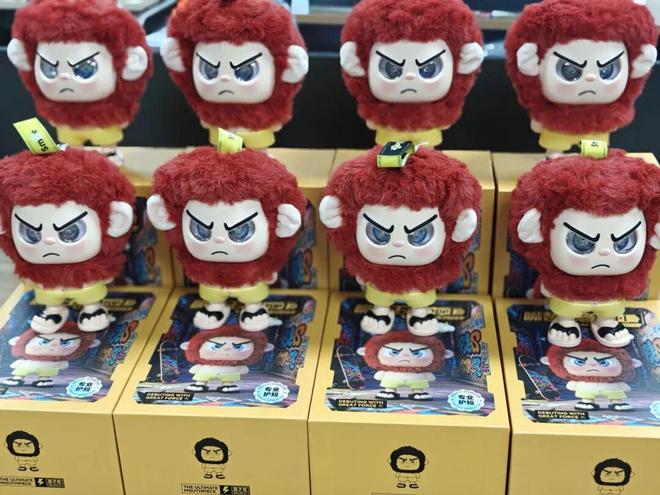
Group 1 - JD.com held the AI Toy Conference in Suqian, Jiangsu, and signed an agreement with the Suqian government to establish an AI toy industry zone, aiming to create a regional benchmark for innovative development in AI toys [1] - JD.com launched the JoyInside integrated hardware and software solution designed for smart hardware terminals, which is highly compatible and supports various hardware, scenarios, and sizes, providing full-link support from technical foundation to product implementation [1] - The company has introduced multiple mass-produced hardware cores that cover a wide range of applications from plush toys to smart home devices, including features like continuous dialogue, offline voice, emotional interaction, and long-term memory [1] Group 2 - JoyInside utilizes technologies such as child scene optimization, long-term memory system integration, and human-like response algorithms, achieving a response delay of less than 2 seconds and a children's voice recognition rate of over 95%, enabling smart terminals to have core capabilities of "perceiving emotions, remembering preferences, and continuous growth" [2] - The solution has been integrated with over 40 leading hardware brands, covering various categories including robots, robotic dogs, and AI toys [2]