LED驱动

Search documents
半导体大厂英飞凌涨价
Di Yi Cai Jing Zi Xun· 2026-02-05 12:54
Group 1 - Infineon announced a price increase for power switches and related chips starting April 1, 2026, due to ongoing supply shortages and rising costs of raw materials and infrastructure [1] - The semiconductor market has seen a significant demand increase for certain Infineon products, primarily driven by the deployment of AI data centers, leading to shortages of power switches and related chips [1] - Infineon stated that it has historically managed cost increases through internal efficiency improvements, but has reached a point where it can no longer absorb these costs entirely, necessitating cost-sharing with valued customers and partners [1] Group 2 - Analog Devices Inc. (ADI) announced a price increase for its entire product line starting in February 2025, reflecting strong demand in automotive and industrial sectors [2] - Domestic chip manufacturers in China, including Zhongwei Semiconductor, Guokai Micro, and others, have also announced price increases this year, indicating a broader trend in the industry [2] - The price increase momentum for power devices, particularly for MOS (Metal Oxide Semiconductor) products, is strong, with extended delivery times reported by several manufacturers [2]
半导体大厂英飞凌涨价
第一财经· 2026-02-05 12:49
Group 1 - Infineon announced a price increase for power switches and related chips starting April 1, 2026, due to ongoing supply shortages and rising costs of raw materials and infrastructure [1] - The semiconductor market has seen a significant demand increase for Infineon's products, primarily driven by the deployment of AI data centers, leading to shortages of power switches and related chips [1] - Infineon stated that it has historically absorbed cost increases through internal efficiency improvements, but has reached a point where it can no longer fully absorb these costs, necessitating cost-sharing with customers and partners [1] Group 2 - Analog Devices Inc. (ADI) announced a price increase for its entire product line starting in February 2025, reflecting strong demand in automotive and industrial sectors [2] - Domestic chip manufacturers in China, including Zhongwei Semiconductor and Guoke Micro, have also announced price increases this year, indicating a broader trend in the industry [2] - There is strong upward pricing momentum for power devices, particularly for MOSFETs, with extended delivery times reported by several manufacturers, leading to multiple companies planning or implementing price hikes [2]

中信证券:电子元件涨价浪潮有望不断蔓延 推荐关注存储等在涨价趋势中受益确定性最高的环节
智通财经网· 2026-02-04 00:33
Core Viewpoint - The electronic components industry is experiencing a price increase across various segments, driven by strong downstream demand and rising upstream metal prices, with a recommendation to focus on segments like storage, CCL, BT substrates, wafer foundry, and packaging that are likely to benefit from this trend [1][2]. Downstream Demand - Downstream customer inventory replenishment is stronger than expected, with AI and automotive sectors driving demand despite pressures on automotive sales. The localization of upstream components is accelerating, and low inventory levels among downstream customers are contributing to strong replenishment motivation [2][3]. - Advanced packaging and storage expansions are occupying mature process capacities, leading to increased demand for replenishment from downstream customers [2]. Upstream Costs - Key raw materials for electronic manufacturing, including gold, silver, and copper, are experiencing significant price increases, with futures prices expected to rise by over 50% for gold, 150% for silver, and 50% for copper by 2025 [2]. Midstream Components - Since the downturn in 2022, many segments within the electronic components industry have maintained relatively low profit margins, creating a strong demand for price increases amid tight supply and rising costs [3]. - Price increase notices have been observed across various segments, including storage, CCL, BT substrates, wafer foundry, packaging testing, LED, power devices, analog chips, and passive components, with some segments experiencing multiple rounds of price hikes [3]. Specific Segment Insights - **Storage**: The AI supercycle is causing ongoing shortages, with TrendForce predicting a 55%-60% increase in traditional DRAM contract prices and a 33%-38% increase in NAND Flash contract prices by Q1 2026, with some NAND modules already increasing by over 40% this year [4]. - **CCL**: The latest round of price increases is expected to take effect by December 2025, supported by low industry inventory levels [4]. - **Wafer Foundry**: High utilization rates are reported, with some categories already seeing price increases, and the trend of advanced packaging and storage expansions affecting mature process capacities is beneficial for domestic supply-demand dynamics [4]. - **Packaging Testing**: High utilization rates (80%-90%) are noted among major companies, with some clients actively requesting price increases to secure capacity [4]. - **Analog Chips**: Strong demand from automotive and industrial sectors is driving price increases, with domestic design companies also showing willingness to raise prices [5]. - **Power Devices**: Strong price increase momentum is observed for mid-low voltage products, with extended delivery times reported [5]. - **SoC**: Initial price increases for internal storage SoC products are expected to enhance market share and profitability for leading manufacturers [5]. - **MCU**: A price increase of 15%-50% for MCU and Nor Flash products is set to take effect on January 27, 2026 [5].

未知机构:国联民生电子电子板块的全面通胀领导好前期我们团队重点推-20260128
未知机构· 2026-01-28 02:00
Summary of Conference Call Notes Industry Overview - The focus is on the **electronic sector**, particularly the inflation trends driven by AI in storage, devices, and packaging/testing [1] Key Points and Arguments 1. **Price Increases Across Segments**: - Recent price hikes have been observed in several sub-segments: - **Passive Components**: Resistors from Yageo have increased by **15-20%** - **Power Components**: Multiple companies have raised prices by **10-20%** - **LED Drivers**: Richtek has seen price increases of over **10%** - **MCUs**: Companies like Zhongwei have raised prices for MCUs and NOR by **15-50%** [2] 2. **Drivers of Price Increases**: - The reasons for price increases vary by segment: - **Downstream Demand Shift**: A turning point in demand coupled with inventory clearance in channels - **Rising Packaging and Foundry Costs**: There is a pressing need to pass on cost pressures - **Supply-Side Constraints**: Supply-side pressures combined with a demand-side inventory buildup cycle [2] 3. **Long-term Industry Logic**: - The AI industry wave presents transformative opportunities for power, passive, and MCU sectors: - **Passive Components**: New demands arise in various AI applications, such as significant power shortages in North America, leading to the need for high-capacitance, high-voltage MLCCs - **Power Supply Innovations**: The VPD (Vertical Power Delivery) scheme is highlighted as a more efficient power supply solution, indicating a shift in power supply evolution - Increased requirements for high-voltage film capacitors, high-frequency power inductors, and non-inductive resistors are anticipated [2] 4. **Investment Strategy**: - The electronic sector is entering a significant inflationary period, with previous surges in storage, devices, and packaging/testing expected to be followed by a wave of price increases in other electronic components - It is advised to prioritize positions and select targets that actively participate in industry transformation and embrace the AI wave [2] Additional Important Content - The call emphasizes the importance of engaging with companies that are positioned to benefit from the ongoing changes in the electronic sector, particularly those that align with AI advancements [2]
未知机构:国联民生电子电子板块的全面通胀领导好前期我们团队重点推荐-20260128
未知机构· 2026-01-28 02:00
Summary of Conference Call Notes Industry Overview - The focus is on the electronics sector, particularly the inflationary trends driven by AI in storage, devices, and packaging/testing segments [1][2]. Key Points and Arguments 1. **Price Increases Across Segments**: - Recent price hikes have been observed in various sub-segments: - Passive components: Resistors from Yageo increased by 15-20% - Power components: Multiple companies reported price increases of 10-20% - LED drivers: Richtek saw price increases of over 10% - MCU companies: Zhongwei Semiconductor's MCUs and NOR flash prices rose by 15-50% [2][2]. 2. **Drivers of Price Increases**: - Different segments have unique drivers for price increases: - Downstream demand turning point and inventory clearance in channels - Rising costs in packaging/testing and foundry services necessitating cost pass-through - Supply-side pressures combined with a demand-side inventory buildup cycle - Current valuations of related stocks are considered low, presenting an opportunity for investment [2][2]. 3. **Long-term Outlook**: - The AI industry wave presents transformative opportunities for power, passive, and MCU sectors: - For passive components, new demands arise in various AI applications: - SOFC (Solid Oxide Fuel Cell): Significant power shortages in North America create demand for high-capacity, high-voltage MLCCs - Vertical Power Delivery (VPD): Google’s adoption of VPD indicates a shift towards more efficient power solutions, increasing requirements for high-voltage film capacitors, high-frequency power inductors, and non-inductive resistors - The electronics sector is entering a significant inflationary period, with previous increases in storage, devices, and packaging/testing expected to be followed by a wave of price adjustments in other electronic components [2][2]. 4. **Investment Strategy**: - It is recommended to prioritize positions and select stocks that actively participate in industry transformations and embrace the AI wave [2][2]. Important but Overlooked Content - Specific companies mentioned in various segments: - MCU: Zhaoyi Innovation, Puran, Guomin Technology, Zhongwei Semiconductor - Power components: Xinjieneng, JieJie Microelectronics, Yangjie Technology - Passive components: Shunluo Electronics, Sanhuan Group - Lead frames: Kangqiang, Xinhenghui [3][3].
蓝箭电子:公司产品包括二极管、ESD等
Zheng Quan Ri Bao Wang· 2025-12-03 13:44
Group 1 - The core viewpoint of the article is that Blue Arrow Electronics (301348) has a diverse product range that includes diodes, LDOs, LED drivers, lithium battery protection ICs, DC-DC converters, and ESD devices, which are applicable in consumer electronics such as laptops, tablets, smartphones, and digital cameras [1] Group 2 - The company engages with investors through an interactive platform, indicating a commitment to transparency and communication [1] - The product applications highlight the company's involvement in the growing consumer electronics market, suggesting potential for future growth [1]
不到10倍PE!这家汽车芯片分销商“捡漏”两家公司
芯世相· 2025-09-29 07:26
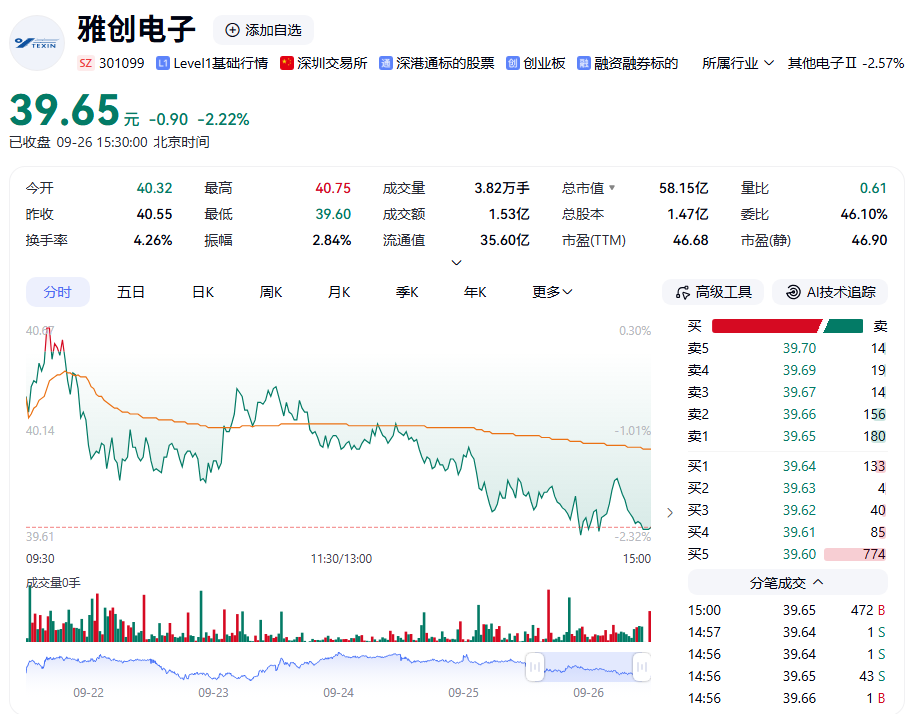
Core Viewpoint - The article discusses the acquisition activities of Yachuang Electronics, highlighting its strategy to enhance control over semiconductor design and distribution companies, specifically through the acquisition of stakes in Ouchuangxin and Yihainengda, aiming for full ownership and increased market competitiveness [3][5][8]. Acquisition Details - Yachuang Electronics announced plans to acquire 40% of Ouchuangxin and 45% of Yihainengda, with the total transaction amounting to approximately 3.17 billion yuan [3][5]. - Prior to the acquisition, Yachuang held 60% of Ouchuangxin and 55% of Yihainengda, indicating a strategic move to consolidate its holdings [5][8]. Financial Overview - The acquisition prices are set at 200 million yuan for Ouchuangxin and 117 million yuan for Yihainengda, with a combination of share payments and cash [5][17]. - Yachuang's revenue for 2024 is projected to reach approximately 3.61 billion yuan, reflecting a 46.14% increase from 2023 [9][14]. Business Strategy - The company emphasizes a dual strategy of organic growth and external acquisitions to enhance operational efficiency and competitive edge in the semiconductor distribution and design sectors [8][10]. - Yachuang's distribution business remains dominant, accounting for 90% of its revenue, while its self-developed IC design contributes only 9.65% [8][14]. Market Position - The acquisitions are expected to strengthen Yachuang's market position in various sectors, including automotive electronics, industrial applications, and consumer electronics [7][12]. - The company has been actively pursuing acquisitions, having completed six asset transactions in the past year, indicating a robust growth trajectory [11][12]. Performance Metrics - Yachuang's revenue growth in the first half of the year reached 125.7%, driven by the expansion of its electronic component distribution business [14]. - The self-developed IC segment has shown steady performance, with sales reaching approximately 15 million yuan, primarily in automotive applications [14][13]. Industry Context - The semiconductor distribution industry is experiencing a valuation adjustment, with recent acquisitions reflecting lower PE multiples, suggesting a shift in market dynamics [17]. - The overall market for semiconductor distributors is showing signs of recovery, with Yachuang leading in revenue growth compared to peers [14][17].

雅创电子拟3.17亿元收购欧创芯与怡海能达
Zhong Guo Zheng Quan Bao· 2025-09-28 01:36
Group 1 - The core point of the news is that Yachuang Electronics plans to acquire 40% of Shenzhen Ouchuang Semiconductor Co., Ltd. and 45% of Shenzhen Yihai Nengda Co., Ltd. for approximately 317 million yuan, enhancing its semiconductor business and market competitiveness [1] - The acquisition will result in Ouchuang and Yihai Nengda becoming wholly-owned subsidiaries of Yachuang Electronics, as the company currently holds 60% and 55% stakes in these firms respectively [1] - The provisional transaction price for Ouchuang's 40% stake is set at 200 million yuan, with share payments of approximately 172 million yuan and cash payments of about 27.84 million yuan [1] Group 2 - Yachuang Electronics reported a revenue of approximately 2.847 billion yuan for the first half of 2023, representing a year-on-year growth of 125.74%, while the net profit attributable to shareholders was 40.82 million yuan, a 1.47% increase year-on-year [2] - The company is pursuing a dual strategy of distributing automotive electronic components and self-research IC design, while also actively exploring emerging technology fields such as AI memory and optical modules [2] - Yachuang Electronics plans to issue shares to no more than 35 specific investors to raise supporting funds for the acquisition, which is expected to enhance asset quality and operational capabilities, creating significant synergies [2]

雅创电子拟3.17亿元加码半导体业务
Zhong Guo Zheng Quan Bao· 2025-09-28 01:04
Core Viewpoint - The company plans to acquire 40% of Shenzhen Ouchuangxin Semiconductor Co., Ltd. and 45% of Shenzhen Yihai Nengda Co., Ltd. through a combination of share issuance and cash payment, with the aim of enhancing asset quality and operational capabilities [1][14]. Group 1: Transaction Details - The transaction involves a total payment of approximately 3.17 billion yuan, with 2 billion yuan allocated for Ouchuangxin and 1.17 billion yuan for Yihai Nengda [3]. - The share issuance price is set at 30.68 yuan per share, which is compliant with regulations as it is not lower than 80% of the average stock price over the past 120 trading days [7][8]. - The funds raised will be used for cash payments, transaction taxes, construction of projects, and to supplement working capital [9]. Group 2: Company Performance - The company reported a revenue of approximately 2.847 billion yuan for the first half of the year, representing a year-on-year increase of 125.74%, with a net profit of 40.82 million yuan, up 1.47% [10]. - The AI strategy has shown initial success, with AI memory sales reaching 73.56 million yuan and related AI glasses business contributing over 53 million yuan [10]. Group 3: Target Companies Overview - Ouchuangxin specializes in analog chip development, focusing on integrated circuit design for LED drivers and power management, with significant market share in automotive lighting and home lighting [10][12]. - Yihai Nengda operates as a distributor and solution provider in the electronic components industry, representing various passive and active components, and has established long-term partnerships with leading manufacturers [11][12].
重要收购出炉!两家A股公司,同日公告!
Zheng Quan Shi Bao· 2025-09-27 14:20
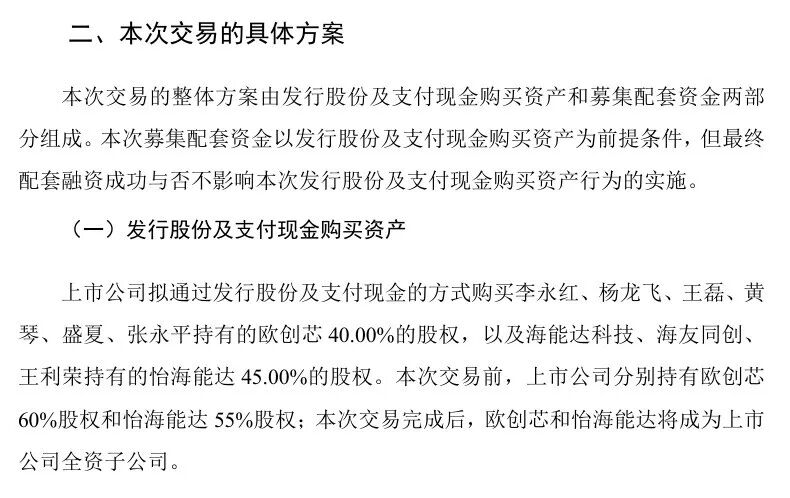
Core Viewpoint - Two A-share listed companies, Yachuang Electronics and Yinhe Magnetic, have announced significant acquisition plans to enhance their market positions and operational efficiencies through strategic investments in semiconductor and magnetic materials sectors [1][6]. Group 1: Yachuang Electronics Acquisition - Yachuang Electronics plans to acquire 40% of Ouchuang Semiconductor and 45% of Yihai Nengda through a combination of stock issuance and cash payment, with a total estimated transaction value of approximately 3.17 billion yuan [1][3]. - The acquisition price for Ouchuang is tentatively set at 200 million yuan, with 172 million yuan in stock and 27.84 million yuan in cash, while Yihai Nengda's price is set at 117 million yuan, with 79.59 million yuan in stock and 37.41 million yuan in cash [3][6]. - The funds raised will be used for cash payments, transaction taxes, construction of projects, and to supplement working capital, with a maximum of 25% allocated for working capital [3][6]. Group 2: Business Profiles of Acquired Companies - Ouchuang Semiconductor specializes in analog chip design and has a strong market presence in automotive lighting and LED driver applications, with significant market share and brand recognition [4][5]. - Yihai Nengda operates as a distributor and solution provider in the electronic components industry, covering various sectors including communications, automotive, and consumer electronics, and has established long-term partnerships with leading global manufacturers [4][5]. Group 3: Financial Performance and Strategic Benefits - Post-acquisition, Yachuang Electronics will enhance its control over Ouchuang and Yihai Nengda, improving operational efficiency and competitive advantage in the electronic components and analog chip design markets [5][6]. - Ouchuang's projected revenues for 2023 and 2024 are approximately 85.24 million yuan and 118.26 million yuan, with net profits of 22.82 million yuan and 46.31 million yuan, while Yihai Nengda's revenues are expected to be 441.03 million yuan and 517.75 million yuan, with net profits of 22.76 million yuan and 29.06 million yuan [6].