
Lumin

Search documents
国内乘用车市场分析:区域篇
3 6 Ke· 2026-02-11 05:09
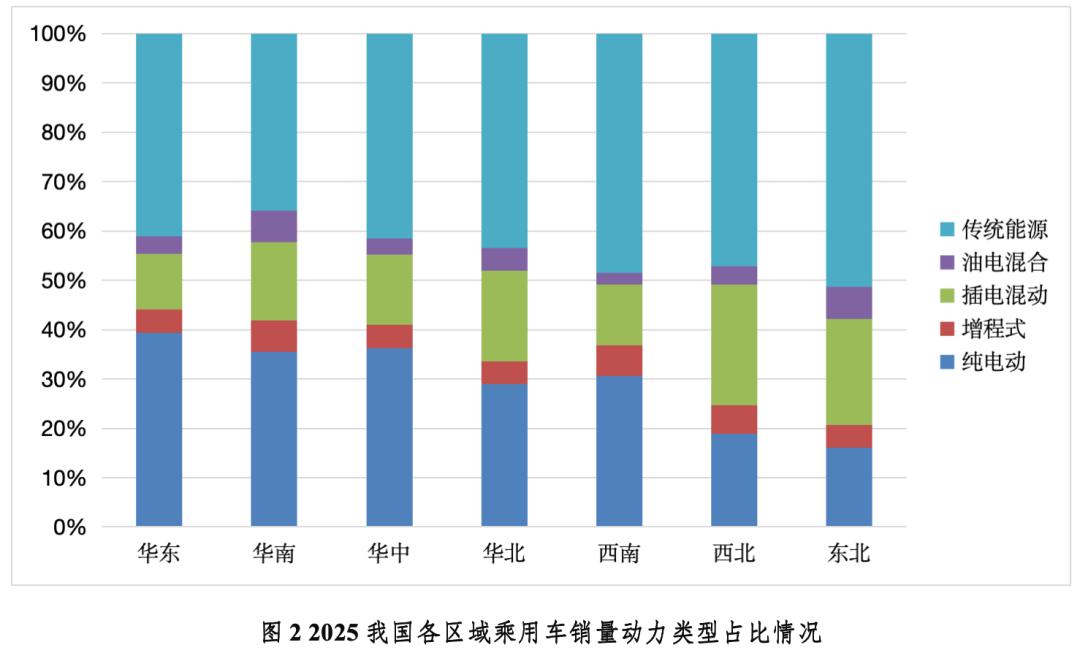
Core Insights - The article analyzes the regional development paths of new energy passenger vehicle sales in China, focusing on market potential in lower-tier cities and development models in typical cities [1] Regional Development Characteristics - China's new energy vehicle (NEV) industry shows a clear regional development pattern, starting from the southeastern coastal areas and expanding to core economic regions like the Pearl River Delta, Yangtze River Delta, Beijing-Tianjin-Hebei, and Sichuan-Chongqing [2] - The penetration rate of NEVs is highest in East and South China, accounting for approximately 54%, while North and Southwest China follow in the second tier. The Northwest and Northeast regions have lower penetration rates due to cold winter climates [2] Market Potential in Western and Northeast Regions - The western and northeastern regions still hold significant growth potential for NEVs, requiring differentiated promotion strategies based on regional resources and climate characteristics [5] - In high-altitude areas, range-extended electric vehicles are more suitable due to their ability to avoid power performance issues caused by thin air [5] - The Northeast faces challenges in NEV promotion due to harsh climates and insufficient charging infrastructure, suggesting the need for regional tax incentives and infrastructure improvements [5] Downstream Market Development Potential - Lower-tier markets are becoming the main driver of growth in China's NEV market, with first and second-tier cities reaching saturation [7] - The penetration rate of NEVs in first and second-tier cities has surpassed 55%, while it remains below 40% in third-tier and below cities, indicating strong growth potential [7] Company Strategies in Lower-tier Markets - Companies are accelerating their focus on lower-tier markets, with brands like Wuling deriving nearly 70% of their sales from these areas [11] - BYD, Geely, and Changan are launching models tailored to the needs of lower-tier markets, achieving rapid sales growth [11] Development Models in Typical Cities - Cities like Guangzhou, Beijing, Chengdu, Shanghai, and Shenzhen are projected to lead NEV sales from 2024 to 2025, each following distinct growth models [14] - The industrial-driven model, represented by Guangzhou, relies on local automakers to create market advantages [17] - The environment-driven model, exemplified by Shenzhen, focuses on building supportive infrastructure for NEVs [20] - The consumption-driven model, as seen in Chengdu, benefits from strong consumer policies and demographic advantages [21] - The policy-driven model in cities like Beijing and Shanghai is closely tied to regulations affecting fuel vehicles and incentives for NEVs [22] Recommendations for Expanding Automotive Consumption - To enhance automotive consumption, it is essential to eliminate unreasonable local restrictions and promote a unified national market [25] - Accelerating the construction of charging infrastructure and upgrading existing facilities is crucial for improving the automotive ecosystem [25] - Engaging in automotive cultural activities can stimulate market vitality and drive consumer demand [25] - Companies should leverage local market advantages to build brand recognition and trust among consumers [25]




11月新能源汽车销量
数说新能源· 2025-12-15 04:00
Core Insights - November wholesale vehicle sales reached 1.706 million units, a year-on-year increase of 18.5% and a month-on-month increase of 5.8%, with a penetration rate of 56.9%, up 1.6 percentage points from the previous month [1] - Retail sales in November totaled 1.321 million units, reflecting a year-on-year growth of 4.0% and a month-on-month growth of 3.0%, with a penetration rate of 59.4%, up 2.2 percentage points from the previous month [1] - Exports in November amounted to 284,000 units, showing a significant year-on-year increase of 255.0% and a month-on-month increase of 19.3%, with a penetration rate of 47.3%, up 3.1 percentage points from the previous month [1] Sales Data by Manufacturer - Tesla sold 86,700 units in November, including 13,600 units exported [3] - BYD's sales reached 474,900 units, with 128,100 units exported, including various models such as Qin DMI (15,700 units) and Dolphin (31,000 units) [3] - SAIC-GM-Wuling sold 107,800 units, with 12,500 units exported, including 53,600 units of Hongguang MINI [3] - NIO sold 36,300 units, with 6,000 units of ES6 [3] - Li Auto sold 33,200 units, with L9 contributing 2,200 units [3] - XPeng sold 36,700 units, with 5,100 units exported [3] - Leap Motor sold 70,300 units, with 7,200 units of C11 [3] - Chery sold 111,600 units, with 48,100 units exported [3] - GAC Aion sold 38,300 units, with 4,100 units exported [3] - Geely sold 187,800 units, with 15,600 units exported [3] - Volkswagen ID sold 4,800 units [3] - Great Wall sold 40,000 units, with 4,500 units exported [3] - SAIC Passenger Cars sold 42,000 units, with 10,800 units exported [3] - Changan sold 107,000 units, with 4,200 units exported [3] - AITO sold 51,700 units [3] - Xiaomi sold 46,200 units, with 12,500 units of Xiaomi SU7 [3]

汽车产业链出海热潮延续 上下游企业加速抢滩海外市场
Xin Hua Wang· 2025-08-12 05:47
Core Insights - China's automotive industry is accelerating its expansion into overseas markets, with multiple companies actively pursuing international strategies [1][2] - In January 2023, domestic automotive exports increased by over 40% year-on-year, continuing a rapid growth trend [1] - In 2023, China's total vehicle exports reached 4.91 million units, a year-on-year increase of 57.9%, making it the world's largest automotive exporter for the first time [1] Group 1: Company Strategies - JAC Motors announced the export of 10,000 electric vehicles to the Gulf and Central South America [1] - Changan Automobile plans to introduce over seven new energy products in Southeast Asia in 2024 and is establishing a local operational base in Thailand [3] - SAIC Motor aims for overseas sales of 1.35 million units in 2024, with plans to launch over ten new energy vehicles internationally [3] Group 2: Market Dynamics - The demand for vehicles in foreign markets is significant, prompting companies to seek international opportunities due to domestic market saturation [2] - The competitive edge of "Chinese cars" in overseas markets is increasing, driven by the rapid development of the domestic new energy vehicle sector [2] - The focus of competition among automotive companies is shifting towards markets in Europe, Southeast Asia, the United States, and Russia [1] Group 3: Supply Chain Implications - The push for international expansion by automotive companies is leading to increased activity among parts suppliers, who are also seeking to enter overseas markets [4]
