MLCC(片式多层陶瓷电容)

Search documents
运力紧张推升油轮运费 全球油轮费率续创六年新高丨A股明日线索
2 1 Shi Ji Jing Ji Bao Dao· 2026-02-26 11:22
Group 1: Oil Shipping Industry - The recent tensions between the US and Iran have led to a significant increase in daily rental rates for Very Large Crude Carriers (VLCC), surpassing $200,000 per day, marking a new high since 2020 [1] - The increase in oil shipping costs is attributed to a rise in crude oil exports from the Middle East as traders seek to secure shipping capacity before potential conflicts [1] - Huayuan Securities predicts that the strong performance of VLCC rates in Q1 2026 will be driven by favorable trends in fundamentals, supply-side restructuring, and geopolitical changes, suggesting a prolonged "oil shipping boom" [1] Group 2: Smartphone Industry - The Chinese smartphone market is expected to experience a comprehensive price increase starting in March 2026, marking the first time multiple brands and categories will raise prices simultaneously [2] - New smartphone models released after March are anticipated to see price hikes of over 1,000 yuan, with high-end flagship models potentially increasing by 2,000 to 3,000 yuan compared to previous generations [2] - The price increases are driven by a sustained rise in upstream component costs, particularly storage chips, which have seen an over 80% increase in procurement costs compared to the previous year [2] Group 3: Semiconductor Industry - The demand for storage components is being driven by AI, with TrendForce forecasting a 144% increase in DRAM market value to $404.3 billion and a 112% increase in NAND Flash value to $147.3 billion by 2026 [3] - The semiconductor sector is experiencing a broader price increase for passive components, with major manufacturers like Murata discussing price hikes for MLCCs due to rising raw material costs and increased demand from AI and automotive sectors [4] Group 4: AI and Cooling Technology - Akash Systems has delivered the first commercial AI servers utilizing Diamond Cooling technology to NxtGen AI, marking a significant innovation in the AI chip market [6] - The potential market for diamond cooling solutions in AI chips is estimated to range from 7.5 billion to 150 billion yuan by 2030, depending on the penetration rates of this technology [6] Group 5: Commercial Space Industry - The commercial space sector is seeing renewed interest with the upcoming launch of the recoverable liquid rocket "Li Jian No. 2" by China Aerospace, scheduled for late March [7] - The company plans multiple launches throughout the year, including satellite internet deployment and significant national missions, reinforcing its position in the commercial launch market [7][9]

氪星晚报 |魅族手机或将成为历史:业务实质性停摆,3月正式退市;英伟达黄仁勋:年内将寻机进行资本运作
3 6 Ke· 2026-02-26 09:24
Group 1: Major Companies - NVIDIA's CEO Jensen Huang announced plans for capital operations within the year, including ongoing stock buybacks and dividends, while focusing on ecosystem investments as a core part of capital allocation [1] - Samsung Electronics will cease production of 2D NAND flash memory by March, reallocating the production line to 1c nm DRAM memory manufacturing [1] - C3.ai announced a 26% workforce reduction as part of a restructuring plan under new CEO Stephen Elwood, with revenue expectations for the current quarter falling below projections, leading to a 20% drop in stock price [3] - AMD and Nutanix are collaborating on a $250 million AI infrastructure platform, with AMD investing $150 million in Nutanix stock and providing up to $100 million for joint engineering and marketing efforts [3] - Gree Electric's largest shareholder plans to reduce its stake by up to 2% through block trades to repay bank loans [3] - BMW is negotiating with the EU for tariff exemptions on electric MINI models produced in China, following a similar agreement reached with Volkswagen [4] - Meizu's mobile phone business is reportedly ceasing operations, with plans to officially delist by March 2026, while its FlymeAuto business will operate independently [5] Group 2: Investment and Financing - "Tianyuanxing," a general industrial embodied intelligence platform, has completed several million yuan in angel financing, with funds aimed at R&D and team expansion [6] Group 3: New Products - ByteDance's PICO is expected to launch a new VR headset, emphasizing efficiency and openness in its upcoming product [6] Group 4: Industry Trends - The demand for AI is driving a price increase in passive components, with major Japanese manufacturer Murata discussing price hikes for MLCCs, indicating a broader trend of price increases across various passive components due to rising material costs and demand [6]

AI需求拉动 被动元器件全面涨价即将到来
Shang Hai Zheng Quan Bao· 2026-02-25 17:32
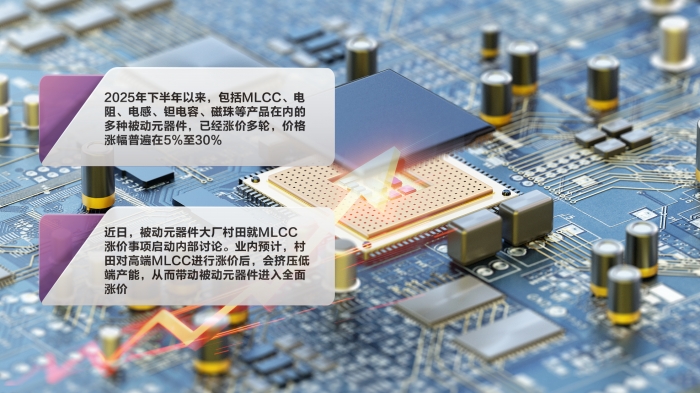
Group 1 - The core viewpoint of the articles indicates that the demand for passive components, particularly MLCCs, is set to increase significantly due to the rapid development of AI technology, leading to a confirmed price increase across the industry [2][3][5] - Murata, the largest MLCC supplier, is initiating discussions on price increases for MLCCs, with expectations to complete assessments of AI-driven demand by the end of Q1 2025 [3][5] - The price increase for passive components, including MLCCs, resistors, inductors, tantalum capacitors, and magnetic beads, is projected to range from 5% to 30% due to rising raw material costs and increased demand from AI and automotive sectors [2][5][6] Group 2 - The demand for high-end MLCCs is expected to grow significantly, with Murata's president stating that current orders for high-end MLCCs are double the company's production capacity, indicating a supply shortage that may persist for the next two years [3][4] - The passive components industry is entering a phase of multiple price increases across various regions and product categories, with several companies already announcing price hikes [5][6] - Analysts predict that the rapid advancement of AI technology will have a profound impact on the passive components industry, driving growth in high-end MLCCs and related materials [6]
看好国产大飞机及军贸主线
2026-01-20 03:54
Summary of the Conference Call Industry Overview - The focus is on the military industry, particularly in the context of China's military modernization and export potential, with two key areas of interest: domestic large aircraft and high-end military trade [2][3][4] Key Points and Arguments Domestic Large Aircraft - The domestic large aircraft, specifically the C919, is highlighted as a significant player in the market, aiming to compete with Airbus and Boeing [5][6] - The C919 has completed the third phase of certification for the European market, with expectations to finalize all certifications by mid-2027 [6][7] - The aircraft has already achieved over 4 million safe flights domestically, indicating operational success [7][8] - Future production targets for the C919 are projected to reach 200 to 400 units by 2030 to 2035, supported by a robust supply chain [8][9] - The development of derivative models, such as high-altitude and extended-range versions, is underway to meet diverse customer needs [9][10] Military Trade - The export of advanced military aircraft, such as the FC-1 (also known as the JF-17 or Thunder), is seen as a catalyst for expanding China's military trade [13][19] - The demand for the FC-1 from countries like Pakistan is expected to enhance China's military supply chain and promote further exports of advanced military equipment [13][19] - Upcoming defense exhibitions in Saudi Arabia and Singapore are anticipated to serve as platforms for showcasing China's military capabilities and fostering international military trade relationships [20][21] Investment Strategy - The investment strategy emphasizes a focus on companies that can create long-term value, particularly those involved in the second growth curve, which includes new business areas like commercial aerospace and military exports [4][5] - The military industry is characterized by a shift towards bottom-up stock selection, with a focus on individual companies that demonstrate potential for growth and profitability [4][5] Additional Important Content - The military industry is experiencing structural changes, with three main segments identified: military trade, military-to-civilian transitions, and domestic military equipment construction [3][4] - The military trade sector is expected to benefit from increased global military spending, particularly as geopolitical tensions rise [16][17] - The U.S. defense budget is projected to increase significantly, which may further stimulate global military trade dynamics [16][17] - The conference also discussed the importance of technological advancements in military equipment and the need for a comprehensive military industrial base to support these developments [17][18] Company-Specific Insights - Torch Electronics is highlighted for its growth potential in specialized electronic components and new materials, with a focus on military applications [23][24] - The company is recognized as a leading supplier of multilayer ceramic capacitors (MLCC) in the military sector, with plans for expansion into new materials for aerospace and missile applications [25][26] - Torch Electronics has implemented multiple employee stock incentive plans to align the interests of management and employees, which is expected to support long-term growth [26][27] This summary encapsulates the key insights from the conference call, focusing on the military industry, investment strategies, and specific company developments.