NIM微服务

Search documents
英伟达投资新思,背后原因曝光
半导体行业观察· 2025-12-04 00:53
Core Insights - The collaboration between NVIDIA and Synopsys aims to integrate advanced computing technologies, including AI-assisted engineering and digital twin platforms, to enhance Synopsys' product offerings and accelerate market strategies [2][11] - NVIDIA's $2 billion investment in Synopsys at a price of $414.79 per share signifies a long-term commitment to this partnership, which is expected to reshape the engineering simulation landscape [1][11] Group 1: Collaboration Details - The partnership will leverage NVIDIA's GPU technology to enhance Synopsys' EDA, simulation, and multiphysics product lines, moving beyond traditional CPU dominance in chip design [1][2] - Synopsys plans to utilize NVIDIA's tools to accelerate various engineering processes, including chip design, physical verification, and optical simulation [2][3] - The collaboration is characterized by its broad scope, aiming to integrate multiple engineering phases from transistor-level design to final physical products [2][11] Group 2: Technical Aspects - Both companies acknowledge that while some workloads currently utilize GPUs, significant algorithmic restructuring is necessary to fully capitalize on GPU acceleration [4][5] - The transition to GPU-accelerated workflows is expected to be gradual, potentially extending into 2026 and 2027, as deeper structural changes are required for multiphysics and electromagnetic workflows [5][7] - The focus on AI integration is crucial, as it will enhance Synopsys' AI technology stack and improve applications in solvers, simulators, and digital twins [7][19] Group 3: Market Opportunities - The collaboration is seen as a way to expand the simulation and modeling market by lowering costs and speeding up processes, which could lead to increased adoption across various engineering sectors [11][12] - Synopsys' recent acquisition of Ansys highlights its ambition to lead in multiphysics simulation, which is relevant across multiple industries beyond semiconductors [11][12] - The potential for significant growth in simulation demand is noted, especially if industries shift towards virtual-first workflows due to enhanced computational capabilities [12][25] Group 4: Customer Integration - The integration of accelerated workflows into customer environments remains a key focus, with Synopsys emphasizing its existing relationships across various sectors [14][15] - The specifics of how Synopsys will package and deliver its accelerated tools are still unclear, raising questions about pricing and deployment models [14][15] - NVIDIA's hardware is expected to be well-suited for these workloads, while cloud deployment is seen as a critical avenue for customers lacking high-density computing resources [15][17] Group 5: Neutrality and AI Integration - Concerns about potential bias towards NVIDIA hardware due to the investment were addressed, with both companies affirming that Synopsys' tools will continue to support multiple hardware environments [17][18] - The role of AI in engineering workflows is positioned as a complementary layer rather than a replacement for traditional solvers, emphasizing the need for verified numerical methods [19][20] - AI is expected to enhance design exploration and automate repetitive tasks, but physical solvers will remain foundational in production workflows [20][21]


20 亿美元跨界联姻!英伟达入股 EDA 巨头新思科技,GPU+AI 重构芯片设计生态
Jin Rong Jie· 2025-12-03 02:56
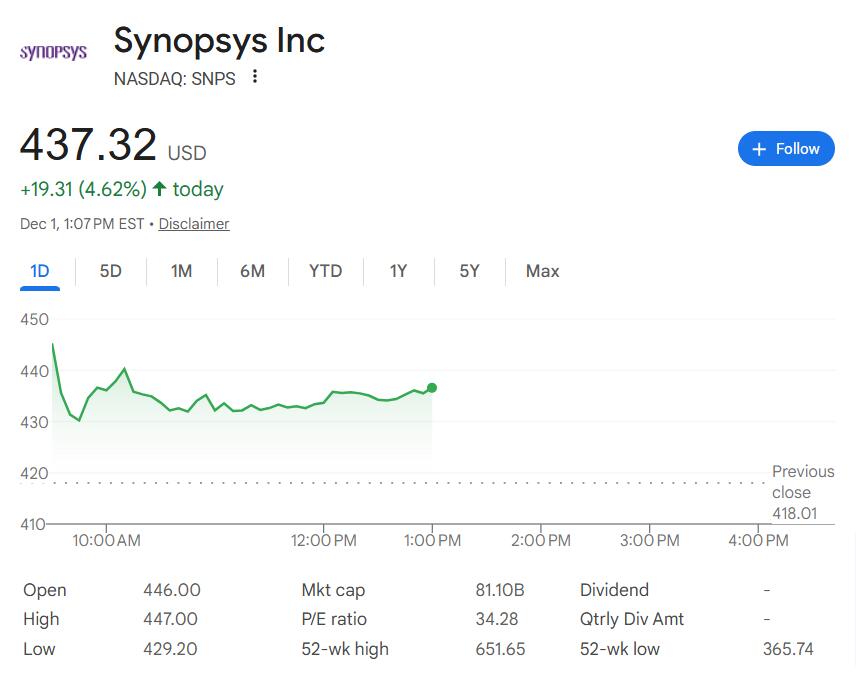
Core Insights - NVIDIA announced a $2 billion investment in Synopsys, a leading EDA company, focusing on GPU acceleration and AI integration, which is expected to reshape the global semiconductor industry landscape [1][5][7] Investment Details - NVIDIA acquired 2.6% of Synopsys shares at $414.79 per share, totaling $2 billion, making it the seventh-largest shareholder [2] - Following the announcement, Synopsys' stock price surged, reaching a peak increase of over 11% before closing up 4.85% [2] Market Impact - The investment reflects a strategic move for NVIDIA to expand from consumer AI to industrial applications, with CEO Jensen Huang describing it as a "revolutionary industry transformation" [5][6] - Synopsys holds a significant market share in the EDA sector, with an estimated 31% in 2024, alongside Cadence and Siemens [3] Collaboration Focus - The partnership will focus on three main areas: 1. Accelerating the GPU transformation of EDA tools, significantly enhancing the efficiency of Synopsys' core applications [3] 2. Developing cross-industry digital twin solutions to reduce prototype costs and increase market opportunities [4] 3. Advancing autonomous design and cloud deployment capabilities in EDA processes [4] Competitive Landscape - The collaboration is expected to set a new standard in the chip design industry, creating a strong ecosystem around NVIDIA chips and Synopsys tools, potentially forcing competitors to adapt [6][7] - Synopsys is also pursuing a $35 billion acquisition of Ansys, indicating a strategic push to strengthen its market position amid cash flow pressures [6]
英伟达与新思科技宣布战略合作 共同推动跨行业设计与工程创新
Zheng Quan Shi Bao Wang· 2025-12-02 11:15
Core Insights - Nvidia and Synopsys are expanding their strategic partnership to drive innovation across various industries, addressing challenges such as increased workflow complexity, rising development costs, and pressure on time-to-market [1][2] Group 1: Partnership Details - Nvidia is investing $2 billion to acquire 2.6% of Synopsys' common stock at a price of $414.79 per share [1] - The collaboration aims to leverage Nvidia's strengths in AI and accelerated computing alongside Synopsys' leadership in engineering solutions [1][2] Group 2: Key Initiatives - The partnership will accelerate Synopsys' product applications by utilizing Nvidia's CUDA-X libraries and AI-Physics technology, enhancing various computationally intensive applications such as chip design and physical verification [3] - Both companies will integrate Synopsys' AgentEngineer technology with Nvidia's Agentic AI technology stack to enable autonomous design capabilities in EDA and simulation workflows [3] - The collaboration will promote the use of digital twin technology to connect the physical and digital worlds, facilitating innovation in sectors like semiconductors, robotics, automotive, energy, industrial, and healthcare [3] - Joint market expansion efforts will be undertaken to promote local and cloud-based solutions, leveraging Synopsys' extensive sales force and existing customer base [3] Group 3: Non-Exclusive Agreement - The partnership is not exclusive, allowing both Nvidia and Synopsys to continue collaborating with a broader ecosystem in the semiconductor and electronic design automation (EDA) sectors [4]
英伟达砸20亿入股EDA巨头新思科技,黄仁勋盛赞“巨大扩展机遇”、否认类似OpenAI交易闭环
Hua Er Jie Jian Wen· 2025-12-01 19:25
Core Insights - Nvidia announced a strategic partnership with Synopsys, investing $2 billion to acquire a 2.6% stake, marking a significant move into the industrial design and engineering sectors [1][3][4] - The collaboration aims to integrate Nvidia's AI computing technology into the electronic design automation (EDA) field, transforming the design process from chips to systems [1][3] - Nvidia's CEO Jensen Huang emphasized the partnership's potential to tap into a trillion-dollar industrial market, far exceeding the consumer AI application space [3][7] Investment Details - Nvidia purchased approximately 4.8 million shares of Synopsys at $414.79 per share, reflecting a 0.8% discount from the previous closing price [4] - The investment positions Nvidia as Synopsys' seventh-largest shareholder, enhancing its influence in the semiconductor design software market [3][4] Strategic Collaboration - The partnership encompasses a multi-year collaboration that includes using Nvidia's CUDA-X libraries and AI physics technology to optimize Synopsys' computational applications [6] - Both companies will work on integrating Synopsys' AgentEngineer technology with Nvidia's AI technology stack to enhance EDA and simulation workflows [6] - The collaboration aims to develop advanced digital twin solutions for various industries, leveraging Nvidia's Omniverse and Cosmos technologies [6] Market Impact - Following the announcement, Synopsys' stock surged over 6.9% in early trading, while Nvidia's stock initially dipped but later rose by nearly 1.9% [1] - Huang highlighted the significant market opportunity in industrial applications, noting that spending on engineering software tools could be several billion dollars, with prototyping costs potentially 10 to 20 times higher [7] Industry Transformation - Huang described the partnership as a revolutionary shift in the design and engineering industry, moving from traditional CPU-based systems to GPU-accelerated solutions [8] - The collaboration is seen as a non-exclusive arrangement, allowing other chip manufacturers to benefit, distinguishing it from Nvidia's previous investments in AI that raised concerns about market monopolization [9][10]
谷歌vs英伟达:AI的下半场巅峰对决
雪球· 2025-11-26 08:24
Core Viewpoint - The article discusses the evolving dynamics between hardware and software companies in the AI era, highlighting the competition between Nvidia and Google as a key indicator of future trends in the industry [4][8][20]. Group 1: Historical Context - The article outlines the historical shifts in the tech industry, noting how different eras have favored certain companies: Google and Facebook in the internet age, Microsoft and Amazon in the cloud computing era, and Apple in the mobile internet era [4][5][6]. Group 2: Nvidia's Position - Nvidia has achieved a dominant position in the GPU market, with over 95% market share in training GPUs and a gross margin exceeding 75% [10]. - The company has transformed from merely selling chips to offering a comprehensive AI software suite, enhancing its platform control [10]. - Nvidia's order backlog extends to 2026, indicating strong demand from major cloud providers like Microsoft and Amazon [10]. Group 3: Google's Capabilities - Google possesses a robust AI stack, including the foundational Transformer architecture and advanced models like LaMDA and Gemini [13]. - The company has developed its own chips (TPUs) that compete with Nvidia's offerings in training efficiency [13]. - Google's extensive data ecosystem, generated from services like Search and YouTube, provides a unique advantage that is difficult for competitors to replicate [13][15]. Group 4: Market Dynamics - The article suggests that the AI landscape is shifting from a focus on infrastructure (who has more GPUs) to creating real value through AI applications [17]. - Key indicators of this shift include the increasing homogeneity of models and the rising importance of inference costs [17]. - Google’s integrated approach allows it to leverage its existing user base and data, positioning it favorably in this new phase [19]. Group 5: Competitive Landscape - The boundaries between hardware and software companies are blurring, with Nvidia venturing into software and Google developing its own chips [22]. - The article emphasizes that the true competitive advantage lies in creating a cohesive ecosystem that integrates hardware and software [23]. - Investors are encouraged to consider the potential for continued infrastructure investment favoring Nvidia or the value realization phase favoring Google [25].


570亿营收也救不了股价!机构正在疯狂抛售英伟达
首席商业评论· 2025-11-24 04:10
Core Viewpoint - Nvidia's recent earnings report for Q3 FY2026 showcased impressive revenue growth, with a 62% year-over-year increase to $57 billion and a 65% rise in adjusted net profit to $31.9 billion, significantly surpassing Wall Street expectations, thus countering the "AI bubble" narrative [3][4][10]. Financial Performance - Revenue reached $57.006 billion, up 62% year-over-year and 22% quarter-over-quarter [4]. - Gross margin stood at 73.4%, slightly down from 74.6% year-over-year [4]. - Operating expenses increased by 36% year-over-year to $5.839 billion [4]. - Operating income was $36.01 billion, reflecting a 65% year-over-year growth [4]. - Diluted earnings per share rose to $1.30, a 67% increase compared to the previous year [4]. Market Reaction - Despite strong earnings, Nvidia's stock fell over 3% after initially rising 5%, indicating market skepticism about future growth sustainability [4][21]. - The stock closed at $178.88, with a market capitalization of $4.35 trillion [4]. Business Segments Performance - Data center revenue was the highlight, contributing $51.2 billion, a 66% year-over-year increase, accounting for nearly 90% of total revenue [10][18]. - Gaming revenue reached $4.265 billion, up 30% year-over-year, driven by RTX 40/50 series sales [16]. - Professional visualization revenue grew by 56% to $760 million, serving clients like Pixar and Disney [16]. - Automotive and robotics revenue increased by 32% to $592 million, with clients including BYD and Xiaomi [16]. Structural Challenges - Nvidia faces three major structural challenges: 1. Changing valuation logic as the market repositions it as a cyclical hardware supplier [11]. 2. Core customers like Microsoft and Google developing their own chips, threatening Nvidia's competitive edge [11]. 3. Geopolitical issues, particularly export restrictions to China, limiting growth opportunities [11][27]. Future Outlook - Nvidia is focusing on rapid technology iteration with the upcoming Rubin platform and promoting its CUDA software platform to deepen developer engagement [33]. - The company is expanding into new areas such as robotics and healthcare, aiming to extend AI applications beyond data centers [34]. - Concerns about the sustainability of capital expenditures and potential market corrections are prevalent among investors [40][42]. Market Sentiment - A significant portion of institutional investors is reducing their holdings in Nvidia, reflecting a shift towards risk management amid concerns of an AI bubble [36][42]. - The debate centers on whether AI represents a transformative opportunity or if current valuations are unsustainable, with implications for Nvidia's future growth trajectory [42].