
NPO(近封装光学)

Search documents
英伟达GTC和全球光通讯大会有哪些看点?
淡水泉投资· 2026-03-27 00:03
Core Insights - The article discusses the significant trends emerging from two major tech events in March 2023: NVIDIA's GTC conference and the OFC conference, focusing on the evolution of AI computing power from training to inference [1][2]. AI Computing Power Transition - Since 2022, the focus of large models has shifted from the "training" phase to the "inference" phase, where trained models apply knowledge to generate content more effectively [2]. - This transition redefines the demand for computing hardware, moving from a reliance on raw computing power to an emphasis on communication efficiency and storage adaptation [4]. Storage Requirements - The inference phase demands "low latency, large capacity, and high reliability" in storage, necessitating detailed optimization across all storage levels [6]. - Different storage media are being utilized for specific roles, leading to structural growth in related demand [6]. Architecture Optimization - Architecture optimization focuses on high-speed communication between computing chips and storage, as well as upgrading communication architecture [10]. - Key components include: - SRAM for low-latency scenarios, enhancing data reading efficiency [10]. - LPDDR DRAM for core data caching, supporting longer context windows in large model inference [10]. - NAND flash for non-volatile storage, ensuring data retention during power outages [10]. AI Application Evolution - Since the launch of ChatGPT, AI applications have proliferated, transitioning from efficiency enhancement to monetization, with enterprise-specific AI applications becoming a clear trend [14][15]. - The enterprise sector is seen as the primary avenue for AI monetization, as general models face challenges in consumer applications [16]. Monetization Pathways - AI's efficiency gains are widespread, but monetization is actively being explored, particularly in B2B contexts [15]. - Key monetization strategies include: - Tool-based monetization, where companies pay for large model usage to double engineer productivity without increasing headcount [17]. - Selling computing power through API interfaces by leading model providers, allowing startups to create industry-specific B2B services [18]. Rise of AI Agents - The emergence of AI Agents, exemplified by OpenClaw, is expected to accelerate, with 2026 anticipated as a breakthrough year [19]. - AI Agents are projected to transform software industry pricing models, challenging traditional SaaS pricing based on headcount as they begin to replace human tasks [22].



光最好的时代-GTCOFC解读
2026-03-24 01:27
Summary of Key Points from the Conference Call Industry Overview - The optical communication industry is experiencing a rapid demand explosion, particularly in the AI data center sector, where optical interconnect capabilities are becoming a core variable determining AI infrastructure performance limits [2][3] - The industry is entering a standardization phase, with five major multi-protocol alliances formed in just 20 days, indicating a strong need for standardized interconnect technologies in the AI era [2] Market Demand and Growth Projections - The OCS (Optical Circuit Switching) market demand has significantly exceeded expectations, with Lumentum forecasting revenues of $400 million in the second half of 2026 and $1 billion in 2027, while Coherent has raised its market size prediction for OCS from $2 billion to $4 billion [3][4] - The DCI (Data Center Interconnect) market is driven by resource limitations such as power and cooling, particularly in North America, leading to a shift from Scale-out to Scale-across interconnects [4][5] - NVIDIA has indicated a demand of $1 trillion for orders by 2027, with expectations of revenues between $600 billion and $700 billion, primarily driven by large-scale data centers [8][9] Technological Developments - NPO (Near-Package Optics) technology is expected to see significant growth, addressing power density and cooling challenges, with demand projected to rise sharply by 2027 [5] - XPO (eXtremely High-Density Pluggable Optics) technology aims to enhance integration density by four times compared to traditional modules, with expected demand reaching millions of units by 2027 [6] - CPO (Co-Packaged Optics) technology is transitioning from chip demonstration to system-level solutions, with optimistic order guidance from major players like NVIDIA [6][9] Supply Chain and Production Capacity - The supply-demand gap for optical chips is widening, with Lumentum planning to increase its EML chip capacity eightfold and Coherent doubling its indium phosphide capacity by 2026 [7] - Companies like Ciena and Nokia are experiencing strong order growth, reflecting high market confidence in the DCI sector [4][5] Investment Insights - The valuation logic in the optical communication industry is shifting towards long-term growth pricing, with 2026 seen as a critical window for future demand [1][13] - Companies involved in multiple high-growth sectors, such as CPO and OCS, are likely to see enhanced investment value due to their broad market coverage and potential for growth [14] Emerging Trends - The integration of optical and semiconductor packaging is becoming a competitive advantage for optical communication companies, leveraging their expertise in optical design [12] - The industry is witnessing a trend towards pooling key components, which is expected to prepare the market for next-generation architectures based on full optical interconnects [10] Conclusion - The optical communication industry is poised for significant growth driven by technological advancements, increasing demand in AI applications, and a shift towards long-term growth valuation strategies. Key players are expected to benefit from their strategic positioning and technological innovations in the coming years [11][14]
英伟达40亿美元重注CPO
2 1 Shi Ji Jing Ji Bao Dao· 2026-03-04 10:39
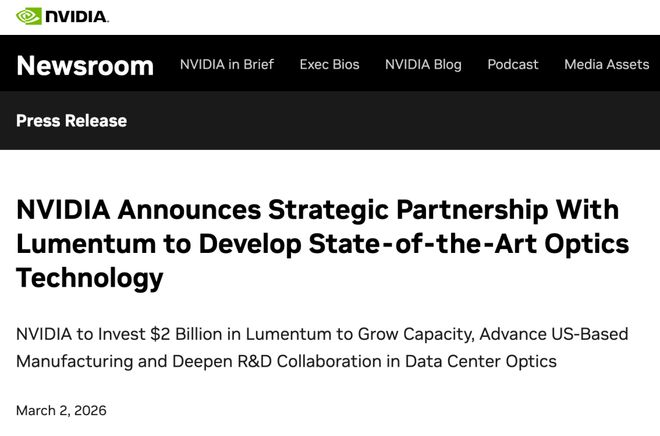
Core Insights - NVIDIA announced a strategic partnership with Lumentum and Coherent, investing $2 billion in each company to secure significant procurement commitments and future capacity rights [1][4] - The collaboration focuses on Co-Packaged Optics (CPO) technology, which is essential for enhancing the efficiency and resilience of AI infrastructure [4][6] - CPO technology is expected to become the mainstream choice for high-performance interconnects, with significant improvements in signal loss and power consumption compared to traditional methods [6][7] Investment and Strategic Moves - NVIDIA's investment in Lumentum and Coherent signals a commitment to CPO technology, which is projected to be fully implemented in AI data centers by 2026 [4][9] - The partnership aims to address the limitations of traditional electrical interconnects as AI clusters evolve from tens of thousands to hundreds of thousands of nodes [6][9] Technology Development - CPO technology integrates network switching chips and optical modules in a single package, significantly reducing signal loss from 22dB to 4dB and power consumption from 30W to 9W [6][9] - The industry anticipates that CPO will transition from server interconnects to chip-level interconnects, with external laser source (ELS) solutions being developed to manage thermal challenges [7][9] Market Trends and Projections - The CPO market is expected to accelerate, with companies like Lumentum receiving multi-million dollar orders for high-power lasers, indicating a robust demand for CPO products [9][10] - Major players such as Intel, Marvell, and Broadcom are advancing towards mass production of CPO technologies, with Broadcom set to deliver a 51.2Tbps CPO Ethernet switch in 2024 [9][10] Manufacturing and Supply Chain - Semiconductor foundries like TSMC and Intel are enhancing their capabilities in silicon photonics, with Tower Semiconductor planning to increase its silicon photonic wafer capacity significantly by 2026 [10] - The growth of CPO technology is expected to drive demand for essential components, including copper-clad laminates and optical engines, leading to a surge in component requirements [10]
英伟达40亿美元重注CPO,商用拐点临近?
2 1 Shi Ji Jing Ji Bao Dao· 2026-03-04 09:54
Core Insights - Nvidia announced strategic partnerships with Lumentum and Coherent, investing $2 billion in each company to secure procurement commitments and future capacity rights, emphasizing the importance of optical interconnect technology and co-packaged optics (CPO) for the expansion of AI infrastructure [1] - The industry consensus is shifting towards "electrical computing and optical transmission" as traditional electrical interconnect technologies approach physical limits, with CPO expected to address the shortcomings of traditional optical modules [2] - CPO technology is anticipated to become mainstream within 2-3 years, with significant applications in server interconnects and challenges in chip-level interconnects being addressed through external laser source (ELS) solutions [3] Industry Developments - The CPO industry is accelerating towards commercialization, with growth expected across upstream silicon photonics chip manufacturing, midstream optical engine packaging, and downstream equipment integration [4] - Global companies like Intel, Marvell, and Broadcom are advancing CPO technology towards mass production, with Broadcom set to deliver the world's first 51.2 Tbps CPO Ethernet switch in 2024 [5] - Domestic companies such as Zhongji Xuchuang and Xinyi Sheng are also ramping up their CPO technology development efforts [5] Component Demand - The advancement of CPO technology is projected to drive significant growth in core components such as M9-grade copper-clad laminates, NPO/CPO optical engines, external laser sources, and fiber connection units [6]
利好释放!这一板块,异动拉升!
Zheng Quan Ri Bao Zhi Sheng· 2026-01-27 05:39
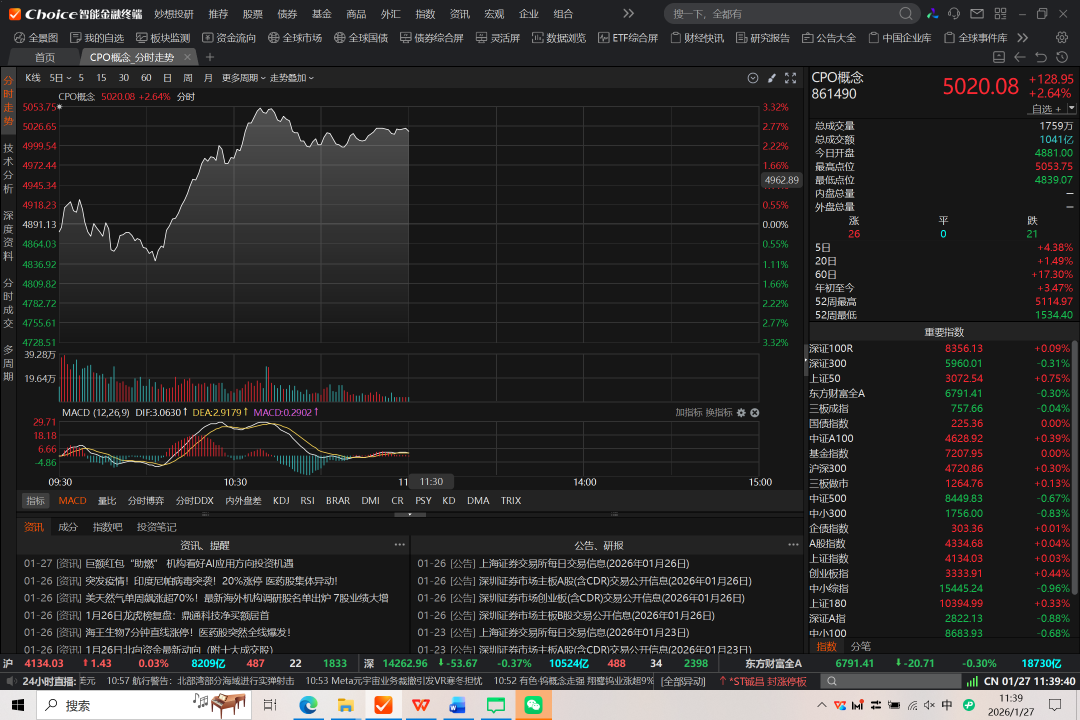
Core Viewpoint - The CPO (Co-Packaged Optics) concept is experiencing a strong recovery driven by the explosive growth in global AI computing demand, leading to increased orders for high-speed optical modules and a revaluation of the sector based on performance drivers [1][3]. Group 1: Market Performance - On January 27, the A-share market saw a surge in the technology sector, particularly in the optical communication segment, with stocks like Kewen Technology and Zhongci Electronics hitting the daily limit [1]. - The CPO concept index rose by 2.64%, with a total transaction volume of 104.1 billion [2]. Group 2: Industry Insights - The CPO technology is transitioning from laboratory experiments to large-scale commercial applications, becoming a new focal point for capital investment as AI computing needs surge [3]. - Key players in the CPO market, such as Zhongji Xuchuang, Xinyi Sheng, and Tianfu Communication, are positioned as core suppliers for global AI infrastructure due to their early advantages in the 800G/1.6T optical module sector [3]. Group 3: Technological Developments - The industry is rapidly evolving, with NPO (Near-Packaged Optics) emerging as a critical solution for transitioning from CPO to fully integrated optical interconnects, driven by efficiency improvements [4]. - Several listed companies have made significant breakthroughs in the CPO field, with advancements in silicon photonics and integrated optical interconnect solutions [4]. Group 4: Company-Specific Developments - Zhongci Electronics, a leader in high-end ceramic packaging, is benefiting from increased demand for optical chip packaging, maintaining high capacity utilization and planning to expand production to meet market needs [5]. - The company anticipates a continuous increase in relevant product output in 2026, with ongoing R&D for CPO ceramic substrates expected to reach mass production within three years [5]. Group 5: Employment and Policy Implications - The Chinese government is implementing measures to support employment in key industries, reflecting a commitment to a smooth transition during the technological revolution [6]. - The rise of AI is expected to create new high-skill jobs, such as optical module engineers and AI operations experts, emphasizing the need for alignment between education and industry demands [6].



叶磊Leo:AI光模块市场预测和新技术展望
Tai Mei Ti A P P· 2025-12-24 09:48
Core Insights - The optical communication industry is facing unprecedented opportunities and challenges due to explosive growth in computing power demand, with optical modules becoming a critical bottleneck in data center development [1][2] - The supply-demand dynamics of the AI optical module market are expected to undergo significant changes by 2026, with current supply constraints primarily driven by four key bottlenecks [2][4] - Emerging technologies such as silicon photonics, CPO, NPO, hollow-core fibers, and micro LED communication are attempting to break existing bottlenecks, but face challenges in cost, reliability, and market acceptance [1][10][22] Supply and Demand Dynamics - AI data centers are currently experiencing a severe shortage of optical modules, a trend expected to continue through 2025, with actual shipment volumes constrained by supply-side factors [2][3] - The demand for 800G and 1.6T optical modules is projected to reach approximately 42 million units by 2025, although inflated market predictions exist [3][4] - Supply-side bottlenecks include shortages of optical chips, optical components, equipment, and skilled personnel, which are critical for production capacity expansion [4][5] Technology Development - Silicon photonics technology is struggling with integration challenges, leading to high costs and low yield rates, which hinder its competitiveness against traditional discrete optical modules [7][8] - CPO technology offers significant advantages in bandwidth density but faces challenges related to integration costs and maintenance difficulties [10][11] - NPO represents a compromise between traditional optical modules and CPO, but its adoption is met with skepticism from traditional optical module manufacturers [12][13] Emerging Technologies - Hollow-core fibers and micro LED communication are highlighted as promising technologies but face significant barriers to commercialization, including high manufacturing costs and integration challenges [22][23][24] - Hollow-core fibers can potentially offer faster transmission speeds and longer distances but require substantial cost reductions to be viable [22][23] - Micro LED technology, while energy-efficient, struggles with performance limitations and the need for a complete overhaul of the existing supply chain [24][25] Market Predictions - By 2026, the optical module market is expected to transition from a state of supply constraints to a more balanced supply-demand scenario, although challenges will persist [5][6] - The industry is at a critical juncture as it approaches the 3.2T era, with significant uncertainty surrounding the technological pathways and potential disruptions to existing market structures [19][20][21]
