
Optimus Gen2

Search documents
集邦咨询:预计人形机器人对固态电池的需求有望于2035年超74GWh
智通财经网· 2026-01-28 09:09
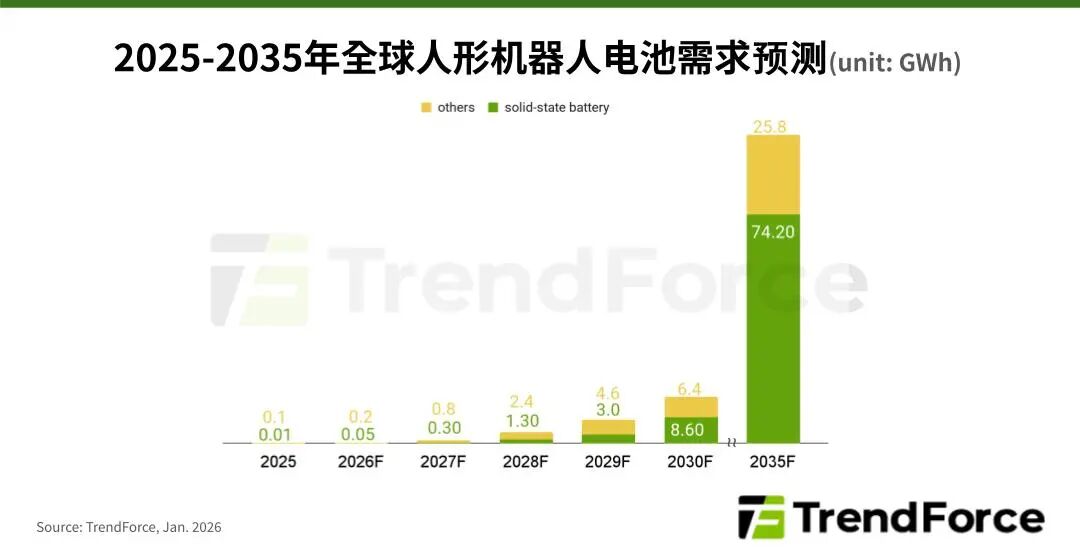
Core Insights - The development of humanoid robots is expected to reach a commercialization milestone by 2026, increasing the importance of batteries as an "energy supply" [1] - Solid-state lithium batteries are projected to become the mainstream solution due to their high energy density, with demand from humanoid robots expected to exceed 74 GWh by 2035, growing over a thousand times from 2026 [1] Group 1: Humanoid Robot Battery Market - Global humanoid robot shipments are forecasted to surpass 50,000 units in 2026, representing an annual growth of over 700% [4] - High-nickel ternary lithium batteries (NMC/NCA) are currently the mainstream choice for robot batteries due to their relatively high energy density, while lithium iron phosphate batteries (LFP) are used for lower endurance applications [4] - Most humanoid robots currently have a battery capacity below 2 kWh, with typical endurance ranging from 2 to 4 hours, such as Unitree's H1 with 0.864 kWh and Tesla's Optimus Gen2 with 2.3 kWh [4] Group 2: Challenges and Opportunities - The development of humanoid robot batteries faces two main challenges: the rapid iteration of core technologies affecting battery customization and the current focus on finding scalable commercial applications rather than improving endurance [5] - Despite these challenges, the demand for high energy density, high discharge rate, and high safety batteries in humanoid robots presents an opportunity for solid-state batteries to demonstrate their advantages [5] - Breakthroughs in solid-state battery technology and cost reductions are expected to help humanoid robots overcome power limitations [5]


镁行业系列报告一:奇点已至,镁业腾飞
Orient Securities· 2026-01-16 02:21
Investment Rating - The report maintains a "Positive" investment rating for the magnesium industry [7]. Core Viewpoints - The magnesium industry is approaching a "singularity moment" as the penetration of magnesium alloys in the electric vehicle and humanoid robot sectors accelerates, with leading manufacturers expected to see a rapid release of orders [4][14]. - The magnesium-aluminum ratio is at a historical low, opening up cost-effective opportunities for magnesium to replace aluminum in various applications [10][12]. - Technological advancements are addressing the corrosion resistance and processing challenges of magnesium alloys, facilitating broader application [10][11]. Summary by Sections 1. Lightweight Cycle Review - The penetration rate of magnesium alloys has lagged behind expectations, particularly in the electric vehicle sector, where the aluminum usage per vehicle is significantly higher than that of magnesium [23][24]. 2. Low Magnesium-Aluminum Ratio - The magnesium-aluminum ratio has dropped below 1, indicating that magnesium alloys are becoming more economically viable compared to aluminum [10][12]. - The supply of aluminum remains tight due to high overseas electricity prices and operational challenges, while the magnesium supply is gradually stabilizing [34][46]. 3. Technological Breakthroughs - Advances in semi-solid forming technology are improving the mechanical properties and corrosion resistance of magnesium alloys, thus expanding their application potential [10][11][32]. - The demand for lightweight materials in electric vehicles and humanoid robots is increasing, with projections indicating a significant rise in magnesium alloy usage [10][12][41]. 4. Summary - The magnesium industry is expected to experience growth driven by increasing demand and supply optimization policies, benefiting leading magnesium refining companies [54][56]. 5. Listed Companies - Key investment targets include Baowu Magnesium Industry (002182, Buy) and Xingyuan Zhuomag (301398, Not Rated), both of which are positioned to benefit from the industry's growth [4][14].

人形机器人的轻量化:镁合金与特种工程塑料(附50页PPT)
材料汇· 2025-11-05 15:57
Core Viewpoint - The article emphasizes the importance of material substitution as a key method for lightweighting in humanoid robots, while structural optimization is ideal but progresses slowly. This reflects the insufficient maturity of the industry chain, leading manufacturers to prefer readily available mature material solutions [4]. Group 1: Lightweighting in Humanoid Robots - Lightweighting is not just about weight reduction; it involves system-level optimization that directly relates to energy efficiency, thermal management, supply chain, and scenario adaptability [4]. - The reduction in weight leads to lower power requirements for motors and bearings, allowing for a broader selection of supply chain options [13]. - Enhanced dynamic stability through lightweighting can improve center of mass control, but materials must possess both lightness and high rigidity, necessitating upgrades in sensors and control algorithms [14]. Group 2: Material Trends - Aluminum alloys are currently the main materials for lightweight applications, while magnesium alloys are emerging as new contenders [38]. - The market for aluminum and magnesium alloys in humanoid robots is projected to reach 101 billion and 37 billion respectively by 2030, with a high CAGR of 130.2%, indicating explosive industry growth expectations [78]. - Magnesium alloys, despite having a market size only one-third that of aluminum alloys, may experience faster growth due to lower prices and increasing demand [79]. Group 3: Engineering Plastics and Material Substitution - The article discusses the ongoing trend of substituting plastics for steel in automotive applications, with a focus on lightweighting through the use of various engineering plastics [86]. - The development of thin-walled and high-performance engineering plastics is crucial for achieving lightweight goals in the automotive sector, with thickness targets decreasing from 2.3mm in 2020 to 1.6mm by 2035 [89]. - Special engineering plastics like PEEK, PPS, and LCP are highlighted for their superior properties, making them key materials for lightweighting in humanoid robots [100][104]. Group 4: Market Dynamics and Company Performance - Companies like Aikodi and Xuji Group are actively expanding their product lines to include aluminum and magnesium alloys for both automotive and robotics applications, indicating a dual-driven growth strategy [85]. - The lightweighting trend is supported by a clear policy direction, but the establishment of a low-cost manufacturing system remains a critical bottleneck [45]. - The article notes that while domestic companies are increasing production capacity for materials like PEEK, they still face challenges in achieving quality consistency compared to imported materials [134].

人形机器人轻量化大势所趋,关注产业链投资机会 | 投研报告
Zhong Guo Neng Yuan Wang· 2025-08-18 02:54
Core Viewpoint - The trend of lightweight humanoid robots is becoming a core aspect of their commercialization process, driven by product iterations from leading domestic and international companies [1][4]. Market Review - From August 11 to August 15, the CSI 300 index rose by 2.4%, while the machinery sector increased by 3.1%, ranking 11th among all primary industries. The laser processing equipment sector saw the highest increase at 9.0%, whereas the engineering machinery sector experienced the largest decline at 0.4% [2]. Industry Insights - The lightweight humanoid robots offer advantages such as improved endurance, flexibility, reduced costs, and decreased safety risks associated with heavy machinery. For instance, Tesla's Optimus Gen2 reduced its weight from 73 kg to 63 kg, achieving a 10 kg reduction while enhancing walking speed by 30% and improving balance and overall control. Additionally, Unitree Technology's Unitree G1 weighs only 35 kg, utilizing a combination of aluminum alloy and engineering plastics to balance strength and lightweight design [4]. - The lightweight design of humanoid robots can be achieved through structural and material lightweighting. Structural lightweighting involves parameter optimization, topology optimization, morphological optimization, and integrated design. Material lightweighting focuses on replacing traditional metals with low-density, high-performance materials, such as magnesium alloys, PEEK, and carbon fiber, which meet mechanical strength, heat resistance, and corrosion resistance requirements while reducing weight [4]. - The industry recognizes that lightweighting significantly enhances the endurance, performance, and safety of humanoid robots, marking it as an important trend for future development. Investment opportunities in the related supply chain are recommended [4].
特斯拉机器人消息不断 六大概念股盘点(名单)
Zheng Quan Zhi Xing· 2025-08-14 07:57
Group 1: Industry Overview - The global humanoid robot industry is projected to reach a market size of $3.4 billion in 2024, representing a year-on-year increase of 57.41%, and is expected to grow to $5.3 billion in 2025, with a potential to exceed $20.6 billion by 2028, indicating a high compound annual growth rate [3]. - The humanoid robot sector is positioned at the beginning of a growth trajectory, with significant potential for expansion in both global and Chinese markets, driven by advancements in artificial intelligence and precision manufacturing [3]. Group 2: Tesla's Optimus Robot - Tesla's Optimus Gen2 humanoid robot has undergone significant upgrades, including a weight reduction of approximately 10 kg, a 30% increase in walking speed, and a doubling of hand dexterity to 22 degrees of freedom, with an overall freedom of movement reaching 28 degrees [2]. - The Optimus Gen2 robot stands 1.73 meters tall, weighs 57 kg, and can perform tasks such as squatting and delicate actions like egg squeezing, with a load capacity of 20 kg and a walking speed of 8 km/h [2]. - Tesla is already working on the third generation of Optimus, which aims to enhance coordination and the ability to perform complex tasks, such as folding clothes and caring for children [2][3]. Group 3: Key Companies in the Supply Chain - Sanhua Intelligent Control (三花智控) is a core supplier of rotating joint assemblies for Tesla's humanoid robots and has entered small-scale trial production for liquid cooling modules [4]. - Top Group (拓普集团) serves as a first-tier supplier for Tesla's robots, responsible for linear joint assembly supply, with a factory in Mexico expected to start production in Q3 2025 [4]. - Harmonic Drive (绿的谐波) is a leading domestic company in harmonic reducers, providing products that meet international standards and are compatible with Tesla's Optimus [4]. - Inovance Technology (汇川技术) is a domestic leader in humanoid robot components, specializing in servo systems and rotary actuator modules suitable for Tesla's Optimus [4]. - Mingzhi Electric (鸣志电器) is a leading provider of dexterous hand components for humanoid robots, with high-precision stepper motors that rank among the top three globally and have entered Tesla's supply chain [4]. - Wuzhou Xinchun (五洲新春) collaborates with Hangzhou Xinjian to support Tesla's supply chain with planetary roller screw products [4].



机器人行业专题报告:轻量化:人形机器人重要产业趋势 镁合金、PEEK等材料或迎来渗透率向上
Xin Lang Cai Jing· 2025-05-07 06:43
Group 1 - The trend of lightweighting is crucial for humanoid robots, enhancing aspects such as endurance, performance, and lifespan, with significant industry acceleration expected due to policy and capital support [1] - Major robot manufacturers like Tesla, UBTECH, and Yushun are adopting weight reduction and lightweighting strategies in their iterations, with Tesla's Optimus Gen2 reducing weight by 10 kg and increasing walking speed by 30% compared to Gen1 [1] - Lightweight materials such as magnesium alloys, PEEK, and carbon fiber are being widely applied in various components of humanoid robots, including body shells, joints, gears, and motors [1] Group 2 - Magnesium alloys are highlighted for their excellent properties, including a density one-third that of aluminum alloys and superior damping and noise reduction capabilities, making them suitable for lightweight applications [1] - The price ratio of magnesium to aluminum has remained low, enhancing the cost-effectiveness of magnesium alloys, with a notable example being the ER4-550-MI industrial robot, which achieved an 11% weight reduction and a 10% decrease in power consumption while improving performance by 5% [1] - PEEK is recognized as a high-performance engineering plastic with applications in harmonic reducers, offering excellent thermal resistance, mechanical strength, and chemical stability, with a projected market growth rate exceeding 10% annually [2] - Domestic companies are pushing for local alternatives in the PEEK market, with firms like Zhongyan Co., Pengfulong, and Water Co. making strides against established international players [2] Group 3 - Investment recommendations suggest focusing on companies benefiting from the lightweighting trend in humanoid robots, with specific mentions of magnesium alloy producers like Xingyuan Zhuomei, Xusheng Group, and Rongtai Co., as well as PEEK manufacturers such as Xinhang New Materials, Zhongxin Fluorine Materials, and Watte Co. [2]