Seedream 4.0

Search documents
谷歌Nano Banana 2来了,设计师时代结束了?
Di Yi Cai Jing· 2026-02-27 05:54
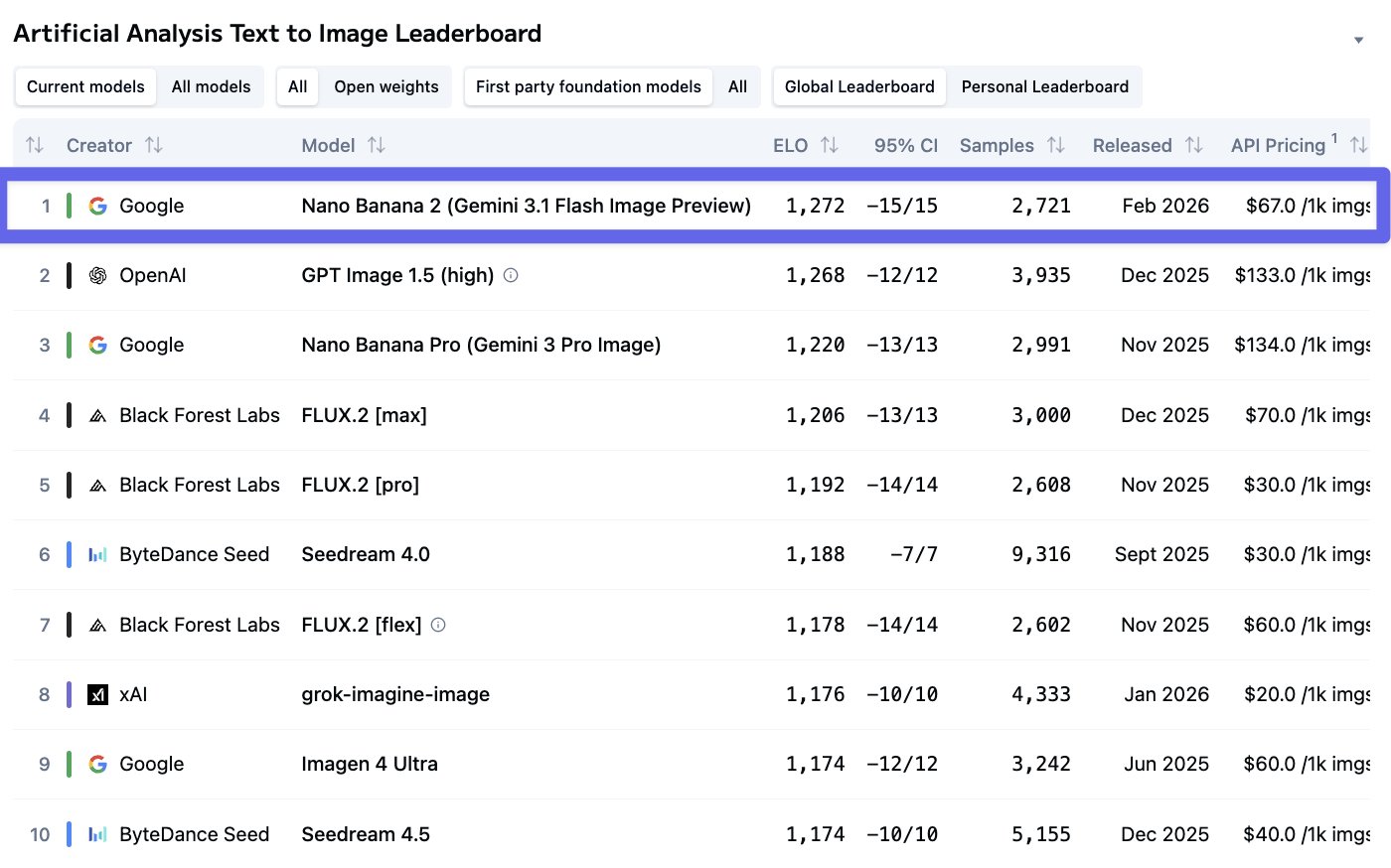
Core Insights - Google has launched Nano Banana 2 (Gemini 3.1 Flash Image), which combines speed and performance at a lower price point, marking it as the best image generation and editing model to date [1][4]. Group 1: Product Performance - Nano Banana 2 ranks first in the text-to-image leaderboard and third in the image editing leaderboard, outperforming GPT Image 1.5 and Nano Banana Pro [1][4]. - The model offers advanced world knowledge, precise text rendering and translation, thematic consistency, accurate instruction execution, and improved visual fidelity [4][13]. - It can generate high-quality, photo-realistic images while maintaining character likeness and object consistency, enhancing narrative creation [16]. Group 2: Pricing and Cost Efficiency - Nano Banana 2 is priced at half the cost of Nano Banana Pro, with a per-image cost of $0.067 for 1k images and $0.5 for input, compared to $0.134 and $2 for the Pro version [4][5]. - The model's cost-effectiveness has been highlighted by both evaluation agencies, emphasizing its superior performance and speed [4]. Group 3: User Experience and Applications - Google has developed a program called "Window Seat" to demonstrate the model's capabilities, allowing users to generate realistic images based on real-time weather data [5]. - The model supports advanced text rendering and localization, enabling dynamic UI generation and multi-language text integration in images, which is valuable for international businesses [13]. - Users have reported mixed experiences, with some noting issues in accuracy and stability, particularly in complex scenarios [11][16].


谷歌 Nano Banana 2 一夜补齐短板,各种图解都能画,价格才是 OpenAI 一半
3 6 Ke· 2026-02-27 04:10
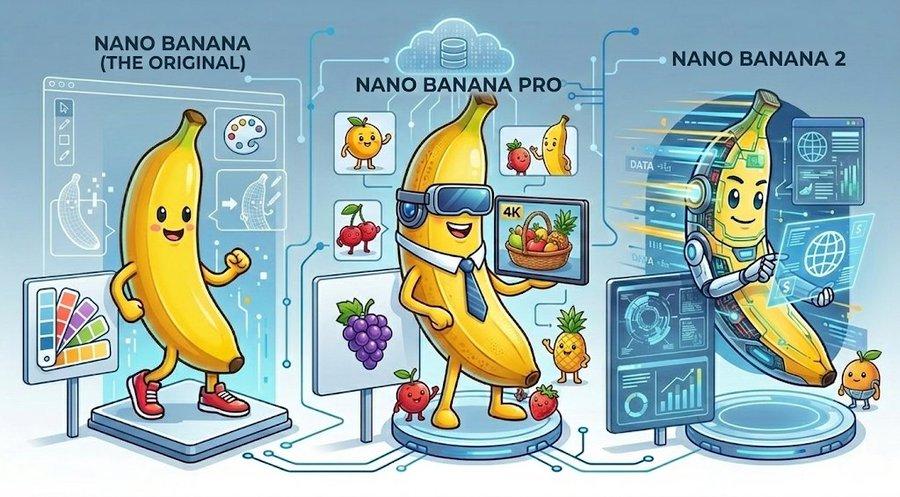
Core Insights - Google has launched Nano Banana 2, which emphasizes "speedy experience" and "professional image quality," with a significant new feature of "real-time connectivity" that enhances its capabilities beyond mere image generation [1][10]. Group 1: Product Features - Nano Banana 2 integrates with Gemini's search capabilities, allowing the model to understand, retrieve, and generate images that are more aligned with real-world information structures [1]. - The model can generate detailed street scenes and character interactions that are nearly indistinguishable from real photographs, showcasing its advanced rendering capabilities [2][3]. - The "real-time connectivity" feature allows for precise generation of images based on real geographical and meteorological data, enhancing the model's utility in various contexts [5][41]. Group 2: Competitive Landscape - In the latest Artificial Analysis rankings, Nano Banana 2 secured the top position, with its image editing capabilities ranking third, while being priced at half of its closest competitor, OpenAI [8][9]. - The competition in the image generation sector has intensified, with leading models showing minimal score differences, indicating a close race among top players [9]. Group 3: User Experience and Applications - Users have reported that Nano Banana 2's ability to generate high-quality images with accurate text rendering has significant implications for marketing materials and global communication [45]. - The model's enhanced consistency in character design and scene elements allows for seamless storytelling in comics and branding [51]. - The ability to visualize complex concepts and data efficiently positions Nano Banana 2 as a transformative tool in education, research, and data analysis [43][42]. Group 4: Technical Upgrades - The model has improved text rendering and translation capabilities, allowing for natural integration of text within images, which is crucial for marketing and promotional content [45]. - It supports multiple resolutions, including a new 512px option optimized for low-latency scenarios, making it suitable for rapid prototyping and iteration [64]. - The visual quality of generated images has been upgraded, with more natural lighting, richer materials, and sharper details, making it a viable tool for professional use [66].
国海证券晨会纪要-20260129
Guohai Securities· 2026-01-29 01:05
Group 1: Company Overview - The report highlights the growth potential of the company through AIDC power engines, expansion to external customers, entry into the new energy sector, and a focus on internationalization [3][4] - The company is one of the few domestic manufacturers capable of producing high-power, high-displacement medium-speed internal combustion engines, with dual production capacity from Lingzhong Engine and Shanghai Diesel Engine [3][4] - The completion of the restructuring of SAIC Hongyan has significantly reduced the company's financial burden, leading to a projected turnaround in net profit for 2025 [5][6] Group 2: Financial Performance - The report anticipates a one-time gain of 3.367 to 3.467 billion yuan from the equity disposal due to the restructuring, which is expected to improve the company's financial structure [5] - The forecasted revenue for 2025-2027 is 6.09 billion, 6.77 billion, and 7.69 billion yuan, with year-on-year growth rates of -6%, +11%, and +14% respectively [7] - The projected net profit for the same period is 2.79 billion, 300 million, and 460 million yuan, with significant fluctuations in growth rates [7] Group 3: Strategic Direction - The new leadership has set a strategic goal to double sales and revenue by 2025, focusing on new energy and internationalization as key growth areas [6] - The company aims to diversify its revenue streams by increasing its presence in high-value, technology-intensive segments, including power batteries and electric drive bridges [6] - The strategy includes enhancing the proportion of external supply and optimizing product structure and overall profitability [6] Group 4: Industry Context - The report discusses the broader context of the AIDC power engine industry, noting high barriers to entry and the increasing demand for reliable power sources driven by AIDC construction expansion [4] - The report indicates that the current inflation in the computing power industry is expected to continue, which may improve profit elasticity for related companies [16][18] - The anticipated price adjustments by major cloud service providers reflect the tightening supply-demand dynamics in the AI training and inference markets, which could impact the overall cloud computing landscape [15][18]

我们是如何把中国最会搞AI的一群人,做成手办礼物送给他们的|Jinqiu Scan
锦秋集· 2025-11-07 04:04
Core Viewpoint - The article discusses the innovative use of AI in creating personalized figurines for CEOs, showcasing how AI can transform from a mere tool into a collaborative partner in creative processes [4][32]. Group 1: Event Overview - On November 1, the Jinqiu Fund held its first annual CEO conference themed "Experience with AI" [3]. - The event aimed to provide each CEO with a unique gift that reflects their individuality, leading to the idea of custom AI-generated figurines [4]. Group 2: AI Figurine Creation Process - The process began with collecting 1-2 photos of each participant along with their interests and fields, using tools like Seedream 4.0 to generate various design styles [8]. - A foundational prompt was used to create a 1/7 scale model in a Q-version style, ensuring high fidelity to the reference images [9]. - Additional descriptions were added to the prompt based on individual characteristics, ensuring accurate representation [10][11]. Group 3: Challenges and Solutions - The AI model demonstrated strong capabilities in style conversion and detail modification, but some issues remained, such as the need for precise prompts to avoid inaccuracies [33][34]. - The model's understanding of proportions and interactions between subjects required explicit instructions to ensure balanced outputs [35]. Group 4: Production and Collaboration - After confirming the initial designs, the Jinqiu Fund partnered with "Shumei Wanshu" for production, utilizing their self-developed model Hitem3D to enhance resolution and detail [39]. - The production process included human collaboration for model refinement, ensuring the final products met quality standards [41][42]. Group 5: Final Product and Impact - The final custom figurines represented a successful integration of creativity, AI capabilities, and manufacturing processes, turning the concept of "experiencing AI" into a tangible keepsake [44].

16个AI的锦秋CEO大会海报比稿大战,谁能拿到设计费?
锦秋集· 2025-11-01 00:06
Core Insights - The article discusses the exploration and evaluation of AI products in real-world applications, focusing on how technology, capital, and creativity intersect in the AI era [1][5][56]. Group 1: AI Product Evaluation - A practical evaluation involving 16 AI tools was conducted to assess their performance in generating visual content in a Chinese context [2][3][4]. - The evaluation aimed to test the capabilities of these AI models in producing high-quality visual outputs that align with brand aesthetics and communication [5][6]. Group 2: Testing Scenarios - Three typical scenarios were designed for the evaluation: main visual testing, artistic concept creation, and application for social media promotion [8][9][21]. - Each scenario had specific prompts to guide the AI tools in generating relevant visual content [9][21]. Group 3: Results and Observations - The results indicated that only the first tier of AI models could generate outputs that were usable in terms of Chinese recognition, composition logic, and brand semantics [50]. - The first tier included models like Hunyuan Image 3.0 and Seedream 4.0, which demonstrated high completion rates and aesthetic quality [30][31]. - The second tier showed artistic strengths but lacked stability in Chinese language and semantic understanding, while the third tier struggled with execution and completion [36][42][49]. Group 4: Future Outlook - The article expresses optimism about the future development of AI tools, suggesting that there is significant room for innovation and improvement in AI design capabilities [53][54]. - The upcoming CEO conference aims to explore how AI can reshape industry logic, influence capital cycles, and inspire creativity [56][58].



AI几分钟生成的绘本,你敢给孩子读吗?
创业邦· 2025-10-31 00:08
Core Insights - The article discusses the rise of AI-generated picture books, highlighting the ease of creation and the potential for customization in storytelling through AI technology [6][24][30]. Group 1: AI Technology and Capabilities - AI has advanced to a point where users can create picture books by simply describing a story in natural language, with AI generating the content in under a minute [6][8]. - The Gemini AI model has introduced features like Storybook, allowing users to input brief descriptions and receive a complete illustrated story [6][18]. - The consistency of character design has improved significantly, addressing previous issues where characters would change appearance throughout the story [14][18]. Group 2: Market Trends and Business Models - The AI picture book market is driven by a demand for customized stories, with parents seeking unique narratives for their children [28][29]. - Many content creators are monetizing AI picture book creation by selling tutorials and prompts, indicating a shift towards teaching others how to utilize AI tools rather than selling the books themselves [24][30]. - The emergence of one-stop platforms for AI picture book creation simplifies the process, making it accessible to non-professionals and increasing the volume of creative output [22][28]. Group 3: Educational Applications and Social Impact - AI picture books are being utilized in educational contexts, such as helping children learn English through engaging visual stories [26][28]. - There is a growing interest in using AI-generated content to address specific needs, such as creating resources for children with autism [26][28]. - The demand for diverse and inclusive narratives in children's literature is prompting parents to seek out AI-generated stories that reflect broader themes [27][29]. Group 4: Challenges and Limitations - Despite advancements, AI-generated picture books still face challenges in achieving the depth and nuance of traditional publishing, with concerns about the quality of storytelling and artistic expression [29][32]. - The "black box" nature of AI models raises ethical concerns, particularly regarding the biases that may be present in the training data, which could affect the content produced for children [32][33]. - Current AI models struggle with modifying existing content, indicating a need for further development in the customization capabilities of AI-generated stories [32].

爆火的AI三宫格图片,比我们的生活更像电影。
数字生命卡兹克· 2025-10-24 01:32
Core Viewpoint - The article discusses the recent trend of creating three-panel AI-generated images, highlighting the cultural significance and emotional resonance behind this phenomenon, which reflects a desire to narrate personal stories through a cinematic lens [46][49][55]. Group 1: Trend and Popularity - The three-panel AI images have gained immense popularity on platforms like Douyin and Xiaohongshu, with likes reaching thousands [3]. - Various user-generated content has emerged, including artistic and abstract interpretations, showcasing the versatility of the format [10][11][17]. Group 2: Creative Process - Users can easily create these images using the Seedream 4.0 AI tool, which allows for customization through prompts [32]. - A template for creating three-panel images is provided, emphasizing the importance of scene description, character details, and overall aesthetic [33][34]. Group 3: Cultural Reflection - The article draws parallels between the current trend and past social media practices, noting that the desire to present life as a cinematic experience has remained consistent over the years [46][49]. - The use of AI to generate idealized versions of oneself serves as a form of escapism and self-expression, allowing individuals to project their aspirations [55][56].

张一鸣公开谈AI人才“过拟合”
Sou Hu Cai Jing· 2025-10-13 13:51
Core Insights - Zhang Yiming, founder of ByteDance, highlighted the shortcomings in AI talent training during the opening ceremony of the Shanghai Xuhui Zhichun Innovation Center, emphasizing the issue of "overfitting" in talent capabilities [1][10] - The demand for AI positions surged tenfold in the first seven months of 2025, with a significant shortage of algorithm-related talent, particularly in search algorithms, where the ratio is "5 positions for 2 candidates" [3][8] - ByteDance's recruitment index for AI positions is the highest among the top 20 companies hiring for new AI roles, indicating a strong focus on AI talent acquisition [3][8] Talent Strategy - The establishment of the Shanghai Xuhui Zhichun Innovation Center aims to recruit young individuals interested in computer science and AI, reflecting ByteDance's commitment to nurturing innovative talent [3][9] - Zhang Yiming's approach signifies a shift in how ByteDance views talent, treating it as a core parameter for algorithm evolution rather than a disposable resource [3][10] - The center plans to cultivate talent through practical exploration, focusing on independent thinking and resilience [10][11] AI Development Initiatives - ByteDance has made significant advancements in AI, launching various key products and models, including the "Kouzi Space" for productivity enhancement and the "Doubao" general model [6][7] - The company has been rapidly upgrading its models, with the "Doubao 1.6" version released in June, and has achieved top rankings in video generation tasks [7][8] - ByteDance's recruitment plan for 2026 includes hiring over 5,000 fresh graduates, with a 23% increase in demand for R&D positions [8][9] Industry Context - The AI sector is at a critical juncture, transitioning from technology to industry application, with a pressing need for talent that can address real-world complex problems [10][12] - Zhang Yiming's focus on fostering cross-disciplinary talent aims to overcome the limitations of traditional talent training, which often leads to a disconnect between technical skills and business challenges [11][12] - The company is striving to create a closed-loop ecosystem for AI infrastructure, covering various applications from foundational models to intelligent agents [12][14]
全球Agent产业化竞速
CAITONG SECURITIES· 2025-10-12 06:42
Investment Rating - The report maintains a "Positive" investment rating for the industry [2] Core Insights - The global large model Agent capability is accelerating its industrialization, shifting from a focus on parameter scale competition to embedding Agent capabilities into systems and core entry points [7][10] - The transformation of large models is evolving from "single language interaction" to "multi-modal perception," enabling them to "see and do" while being controllable and manageable throughout the entire process [10] - Domestic companies are collaborating around a "model-entry-computing power" framework, establishing a triangular industrial structure that is gradually closing the loop from "model → platform → entry/scenario → supply side" [7][10] Summary by Sections Global Large Model Agent Capability Industrialization - Since September 2025, the focus has shifted from "parameter scale competition" to "Agent capability embedding," with significant advancements in commercial viability from companies like OpenAI, Anthropic, and Google [10] - OpenAI's Sora 2 model and app have entered a commercial operational phase, integrating video generation technology with compliance management [12] - Anthropic's Claude Sonnet 4.5 model enhances engineering capabilities for long-term tasks and tool operations, focusing on production environment usability [13] - Google has integrated Gemini into Chrome, enabling high-frequency scenarios and expanding capabilities from answering to executing tasks [18] Content, Agent, and Entry Advancement: Paths of Overseas Leading Companies - Overseas companies are using product forms and system interfaces to support Agents, transitioning from "can speak and answer" to "can see and do" [22] - The focus is on thickening entry points (browsers/home) and toolchains (SDK/testing/security) to facilitate the transition from technical demonstrations to industrialization [22] Model-Entry-Computing Power Convergence: The Chinese Path - Alibaba's Qwen3-Max flagship model leads the "model-platform-entry" upgrade, establishing a comprehensive path from foundational models to enterprise tools and creative entry points [23] - Tencent's Agent Development Platform 3.0 and mixed models have shown significant advancements, with a focus on efficiency and global expansion [28] - Baidu's Wenxin model X1.1 has improved performance metrics significantly, enhancing its capabilities in complex writing and long-term tasks [30] Domestic and International AI Upgrade Resonance - The AI industry is entering a critical phase of large-scale implementation, with future competition focusing on the construction of an "engineering triangle" system [47] - The core differences between domestic and international developments lie in the pace and financial structure, with international firms accelerating exploration but facing higher risks [56]


从摄影棚到Prompt:锦秋基金用AI拍了组官网团队照片
锦秋集· 2025-10-11 08:59
Core Insights - The article discusses the use of AI technology to generate professional photos for a company, highlighting the advancements in AI models that can produce high-quality images suitable for corporate branding [3][36]. Group 1: AI Application in Professional Photography - The company tested 10 latest AI image generation models, including Google’s Nano-Banana and ByteDance’s Seedream 4.0, finding that some models are approaching a "ready-to-use" standard in maintaining identity consistency [3][36]. - Due to logistical challenges in gathering team members for a photoshoot, the company decided to utilize AI to generate the required professional images instead [4][5]. Group 2: Model Performance and Selection - Seedream 4.0 was chosen for its superior performance in facial consistency, skin texture, and lighting details compared to Nano-Banana, making it the primary tool for generating the professional photos [20][24]. - The AI-generated images were able to present natural expressions and maintain a high level of detail, which is often difficult to achieve in traditional photography [24][30]. Group 3: Future Implications of AI in Corporate Identity - The experiment indicates a shift where AI-generated professional photos can become a sustainable asset for companies, allowing for continuous updates to team images rather than being static [36][38]. - AI technology enables a new approach to corporate branding, allowing for personalized expressions within a unified style, thus enhancing the relationship between companies and their visual assets [37][38]. Group 4: Challenges and Limitations - Some team members expressed dissatisfaction with the AI-generated images, particularly regarding facial expressions, indicating that current models struggle with nuanced emotional representation [39][41]. - The article notes that while AI can generate high-quality images, there are still challenges in achieving natural poses and expressions, suggesting a need for further refinement in AI capabilities [41].