Tinker

Search documents
英伟达,又投了一家公司
半导体芯闻· 2026-03-11 11:05
Core Insights - Nvidia has invested in Thinking Machines Lab, founded by Mira Murati, establishing a multi-year partnership to deploy at least 1 gigawatt of cutting-edge chips for training and running advanced AI models [1] - The collaboration includes joint research to design AI training and inference service systems based on Nvidia's technology [1] - Thinking Machines Lab aims to create AI systems that work collaboratively with humans rather than operate independently [1] Group 1 - The investment details, including the specific scale and structure, have not been disclosed [1] - Thinking Machines Lab was established last year and has released its first product, Tinker, which assists researchers in training AI models [1] - This partnership reinforces Thinking Machines Lab's status as a client of Nvidia, with Murati stating that Nvidia's technology is the "cornerstone of the entire AI field" [1] Group 2 - The valuation of AI companies is soaring, and Thinking Machines Lab is actively recruiting top AI research talent, growing its employee count from approximately 30 to around 120 in a year [2] - Nvidia's CEO Jensen Huang has praised the core team at Thinking Machines Lab, which includes top industry talents like OpenAI co-founder John Schulman, as a key reason for the partnership [2] - The collaboration is seen as a significant step in supporting emerging players in the AI industry [1][2]


Mira翁荔陈丹琦公司,让老黄掏出了600亿美金
量子位· 2026-03-11 05:35
Core Insights - Nvidia has made a significant investment in the startup company Thinking Machines Lab, which includes both computational resources and cash funding [1][3][15] - The partnership aims to establish a data center with an estimated cost of $60 billion and a capacity of 1GW, with the first deployment scheduled for early 2027 [3][10] - Thinking Machines Lab's valuation has skyrocketed from $12 billion during its seed funding round to $50 billion currently [8][9][19] Investment and Partnership Details - The strategic partnership between Nvidia and Thinking Machines Lab includes a multi-year agreement to deploy at least 1GW of the next-generation Vera Rubin computing system [10] - Nvidia's hardware and associated solutions are valued at approximately $35 billion within the total project cost of $50-60 billion [14] - The agreement also includes a substantial cash injection from Nvidia to support the long-term growth and technology development of Thinking Machines Lab [15] Technological Advancements - The Vera Rubin platform, which is the successor to the Blackwell architecture, features R100 series GPUs and GR200 series Grace Rubin superchips, providing significant computational power [11] - The system is designed to support advanced model training tasks and provide foundational support for large-scale customized AI platforms [13] Company Background and Growth - Thinking Machines Lab was founded in February of last year by Mira Murati, who previously served as CTO of OpenAI, and has attracted top engineering talent and academic experts [17][18] - The company launched its flagship product, Tinker, allowing enterprises to customize large models without needing to purchase their own servers [20] - Despite facing challenges such as talent loss, the company has shown resilience by quickly hiring a new CTO, Soumith Chintala, to stabilize its research and development efforts [21][22] Strategic Positioning - The partnership with Nvidia not only secures next-generation production capacity but also helps Thinking Machines Lab build a robust competitive moat by controlling scarce foundational computing resources [24] - This strategic move is seen as a response to the competitive landscape in Silicon Valley, where talent mobility is high, and securing computational resources is critical for algorithm development [23][24]

Nvidia Partnership Hints at Big Ambitions for Former OpenAI Tech Chief’s Startup
Yahoo Finance· 2026-03-11 04:01
Core Insights - Thinking Machines Lab, an AI startup led by former OpenAI CTO Mira Murati, has entered a strategic partnership with Nvidia, which includes a significant investment, indicating ambitions to disrupt the frontier AI space [1][6]. Company Overview - Founded in February 2025 as a public benefit corporation by OpenAI veterans, Thinking Machines raised $2 billion at a $12 billion valuation within five months, attracting top investors like Andreessen Horowitz, Nvidia, AMD, and Cisco [2]. - The company emerged from stealth mode in October with its first product, Tinker, which automates the fine-tuning of large language models and works with open-source models from Meta and Alibaba [3]. Executive Changes - The executive team at Thinking Machines has experienced instability, with co-founder Andrew Tulloch leaving for Meta and co-founders Barret Zopf and Luke Metz re-joining OpenAI [4]. Strategic Developments - Nvidia's investment will enable Thinking Machines to deploy at least 1 gigawatt of its new Vera Rubin hardware starting next year, a capacity comparable to that of a nuclear power plant, suggesting significant resource allocation for competition in the frontier model space against major players like Anthropic, Google, OpenAI, Meta, and Alibaba [6].
英伟达(NVDA.US)再投AI初创Thinking Machines Lab 并供应Vera Rubin芯片
Zhi Tong Cai Jing· 2026-03-10 13:41
Core Insights - Nvidia (NVDA.US) has announced a new investment in AI startup Thinking Machines Lab, founded by former OpenAI executive Mira Murati, and will supply chips for training and running AI models [1][2] - The partnership includes a multi-year agreement where Thinking Machines Lab will utilize Nvidia's upcoming Vera Rubin AI acceleration chip, expected to provide at least 1 gigawatt of computing power, equivalent to the electricity consumption of approximately 750,000 households [1] - Nvidia's previous investment in Thinking Machines Lab occurred last year, but specific terms of the current investment have not been disclosed, described only as a "significant investment" [1] Investment Context - Nvidia, as the world's most valuable company, is actively pursuing multiple investment deals to drive AI implementation across various industries, contributing to what it terms a "new industrial revolution" [2] - Concerns have been raised regarding Nvidia's investment model, which involves taking equity stakes in its own customers [2] - Last November, Thinking Machines Lab sought new funding with a valuation target of $50 billion, which would represent a fourfold increase from its July valuation of $12 billion, following a $2 billion funding round [2] Company Background - Mira Murati, the founder of Thinking Machines Lab, previously served as the Chief Technology Officer at OpenAI and has recruited dozens of employees from OpenAI to her new venture [2] - Thinking Machines Lab launched its first product, Tinker, in October last year, aimed at helping users optimize large language models, which are foundational technologies for chatbots like ChatGPT [2] - Recently, Thinking Machines Lab has faced talent retention challenges, with several employees, including its CTO, returning to OpenAI [2]
达沃斯科技CEO展现AI全球扩张愿景
Sou Hu Cai Jing· 2026-01-28 14:39
Group 1: AI Industry Insights - The World Economic Forum in Davos highlighted the overwhelming interest in artificial intelligence (AI), with many tech companies showcasing their innovations and potential applications [2] - Microsoft CEO Satya Nadella emphasized the need for distributed data centers, referred to as "Token factories," to integrate AI into the global economy [2][10] - Concerns were raised by DeepMind's Demis Hassabis regarding the potential for an AI investment bubble, although he suggested that Google would remain unaffected if such a bubble were to burst [3] Group 2: Company Developments - Thinking Machines Lab, founded by former OpenAI CTO Mira Murati, faced internal turmoil with the firing of its CTO Barrett Zoff due to productivity issues, leading to several employees leaving for OpenAI [4][5] - Thinking Machines Lab has raised $2 billion in venture capital since its inception in February 2024, achieving a valuation of $12 billion [5] - Another startup, Humans&, has raised $480 million from investors like Nvidia and Jeff Bezos, but has yet to launch any products, resulting in a valuation of $4.48 billion [6] Group 3: Regulatory Environment - Tesla announced the removal of human safety supervisors from its Robotaxis in Texas, highlighting the state's lenient regulations compared to California regarding autonomous vehicles [7][8] - Texas allows autonomous vehicles to operate without specific licensing, as long as they comply with traffic laws, while California has stricter testing and licensing requirements for commercial autonomous vehicles [8][10]




500亿美元估值AI明星初创内讧,创始团队分裂,上演“回归OpenAI”大戏
Sou Hu Cai Jing· 2026-01-26 06:52
Core Insights - Thinking Machines Lab, an AI startup co-founded by former OpenAI employees, is facing internal turmoil with a split among its founding team and the departure of several executives [3][5][6] - The company had previously raised $2 billion at a valuation of $12 billion, despite not having any products launched [4] - Following the internal conflicts, the company is now under scrutiny regarding its ability to stabilize and achieve its projected valuation of $50 billion [7][9] Company Developments - The leadership rift primarily involves CEO Mira Murati and CTO Barret Zoph, stemming from disagreements over the company's direction and Zoph's personal issues [3][6] - Zoph's alleged extramarital affair with a former OpenAI colleague contributed to the tensions, leading to his eventual resignation and Murati's decision to terminate him [5][6] - Following Zoph's exit, several employees have left for OpenAI and Meta, raising concerns about the company's talent retention [6][7] Market Position and Competition - Thinking Machines Lab launched its AI development tool, Tinker, in October and was planning to raise an additional $4 to $5 billion [5] - The company is competing with other AI firms, particularly Anthropic, which has gained significant traction in the enterprise market [7][8] - OpenAI is also intensifying its focus on the B2B market, with Zoph expected to play a key role in this strategy [8] Founding Team Dynamics - The founding team has seen a significant reduction, with only half of the original six co-founders remaining [9] - The company was initially formed after Murati and other key members left OpenAI, indicating a trend of former OpenAI employees starting their own ventures [7][9] - The ongoing leadership issues and employee turnover may hinder the company's path to achieving its ambitious valuation [9]

硅谷真实「无间道」,OpenAI前CTO怒斩泄密联创,奥特曼打包收了
3 6 Ke· 2026-01-16 12:42
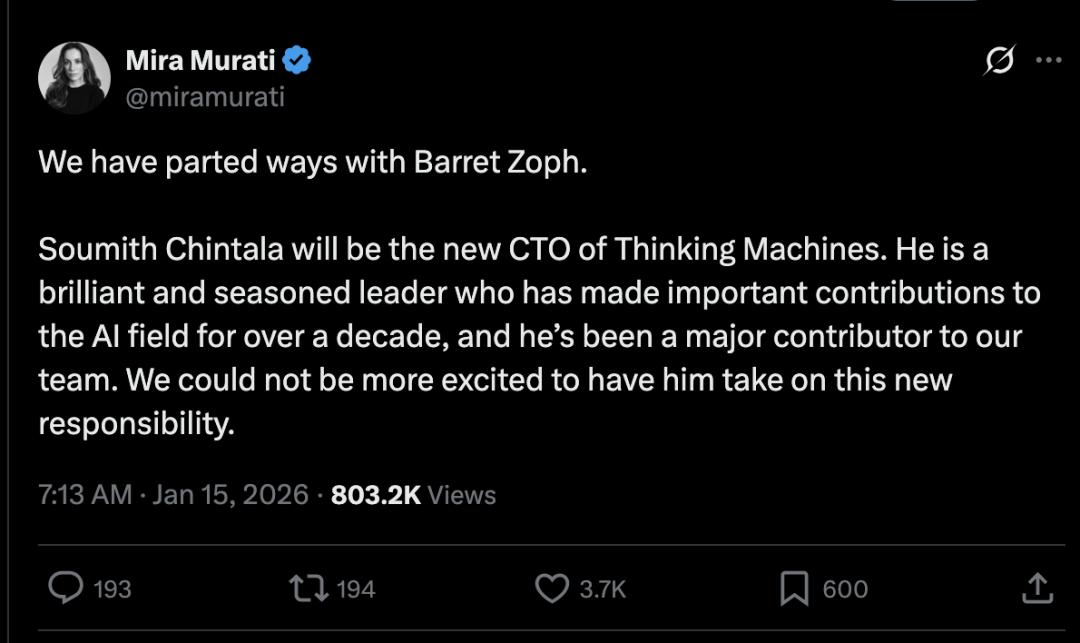
Core Insights - The recent departure of CTO Barret Zoph from Thinking Machines Lab, founded by former OpenAI CTO Mira Murati, has created significant turmoil within the company, which is rumored to be valued at $50 billion [2][12] - OpenAI has welcomed Zoph and two other key members back, indicating a strategic move to strengthen its team amidst ongoing competition in the AI sector [1][17] Group 1: Company Developments - Mira Murati announced the separation from Barret Zoph via a brief statement, indicating a lack of amicability in the departure [3][8] - Zoph's dismissal was reportedly due to "misconduct," with allegations of leaking company secrets to competitors [6][9] - OpenAI's CEO Fidji Simo expressed excitement over the return of Zoph, Luke Metz, and Sam Schoenholz, suggesting that this move was planned weeks in advance [8][9] Group 2: Impact on Thinking Machines Lab - The loss of Zoph and other core team members poses a significant challenge for Thinking Machines Lab, especially as it is in a critical fundraising phase [12][28] - The company has appointed Soumith Chintala, known as the "father of PyTorch," as the new CTO to stabilize the situation and maintain engineering capabilities [13][15] - The departure of key personnel raises concerns about the company's governance and internal stability, potentially affecting its market perception [13][28] Group 3: Competitive Landscape - The incident highlights the ongoing "poaching" dynamics in Silicon Valley, where companies like OpenAI and Anthropic are actively recruiting talent from each other [28][30] - The return of Zoph and his colleagues to OpenAI is seen as a reinforcement of its technical strength and leadership position in the AI industry [17][27] - The competitive environment is intensifying, with expectations of further talent shifts in the coming weeks [28][30]

OpenAI前团队创业内乱,CTO泄密竞对遭开除,翁荔火速发文
3 6 Ke· 2026-01-16 08:50
Core Insights - The recent personnel changes at Thinking Machines Lab, founded by former OpenAI CTO Mira Murati, reflect deeper shifts in technology direction, organizational philosophy, and power structures within the AI industry [1][9][19] - The departure of CTO Barret Zoph, attributed to unethical behavior involving the leakage of company secrets, has led to a significant talent shift back to OpenAI, highlighting the competitive dynamics in the AI sector [3][5][25] Group 1: Company Background and Developments - Thinking Machines Lab was established with a vision to create more general, customizable, and understandable AI systems, and it raised $2 billion in seed funding, achieving a valuation of approximately $12 billion [19][20] - The company has faced challenges in product development, with its first product, Tinker, launched in October 2025, receiving cautious market feedback and lacking distinctiveness compared to existing offerings [21][22] Group 2: Key Personnel and Their Impact - Mira Murati, a pivotal figure in the development of core models like GPT-4 at OpenAI, co-founded Thinking Machines Lab after leaving OpenAI in September 2024 [9][11] - Barret Zoph, who played a crucial role in OpenAI's research, was responsible for key projects related to model alignment and performance enhancement, making his departure significant for Thinking Machines Lab [12][14] - Luke Metz and Sam Schoenholz, also former OpenAI members, joined Zoph in returning to OpenAI, indicating a strategic move by OpenAI to reinforce its talent pool [5][16][18] Group 3: Organizational Dynamics and Market Reactions - The simultaneous announcements from Thinking Machines Lab and OpenAI created a rare instance of "information hedging," revealing the complexities of talent movement in the AI industry [7][25] - The incident has sparked discussions on social media regarding the nature of talent flow in AI, with some users commenting on OpenAI's ability to attract former employees due to its resources and brand influence [28][29] - The situation underscores the structural tensions within Thinking Machines Lab, despite its substantial funding, suggesting that financial resources alone cannot resolve organizational challenges in high-stakes environments [27]

失去三个联创后,Mira公司危机持续:又有两人要出走
机器之心· 2026-01-16 08:13
Core Insights - The article discusses significant personnel changes at Thinking Machines Lab, co-founded by former OpenAI CTO Mira Murati, highlighting the departure of key team members back to OpenAI [3][4][10] - The situation is characterized as a "raid" by OpenAI on Thinking Machines Lab, with reports indicating that this recruitment effort had been planned internally for several weeks [8] - Internal disagreements regarding product direction and company governance at Thinking Machines Lab are cited as core reasons for the departures [11][14] Group 1 - Key personnel changes include the firing of CTO Barret Zoph and the departure of co-founders Luke Metz and Sam Schoenholz, with indications that more team members may leave [3][7] - The internal conflict at Thinking Machines Lab revolves around product development, technical direction, and leadership trust, leading to a lack of clarity on future goals [11][14] - The company has faced criticism for not having a flagship product, despite having launched a product named "Tinker" aimed at addressing post-training infrastructure complexities [13][14] Group 2 - The trend of rapid personnel movement, including hiring and departures, is becoming common in the AI labor market, potentially impacting project timelines and strategies [16][17] - The article notes that the loss of co-founders is not unique to Thinking Machines Lab, as similar trends have been observed across leading AI companies [16]

前OpenAI CTO押注的赛道,被中国团队抢先跑通,AI「下半场」入场券人人有份
机器之心· 2026-01-04 03:01
Core Viewpoint - The article discusses the challenges faced by small entrepreneurs and researchers in the AI field amidst the dominance of large companies, highlighting the emergence of new tools like Mind Lab's MinT that aim to democratize access to advanced AI training capabilities [1][2][3]. Group 1: AI Landscape and Challenges - The AI landscape is increasingly perceived as a domain dominated by large companies, leaving smaller players and researchers feeling lost [1][2]. - The traditional path from academia to industry is being questioned, particularly regarding its relevance in the current AI environment [1]. - The saturation of pre-training models has led to new bottlenecks in deploying AI systems, necessitating a shift towards post-training and reinforcement learning [10][11]. Group 2: Innovations in Post-Training - Mind Lab, a research center backed by a team of young scientists, has developed the Mind Lab Toolkit (MinT), which allows efficient training of trillion-parameter models using standard CPUs, optimizing costs by tenfold [3][5]. - MinT is designed to address the limitations of current AI models that become "frozen" after training, enabling continuous learning from real-world interactions [23][24]. - The platform's architecture allows users to focus on data and algorithms while MinT manages the complexities of infrastructure, significantly enhancing engineering efficiency [31][39]. Group 3: Competitive Landscape - Mind Lab's MinT is positioned as a competitor to Thinking Machines' Tinker, with both platforms offering compatibility and advanced capabilities for post-training [21][25]. - MinT has achieved significant milestones, including being the first to implement 1T LoRA-RL for efficient reinforcement learning on trillion-parameter models, showcasing its technological leadership [25][36]. - The team behind MinT has published over 100 papers with more than 30,000 citations, indicating a strong research foundation [6]. Group 4: Market Applications and Benefits - MinT is expected to benefit startups in the agent domain and top academic labs that are constrained by computational resources, allowing them to validate algorithms at a lower cost [41][44]. - The platform supports a wide range of applications, from basic research to specific industry needs, demonstrating its versatility [44]. - By reducing the barriers to entry for reinforcement learning and post-training, MinT aims to empower more organizations to leverage advanced AI capabilities [49][50].