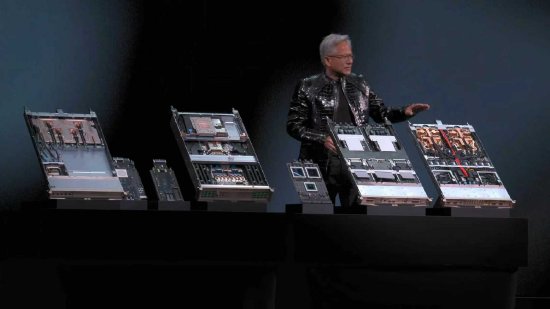
Vera Rubin计算平台

Search documents
推理效率革新与Agent共振,打开万亿市场空间
GF SECURITIES· 2026-03-18 07:34
Investment Rating - The industry investment rating is "Buy" with a previous rating of "Buy" as well [2]. Core Insights - The AI inference market is projected to reach a potential market size of $1 trillion by 2027, driven by the shift from training performance breakthroughs to optimizing inference efficiency [13][19]. - The demand for inference computing power is expected to grow structurally, with Deloitte predicting that the global inference workload will increase from approximately one-third of AI computing power in 2023 to about two-thirds by 2026, and potentially exceeding 80% in the long term [13][15]. - NVIDIA is transitioning from being a "shovel seller" in AI to an "AI factory," emphasizing the importance of integrated AI systems and infrastructure [19][30]. - The introduction of the NemoClaw platform aims to create a secure and controllable environment for AI agents, marking a shift towards "Agentic AI as a Service" [30][39]. - The physical AI sector is advancing with the release of the Cosmos world model and the Isaac simulation framework, which are expected to accelerate the deployment of robotics and autonomous driving technologies [41][46]. Summary by Sections Section 1: GTC Narrative Changes - AI inference chips are opening a potential market space of $1 trillion by 2027, with a focus on reducing inference costs and optimizing efficiency [13][19]. - The shift in AI narrative emphasizes the importance of inference capabilities over mere training performance [19][30]. Section 2: AI Applications - The introduction of NemoClaw enhances the OpenClaw ecosystem, providing a secure environment for AI agents [30][39]. - The physical AI domain is being bolstered by the Cosmos model, which integrates data generation and simulation for robotics [41][46]. Section 3: Investment Recommendations - The narrative in the AI industry is shifting from training-driven to inference-driven, with a focus on the cost-effectiveness and stability advantages of integrated AI solutions [47][48]. - The rise of Agent as a Service is expected to replace traditional enterprise SaaS products, indicating a collaborative evolution rather than a complete disruption of existing software [47][48].

黄仁勋演讲关键词:1万亿美元、进军太空、一键养虾
新华网财经· 2026-03-17 01:54
Group 1 - The core viewpoint of the article highlights NVIDIA's ambitious projections for its AI chip architectures, predicting at least $1 trillion in revenue from the Blackwell and Rubin products by the end of 2027, with a total sales forecast of $500 billion over the next five quarters [2] - NVIDIA officially launched the Vera Rubin computing platform, consisting of seven groundbreaking chips, which is described as a "revolutionary supercomputer" for driving intelligent agents. The computing power has increased by 40 million times compared to a decade ago [2] - The new Vera CPU features an 88-core design, with enhancements including a 3x increase in memory bandwidth per core, approximately 2x improvement in energy efficiency, and about 1.5x better performance for AI tasks compared to traditional x86 CPUs [2] Group 2 - NVIDIA announced the establishment of the Nemotron alliance to collaborate with global AI laboratories on developing open foundational models, alongside the release of an open-source agent toolchain. This initiative aims to advance the frontier of open-source models [3] - The company introduced a "space computing" platform, which includes the Space-1 Vera Rubin module, IGX Thor, and Jetson Orin, emphasizing the necessity of intelligence at the data generation sites as satellite constellations and deep space exploration progress [3]


英伟达携手礼来制药投资10亿美元建立AI药物研发实验室
Sou Hu Cai Jing· 2026-01-13 12:42
Core Insights - Nvidia and Eli Lilly announced a collaboration to invest up to $1 billion over the next five years to establish a research lab focused on AI-assisted drug discovery models [2] - The partnership aims to leverage Nvidia's BioNeMo software platform and Vera Rubin accelerator to develop necessary infrastructure, talent, and computational resources for biological and chemical modeling [2] Group 1: Collaboration Details - The joint innovation lab will be located in the San Francisco Bay Area, bringing together top biologists and chemists from Eli Lilly with Nvidia's software engineers and model developers [2] - Eli Lilly's CEO, David Ricks, emphasized that combining their extensive data and scientific knowledge with Nvidia's computational power could revolutionize drug discovery [2] Group 2: Technology Platforms - BioNeMo is an open-source framework launched by Nvidia in the fall of 2022, specifically designed for building and training deep learning models for drug discovery [4] - The Vera Rubin computing platform, recently unveiled at CES, promises five times the performance of Nvidia's previous Blackwell GPU, providing essential computational power for training new foundational models [3][4] Group 3: Broader Applications - The lab's focus extends beyond AI drug discovery; researchers will also explore AI applications in clinical development, manufacturing, and commercial operations [3] - Eli Lilly is investigating Nvidia's Omniverse robotics platform to optimize manufacturing facilities and increase production of high-demand drugs [3]

法巴CES洞察:机器人站上规模化商用临界点 AI浪潮英伟达(NVDA.US)再成赢家
智通财经网· 2026-01-12 02:32
Group 1: Industry Insights - Robotics technology is emerging as a key market in the tech sector, with expected explosive growth in application scenarios [1] - AI technology is increasingly penetrating various industries, while AR glasses have seen significant improvements in technology [1] - The robotics industry is nearing a critical point for large-scale commercialization, but lacks catalysts to drive massive demand [1] Group 2: Company Analysis - Nvidia is positioned as a winner in the AI wave, benefiting from increased demand for CPU servers, while AMD is expected to be the largest beneficiary among covered companies [2] - Nvidia's new Vera Rubin computing platform features six new chips, with a focus on the Inference Context Memory Storage Platform designed for key-value cache needs [3] - The new storage platform can support 16TB of storage per GPU, with a significant increase in storage capacity from 8TB to 20TB, representing a 150% increase [3]

新浪财经隔夜要闻大事汇总:2026年1月8日
Xin Lang Cai Jing· 2026-01-07 23:19
Market - US stock market closed mixed on January 8, with the Dow Jones and S&P 500 hitting record highs before retreating. The Dow fell by 0.94%, while the Nasdaq rose by 0.16% and the S&P 500 dropped by 0.34% [2] - Major sectors such as financials and energy saw declines of over 1%, with bank stocks giving back gains. ExxonMobil and other energy stocks were dragged down by falling oil prices [2] - The top traded stocks included Nvidia, which rose by 1% after announcing a new AI platform, and Alphabet, whose market capitalization surpassed Apple's after a 2.43% increase [3] Macro - President Trump announced a significant increase in the military budget for 2027, raising it from approximately $1 trillion to $1.5 trillion, citing national security concerns and tariff revenues as reasons [9] - Trump proposed to ban Wall Street from investing in single-family homes to lower housing prices, a move that caused a sharp decline in housing construction stocks [10][11] - The US Bureau of Economic Analysis will use the average CPI from September and November to estimate October's PCE data due to missing data [12] - Trump stated that revenues from Venezuelan oil sales will be used exclusively to purchase American goods, indicating a desire to strengthen trade ties between the US and Venezuela [13] - The US has begun selling Venezuelan oil globally, with proceeds deposited in US-controlled accounts [14] Company - OpenAI launched ChatGPT Health, a new feature aimed at providing health information and analysis, connecting to electronic health records and wearable devices [28] - Morgan Stanley is set to take over Apple's credit card business from Goldman Sachs, which is divesting due to poor performance [30] - AbbVie is in deep negotiations to acquire Revolution Medicines, a cancer drug manufacturer, with a potential deal exceeding $20 billion [31] - Anthropic plans to raise $10 billion at a pre-money valuation of $350 billion, with significant interest from major investors [32] - The Venezuelan state oil company is negotiating with the US regarding oil sales, aiming to establish a mutually beneficial relationship [33] - Trump threatened to cut off Raytheon's government contracts unless the company increases its investment in production and R&D [29] - GameStop announced a $35 billion compensation plan for CEO Ryan Cohen, contingent on achieving specific financial targets [36]





黄仁勋点赞三款中国大模型,英伟达押宝物理AI
Guan Cha Zhe Wang· 2026-01-06 11:22
Core Insights - The CES 2026 showcased NVIDIA's strategic focus on next-generation computing platforms and advancements in physical AI, marking the first time in five years that NVIDIA did not release a new GPU at the event [2][3]. Group 1: Open Source Ecosystem - NVIDIA's CEO highlighted the significant investment of approximately $10 trillion in computing resources over the past decade, emphasizing a shift in software paradigms rather than just hardware upgrades [3]. - The presentation acknowledged the rapid development of Chinese open-source models, specifically naming Kimi K2, DeepSeek V3.2, and Qwen, which are leading the open-source ecosystem alongside OpenAI's GPT-OSS [5]. - Despite being approximately six months behind the top models, the open-source models are expected to see new iterations every six months, attracting interest from startups, giants, and researchers alike [5]. Group 2: Next-Generation Computing Platform - NVIDIA introduced the Vera Rubin computing platform, designed to accelerate AI training speeds and facilitate the development of next-generation models [7]. - The platform features a complete redesign of six chips, including Vera CPU and Rubin GPU, with the Rubin GPU achieving a performance of 50 PFLOPS, five times that of its predecessor [7][8]. - The engineering design of Vera Rubin simplifies assembly, reducing the number of cables from 43 to just six liquid cooling pipes, allowing for quicker setup times [8]. Group 3: Advancements in Physical AI - NVIDIA's CEO announced the launch of the Alpamayo open-source AI model aimed at enhancing autonomous driving capabilities, addressing complex driving scenarios through a new reasoning model [10][11]. - The Alpamayo series incorporates a "thinking chain" reasoning model, improving decision-making processes in autonomous vehicles and enhancing user trust in the technology [11]. - The first vehicles utilizing NVIDIA's technology are expected to hit the roads in the U.S. in Q1, Europe in Q2, and Asia later in the year, with interest from companies like Jaguar Land Rover and Uber [11]. Group 4: Robotics Development - NVIDIA unveiled two new open-source models for robotics, NVIDIA Cosmos and GR00T, along with a performance evaluation tool, Isaac Lab-Arena, aimed at simplifying robot training processes [12]. - The collaboration with Hugging Face integrates NVIDIA's Isaac open-source models into the LeRobot project, accelerating the development of the open-source robotics community [12]. - Companies such as Boston Dynamics and Caterpillar are developing new robots and autonomous devices based on NVIDIA's technology, indicating a significant advancement in the robotics sector [13].

比Blackwell算力提升5倍!黄仁勋展示Vera Rubin计算平台|直击CES
Xin Lang Cai Jing· 2026-01-06 02:01
Core Insights - The article discusses the unveiling of NVIDIA's Vera Rubin computing platform at CES 2026, aimed at accelerating AI training speeds to bring next-generation models to market sooner [1][5] - NVIDIA's approach involves extreme collaborative design across all levels of chips and platforms due to the slowing of Moore's Law, which can no longer keep pace with the tenfold annual growth of AI models [1][5] Group 1: Vera Rubin Platform Features - The Vera CPU features 88 custom NVIDIA Olympus cores, supports 176 threads, and has a system memory of 1.5TB, which is three times that of the previous generation [1][5] - The Rubin GPU achieves a NVFP4 inference performance of 50 PFLOPS, which is five times that of the previous Blackwell architecture, and contains 336 billion transistors, a 1.6 times increase from Blackwell [1][5] Group 2: Additional Components - The ConnectX-9 network card operates on an 800 Gb/s Ethernet with 200G PAM4 SerDes and has 23 billion transistors [2][6] - The BlueField-4 DPU is designed for next-generation AI storage platforms, featuring an 800G Gb/s capability and 126 billion transistors [2][6] - The NVLink-6 switch chip connects 18 compute nodes and supports up to 72 Rubin GPUs, providing 3.6 TB/s all-to-all communication bandwidth [2][6] Group 3: Performance Enhancements - The Vera Rubin NVL72 system shows a fivefold increase in NVFP4 inference performance, reaching 3.6 EFLOPS, and a 3.5 times increase in training performance at 2.5 EFLOPS compared to Blackwell [3][7] - The system includes 54TB of LPDDR5X memory, three times that of the previous generation, and HBM capacity of 20.7TB, a 1.5 times increase [3][7] - HBM4 bandwidth reaches 1.6 PB/s, a 2.8 times improvement, while Scale-Up bandwidth achieves 260 TB/s, doubling the previous performance [3][7]