openGauss

Search documents
从“参与”到“主导”:华为开源之路越走越宽
Sou Hu Cai Jing· 2026-02-27 11:44
Core Insights - Huawei has rapidly evolved from using open-source software to becoming a major contributor to various large open-source projects since 2010, with over 6,000 employees involved in development [1][3]. Group 1: Open Source Contributions - Huawei is a top player in the global open-source field, being a founding member of several prominent international open-source foundations and contributing core code to many communities [3]. - The company has initiated over ten significant open-source projects, particularly in foundational software, which has garnered widespread support from global developers [3]. Group 2: AI and Computing Frameworks - Huawei's CANN architecture, launched in 2019, facilitates AI developers in utilizing underlying computing power and is set to be fully open-sourced by 2025, allowing clients to optimize their usage [4]. - The CANN community is actively collaborating with universities to cultivate professional talent, enhancing the AI ecosystem [4]. Group 3: Hardware and Software Ecosystem - Huawei's Kunpeng processor, launched in 2019, has made significant strides in supporting major open-source software, addressing the challenges posed by the dominance of X86 architecture [5]. - The company has developed the Kunpeng DevKit and BoostKit to improve computing performance through software-hardware synergy, boosting the Kunpeng ecosystem's attractiveness [5]. Group 4: Operating Systems and Databases - The openEuler operating system, based on Linux, has attracted over 2,100 enterprises and institutions, with more than 26,000 contributors, and is projected to exceed 16 million installations by the end of 2025 [6]. - Huawei's openGauss project, a relational database, is gaining traction in critical industries and will continue to enhance its capabilities to support distributed architectures and multi-modal data [7]. Group 5: Strategic Vision - Huawei's strategy in the computing sector focuses on hardware openness, software open-sourcing, enabling partners, and talent development to drive innovation in China's computing industry [7].


2025年中国数据库产业研究报告
Sou Hu Cai Jing· 2026-02-22 07:04
Core Insights - The report highlights that the development of China's database industry is driven by national-level policies and technological innovations such as cloud-native and AI, transitioning from a "supporting system" to an "intelligent data foundation" [1][8][9] Industry Overview - The Chinese database market is projected to reach a scale of 59.62 billion yuan in 2024, with a compound annual growth rate (CAGR) of 17.2% from 2020 to 2030 [1][25] - The market structure is characterized by a dominance of relational databases, which will continue to hold a significant share, while non-relational databases are diversifying to meet emerging scenarios [1][29] Market Dynamics - By 2025, the market share of domestic databases is expected to rise to 71%, particularly in sectors like government and telecommunications, although penetration in core business systems remains low [2] - The competition landscape features diverse participants, with open-source communities becoming central to technological innovation, exemplified by the rise of domestic open-source projects like openGauss [1][49] Technological Trends - The integration of cloud-native architecture, AI, and hybrid transaction/analytical processing (HTAP) is shaping the future of database technology, moving from structured management to comprehensive data management [2][18] - Domestic vendors are achieving self-innovation in core modules such as storage engines and distributed transactions, although gaps remain in high-end capabilities compared to international firms [1][2] Challenges in Development - The industry faces challenges including the need for breakthroughs in core capabilities, fragmented resource allocation, significant application migration resistance, and an incomplete ecosystem [2][12] - The report suggests enhancing core technology innovation, deepening the integration of technology and application scenarios, and improving talent cultivation systems [2][12] Future Development Recommendations - Strengthening core technology innovation and promoting collaboration in building an industrial ecosystem are recommended to ensure high-quality development [2][12] - The report emphasizes the importance of international cooperation and participation in international standard-setting to expand overseas markets [2][12]

华为超节点赶超英伟达:驾驭“光”很关键
Guan Cha Zhe Wang· 2026-02-10 03:20
Core Insights - The emergence of SuperPods as a new AI computing infrastructure has become a focal point in the industry since 2025, with Huawei's Ascend 384 SuperPod leading the way in performance metrics compared to foreign competitors [1][3] - The demand for computing power is far from being met, with token consumption expected to exceed trillions daily in China, highlighting the inadequacy of simply stacking servers to address the computing gap [3][4] Group 1: SuperPod Characteristics - SuperPods are not merely about stacking chips; they represent a fundamental restructuring of traditional computing architectures, enabling equal interconnectivity among CPUs, NPUs, and memory units [4][6] - Key features of a true SuperPod include high bandwidth to eliminate communication delays, low latency, and the ability to form a logically unified system through unified memory addressing [6][7] Group 2: Efficiency and Performance - SuperPods can significantly enhance computing efficiency, with potential model utilization rates increasing from 30% to 45%, effectively a 50% improvement, which can help mitigate the limitations of chip manufacturing processes [7][8] - The architecture of SuperPods differs from traditional systems, as Huawei employs optical communication technology, allowing for greater scalability and interconnectivity compared to NVIDIA's copper-based systems [8][9] Group 3: Innovation and Ecosystem - Huawei's systematic innovation in chip design, optical components, and foundational protocols has positioned it uniquely in the market, leveraging over 20 years of experience in optical technology [9][12] - The company is also developing general computing SuperPods, with the TaiShan 950 SuperPod set to launch in Q1 2026, aimed at replacing various server applications [11][12] Group 4: Software and Community Engagement - The success of SuperPods relies not only on hardware but also on a robust software ecosystem, including open-source initiatives like CANN and openEuler, which are crucial for fostering industry collaboration [14] - Huawei has engaged a large developer community, with 3.8 million registered developers for Kunpeng and nearly 4 million for Ascend, emphasizing the importance of open-source collaboration in the AI era [14]


华为打造“最强超节点”,这项全球领先技术很关键
Guan Cha Zhe Wang· 2026-02-10 03:10
Core Viewpoint - The emergence of SuperPod as a new AI computing infrastructure has become a focal point in the industry since 2025, with Huawei's Ascend 384 SuperPod leading the way in performance metrics compared to foreign competitors [1][3]. Group 1: SuperPod Concept and Advantages - SuperPod is not merely about stacking chips; it represents a fundamental restructuring of traditional computing architecture, enhancing communication efficiency among CPU, NPU, and memory units [4][6]. - The key advantages of SuperPod over traditional clusters include significantly improved computational efficiency, with potential model computing utilization rates increasing from 30% to 45%, equating to a 50% performance boost [7][8]. Group 2: Technical Challenges and Innovations - Building a true SuperPod is complex; Huawei's Ascend 384 SuperPod consists of 12 computing cabinets and 4 bus cabinets, while NVIDIA's NVL72 system is confined to a single cabinet due to architectural differences [8]. - Huawei employs optical communication technology for interconnection, allowing for greater scalability beyond single cabinet limitations, while traditional systems face constraints with electrical signal transmission [8][9]. Group 3: Systematic Innovation and Ecosystem Development - Huawei's systematic innovation includes proprietary chip development, optical device capabilities, and foundational protocols, enabling the creation of SuperPods that leverage full optical interconnectivity [9][12]. - The company is also developing general computing SuperPods, such as the TaiShan 950, which aims to replace various server applications by 2026 [9][11]. - A robust software ecosystem, including open-source initiatives like CANN and openEuler, is essential for the operation of SuperPods, with a focus on collaborative development within the industry [14].

国产数据库新突破:openGauss发布AI原生底座,实现数据零丢失
Feng Huang Wang· 2025-12-29 11:53
Group 1 - The openGauss community announced that openGauss has achieved a 35.02% market share in China's offline centralized relational database market, with the commercial version accounting for nearly 30% (29.4%) [1] - The community introduced the "1+2" strategy focusing on the development of oGRAC multi-read and multi-write databases, as well as an AI-native multimodal database foundation [1] - The newly released oGRAC multi-master database architecture offers RPO=0 (zero data loss) and RTO<10 seconds for business recovery, with TPCC performance reaching 3.5 million tpmC in a dual-node deployment [1] Group 2 - The Chinese Academy of Sciences Software Research Institute has officially joined the openGauss community council to enhance original innovation in the foundational software sector [2] - openGauss has gathered over 880 industry partners and more than 8,400 developers, with global downloads exceeding 5.5 million [2] - Huawei's Kunpeng Computing Business President reiterated Huawei's commitment to the community, stating that they will share technologies such as modular capabilities and distributed memory with the database ecosystem [2]
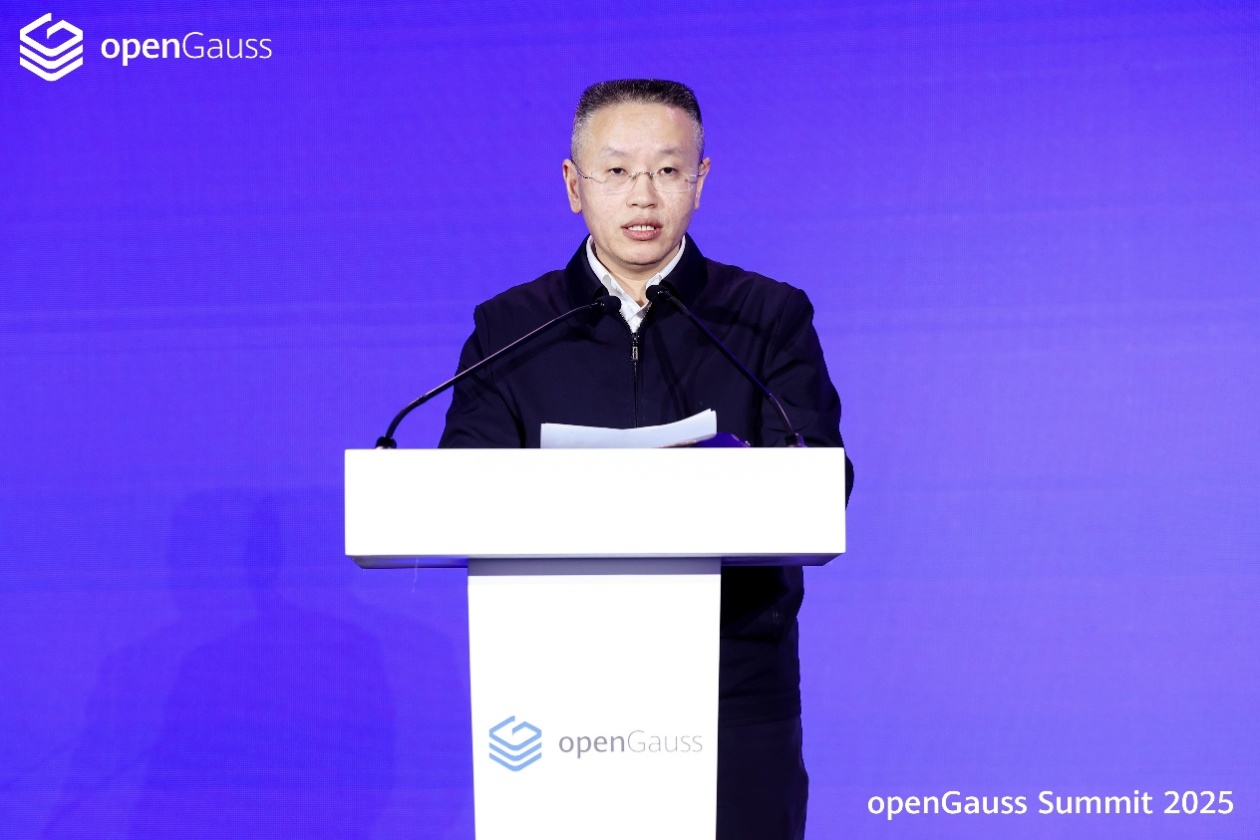
openGauss Summit 2025在京成功举办:共绘AI时代数据库新图景
Huan Qiu Wang· 2025-12-28 07:13
Core Insights - The openGauss Summit 2025 showcased the innovation and ecological impact of openGauss as an enterprise-level open-source database community, emphasizing its role in the evolution of open-source database technology and AI integration [1][10]. Group 1: Community and Industry Collaboration - The openGauss community has gathered over 880 industry partners and more than 8,400 global developers, with over 5.5 million downloads of its versions [6]. - The community's "1+2" strategy focuses on long-term technological evolution and aims to develop two major breakthroughs: the oGRAC multi-read and multi-write database and an AI-native multimodal database foundation [6]. - A "Supernode Database Industry-Academia-Research Alliance" has been established to promote technological innovation and results transformation in supernode architecture [9]. Group 2: Technological Advancements - The oGRAC multi-master database architecture features global consistency mechanisms and rapid failover technology, achieving RPO=0 (zero data loss) and RTO<10 seconds (business recovery in seconds) [8]. - The DataVec capability has been enhanced to support integrated AI pipelines and in-database large models, addressing issues like "model hallucination" [8]. - The first multi-database kernel engine, DataVec, has been launched, enabling precise and rapid retrieval for intelligent platforms [8]. Group 3: Market Performance - openGauss holds a 35.02% market share in China's offline centralized relational database market, with its commercial version accounting for 29.4%, making it the leading open-source database [10]. - The technology has been successfully implemented in various sectors, including finance, government, telecommunications, healthcare, manufacturing, and industrial control [10]. - Companies like Zhihu, Donghua Medical, and others shared their successful practices in performance tuning and intelligent manufacturing, validating openGauss's reliability in complex business scenarios [10].
openGauss联合13家单位成立“超节点数据库产学研联盟”
Bei Jing Shang Bao· 2025-12-27 13:02
Core Viewpoint - The establishment of the "Supernode Database Industry-Academia-Research Alliance" aims to promote breakthroughs and innovations in database technology under the supernode architecture, accelerating the transformation and application of results [1] Group 1: Alliance Formation - The alliance consists of 13 entities, including operators, databases, the Chinese Academy of Sciences, and top universities [1] - The Chinese Academy of Sciences Software Research Institute has announced its membership in the openGauss community council [1] Group 2: Community Achievements - The openGauss community has gathered over 880 industry partners and more than 8,400 global developers in five years [1] - The community version has been downloaded over 5.5 million times globally [1] Group 3: Market Position - In the Chinese offline centralized relational database market, openGauss holds a market share of 35.02% [1] - The commercial version of openGauss accounts for 29.4% of the market, surpassing other open-source database versions [1] - openGauss has maintained its position as the leading database solution in the market [1] Group 4: Future Commitment - Huawei's Kunpeng Computing Business President Li Yi stated that Huawei will continue to invest firmly in the openGauss community [1]
国产数据库加速创新,产学研用共建超节点数据库联盟
Xin Lang Cai Jing· 2025-12-27 05:18
Core Insights - The article discusses the establishment of the "Supernode Database Industry-Academia-Research Alliance" at the openGauss community summit, highlighting the importance of databases in the AI era and the need for innovation in domestic database technology [1][2]. Group 1: Industry Trends - The rise of supernode technology is identified as a key trend, which integrates thousands of computing cards into a powerful computing unit for large-scale tasks [1]. - The Chinese database industry is at a critical stage of high-quality development, facing challenges such as technology route collaboration and the integration of AI [2]. Group 2: Community and Collaboration - The openGauss community has grown significantly, with over 880 industry partners and more than 8,400 global developers, achieving over 5.5 million downloads of its community version [2]. - The integration of top national research institutions, such as the Chinese Academy of Sciences, into the openGauss community is expected to enhance original innovation and exploration capabilities in the foundational software field [3]. Group 3: Market Position - openGauss has achieved a market share of 35.02% in China's offline centralized relational database market, with a commercial version adoption rate of 29.4% [2].

鲲鹏展翅 智绘京华 | 鲲鹏开发者创享日·北京站圆满举办
Huan Qiu Wang Zi Xun· 2025-12-17 04:05
Core Insights - The event "Kunpeng Developer Day" in Beijing focused on the theme "Create the Future, Enjoy the Extraordinary," featuring a main forum, two sub-forums, and an interactive exhibition area to foster deep technical exchanges and industry practice sharing among developers from various sectors [1] Group 1: Event Overview - The event was organized by Huawei Technologies Co., Ltd. and hosted by the Beijing Kunpeng Joint Innovation Center, bringing together hundreds of developers from universities, enterprises, and research institutions [1] - Huawei's Vice President Ma Haixu expressed gratitude to developers for their support of the Kunpeng ecosystem, emphasizing their role in driving innovation and collaboration [1] Group 2: Technical Presentations - Peking University's Fan Chun discussed the integration of cloud computing and high-performance computing in AI applications, highlighting the development of the "Hesi Scheduling System" and the "SCOW Computing Platform," which supports over 80 computing centers [3] - Huawei's Li Sicong introduced the Kunpeng Unified Acceleration Library (KUPL), which enhances performance in high-performance applications by 2.7 to 4.6 times compared to traditional hardware, and reported that the openEuler operating system is expected to exceed 16 million installations by the end of 2025 [5] - Tsinghua University's Zong Zan shared advancements in large model inference acceleration on the Kunpeng architecture, achieving significant throughput improvements [7] Group 3: Industry Applications - North控数科's Cheng Xiaopei presented a cloud platform for state-owned enterprises built on Kunpeng technology, which has developed over 140 solutions across various sectors [9] - China Everbright Bank's Shen Jie highlighted the bank's use of Kunpeng's trusted cloud technology to enhance core business system performance, achieving a 36% increase in concurrency and a 27% reduction in latency [11] - Yuxin Technology's Song Tao discussed the end-to-end solutions based on Kunpeng technology, showcasing significant efficiency improvements in data processing for a banking project [13] Group 4: Educational and Collaborative Initiatives - China National Knowledge Infrastructure's Wang Liang shared the implementation of Kunpeng nodes in their research platform, resulting in reduced latency and energy costs [16] - The event featured the launch of the "Kunpeng Partner Co-Development Excellent Solutions" initiative, marking a new phase in collaborative development with over a thousand partners [18] - The Kunpeng Innovation Competition awarded prizes to outstanding teams, encouraging developers to continue exploring Kunpeng technology [20] Group 5: Developer Engagement - The event included technical forums and hands-on training sessions to empower developers with practical skills and knowledge about Kunpeng technology [23] - An interactive exhibition area provided developers with direct access to Kunpeng tools and resources, enhancing their experience and engagement [25] - The successful hosting of the Kunpeng Developer Day is expected to inject new momentum into the Kunpeng ecosystem in Beijing and North China, promoting the deep integration of computing technology into various industries [27]

鲲鹏展翅智绘京华 |鲲鹏开发者创享日·北京站圆满举办
Xin Lang Cai Jing· 2025-12-16 14:04
Core Insights - The event "Kunpeng Developer Sharing Day" was held in Beijing, focusing on the theme "Create the Future, Enjoy the Extraordinary," featuring a main forum, two sub-forums, and an interactive exhibition area to foster deep technical exchanges and industry practice sharing among developers from various sectors [1][30]. Group 1: Event Overview - The event was organized by Huawei Technologies Co., Ltd. and hosted by the Beijing Kunpeng Joint Innovation Center, gathering hundreds of developers from universities, enterprises, and research institutions [1][30]. - Huawei's Vice President, Ma Haixu, expressed gratitude to developers for their support of the Kunpeng ecosystem, emphasizing the importance of developers in driving innovation and collaboration [1][31]. Group 2: Technical Presentations - Peking University's Director of the Computing Center, Fan Chun, discussed the integration of cloud computing and high-performance computing in AI applications, highlighting the "Hesi Scheduling System" and the "SCOW Computing Platform" that supports over 80 computing centers [3][33]. - Huawei's high-performance computing expert, Li Sicong, introduced the unified acceleration library system (KUPL), which enhances performance in various applications, achieving up to 4.6 times improvement in traditional high-performance applications [5][35]. - Tsinghua University's researcher, Zong Zan, shared optimization practices for large model inference acceleration on the Kunpeng platform, achieving significant throughput improvements [7][37]. Group 3: Industry Applications - North Control Data's General Manager, Cheng Xiaopei, presented a cloud platform developed for state-owned enterprises, which has created over 140 solutions across various sectors, including energy and manufacturing [10][39]. - China Everbright Bank's technology manager, Shen Jie, reported a 36% increase in concurrent processing capacity and a 27% reduction in latency through the implementation of Kunpeng's trusted cloud technology [12][41]. - Yuxin Technology's solution director, Song Tao, discussed the end-to-end solutions built on Kunpeng technology, showcasing significant efficiency improvements in data processing for a major bank [14][43]. - China National Knowledge Infrastructure's Deputy Director, Wang Liang, highlighted the reduction in research computing latency by 35% and power costs by 33% through the adoption of Kunpeng nodes [17][44]. Group 4: Ecosystem Development - The event featured the launch of the "Kunpeng Partner Co-Development Excellent Solutions" initiative, marking a new phase in collaborative development with over a thousand partners [19][47]. - The Kunpeng Innovation Competition awarded prizes to outstanding teams, encouraging developers to continue exploring Kunpeng technology [21][49]. - The event included technical forums and hands-on training sessions, providing developers with resources and experiences to effectively utilize Kunpeng technology [24][52].