
Xin Hua Cai Jing

Search documents
【环球财经】埃塞俄比亚今年经济增速将达10.2%
Xin Hua Cai Jing· 2026-02-04 02:13
Economic Growth Forecast - Ethiopia's Prime Minister Abiy announced an expected economic growth of 10.2% for the fiscal year 2025/2026, aligning with the International Monetary Fund's predictions [1] - The assessment of the first six months of the current fiscal year indicates that Ethiopia is on track to achieve this growth target [1] Economic Performance Indicators - In the past six months, Ethiopia's goods trade export reached $5.1 billion, achieving 120% of the initial target [1] - Service trade exports amounted to $4.5 billion [1] - Foreign direct investment (FDI) totaled $2.3 billion [1] Government Economic Management - The current economic growth reflects the effectiveness of the government's macroeconomic management [1] - Ongoing economic reforms aim to stabilize the macroeconomy, reduce national debt burdens, and transition from an agriculture-based economy to a more diversified economic structure for high-quality growth [1] Telecommunications and Digital Services - Over the past eight years, the number of mobile phone users in Ethiopia increased from 37 million to 97 million [1] - Currently, more than 58 million people in the country are using mobile payment services out of a total population of approximately 130 million [1]
【财经分析】澳大利亚央行加息25个基点 通胀压力重塑经济前景
Xin Hua Cai Jing· 2026-02-04 02:09
Group 1: Monetary Policy and Economic Outlook - The Reserve Bank of Australia (RBA) raised interest rates by 25 basis points, marking its first increase since November 2023, after three rate cuts in 2025 [1][2] - The RBA revised its inflation forecasts, indicating that inflation in Australia is expected to remain above the target range of 2-3% for some time due to increased capacity pressures [2][6] - The RBA's updated estimates for inflation in 2025 and 2026 show an increase, with the 2025 inflation rate revised from 3.3% to 3.6% and the 2026 inflation rate from 3.2% to 3.6% [6][8] Group 2: Inflation and Economic Pressures - Australia's inflation rate rose to 3.8% in January 2025, up from 3.4% in November 2024, exceeding market expectations [2][3] - The average input costs for Australian manufacturing saw the largest increase in nine months, leading companies to raise product prices [2] - The RBA's goal is to reduce the average inflation rate to 2.5%, but inflation has remained persistently high, averaging around 4.5% since the RBA began raising rates in 2022 [3][5] Group 3: Government Spending and Economic Impact - The Australian government plans to increase federal spending to about 27% of GDP over the next two years, the highest level since 1986, which analysts believe contributes to ongoing inflation [4][5] - Analysts argue that high government spending is crowding out private sector activity, leading to increased prices for labor and other inputs [4][5] - The Australian Chamber of Commerce suggests reducing federal spending to 25% of GDP to alleviate inflationary pressures [5] Group 4: Future Rate Hikes and Economic Conditions - There is uncertainty regarding whether the RBA will continue to raise rates, with some analysts predicting another increase in May 2025 [8][9] - The RBA's recent statements indicate a cautious approach, with the possibility of further rate hikes depending on upcoming inflation data [7][8] - Some analysts believe the recent rate hike may be a one-time event due to potential slowdowns in consumer spending and the strengthening Australian dollar, which could reduce inflationary pressures [9][10]
【环球财经】2026年1月标普全球澳大利亚综合PMI增至55.7点
Xin Hua Cai Jing· 2026-02-04 02:09
Group 1 - The S&P Global Australia Composite PMI increased from 51 to 55.7 in January 2026, indicating the overall output of the Australian private economy has risen for the 16th consecutive month, with the highest growth rate in 45 months [1] - The manufacturing output and service business activity in Australia both saw an increase in January 2026, with new business growth reaching the highest level since April 2022 [2] - The Australian services business activity index rose significantly from 51.1 in December 2025 to 56.3 in January 2026, marking the highest level since February 2022 and indicating continuous expansion for 24 months above the 50-point threshold [2] Group 2 - The increase in domestic and external demand contributed to the significant improvement in the Australian services sector, with the expansion rate in January reaching the highest level in nearly four years [2] - Despite the growth in new business leading to increased hiring, the business confidence level among private enterprises fell to the lowest point since October 2024 [2] - Input cost pressures eased for service sector businesses in January, allowing them to reduce the pace of price increases, which is beneficial for future demand growth [2]

2026年1月标普全球澳大利亚综合PMI增至55.7点
Xin Hua Cai Jing· 2026-02-04 02:09
Group 1 - S&P Global's Australia Composite PMI increased from 51 to 55.7 in January 2026, indicating the highest growth in the private sector output in 45 months and marking the 16th consecutive month of expansion [1] - The growth in both manufacturing output and service sector activity in January 2026 reached the highest level since April 2022, with new business growth accelerating [2] - The service sector PMI rose significantly from 51.1 in December 2025 to 56.3 in January 2026, indicating continuous expansion for 24 months above the neutral mark of 50 [2] Group 2 - The increase in service sector activity was attributed to improvements in both domestic and external demand, leading to the highest expansion rate in nearly four years [2] - Despite the growth in business activity, private sector business confidence fell to its lowest level since October 2024, reflecting concerns over the economic outlook and increased competition [2] - Input cost pressures eased in January, allowing businesses to slow down the pace of price increases, which could support future demand growth [2]
今年迎峰度冬我国能源保供情况如何?国家能源局详解
Xin Hua Cai Jing· 2026-02-04 02:04
Group 1 - The core viewpoint of the news is that the National Energy Administration is ensuring stable energy supply during the winter season, especially in light of increased cold weather and high electricity demand [1][2][3] - As of January 4, 2026, the maximum national electricity load reached 1.351 billion kilowatts, marking a historical winter peak, with subsequent days seeing the load exceed 1.4 billion kilowatts for the first time [1] - The coal inventory at national regulated power plants was reported at 220 million tons as of January 27, sufficient for 26 days, indicating a stable coal supply for winter peak demand [2] Group 2 - The refined oil market in China is expected to maintain a weak demand in 2025, with a projected consumption of 378 million tons, a decrease of 2.9% year-on-year [2] - Natural gas consumption during the heating season reached 119.52 billion cubic meters as of January 27, reflecting a year-on-year increase of 4.6%, with stable domestic and imported gas supplies [2] - The National Energy Administration is coordinating with local governments and energy companies to enhance monitoring and response to adverse weather conditions, ensuring energy supply stability during the winter and upcoming Spring Festival [3]
1月RatingDog服务业PMI为52.3
Xin Hua Cai Jing· 2026-02-04 01:57
Core Viewpoint - China's January RatingDog Services PMI stands at 52.3, exceeding expectations of 52 and the previous value of 52 [1] Group 1 - The Services PMI indicates a continued expansion in the services sector, as a reading above 50 signifies growth [1] - The current PMI value reflects a stable economic environment, suggesting resilience in the services industry [1] - The increase from the previous month's value indicates a positive trend in service sector activity [1]
销量环比下滑超20%,单车成本激增7000元:2026车市开局承压
Xin Hua Cai Jing· 2026-02-04 01:16
Core Viewpoint - The automotive market in China experienced a significant month-on-month decline in January 2026, influenced by changes in tax policies and early consumer demand, while year-on-year sales remained relatively stable [1]. Group 1: Market Performance - In January 2026, the retail sales of narrow passenger vehicles in China were approximately 1.8 million units, representing a month-on-month decrease of 20.4% and a slight year-on-year increase of 0.3% [1]. - The retail sales of new energy vehicles (NEVs) in January were around 800,000 units, showing a year-on-year decline of 40.2%, but a month-on-month growth of 7.5% [1]. - Major traditional automakers like SAIC and Geely surpassed BYD in sales, with SAIC selling 327,000 units (up 23.9% year-on-year) and Geely selling 270,200 units (up 1.3% year-on-year) [2]. Group 2: New Energy Vehicle Segment - In the new energy vehicle sector, brands like Xiaomi, Hongmeng Zhixing, and NIO saw significant year-on-year growth, with Xiaomi's sales increasing by 95% to over 39,000 units [3][4]. - NIO delivered 27,200 units in January, marking a 96% year-on-year increase, driven by the new ES8 model [4]. - Conversely, companies like XPeng and Li Auto experienced declines, with XPeng's deliveries down 47% month-on-month and 34% year-on-year [4]. Group 3: Cost Pressures - The automotive industry is facing rising costs, with single-vehicle costs increasing by 4,000 to 7,000 yuan due to surging prices of key materials like lithium, aluminum, and DRAM [5][6]. - The price of battery-grade lithium carbonate rose from 75,700 yuan per ton at the beginning of 2025 to 146,600 yuan per ton by February 3, 2026, a nearly 94% increase [5]. - UBS reported that the cost increases in metals and chips could compress profit margins significantly, with potential reductions of 33% to 93% for vehicles priced at 150,000 yuan [6]. Group 4: Strategic Directions - To counteract rising costs and stagnant market demand, automakers are focusing on international expansion, with Chery exporting 119,600 units in January, accounting for nearly 60% of its total sales [7]. - BYD's overseas sales exceeded 100,000 units, a year-on-year increase of 43.3%, while Geely's exports grew by over 120% [7]. - Companies are also targeting the high-end market, with Great Wall Motors launching the WEY brand's flagship V9X, indicating a competitive push in the premium segment [9]. Group 5: Market Outlook - The automotive consumption index for January 2026 was reported at 31.1, reflecting a cautious consumer sentiment influenced by various factors, including the upcoming Spring Festival and changes in tax policies [10]. - Industry experts suggest that the market may not see a clear recovery until March or the end of the first quarter [10].




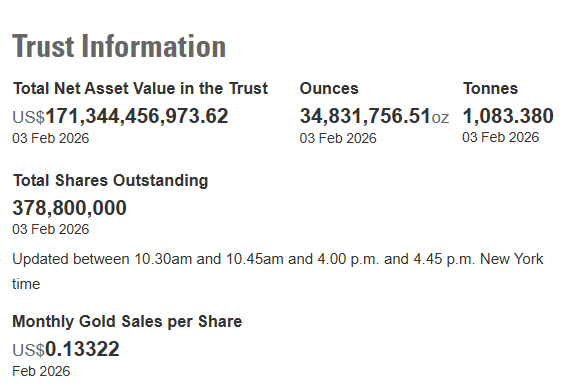
2月3日SPDR黄金持仓量较前一交易日减少3.72吨
Xin Hua Cai Jing· 2026-02-04 01:00
截至2月3日,全球最大的黄金ETF——SPDR Gold Trust的黄金持仓量为1083.38吨,较前一交易日减少 3.72吨。 资讯编辑:王芳琴 021-66896877 资讯监督:乐卫扬 021-26093827 资讯投诉:陈跃进 021-26093100 免责声明:Mysteel发布的原创及转载内容,仅供客户参考,不作为决策建议。原创内容版权归Mysteel所有,转载需取得Mysteel书面授 权,且Mysteel保留对任何侵权行为和有悖原创内容原意的引用行为进行追究的权利。转载内容来源于网络,目的在于传递更多信息,方 便学习与交流,并不代表Mysteel赞同其观点及对其真实性、完整性负责。 ...

2月3日iShares白银持仓量较前一交易日减少108.89吨
Xin Hua Cai Jing· 2026-02-04 01:00
Group 1 - The core point of the article highlights that as of February 3, the iShares Silver Trust, the world's largest silver ETF, reported a silver holding of 16,437.7 tons, which is a decrease of 108.89 tons compared to the previous trading day [1]
逢低买盘推动纽约贵金属3日大幅反弹
Xin Hua Cai Jing· 2026-02-04 01:00
Core Viewpoint - The New York precious metals prices rebounded across the board on February 3, driven by bargain buying, with gold and silver prices experiencing significant increases [1] Group 1: Gold Market - The most actively traded April 2026 gold futures price rose by $289.6, closing at $4,970.5 per ounce, marking a 6.19% increase [1] - The interest in precious metals was supported by a slight decline in the three major U.S. stock indices [1] - A weaker U.S. dollar index and rising crude oil prices also contributed positively to the rebound in precious metals [1] Group 2: Silver Market - The March delivery silver futures price increased by 565 cents, closing at $84.915 per ounce, reflecting a 7.13% rise [1] Group 3: Economic Context - The U.S. Labor Department will pause data collection, processing, and publication due to a partial government shutdown, affecting the release schedule of key employment data [1] - The dollar index fell by 0.21%, ending the day at 97.434 [1]