
Xin Hua Cai Jing

Search documents
【读财报】1月董监高增减持动态:增持总额同比增逾六成 大中矿业、凯普生物增持金额较多
Xin Hua Cai Jing· 2026-02-03 23:27
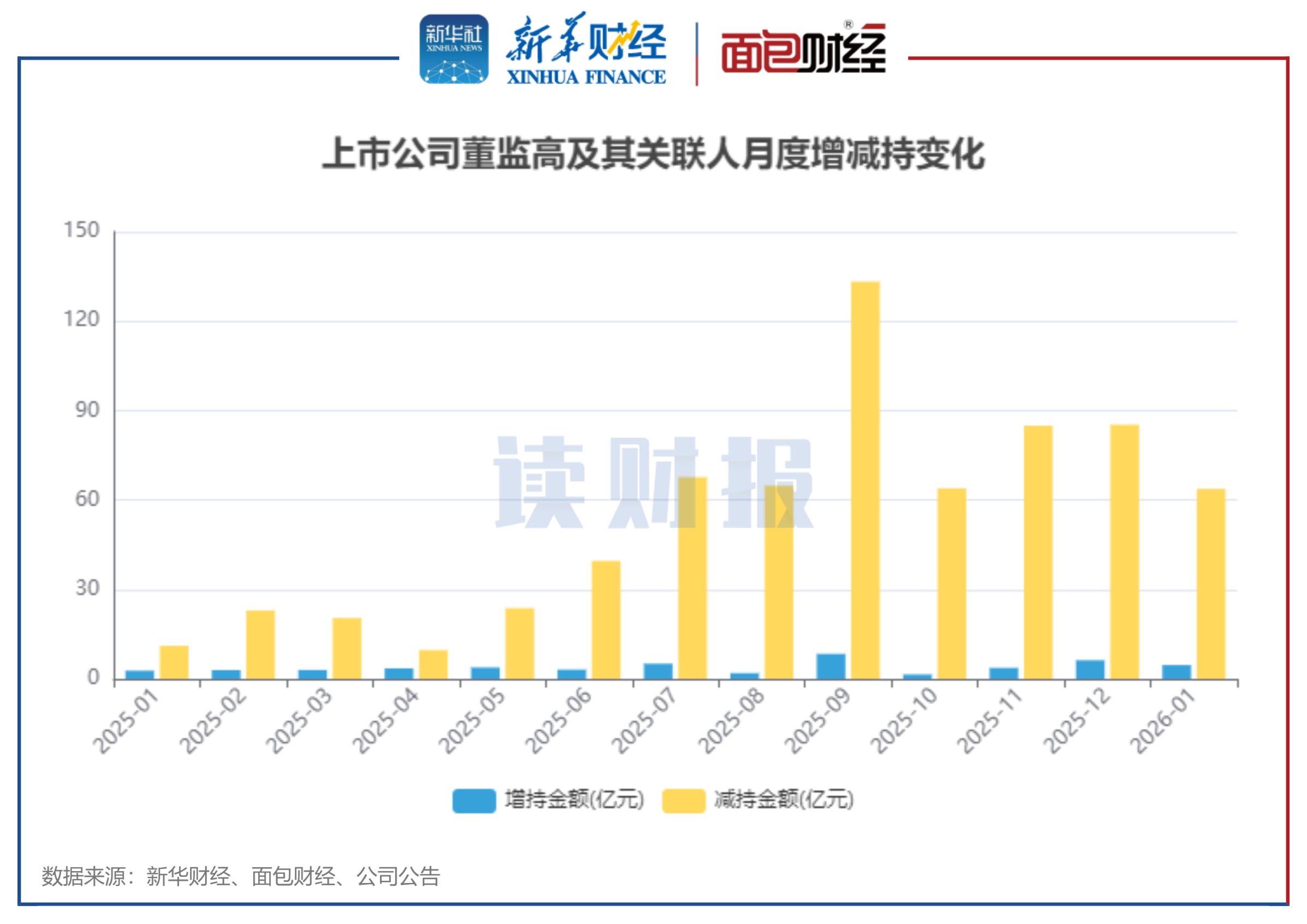
Core Viewpoint - In January 2026, the total amount of stock reduction by executives and their related parties in the Shanghai and Shenzhen stock markets reached approximately 6.373 billion yuan, with a net reduction of about 5.91 billion yuan after accounting for increases [1][4]. Group 1: Stock Reduction - The total reduction amount in January 2026 was approximately 6.373 billion yuan, involving 222 companies [4][12]. - The highest reduction amount was from Tianshan Aluminum, with a reduction of approximately 816 million yuan [5][12]. - The second highest reduction was from Gaode Infrared, totaling approximately 798 million yuan [5][12]. - Perfect World ranked third with a reduction of approximately 464 million yuan [5][12]. - The non-metallic mineral industry had the highest reduction amount, approximately 1.113 billion yuan, followed by the defense industry at about 889 million yuan [12][21]. Group 2: Stock Increase - The total amount of stock increase in January 2026 was approximately 462 million yuan, involving 34 companies [13][21]. - The highest increase was from Dazhong Mining, with an increase of approximately 392 million yuan [15][18]. - The second highest increase was from Kaipu Biological, totaling approximately 27 million yuan [15][18]. - The third highest increase was from Sentai Co., with an increase of approximately 15 million yuan [15][18]. - The steel industry had the highest increase amount, approximately 392 million yuan, followed by the pharmaceutical industry at about 27 million yuan [21].

3个月期买断式逆回购再迎加量续作 净投放1000亿元助流动性保持充裕
Xin Hua Cai Jing· 2026-02-03 16:37
Core Viewpoint - The People's Bank of China (PBOC) is conducting a 800 billion yuan reverse repo operation to maintain liquidity in the banking system, marking the first increase in three-month reverse repos since November of the previous year [1][2]. Group 1: Reverse Repo Operations - The PBOC will conduct a reverse repo operation of 800 billion yuan with a three-month term, which is an increase of 100 billion yuan compared to the amount maturing [1]. - This operation is aimed at injecting medium-term liquidity into the market to stabilize the funding environment ahead of the Chinese New Year [1][2]. Group 2: Market Liquidity and Government Bonds - In January, the PBOC's liquidity injection included net investments of 700 billion yuan through Medium-term Lending Facility (MLF), 100 billion yuan through open market treasury transactions, and 100 billion yuan through reverse repos, indicating a generally stable liquidity environment [2]. - The supply of government bonds in January was significantly higher compared to the same period last year, leading to an expansion of the treasury purchase scale to 100 billion yuan, which improved market sentiment and caused a decline in yield curves [2]. Group 3: Future Expectations - Looking ahead, it is anticipated that the PBOC will maintain a broad liquidity injection strategy in February, considering the dual pressures of cash disturbances and the upcoming holiday [2]. - There is a possibility of further reserve requirement ratio (RRR) cuts as the government bonds are expected to be supplied in concentrated phases, with 500 billion yuan of six-month reverse repos and 300 billion yuan of MLF maturing in February [2].
SGS:预计马来西亚1月1-31日棕榈油出口量为944885吨 环比减少5.58%
Xin Hua Cai Jing· 2026-02-03 14:11
Core Insights - The core insight of the article is that Malaysia's palm oil export volume for January 1-31 is projected to be 944,885 tons, representing a decrease of 5.58% compared to the 1,000,703 tons exported during the same period last month [1] Group 1 - The expected palm oil export volume for Malaysia in January is 944,885 tons [1] - This figure indicates a month-over-month decrease of 5.58% from the previous month's export volume of 1,000,703 tons [1]
中国银行债券主承销规模三年增长近3000亿元
Xin Hua Cai Jing· 2026-02-03 13:47
Group 1 - The core viewpoint of the articles highlights that the China Bank is significantly increasing its bond underwriting scale, projected to reach 1.68 trillion yuan from 2023 to 2025, marking a growth of nearly 300 billion yuan [1] - The bank is focusing on major national strategic deployments and promoting high-quality development in the bond market, with over 1,000 billion yuan in underwriting for technology innovation bonds and related securities for more than 160 issuers [1] - The bank has assisted in issuing seven phases of special bonds aimed at stabilizing growth and expanding investment, with all funds directed towards critical areas such as major equipment updates and technological innovation [1] Group 2 - The bank is leveraging its global advantages to build a bridge for the two-way opening of China's capital market, with panda bond underwriting expected to reach nearly 38 billion yuan by 2025, maintaining its market leadership [2] - The bank has successfully executed several market "firsts," including the first panda bonds for African multilateral development institutions and U.S. and U.K. entities, contributing positively to the influence of the renminbi in the international financial system [2] - The bank's dim sum bond underwriting has exceeded 110 billion yuan, securing its position as the top underwriter in the offshore renminbi bond market for three consecutive years [2]

筑牢仙作“链群协同”优势 促进产业融合化集群化生态化发展
Xin Hua Cai Jing· 2026-02-03 12:34
Core Insights - The report emphasizes the need for the Xianyou Xianzao industry to strengthen its "chain collaboration" advantages to promote integrated, clustered, and ecological development, aiming for deeper, higher, and newer advancements in cluster construction [1] Group 1: Industry Overview - The Xianzao industry is a traditional advantageous industry in Xianyou County, Fujian Province, which has been accelerating its development by leveraging opportunities from the new technological revolution and industrial transformation, aiming to build a trillion-yuan industry system [1] - Data from the National Bureau of Statistics indicates that from January to December 2025, the revenue and total profit of large-scale furniture manufacturing enterprises experienced a year-on-year decline of over 10% [1] - The Xianyou Xianzao industry is showing a new operational trend amidst challenges and transformations, with monitoring indices for industry scale and brand influence steadily improving [1] Group 2: Chain Integration - Xianyou County is advancing the integration of the industrial chain, innovation chain, value chain, and policy chain, forming a new ecological system for the Xianzao industry through comprehensive and multi-factor integration [2] - The county is focusing on achieving vertical integration of the industrial and innovation chains by consolidating resources across the entire industry chain, effectively reducing the operational risks for furniture enterprises reliant on imported raw materials and exported finished products [2] - The average annual growth rate of the Xianzao industry development index in 2025 is projected to be 6.6%, indicating a significant enhancement in the resilience of the supply chain [2] Group 3: Cluster Development - The report highlights that industrial clusters represent competitiveness and comprehensive strength, with Xianyou County leveraging its resource endowments and brand advantages to establish advanced manufacturing clusters as a key support for building a modern industrial system [3] - The county is advised to adopt a "leading enterprise and supporting collaboration" model, enhancing policy synergy and strategic planning to deepen digital empowerment initiatives for small and medium-sized enterprises within the Xianzao industry cluster [3] - A systematic approach to cultivating high-quality enterprises within the Xianzao industry cluster is recommended, supporting leading enterprises to strengthen their capabilities and promoting the growth of specialized and innovative enterprises [3]
货币市场日报:2月3日
Xin Hua Cai Jing· 2026-02-03 12:27
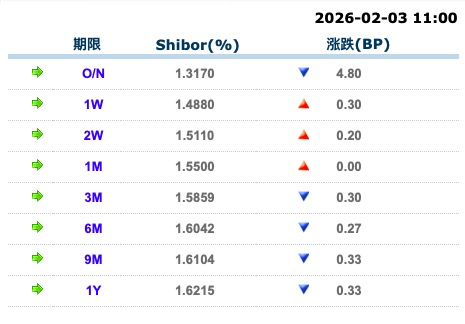
Core Viewpoint - The People's Bank of China conducted a 7-day reverse repurchase operation of 105.5 billion yuan at an interest rate of 1.40%, resulting in a net withdrawal of 296.5 billion yuan from the open market due to the maturity of 402 billion yuan in reverse repos on the same day [1]. Group 1: Market Rates - The Shanghai Interbank Offered Rate (Shibor) showed slight fluctuations, with the overnight Shibor decreasing by 4.80 basis points to 1.3170%, while the 7-day Shibor increased by 0.30 basis points to 1.4880%, and the 14-day Shibor rose by 0.20 basis points to 1.5110% [1][2]. - The overnight funding rate in the interbank pledged repo market slightly fell to around 1.3%, while the 7-day and 14-day rates saw minor increases [4]. Group 2: Trading Activity - The overall funding environment on February 3 was relatively loose, with overnight rates for certificates of deposit trading around 1.52%-1.55% and 7-day rates at 1.52%-1.53% [10]. - The secondary market for certificates of deposit was active, with yields showing slight upward movements, particularly for 3-month and 6-month maturities [11]. Group 3: Central Bank Operations - In January, the central bank reported a net injection of 700 billion yuan through Medium-term Lending Facility (MLF) and a net withdrawal of 79 million yuan through Standing Lending Facility (SLF) [13]. - The central bank emphasized the importance of maintaining a reasonable growth in credit volume and balanced allocation, aiming to support the real economy effectively [14].
香港2025年零售业总销货价值轻微增长
Xin Hua Cai Jing· 2026-02-03 12:27
Core Insights - The retail sales value in Hong Kong for December 2025 is estimated to have increased by 6.6% year-on-year, reaching 35 billion HKD [1] - The total retail sales value for the entire year of 2025 is estimated to have risen by 1.0% year-on-year, amounting to 380.5 billion HKD [1] Retail Sales Breakdown - Online sales accounted for 8.8% of the total retail sales value in December, with an estimated value of 3.1 billion HKD, reflecting a year-on-year increase of 30.9% [1] - The estimated value of online sales for the entire year of 2025 is 35.7 billion HKD, showing a year-on-year growth of 12.8% [1] Quarterly Performance - The seasonally adjusted retail sales value for the fourth quarter of 2025 increased by 1.2% compared to the third quarter, while the seasonally adjusted retail sales volume decreased by 0.4% [1] Economic Context - A government spokesperson indicated that the retail sales value continues to recover steadily, supported by positive economic growth and an improving local consumption atmosphere, along with a significant increase in visitor numbers to Hong Kong [1]
商务部:坚持“政策+活动”双轮驱动,着力推进贸易投资一体化、内外贸一体化发展
Xin Hua Cai Jing· 2026-02-03 12:27
Core Viewpoint - The 2026 National Foreign Trade Work Conference highlighted the resilience and vitality of China's foreign trade, achieving record import and export scales and optimizing trade structure, contributing significantly to national economic development [1] Group 1: Economic Context - The year 2025 was described as extraordinary, with various levels of business authorities overcoming external challenges and actively exploring diversified markets [1] - The "14th Five-Year Plan" period has seen positive results in building a strong trading nation [1] Group 2: Future Outlook - The year 2026 marks the beginning of the "15th Five-Year Plan," making foreign trade work crucial [1] - The foreign trade environment remains complex and severe, with both strategic opportunities and risks, as well as increasing uncertainties [1] - Business authorities are urged to align their thoughts and actions with the Central Committee's decisions, focusing on the dual drivers of "policy + activities" [1] Group 3: Strategic Initiatives - Emphasis on promoting integrated development of trade and investment, as well as integration of domestic and foreign trade [1] - A commitment to stabilize foreign trade, develop new trade momentum, and promote balanced import and export growth [1] - The goal is to achieve a good start for the "15th Five-Year Plan" in building a strong trading nation [1]
每日机构分析:2月3日
Xin Hua Cai Jing· 2026-02-03 12:27
Group 1 - The NLI Research Institute indicates that a weak yen may trigger a chain reaction in the US bond market, raising concerns about rising US bond yields and asset sell-offs due to fluctuations in the Japanese debt market [1][3] - The Australian Reserve Bank's unexpected rate hike of 25 basis points aims to curb overheating in the housing market, signaling heightened vigilance against persistent inflation [1][3] - HSBC analysts warn that the AI boom has inflated credit bond valuations, pushing US credit spreads close to pre-2007 financial crisis lows, with potential risks of a credit market chain reaction from any negative shocks [1] Group 2 - The Korean Health Industry Development Institute forecasts that South Korea's biohealth industry will reach $290 billion by 2026, growing at 20.8%, driven by strong exports of cosmetics, pharmaceuticals, and medical devices [2] - SMBC strategists note that US bank reserves are nearing $3 trillion, and further balance sheet reduction could threaten financial stability, making substantial balance sheet contraction operationally unfeasible [2] - Evercore ISI analysts expect the next Federal Reserve chair nominee, Waller, to adopt a pragmatic stance, promising not to abruptly change balance sheet policies and potentially coordinating monetary policy adjustments with the Treasury [2]
新财观|打造产业并购利器 赋能产业高质量发展
Xin Hua Cai Jing· 2026-02-03 12:27
Group 1 - Government investment funds are crucial for developing new productive forces, supporting national strategies, promoting industrial upgrades, and fostering innovation and entrepreneurship [1] - A series of favorable policies have invigorated the merger and acquisition (M&A) activities of government investment funds, which are significant players in the private equity market [2] - Government investment funds are focusing on "building, strengthening, and supplementing" industrial chains through M&A, integrating platform assets, and facilitating the transformation of state-owned enterprises [2] Group 2 - The choice of M&A models and tools is critical for success, with government investment funds needing to embrace industrial M&A and innovation as a long-term challenge [3] - Government investment funds typically adopt a guiding fund model, employing strategies such as F (investing in sub-funds), D (direct investment), and S (participating in secondary share transfers) [3] - Key considerations for M&A include timing, pricing, transaction methods, and balancing the interests of various stakeholders [3] Group 3 - Compliance and risk control remain core issues, with government investment funds facing strict regulatory constraints in decision-making, valuation, and post-investment governance [4] - The risk of M&A transactions is high, with potential issues such as synergy failure and governance chaos in target companies [4] - The shift towards deep industrial chain collaboration necessitates a coordinated approach among government investment funds, industry players, intermediaries, and target companies [4] Group 4 - Establishing a risk-sharing mechanism is essential for addressing uncertainties in high-tech industry M&A, leveraging government investment funds as patient capital [5] - Emphasis should be placed on the substantive risks of M&A transactions, avoiding unrealistic high-premium acquisitions and performance commitments [5] - Innovations in payment methods, such as installment payments and convertible bonds, are recommended to mitigate risks [5][6]