Yang Zi Wan Bao Wang

Search documents
果麦文化主办AI出版数智化研讨会,正式发布自研“书世界智能出版平台”
Yang Zi Wan Bao Wang· 2026-01-08 03:52
Core Insights - The event "Trends in the Publishing Industry in the AI Era" was hosted by Guomai Culture and aimed to explore the transformation paths of the publishing industry in the context of AI [1] - The "Book World Intelligent Publishing Platform" was launched, designed specifically for publishing institutions to enhance efficiency and quality throughout the publishing process [3] Group 1: AI Integration in Publishing - Leading international publishing institutions are leveraging AI as a structural upgrade tool, transitioning from content companies to knowledge infrastructure companies, focusing on data-driven content, AI process integration, and platform ecosystem development [2] - AI is viewed as a core engine of a new industrial revolution, promising efficiency and creativity upgrades in the publishing industry, similar to past technological advancements like the steam engine and the internet [2] - The publishing industry is shifting from a segmented, traditional ecosystem to a more efficient and integrated model, with 2026 anticipated as a pivotal year for AI in publishing [2] Group 2: Features of the "Book World Intelligent Publishing Platform" - The platform incorporates four core functionalities, supporting the entire publishing process from topic selection to marketing and video production, aiming to reduce repetitive tasks by over 80% [3] - The platform promises to deliver certainty rather than mere services, focusing on building a high-success-rate system adaptable for both large and small publishing houses [3] - Future developments for the platform include AI digital live streaming and online review processes to further shorten publishing cycles and enhance content quality [3] Group 3: Industry Dialogue on AI Publishing - A roundtable discussion highlighted the need for AI to provide comprehensive solutions that capture online trends, user profiles, and competitive analysis [4] - Educational institutions are adjusting their curricula to integrate AI technology, aiming to cultivate skilled and practical talents for the evolving industry [4] - The dialogue emphasized the importance of publishing professionals mastering AI to create a new content era [5]
北沿江高铁南京特大桥跨京沪铁路 转体梁成功转体
Yang Zi Wan Bao Wang· 2026-01-08 03:48
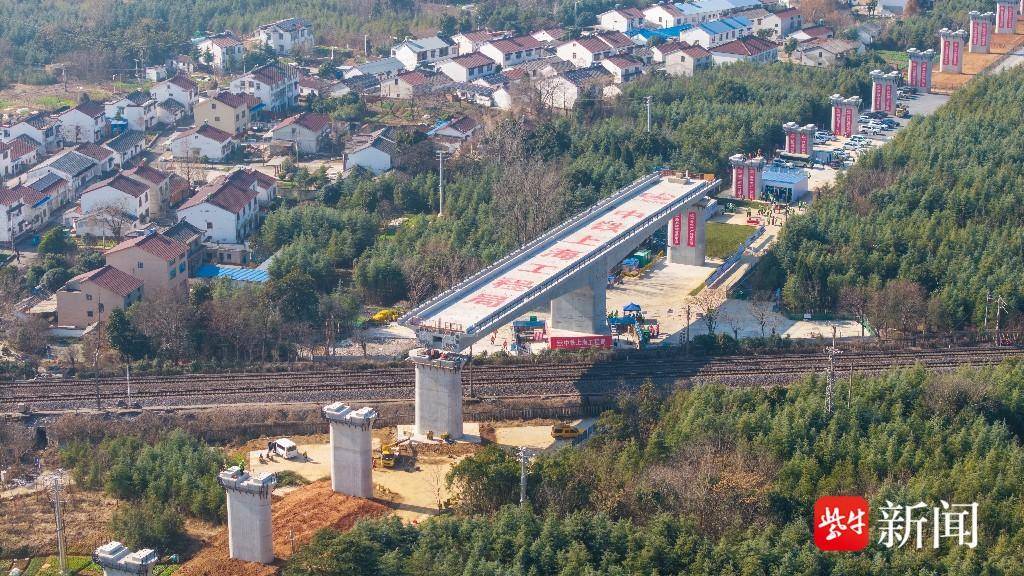
Core Viewpoint - The construction of the Shanghai-Nanjing-Hefei High-Speed Railway (North Jiangsu High-Speed Railway) has achieved a significant breakthrough with the successful rotation of a 6,300-ton turning beam, facilitating the subsequent box girder installation [1][5]. Group 1: Construction Details - The continuous beam measures 97.5 meters in length and is designed as a prestressed concrete box girder with a variable height and cross-section [3]. - The construction utilized a turning method, where the beam was first cast parallel to the railway on one side, with the 0 block constructed using a formwork support system, while the remaining segments were cast using a cantilever method [3]. - The entire beam segment was symmetrically pulled using two 200-ton jacks during the railway's operational "window period," achieving a precise 60-degree counterclockwise rotation to its designated position [3][5]. Group 2: Project Management and Safety - To ensure the successful execution of the turning operation, the project management team conducted thorough planning and multiple optimizations of the construction scheme, coordinating with local meteorological departments to select an optimal date for the operation [5]. - Prior to the turning operation, the beam was allowed to rest for 24 hours, and a monitoring team verified all measurement data and balance status [5]. - Key project elements, including counterweights, sliding tracks, and traction systems, were meticulously checked and signed off by supervisory and construction teams to ensure compliance with standards [5]. Group 3: Strategic Importance - The Shanghai-Nanjing-Hefei High-Speed Railway is a crucial segment of the eastern section of the Chongqing-Lanzhou High-Speed Railway and an important part of the national "Eight Vertical and Eight Horizontal" high-speed railway network along the Yangtze River [6]. - Once completed, the project will establish a rapid new corridor between the Shanghai metropolitan area, Nanjing metropolitan area, and Hefei metropolitan area, significantly enhancing the railway network layout in the Yangtze River region and supporting high-quality development in the Yangtze Economic Belt [6].

这项“海事经验”从南京走向全国
Yang Zi Wan Bao Wang· 2026-01-08 03:28
扬子晚报/紫牛新闻记者笪越 1月7日,最高人民法院会同交通运输部召开新闻发布会,对双方共同印发的《关于推进水上"一站式"解 纷中心建设的意见》(以下简称《意见》)进行解读,并发布水上纠纷多元化解典型案例。该中心是2020 年6月江苏海事局与南京海事法院在南京联合设立了全国首家水上"一站式"解纷中心,由南京推广至全 国。 通讯员唐晓凡 校对盛媛媛 ...
AI健康火了!蚂蚁阿福之后,ChatGPT今日跟进发布健康服务
Yang Zi Wan Bao Wang· 2026-01-08 03:28
Core Insights - Ant Group's "Ant Aifu" has seen rapid growth, prompting OpenAI to enter the AI healthcare sector with the launch of ChatGPT Health, which offers similar functionalities [1][2] - Health is emerging as a high-demand area, with over 230 million weekly consultations related to health and fitness on ChatGPT globally [1] - Ant Aifu's December update provides comprehensive health services, connecting users with 5,000 hospitals and 300,000 doctors, while ChatGPT Health currently lacks full medical resource integration [1] Group 1 - Ant Aifu's monthly active users reached 30 million, with daily queries exceeding 10 million, doubling in just one month [2] - OpenAI's ChatGPT Health is currently available to a limited number of early users [2] - Ant Aifu's features include health Q&A, health companionship, and health services, covering the entire healthcare service chain [1]
向海图强启新程,盐城召开海洋经济高质量发展推进会议
Yang Zi Wan Bao Wang· 2026-01-07 22:52
Core Viewpoint - The meeting in Yancheng emphasizes the importance of developing a high-quality marine economy, aligning with national strategies and local initiatives to leverage marine resources for economic growth [1][2]. Group 1: Development Strategy - Yancheng aims to transform its marine economy from "scale growth" to "quality and efficiency improvement" by recognizing the ocean as a significant potential space for productivity and new growth points [1]. - The city plans to establish a national marine economy development demonstration zone and an international wetland modern marine city, focusing on enhancing the quality and efficiency of marine economic development [2]. Group 2: Industry Focus - The meeting outlines a "3+3+X" marine industry system cultivation project, which includes upgrading traditional industries, strengthening emerging industries, and planning for future industries [2]. - Emphasis is placed on fostering marine innovation, improving platforms, and enhancing ecological quality to cultivate new productive forces in the marine sector [2]. Group 3: Collaborative Efforts - The meeting calls for effective organizational leadership to unify efforts in marine strategy, promoting a comprehensive approach to coastal development and optimizing policy support [2]. - Key stakeholders, including experts from various universities and research institutions, participated in the meeting to provide guidance and feedback on the proposed marine economic development plans [3].
连续 4 年发力,五大举措助企发展!镇江交通印发 2026 优化营商环境方案
Yang Zi Wan Bao Wang· 2026-01-07 22:52
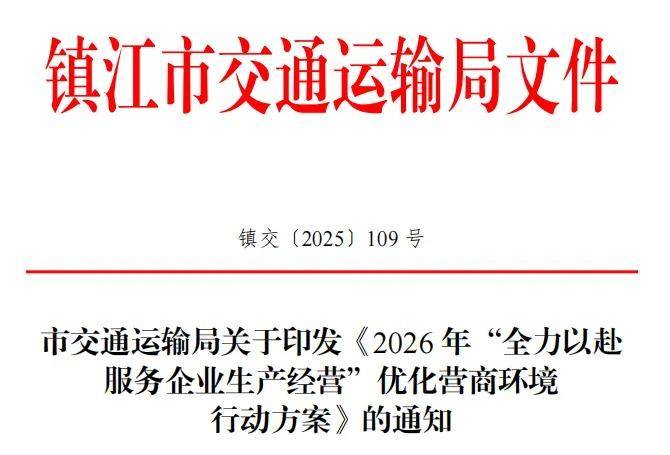
Core Viewpoint - The Jiangsu Provincial Transportation Bureau has issued an action plan for optimizing the business environment by 2026, focusing on enhancing service for enterprises and addressing their development challenges through a collaborative approach between government and businesses [1][3]. Group 1: Action Plan Overview - The action plan is guided by Xi Jinping's thoughts on socialism with Chinese characteristics and emphasizes principles such as party leadership, government-business collaboration, innovation-driven strategies, and results orientation [1]. - This marks the fourth consecutive year of the bureau's special actions to optimize the business environment, with previous efforts yielding significant results through various engagement methods [3]. Group 2: Key Tasks and Innovations - Five major tasks and innovative measures will be implemented this year, including strengthening party coordination and establishing a "three-in-one" leadership mechanism to ensure accountability and follow-up on enterprise issues [3]. - A series of face-to-face communication activities will be organized, including meetings with business leaders to gather feedback and address concerns directly [4][5]. Group 3: Communication Platforms - A multi-faceted government-business interaction system will be created, featuring both online and offline platforms for collecting enterprise demands and providing tailored support [6]. - The "Assistance Officer" system will assign dedicated personnel to ensure precise service delivery for policy promotion and issue tracking [6]. Group 4: Problem-Solving Mechanisms - A comprehensive management mechanism will be established to categorize and address enterprise demands, ensuring timely responses and effective follow-up [7]. - Monthly progress tracking will be conducted to monitor the resolution of issues raised by enterprises [7]. Group 5: Customized Support Services - The plan will focus on high-quality development in key areas such as ports and freight, with specific annual goals and detailed action measures outlined [8]. Group 6: Brand Building and Promotion - The bureau will cultivate and promote exemplary cases of effective enterprise support, leveraging various media channels to create a demonstration effect [9].
南京栖霞区:“十五五”期间目标经济总量年均增长5.5%
Yang Zi Wan Bao Wang· 2026-01-07 22:52
Core Insights - The report outlines the economic goals for Qixia District, aiming for a GDP exceeding 190 billion yuan by 2025, with an average annual growth rate of 5.5% during the 14th Five-Year Plan period [1][3] Economic Performance - In 2025, Qixia District's general public budget revenue is projected to reach 15.17 billion yuan, a growth of 2.3%, surpassing the city average; industrial investment is expected to be 6.2 billion yuan, a 17.1% increase, ranking third in the city [2] - The total output value of industrial enterprises above designated size is anticipated to reach 316.8 billion yuan [2] Industry Development - Qixia District is focusing on upgrading its petrochemical energy and optoelectronic display industries towards high-end, intelligent, and green development, while establishing strategic emerging industry clusters such as smart power and new energy vehicles [2] - Significant projects include the intelligent transformation of LG's new energy battery production line and the construction of the world's largest glass insulator production base [2] Innovation and Education - The district is enhancing the integration of technological and industrial innovation, with 23 projects in collaboration with local universities, resulting in 170 industry-academia cooperation projects and over 10 billion yuan in technology contract transactions [2][3] Future Development Goals - The report sets four development orientations: becoming a global logistics hub, a national demonstration area for new and old kinetic energy conversion, a key innovation source in the Yangtze River Delta, and a livable urban area [4] - Twelve implementation paths are defined, including promoting deep integration of technology and industry, expanding domestic demand, and enhancing cultural soft power [4] 2026 Work Objectives - For 2026, the district aims for GDP growth of over 5%, general public budget revenue growth of over 1%, and fixed asset investment growth of 5.5% [5][6] Urban Development and Livelihood - Qixia District plans to complete urban renewal projects, including the renovation of old residential areas and the construction of vibrant centers that integrate culture, art, and leisure [7]
未来五年江苏交通建设再投一万亿!将新增7座过江通道
Yang Zi Wan Bao Wang· 2026-01-07 15:26
Group 1 - The core viewpoint of the article is the ambitious plan for transportation modernization in Jiangsu during the "14th Five-Year Plan" period, with a focus on significant infrastructure investments and projects aimed at improving connectivity and convenience for citizens [1] - Jiangsu's transportation fixed asset investment is expected to exceed 1 trillion yuan during the "14th Five-Year Plan" period, with substantial progress on major projects related to daily commuting [1] - The construction of new highways and the expansion of existing ones will be prioritized, with an addition of approximately 600 kilometers of new highways and over 800 kilometers of expansions by the end of 2030 [2] Group 2 - The plan includes the completion of key river crossing projects, with a total of 28 river crossings expected to be built by 2030, enhancing connectivity between the two banks of the Yangtze River [3] - The Jiangyin-Jingjiang Yangtze Tunnel and the Nanjing Jianing West Road River Crossing are set to open in 2026, which will alleviate congestion on existing bridges [3] - The second Suzhou River Crossing is planned to commence construction this year, aimed at reducing pressure on the existing Suzhou Bridge [3] Group 3 - The high-speed rail network in Jiangsu will be expanded, with a target of reaching 5,700 kilometers of railway by 2030, including 3,600 kilometers of high-speed rail [4] - Key high-speed rail projects such as the North Jiangsu Railway and Tongsu-Jiaxing-Ningbo Railway are expected to be completed in the next five years, significantly altering the transportation landscape [4] - The Nanjing-Xuancheng Railway is a critical component of the Yangtze River Delta integrated transportation network, aiming for a direct connection between Nanjing and Hangzhou [5] Group 4 - The development of comprehensive transportation hubs is a priority, with over 60 hubs planned to enhance the efficiency of passenger transfers and cargo logistics [6] - The focus will be on improving the connectivity of major hubs like Nanjing Airport and Suzhou North Station, facilitating seamless transfers between different modes of transport [6] - The introduction of specialized tourist trains and enhanced air routes connecting Jiangsu with major cities is also part of the strategy [6] Group 5 - The low-altitude economy is being recognized as a new area for development, with plans to explore urban air transportation options such as "air taxis" and "air buses" [7] - Jiangsu aims to establish a low-altitude flight service guarantee system and initiate the construction of standardized low-altitude takeoff and landing sites by 2026 [7] - The province will also upgrade its low-altitude flight service platform to streamline processes related to flight planning and airspace applications [7]
宜家中国宣布关闭7家商场,开业近九年的南通店在列
Yang Zi Wan Bao Wang· 2026-01-07 15:09
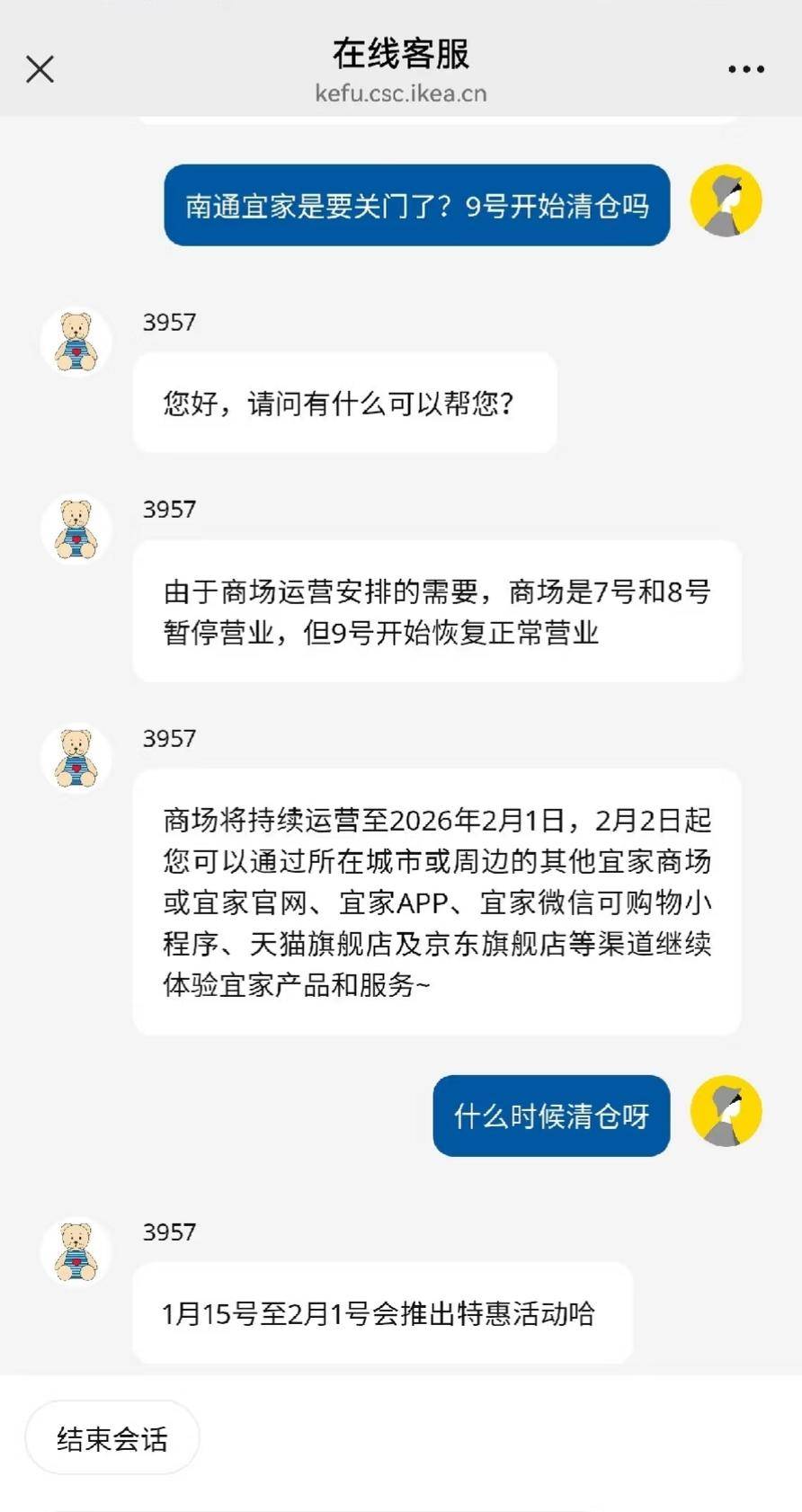
Core Viewpoint - IKEA China announced the closure of seven stores in Shanghai, Guangzhou, Tianjin, Nantong, Xuzhou, Ningbo, and Harbin starting February 2, 2026, as part of its strategy to optimize channel layout and build business resilience [1][4] Group 1: Store Closures - The affected stores include the Nantong location, which opened in May 2017 and was the 22nd store in China [1] - The closure is part of a broader strategy to streamline operations, with IKEA maintaining 34 customer touchpoints in China after the closures [4] Group 2: Customer Engagement - During the closure period, the Nantong store will temporarily suspend operations from January 7 to January 8, 2026, but will resume on January 9, allowing customers to shop online through various platforms [1] - A promotional discount event is planned from January 15 to February 1, 2026, to clear inventory [1] Group 3: Employee Support - IKEA has committed to providing comprehensive support to affected employees through open communication and transparent processes [1] - Employees have expressed confidence in the company's support, including arrangements for psychological counseling [1]
长三角最深!南京地铁4号线二期过江隧道顺利贯通
Yang Zi Wan Bao Wang· 2026-01-07 14:40
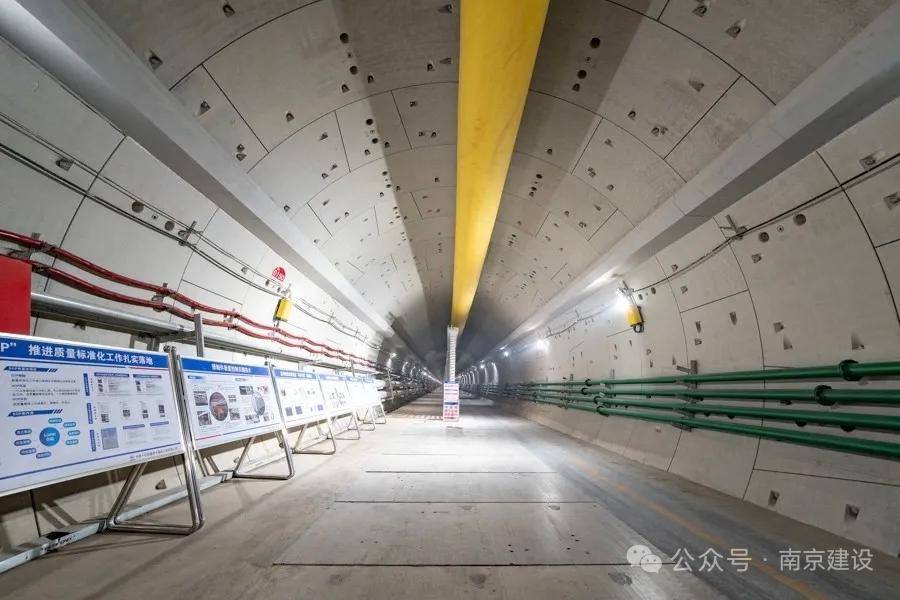
Core Viewpoint - The successful completion of the Nanjing Metro Line 4 Phase II underwater tunnel marks a significant milestone in the construction of urban rail transit, achieving a record depth of 68.58 meters below the Yangtze River surface, enhancing the connectivity of Nanjing's cross-river transit network [1][3]. Group 1: Project Overview - The Nanjing Metro Line 4 Phase II project starts from Zhenzhuquan East Station and runs approximately 10 kilometers, featuring six underground stations [3]. - The underwater tunnel spans 3,062.6 meters and employs a single-tube double-track design, utilizing a large-diameter slurry balance shield tunneling machine with a diameter of 11.64 meters [3][4]. Group 2: Technical Challenges - The construction faced significant challenges, including traversing 2,200 meters of the Yangtze River's middle section, characterized by high water permeability and extreme underwater pressure of nearly 90 meters [4]. - The tunnel had to pass through 13 different geological strata, with the most challenging being a 788-meter section of moderately weathered mudstone, which has a quartz content of 90% and poses risks such as increased tool wear and reduced tunneling efficiency [4]. Group 3: Technological Innovations - The project utilized a custom-designed shield machine, "Xin Zheng Cheng Hao," equipped with advanced systems for pressure balance and high-pressure flushing, enhancing cutting efficiency and tool lifespan [5]. - The application of synchronous double-liquid slurry technology was a first in domestic metro underwater tunnels, effectively controlling the segment uplift to within 5 millimeters and ensuring high-quality tunnel formation with no leakage [6].