Qian Zhan Wang

Search documents
GMV接近300亿!美团宣布全面拓展即时零售业务,小象超市逐步拓展到所有一二线城市【附即时零售行业市场分析】
Qian Zhan Wang· 2025-06-24 03:09
Core Viewpoint - Meituan is expanding its instant retail business through its Xiaoxiang supermarket, aiming to enhance delivery efficiency and optimize supply chain digitalization to provide faster and more refined services to consumers [2][10]. Group 1: Business Expansion - Xiaoxiang supermarket will expand its coverage to all first- and second-tier cities and plans to cover 200 high-quality county-level agricultural areas in China, such as Shouguang and Enshi, to offer more diverse and distinctive fresh food products [2]. - The overseas version of Xiaoxiang supermarket, Keemart, is set to launch in Riyadh, Saudi Arabia, in June 2025, with plans for further regional expansion [2]. Group 2: Market Dynamics - The instant retail market in China has seen significant growth, with order volume increasing from 4.6 billion in 2016 to 21 billion in 2020, and the user base growing from 124 million to 506 million during the same period, reflecting a compound annual growth rate of 46% [3]. - Despite the rapid growth, the overall profitability of the industry remains concerning, with Dingdong Maicai reporting a net profit margin of only 0.1% in Q1 2025, while Xiaoxiang supermarket is currently operating at a loss [3][9]. Group 3: Cost Challenges - Cost differences are a core issue affecting profitability in the industry, with delivery costs for Dada Express at 4.3 yuan per order compared to 12.7 yuan for Dingdong Maicai, primarily due to differences in business models and delivery efficiency [6]. Group 4: Strategic Focus - The instant retail market is shifting from rapid expansion to a focus on comprehensive service capabilities, as seen in Xiaoxiang supermarket's strategy of optimizing supply chains through direct sourcing and digital enhancements [9]. - The future of instant retail hinges on three key variables: technological breakthroughs, innovative business models, and changes in consumer habits, with companies exploring various paths to achieve efficiency and scale [10].



【投资视角】启示2025:中国无人驾驶物流车行业投融资及兼并重组分析(附投融资汇总、产业基金和兼并重组等)
Qian Zhan Wang· 2025-06-24 02:15
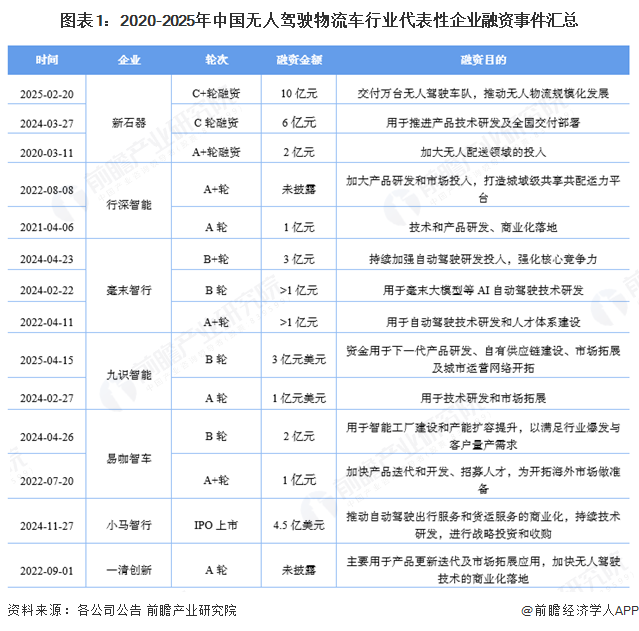
Core Insights - The article discusses the investment landscape and trends in the autonomous logistics vehicle industry in China, highlighting key financing events, company strategies, and market dynamics from 2020 to 2025 [1][2][5]. Group 1: Financing and Investment Trends - Representative companies in the autonomous logistics vehicle sector are primarily startups, focusing on multiple rounds of financing to accelerate product development [1]. - Major listed companies like JD Logistics, SF Express, Meituan, and others are investing heavily in artificial intelligence and automation to enhance logistics vehicle capabilities [2]. - The financing events from 2021 to 2025 are concentrated among L4 autonomous driving solution providers and manufacturers, indicating a focus on technology development and production [5]. Group 2: Investment Amounts and Events - The number of investment events in the autonomous logistics vehicle sector from 2016 to 2025 is relatively low, with significant peaks in 2018, 2023, and 2024, where single financing amounts exceeded 1 billion yuan [8]. - The analysis of investment rounds shows that 44.44% of representative companies are still in early financing stages, with expectations for increased C-round financing in the future [10]. Group 3: Geographic Distribution and Investor Types - Investment activities are predominantly concentrated in eastern cities like Beijing, which accounts for 33.30% of financing enterprises, reflecting the strong industrial foundation in these regions [13]. - The primary investors in the autonomous logistics vehicle sector are investment firms, with notable participants including CICC Capital and Meituan, while industrial players like SF Express also engage in investments [15]. Group 4: Industry Funds and Mergers - There are few industry funds specifically targeting the autonomous logistics vehicle sector, with notable funds investing in companies like Sien Intelligent and White Rhino Intelligent [16]. - Mergers and acquisitions in the industry are limited, primarily involving internal business integrations and technology complementarity among companies [19].



重磅!2025年中国及31省市矿用机器人行业政策汇总及解读(全)政策鼓励矿用机器人进行安全生产
Qian Zhan Wang· 2025-06-23 06:48
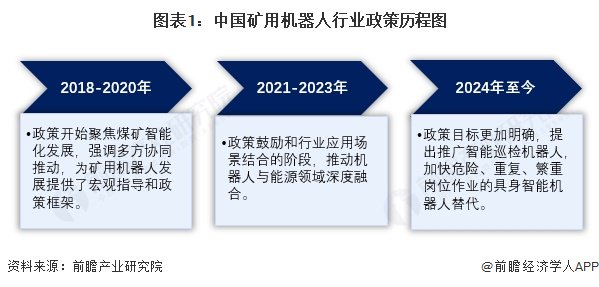
Core Insights - The article discusses the development and policy framework of the mining robot industry in China, highlighting the government's focus on promoting intelligent mining solutions to enhance safety and efficiency in coal mining operations [1][3]. Policy Development Timeline - The policy development for mining robots began with the integration of 5G, big data, and AI technologies, with a significant focus on coal mine automation from 2018 to 2020. This period emphasized collaboration among various stakeholders to establish a macro guidance framework for the industry [1]. - From 2021 to 2023, policies encouraged the combination of industry applications with technological frameworks, leading to the issuance of guidelines for intelligent coal mine construction [1][3]. - Starting in 2024, the policies aim to promote research and technological breakthroughs in large mining enterprises, with local governments introducing policies to accelerate the adoption of intelligent inspection robots [1]. National Policy Summary - The national government has prioritized the research and application of mining robots to ensure safe and efficient production in the mining sector. Key policies include the 2019 focus on coal mine robot development and the 2022 "14th Five-Year" plan promoting robot application scenarios [3][4]. - By 2025, large coal mines are expected to achieve full system automation, with a target of 40% unmanned transport equipment in open-pit mines [3][4]. Provincial Policies - Various provinces have tailored their mining robot policies to local conditions, with Inner Mongolia and Xinjiang focusing on intelligent mining construction from 2022 to 2025. These policies aim to establish a comprehensive standard system for mining automation and enhance data integration capabilities [10][11]. - Financial support and tax incentives are being offered to encourage the development and application of mining robots, aiming to reduce human labor in hazardous mining operations [10][12]. Key Development Goals - Specific provincial plans include achieving a basic level of intelligent mining by 2025 in regions like Xinjiang and Ningxia, with significant advancements in technology and automation expected by 2026 [13][12]. - The overall goal is to enhance safety and operational efficiency in mining through the widespread adoption of intelligent technologies and robots [10][12].


2025年中国奶酪行业技术现状 再制奶酪工艺复杂【组图】
Qian Zhan Wang· 2025-06-23 05:19
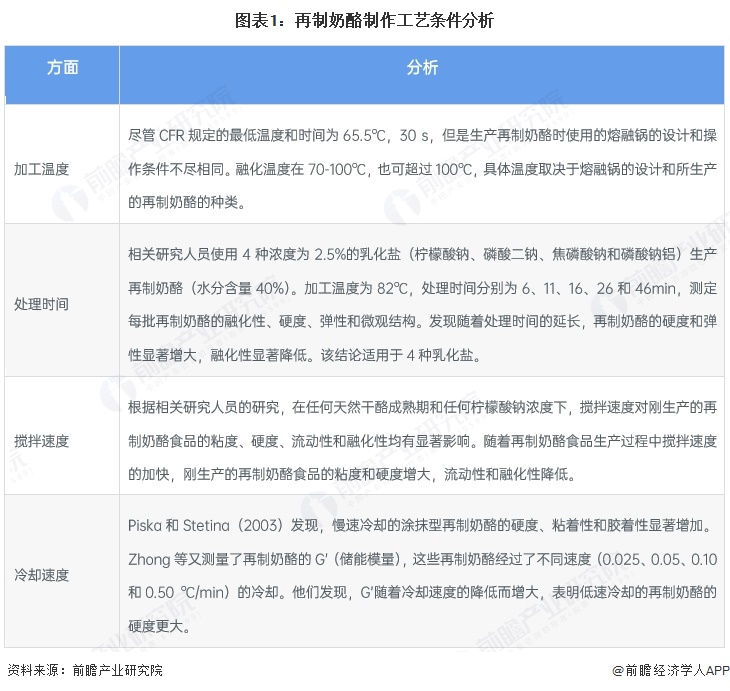
Core Insights - The article discusses the cheese industry in China, focusing on the production processes, patent applications, and the technological aspects of processed cheese [10][11]. Group 1: Cheese Production Process - The production of processed cheese involves a complex process that includes natural cheese treatment, mixing with emulsifying salts and other ingredients, heating, continuous stirring, packaging, cooling, and storage [5][9]. - Key parameters affecting the quality of processed cheese include melting temperature, processing time, stirring speed, and cooling rate, which significantly influence the final product's texture and functionality [2][4][9]. Group 2: Ingredients and Composition - The composition of processed cheese is influenced by various chemical components such as fat content, moisture content, pH value, total calcium content, casein content, lactose content, and whey protein content [7][9]. - The total calcium content in processed cheese affects its manufacturing difficulty and functional properties, with higher calcium levels leading to increased hardness and reduced meltability [9]. - The pH value of processed cheese is crucial for its quality and microstructure, with an optimal range identified between 5.4 and 5.8 [9]. Group 3: Patent Landscape - As of now, there are over 3,700 cheese-related patents in China, with a notable increase in applications since 2015, peaking at 541 applications in 2023 [10][11]. - The leading applicant for cheese-related patents is Yijia Haonai, a subsidiary of Yili Group, with 137 patents, followed by Mengniu Dairy, Bright Dairy, Yili Company, and Miaokelan Duo [11].






重磅!2025年中国及31省市铝型材行业政策汇总及解读(全)“政策引导国内铝企业高质量发展”
Qian Zhan Wang· 2025-06-22 07:14
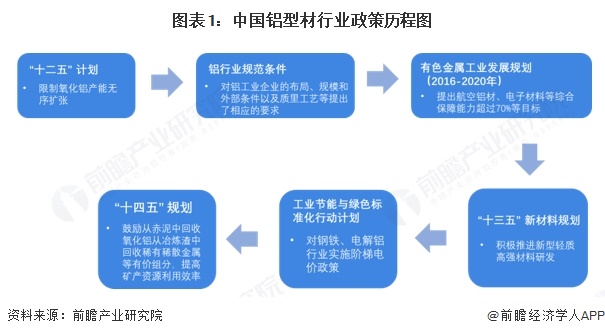
Core Viewpoint - The article discusses the evolution of policies in China's aluminum profile industry, emphasizing the shift towards high-quality development, green technology, and international competitiveness in the sector [1][3][7]. Policy Evolution - The aluminum profile industry's policy development has followed the macro policies of the aluminum processing industry, transitioning from capacity restrictions to promoting new materials and enhancing recycling technology [1]. - Key milestones include the 2011 "12th Five-Year Plan" which aimed to control the blind expansion of electrolytic aluminum capacity and the 2024 announcement to cancel export tax rebates for aluminum products to guide domestic enterprises towards high-quality development [1][3]. National Policy Summary - The Chinese government has made comprehensive plans for the aluminum profile industry, focusing on green and low-carbon development, particularly in the "14th Five-Year Plan" [3]. - Recent policies include the cancellation of export tax rebates to encourage high-quality development and the promotion of standards for aluminum alloys and composite materials [3][7]. Key Policy Documents - A summary of key policies includes: - "High-Quality Development Implementation Plan (2025-2027)" aiming for a significant increase in aluminum resource security and recycling capacity by 2027 [4]. - "Action Plan for Energy Conservation and Carbon Reduction in the Electrolytic Aluminum Industry" targeting a 30% share of benchmark energy efficiency capacity by 2025 and a recycling aluminum output of 11.5 million tons [11][12]. Provincial Policy Initiatives - Various provinces have introduced policies to enhance the aluminum processing industry, focusing on safety, technological advancement, and environmental sustainability [13][14]. - For instance, Guangdong aims to improve energy efficiency levels of aluminum products by 5% by 2025, while Jiangsu plans to update significant equipment in aluminum processing facilities by 2027 [18]. Future Outlook - The demand for aluminum alloy new materials is expected to grow significantly, driving technological reforms and development in the aluminum profile industry [17].



2025年中国运动服行业贸易分析:出口规模有所下滑,欧美是最大的出口市场
Qian Zhan Wang· 2025-06-22 05:10
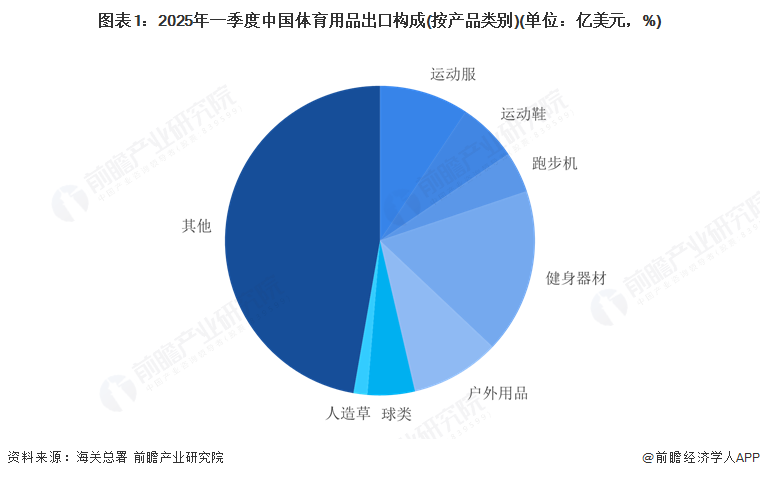
Core Viewpoint - The export scale of Chinese sportswear has recently declined, with significant fluctuations observed over the years, influenced by global trade policies and market competition [2][6]. Export Scale and Trends - In Q1 2025, the export value of sportswear from China reached $6.97 billion, making it a significant contributor to the sports goods export sector, second only to fitness equipment and outdoor products [1]. - The export value of sportswear from China was stable at around $2 billion from 2015 to 2019, but saw a sharp decline in 2020 due to the pandemic. A notable recovery occurred in 2021-2022, followed by a downturn in 2023-2024, with a 7.54% year-on-year decrease in the first four months of 2025 [2]. Major Export Destinations - The United States remains the largest market for Chinese sportswear, with an export value of $5.97 billion in 2024, accounting for 25.82% of total exports. The UK and Germany follow with $1.40 billion (6.05%) and $1.03 billion (4.45%) respectively [6][7]. - Other countries like Spain, Australia, and the Netherlands also contribute to the export market, while exports to Russia, Japan, and France have decreased [6]. Company Performance and International Strategy - Companies in the sportswear sector show varied performance in international markets. For instance, Jiasheng Group and Jialinjie have high overseas revenue shares of 62.27% and 85.17%, respectively, while Li Ning and 361 Degrees have less than 2% [8]. - Anta has established a significant presence in Southeast Asia and is expanding into the US and Europe, with 243 overseas stores by the end of 2024. Li Ning is more cautious in its international strategy, with overseas revenue accounting for less than 10% [9][12]. - Xtep focuses on the Southeast Asian low-end market, while 361 Degrees has expanded its sales network to 1,365 locations in the Americas and Europe, launching an independent overseas e-commerce site [12][13].
【全网最全】2025年稀土产业上市公司全方位对比(附业务布局汇总、业绩对比、业务规划等)
Qian Zhan Wang· 2025-06-22 03:08
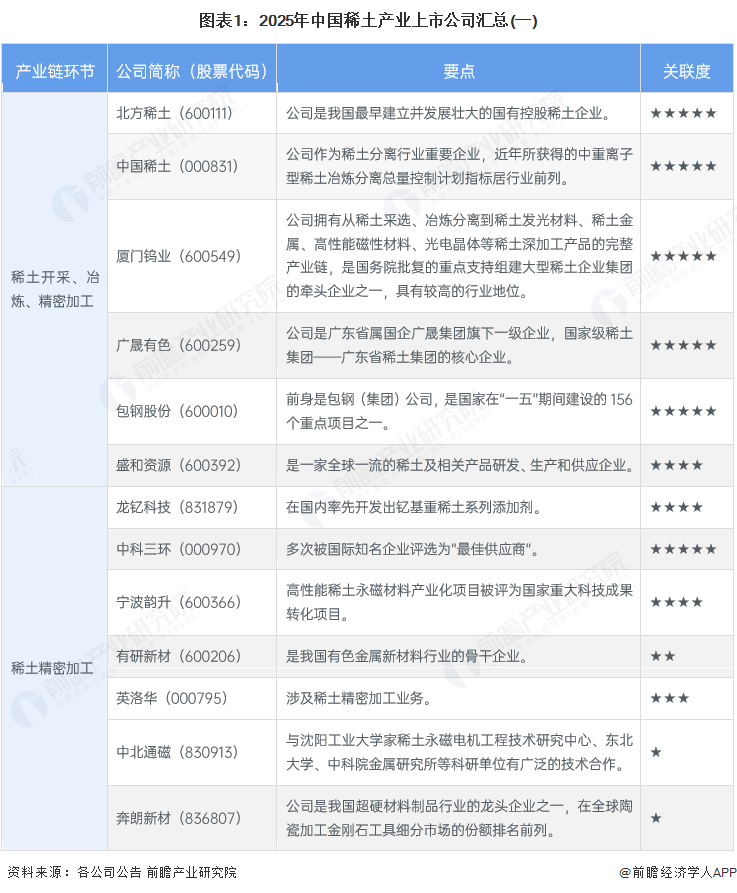
Summary of Key Points Core Viewpoint - The article provides a comprehensive overview of the rare earth industry in China, highlighting the major listed companies, their revenue performance, business layouts, and the challenges faced in 2024. Group 1: Overview of Listed Companies - The number of listed companies in China's rare earth industry is significant, covering various segments such as mining, smelting, processing, and recycling [1][3]. - Key companies include Northern Rare Earth (600111), China Rare Earth (000831), Xiamen Tungsten (600549), and Guangsheng Nonferrous (600259), among others [1][3]. Group 2: Revenue Performance - In 2024, the revenue of major companies showed a decline, with Shenghe Resources reporting the largest scale of rare earth-related business revenue at 54.38 billion yuan in the first half of the year [12]. - Companies like Xiamen Tungsten, Mifeng New Materials, and others achieved over 20% growth in rare earth business revenue during the same period [12]. Group 3: Business Layout Comparison - The article details the business layouts of various companies, indicating that Shenghe Resources has the largest revenue scale, while companies like Mifeng New Materials and Xiamen Tungsten are expanding their operations [12][20]. - Companies are focusing on enhancing their competitive edge through various strategies, including expanding production capacity and improving product quality [22]. Group 4: Profitability and Margins - The gross profit margins of rare earth businesses vary significantly among companies, with Mifeng New Materials leading at 22.84%, while Hengyuan Technology reported a negative margin of -5.92% [15]. - The overall distribution of gross margins indicates a disparity in profitability, influenced by business models and market competition [15]. Group 5: Overseas Business and Growth - Xiamen Tungsten has the largest overseas revenue scale among listed companies, with an estimated 5.19 billion yuan in the first half of 2024 [18][19]. - Companies like Mifeng New Materials and Yingluohua have shown significant growth in overseas revenue, indicating their competitive position in international markets [18][19]. Group 6: Research and Development - R&D investment varies widely, with Mifeng New Materials and Zhongbei Tongci showing high R&D intensity at 13.64% and 13.83%, respectively [20][21]. - Xiamen Tungsten leads in R&D expenditure, reflecting its comprehensive industry chain and accumulated expertise [20][21]. Group 7: Future Business Plans - Companies are actively pursuing various business plans, such as Xiamen Tungsten's focus on domestic and international industrial cycles and Northern Rare Earth's investment in wet smelting and inorganic functional materials [22]. - The overall trend indicates a proactive approach to expanding business operations and enhancing competitiveness in the rare earth sector [22].


【行业深度】洞察2025:中国电力行业竞争格局(附竞争梯队、企业竞争力评价等)
Qian Zhan Wang· 2025-06-21 03:09
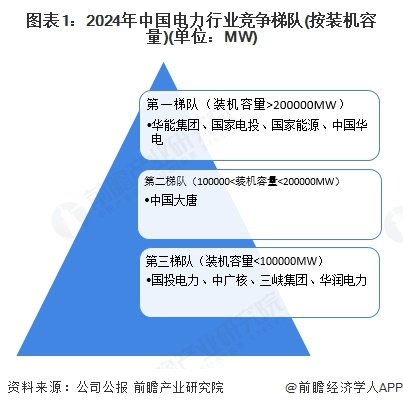
Group 1 - The core viewpoint of the article is the competitive landscape of the Chinese power industry, highlighting the tiered structure of major companies based on installed capacity [1][12]. - The Chinese power industry can be divided into three competitive tiers: the first tier includes companies with installed capacity over 200,000 MW, such as Huaneng Group and State Power Investment; the second tier includes companies with capacity between 100,000-200,000 MW, like China Datang; and the third tier includes companies with capacity below 100,000 MW, such as State Power and China General Nuclear Power [1][12]. - In 2024, the total power generation in China reached 10,086.88 billion kWh, a year-on-year increase of 6.7%, with the top ten listed companies accounting for only 22.5% of the total generation [6][12]. Group 2 - In 2024, Huaneng International generated 479.864 billion kWh, making it the largest power generation company in the industry, followed by Guodian Power with 459.452 billion kWh and Yangtze Power with 295.904 billion kWh [3][12]. - The market concentration in the Chinese power industry is relatively low, with the top three companies only accounting for 12.2% of the total power generation [6][12]. - The majority of listed companies in the power sector have a revenue share from power generation that exceeds 90%, with some being part of diversified energy groups while others focus on clean energy like hydropower or nuclear power [9][12]. Group 3 - The competitive state of the Chinese power industry is characterized by intense internal competition, with domestic companies facing threats from foreign giants that leverage financial and technological advantages [12]. - The bargaining power of buyers in the power industry is weak, while suppliers have some bargaining power due to the essential nature of electricity for economic development [13][12]. - The article employs Porter's Five Forces model to analyze the competitive environment of the Chinese power industry, indicating a trend towards oligopoly as barriers to entry increase [12][13].





【投资视角】启示2025:中国低空物流行业投融资及兼并重组分析(附投融资事件、产业基金和兼并重组等)
Qian Zhan Wang· 2025-06-21 01:10
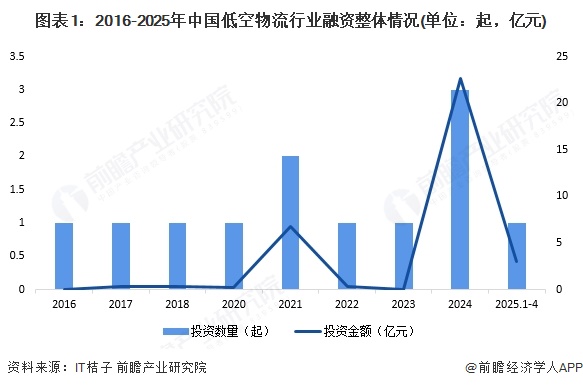
Group 1 - The low-altitude logistics industry in China has seen a low level of investment and financing activity, with a significant increase in investment amount in 2021 to 680 million yuan, followed by a surge to 2.27 billion yuan in 2024 [1][8] - Investment rounds in the low-altitude logistics sector are primarily early-stage, focusing on A-round and angel financing, indicating that the industry is still in its developmental phase with many innovative companies seeking funding for technology development and market expansion [2][8] - The majority of financing events in the low-altitude logistics industry are concentrated in Zhejiang, Beijing, and Shanghai, with Zhejiang leading at 7 events, followed by Beijing with 3 and Shanghai with 2 [6][8] Group 2 - The primary focus of investment in the low-altitude logistics industry is on drone delivery, with several significant financing events recorded from 2016 to 2025 [8][9] - Investors in the low-altitude logistics sector are predominantly capital organizations, accounting for 92% of the investment, with notable investors including Sequoia China and Matrix Partners [5][8] - There are numerous industry investment funds related to low-altitude logistics, although no private equity funds specifically for low-altitude logistics have been identified [12][8] Group 3 - Vertical acquisitions to expand business areas have become mainstream in the low-altitude logistics industry, with several notable mergers and acquisitions recorded from 2016 to 2025 [15][8] - The overall investment and merger activity in the low-altitude logistics industry remains low, with a concentration of investments from capital institutions primarily in Zhejiang, Beijing, and Shanghai [8][16]
1222万大学生毕业!李书福:人才培养模式应是千人千面,学历不等于能力,学位不等于地位【附高等教育行业市场分析】
Qian Zhan Wang· 2025-06-20 09:17
Group 1 - The core theme of the dialogue is "Talent Development in the AI Era," emphasizing the importance of aligning personal interests with career goals for students [2] - Wang Xingxing highlights the need for students to focus on their interests and understand the job market to enhance their future growth [2] - Li Shufu discusses Geely's innovative approach to talent cultivation, advocating for a "personalized" training model rather than a one-size-fits-all approach [2][3] Group 2 - Li Shufu reflects on the current education landscape, stating that a degree does not equate to capability, and emphasizes the importance of practical experience and continuous self-improvement [3] - The number of college graduates in China has been steadily increasing, reaching 11.58 million in 2023 and projected to hit 12.22 million by 2025, intensifying competition in the job market [3][4] - There is a significant skills gap in China, with a shortage of over 19 million skilled workers in 2020, expected to rise to 30 million by 2025, particularly in fields like information technology and new materials [4] Group 3 - The traditional division of academic disciplines often leads to fragmented knowledge among students, necessitating a shift towards interdisciplinary education to solve complex societal issues [5] - The current educational reforms in China aim to build a strong education system, responding to fundamental changes in both domestic and international contexts [5]