Qian Zhan Wang

Search documents
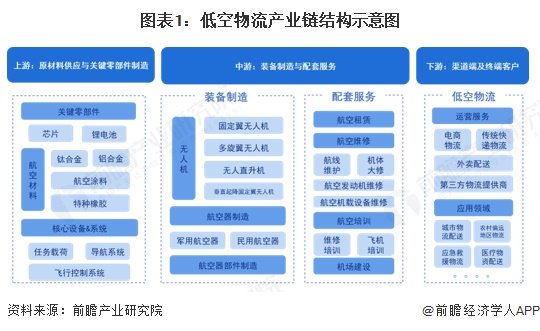
【干货】2025年低空物流行业产业链全景梳理及区域热力地图
Qian Zhan Wang· 2025-05-31 03:10
Industry Overview - The low-altitude logistics industry in China consists of a comprehensive supply chain, including upstream raw materials and core components, midstream low-altitude manufacturing, and downstream operational services and applications [1][2] - Upstream materials include metals, special rubber, and polymer materials, while midstream encompasses low-altitude manufacturing, flight operations, and comprehensive services [1][2] - Downstream services cover e-commerce logistics, traditional express delivery, takeaway delivery, and third-party logistics providers, with applications in urban logistics, rural logistics, emergency rescue, and medical supplies delivery [1] Key Players and Their Business Layout - Major companies in the low-altitude logistics sector include Hongdu Aviation, AVIC Helicopter, and DJI, with a focus on various aspects of the supply chain [2][10] - Hongdu Aviation specializes in the design, manufacturing, and maintenance of trainer aircraft, with over 8,000 pieces of equipment [11] - AVIC Helicopter is the largest player in China's helicopter manufacturing industry, with a comprehensive product range [11] - DJI and other drone manufacturers are pivotal in the midstream segment, while logistics companies like SF Express, Meituan, and JD.com are key players in the downstream segment [2][10][12] Regional Development - The low-altitude logistics industry is primarily concentrated in Beijing and Guangdong, where the development of the supply chain is more robust [4][6] - As of April 2025, there are 16 drone industrial parks across China, with notable concentrations in Zhejiang and Jiangsu [8] Recent Developments and Trends - Companies are diversifying their operations, with SF Express, Meituan, and JD.com expanding their business through digital logistics solutions and technological innovations [13][14] - The industry is witnessing advancements in drone technology, including battery life improvements and enhanced obstacle avoidance capabilities [14] - Collaboration among companies is increasing to explore new application scenarios and business models in low-altitude logistics [14] Representative Companies' Latest Developments - SF Express has established a three-segment air transport network and operates a significant number of drone flights daily [12][15] - Meituan has launched multiple drone delivery routes and is expanding its operations internationally, including in the UAE [15] - JD.com is focusing on last-mile delivery in remote areas and has introduced a new generation of logistics drones [15] - China Post is developing a low-altitude logistics network and has signed strategic agreements to enhance its infrastructure [15] - Xunyi Technology is collaborating with China Mobile to promote low-altitude logistics and smart city initiatives [15]




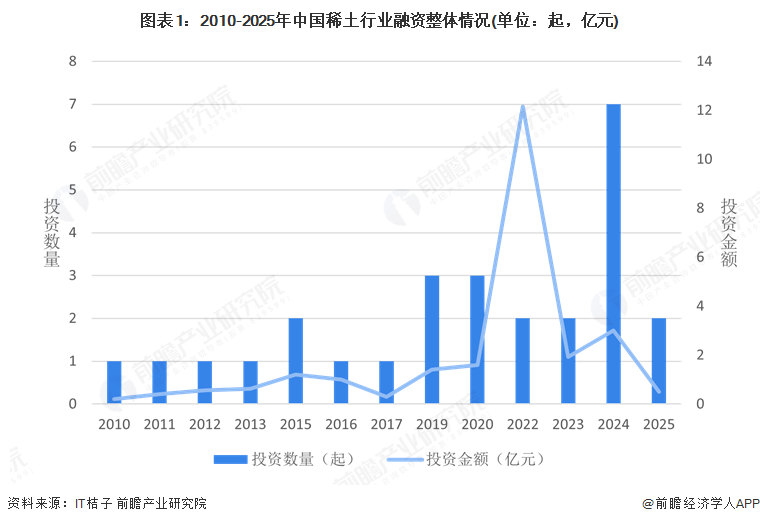
【投资视角】启示2025:中国稀土行业投融资及兼并重组分析(附投融资事件、产业基金和兼并重组等)
Qian Zhan Wang· 2025-05-31 01:11
Core Insights - The recent trend in China's rare earth industry shows an increase in investment and financing activities, with a notable rise in financing events in 2024 [1][2] Group 1: Financing Trends - The number of financing events in China's rare earth industry has fluctuated from 2010 to 2023, with a significant increase in 2024, where two financing events totaling 0.5 billion yuan have already occurred by April 17, 2025 [1] - The average single financing amount in 2025 is 0.25 billion yuan, indicating that financing amounts have generally remained below 1 billion yuan, except for specific years [2] - Financing rounds are primarily concentrated in strategic investments and A-round financing, reflecting the industry's emphasis on technological maturity [4] Group 2: Regional Financing Characteristics - Financing activities in the rare earth sector are concentrated in regions such as Jiangsu, Anhui, and Inner Mongolia, with Jiangsu leading with five financing events [7] - The regional disparities in financing reflect the availability of rare earth resources, strong policy support, and the growth potential of enterprises in these areas [7] Group 3: Investment Focus - The primary focus of investments in the rare earth industry is on technology research and development companies, with 13 out of 27 financing events targeting R&D firms [12] - The majority of investors in the rare earth sector are capital organizations, accounting for over two-thirds of the total, with notable investors including Fengshang Capital and Yunsong Investment [14] Group 4: Mergers and Acquisitions - The rare earth industry is experiencing horizontal mergers and acquisitions aimed at expanding scale and enriching product lines, with a focus on midstream enterprises [17] - Recent notable acquisitions include the absorption of 100% equity stakes in various companies, with transaction values ranging from 1.05 billion to 14.97 billion yuan [18]


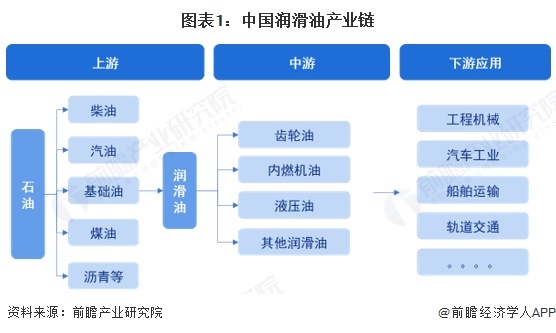
2025年中国润滑油产业价值链分析:车用润滑油毛利率相对较高
Qian Zhan Wang· 2025-05-30 08:18
Industry Overview - The lubricating oil industry in China has a supply chain that includes upstream oil extraction, refining of base oils, and additive supply, with downstream applications in engineering machinery, automotive, shipping, and rail transportation [1] Cost Structure - In the lubricating oil production process, direct materials account for over 80% of total costs, with specific figures showing that direct material costs are approximately 87.6% for Unified Corporation and 80.8% for Longpan Technology [3][3] - Other cost components include transportation costs (2.1% for Unified Corporation and 6.5% for Longpan Technology) and direct labor costs (1.3% for Unified Corporation) [3] Price Transmission Mechanism - The market price of lubricating oil is influenced by supply, manufacturing, and application sectors, with costs from raw materials, labor, and equipment impacting the manufacturing costs, which in turn affect the final pricing based on market demand elasticity [4] Profitability Analysis - The gross margin for automotive lubricating oils is relatively high, ranging from 30% to 45%, while internal combustion engine oils have a gross margin between 25% and 40%, indicating higher profitability in the automotive sector [6] - However, the overall profitability of lubricating oil companies has been declining, with average sales gross margins dropping to around 11% in 2023 and 15.60% in the first three quarters of 2024 [9] - Longpan Technology has experienced a significant decline in gross margin from 35% in 2019 to negative levels in 2023, reflecting a broader trend of decreasing profitability across the industry [9]
富士康:已推出全方位机器人生产平台,在智能化制造领域迈出重要一步【附智能制造行业市场分析】
Qian Zhan Wang· 2025-05-30 04:00
Group 1 - Foxconn's chairman Liu Yangwei announced the successful establishment of a comprehensive robot production platform, marking a significant step in smart manufacturing and enhancing Foxconn's leading position in the global electronics manufacturing industry [2] - The smart manufacturing industry is a key direction for the transformation and upgrading of global manufacturing, integrating advanced technologies such as artificial intelligence, IoT, big data, and cloud computing with traditional manufacturing [2] - Smart manufacturing aims to achieve high levels of automation, precision, and efficiency in production processes, optimizing production flows, improving product quality, and reducing costs through real-time data analysis and AI algorithms [2] Group 2 - The 2023 China Digitalization Conference and the Global Business Intelligence Forum by Lyon Business School released the "2023 China Smart Manufacturing Top 100 List," with Haier, BYD, and Fuyao Glass ranking in the top three [3] - Haier and BYD are tied for first place, Fuyao Glass is third, Huawei is fourth, and Foxconn is fifth in the rankings [4] - The top ten companies are primarily from the computer, communication, and other electronic equipment manufacturing industries, followed by transportation equipment and automotive manufacturing sectors [4] Group 3 - The establishment of Foxconn's robot production platform reflects the broader trend of smart manufacturing development in China, with more companies investing in technology innovation to elevate manufacturing standards [6] - Experts emphasize the need for macro-level support and technological innovation to advance embodied intelligence in various fields, focusing on key technology research and resource optimization [6] - The core technology system of smart manufacturing consists of intelligent manufacturing equipment, software, and cyber-physical systems, forming a closed loop of data flow for decision-making and execution [7]


前瞻全球产业早报:2025年新一线城市名单发布
Qian Zhan Wang· 2025-05-30 02:16
Group 1 - Chengdu has topped the "2025 New First-tier City Charm Ranking" for 11 consecutive years, achieving a perfect score in four out of five dimensions [2] - The "2025 New Domain New Quality Innovation Competition" targets 169,000 specialized and innovative enterprises, aiming to identify 500 outstanding projects [3] - Honor has officially entered the robotics sector, showcasing a robot that can run at a speed of 4m/s, setting a new industry record [4] Group 2 - CATL is committed to continuous investment in solid-state batteries, with expectations for small-scale production by 2027 [5] - Pony.ai has signed a strategic cooperation agreement with Guangzhou Public Transport Group to advance the commercialization of autonomous driving [6][7] - DJI is set to enter the robotic vacuum market, with its first product expected to launch in June after four years of development [8] Group 3 - BYD has established a new automotive sales company in Changsha with a registered capital of 1 million RMB, focusing on new energy vehicle sales [9] - ByteDance will ban third-party AI programming tools internally, opting for its own tool, Trae, to mitigate data leak risks [10] - The European Union aims to reduce carbon emissions by 54% by 2030, slightly below its 55% target [11] Group 4 - SpaceX's Starship experienced a failure during its ninth test flight, but CEO Elon Musk noted significant progress compared to previous flights [12] - Volvo has temporarily halted production at its South Carolina plant due to supply chain issues related to a hardware component [13] - South Korea plans to invest approximately 480 billion KRW (around 349.1 million USD) in AI-related products and services this year [14] Group 5 - Nissan is seeking over 7 billion USD in funding with the assistance of the UK government to maintain operations [15] - Japan's parliament has passed its first law specifically addressing artificial intelligence, aimed at promoting development and preventing misuse [16] - Eli Lilly announced its acquisition of private company SiteOne Therapeutics to gain access to an experimental non-opioid pain medication [17]

预见2025:《2025年中国预制菜行业全景图谱》(附市场现状和发展趋势等)
Qian Zhan Wang· 2025-05-30 02:13
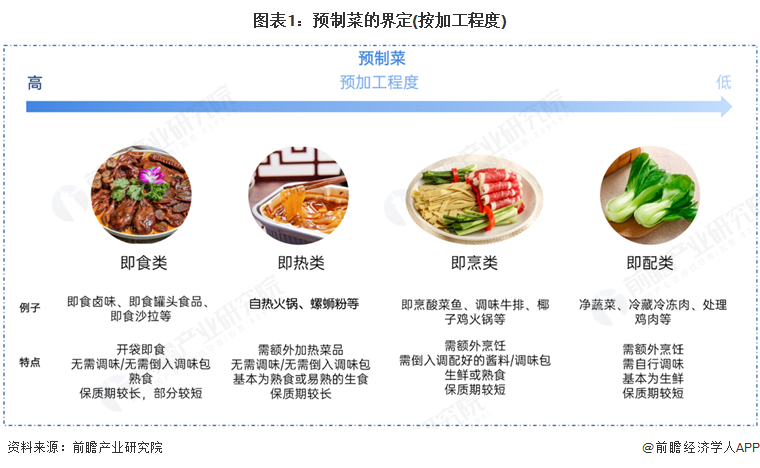
Industry Overview - The pre-prepared food, also known as pre-prepared dishes, is defined as packaged meals made from one or more edible agricultural products, which undergo industrial pre-processing without preservatives and are ready to be consumed after heating [1][3] - The pre-prepared food industry can be categorized into four types based on processing degree and subsequent handling: ready-to-eat, ready-to-heat, ready-to-cook, and ready-to-assemble [1] Industry Chain Analysis - The production enterprises in China's pre-prepared food industry are mainly divided into self-produced and commissioned processing categories [3] - Key upstream participants include agricultural producers, initial processing companies, and packaging manufacturers, while downstream participants consist of various consumer outlets and logistics companies [6] Industry Development History - The pre-prepared food industry in China has evolved since the 1990s, with significant growth during the COVID-19 pandemic from 2020 to 2023, driven by changes in consumer behavior [9] - The industry is currently in a phase of enhanced food safety regulation and innovation to meet diverse consumer demands [9] Industry Policy Direction - The Chinese government has issued multiple policies to support and regulate the pre-prepared food industry, focusing on food safety management, production base construction, and cold chain logistics improvement [11] Current Industry Status - The market size of China's pre-prepared food industry has expanded significantly, growing from 244.5 billion yuan in 2019 to 516.5 billion yuan in 2023, with an average annual growth rate exceeding 20% [14] - The industry's gross profit margin has been declining, from 20.07% in 2018 to an estimated 13.79% in 2024, due to increased competition [16] Competitive Landscape - The majority of pre-prepared food production companies are concentrated in East and Central China, particularly in Shandong and Henan provinces, which account for a significant portion of the industry [21] - Leading companies in the industry include Shuanghui Development and Anjijia Food, with annual revenues exceeding 10 billion yuan [23] Future Industry Trends - The pre-prepared food industry is expected to continue its rapid growth, with market size projected to exceed 600 billion yuan by 2025, driven by urbanization, consumer demand upgrades, and agricultural industrialization [25] - The industry is moving towards standardization, diversification, and full-chain integration, with a focus on enhancing supply chain efficiency and food safety standards [26]
2025年中国矿用机器人行业发展现状 上游原材料和零部件需求量稳步增长【组图】
Qian Zhan Wang· 2025-05-29 08:40
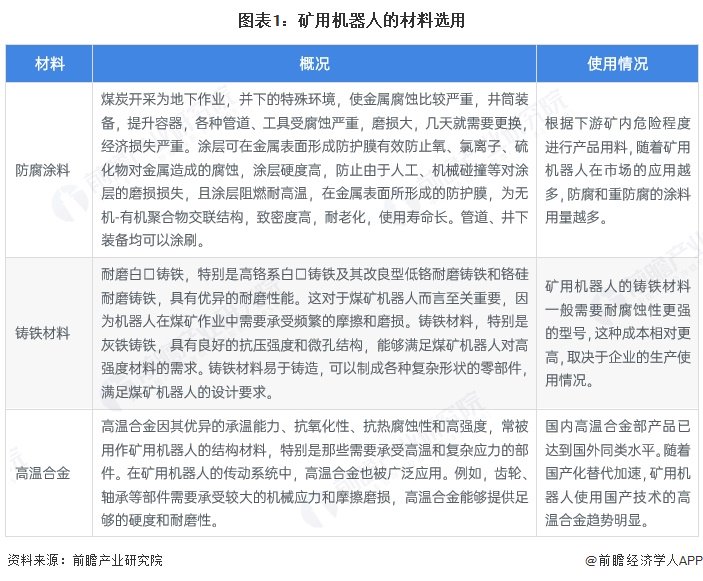
Core Insights - The article discusses the materials used in mining robots, emphasizing the importance of corrosion-resistant coatings and cast iron components for durability in harsh mining environments [1][3][4]. Material Overview - Corrosion-resistant coatings are essential in mining due to the severe corrosion caused by acidic gases and saline mist, which can damage metal parts and electronic components of robots [3]. - The coatings form a dense protective layer that reduces direct contact with corrosive substances, thereby extending the lifespan of mining robots [3]. - Cast iron, particularly wear-resistant varieties, is favored for structural components of mining robots due to its high strength and durability against wear [4]. - High-temperature alloys are also utilized in mining robots for parts that endure high temperatures and complex stresses, with domestic production reaching levels comparable to international standards [2][4]. Production Data - In 2023, China's production of corrosion-resistant coatings reached 7.15 million tons, accounting for approximately 20% of the total paint market, with a projected increase to 7.52 million tons in 2024 [3]. - The production of cast iron components in China was 51.95 million tons in 2023, reflecting a year-on-year increase of 250,000 tons, with a compound annual growth rate of 13.7% from 2016 to 2023 [4].


【投资视角】启示2025:中国纺织行业投融资及兼并重组分析(附投融资事件、产业基金和兼并重组等)
Qian Zhan Wang· 2025-05-29 08:10
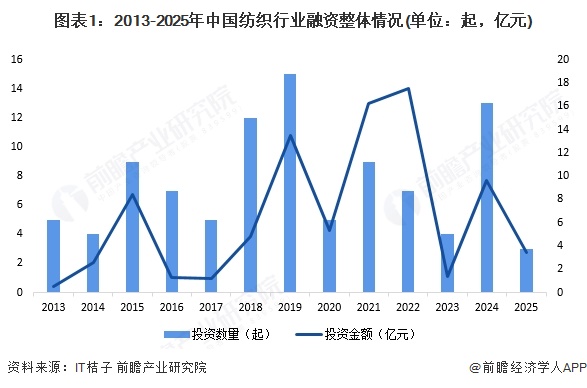
Group 1 - The textile industry in China has experienced fluctuations in investment and financing, with a peak in 2019 and a decline starting in 2020, leading to a total of 13 financing events and an investment amount of 9.65 billion yuan in 2024 [1][20] - Investment rounds in the textile industry are primarily early-stage, focusing on A-round, angel, and strategic investments, indicating a trend towards resource integration and industry chain extension [2] - The majority of financing events are concentrated in Guangdong and Zhejiang provinces, with 21 events each, due to their complete textile industry chain and mature market environment [5] Group 2 - The focus of investment in the textile industry is shifting towards new textile materials, reflecting a strategic direction in the sector [7] - The investment entities in the textile industry are predominantly capital organizations, accounting for 74%, with notable investors including Shenchuang Investment and SoftBank China Capital [11] - There are several textile-related private equity funds established, indicating a growing interest in the sector [14] Group 3 - Horizontal mergers and acquisitions among midstream textile companies have become mainstream as a strategy to expand scale amid intense competition [16][18] - Recent merger and acquisition activities include significant transactions, such as the acquisition of 100% of Longrun Materials by Jiulong Recycling [17] - The overall trend in the textile industry indicates a focus on consolidation through mergers and acquisitions to enhance competitiveness [20]


【行业深度】洞察2025:中国无人机用微型涡轮喷气发动机市场规模及竞争格局(附市场规模、竞争格局等)
Qian Zhan Wang· 2025-05-29 03:46
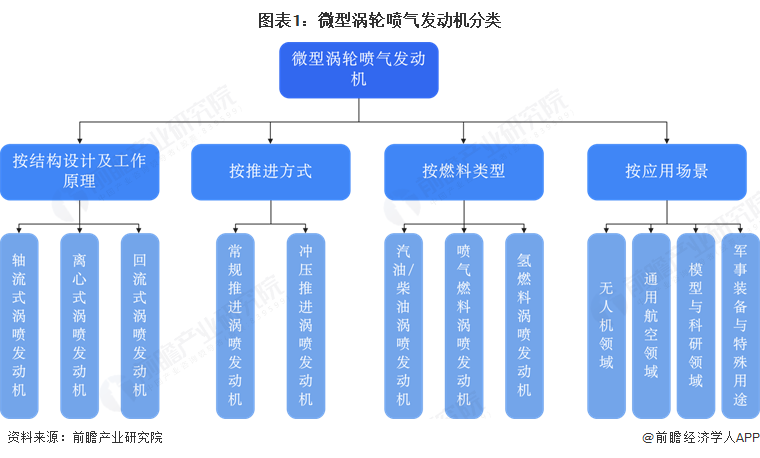
Core Insights - The global market for micro turbojet engines used in drones is projected to exceed $300 million by 2024 and reach $500 million by 2030, driven by military modernization, drone proliferation, and emerging aviation scenarios [6] - The Chinese market for micro turbojet engines is expected to reach 154 million yuan by 2024, with significant growth attributed to domestic innovation and policy support [7][20] Market Overview - Micro turbojet engines are categorized based on thrust, with those under 100 daN classified as micro engines, primarily used in small UAVs [1] - The market is characterized by a dual drive of technological iteration and expanding demand, with North America currently holding a technological advantage while the Asia-Pacific region, particularly China, is anticipated to become a core growth area [6] Industry Structure - The upstream of the micro turbojet engine industry includes raw materials such as titanium alloys, aluminum alloys, and composite materials, which are essential for manufacturing key engine components [2] - The midstream manufacturing segment involves the design, assembly, testing, and maintenance of micro turbojet engines, representing the core of the industry chain [2] Application Scenarios - The downstream applications of micro turbojet engines are diverse, covering military training target drones, reconnaissance drones, and civilian applications such as emergency firefighting and logistics [3][20] - Military training target drones represent the largest demand segment, with a projected annual requirement of approximately 4,800 units by 2024 [14][19] Competitive Landscape - The domestic market for micro turbojet engines is competitive but not highly concentrated, with leading companies holding a market share of 10%-20% [22] - Key players in the Chinese market include companies like Xuanyun Power and Zhongke Hangxing, which are rapidly advancing through innovation and market positioning [22]
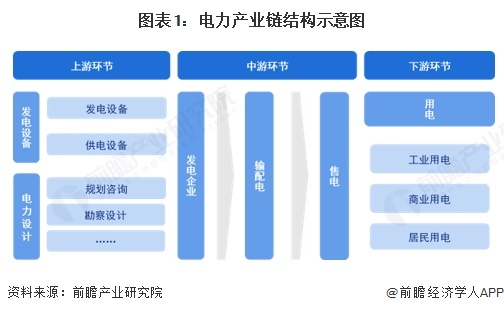
【干货】2025年电力行业产业链全景梳理及区域热力地图
Qian Zhan Wang· 2025-05-29 03:08
Group 1 - The core viewpoint of the article is a comprehensive analysis of the Chinese power industry, including its entire value chain, regional distribution, and representative companies' business layouts [1][4][6] - The power industry value chain consists of three main segments: upstream (generation), midstream (transmission and distribution), and downstream (end-users) [1][3] - Key players in the upstream generation segment include companies like China XD Group, XJ Electric, and Dongfang Cable, while major midstream players include Huaneng International, State Power Investment, and China Datang [3] Group 2 - The regional distribution of the power industry shows that provinces like Guangdong, Beijing, and Jiangsu have a high concentration of listed power companies, indicating a robust industry presence [4] - Huaneng International leads in several key performance indicators for 2024, including operating revenue of 245.55 billion, power business revenue of 237.55 billion, generation volume of 479.86 billion kWh, and total installed capacity of 145,125 MW [6][8] - Other notable companies include Datang Power with 123.47 billion in revenue and 28.52 million kWh in generation, and Huadian International with 112.99 billion in revenue and 22.26 million kWh in generation [8] Group 3 - Future investment trends indicate a shift towards renewable energy, with companies like Huaneng International planning to invest over 50 billion in renewable projects by 2025 [9] - Datang Power is set to invest approximately 5.969 billion in a coal power project, while Huadian International is undergoing a major asset restructuring to enhance its market share [9] - State Power Investment plans to invest around 19.2 billion in hydropower and photovoltaic projects, reflecting a broader industry trend towards integrating renewable energy sources [9]