
Guo Jia Tong Ji Ju

Search documents
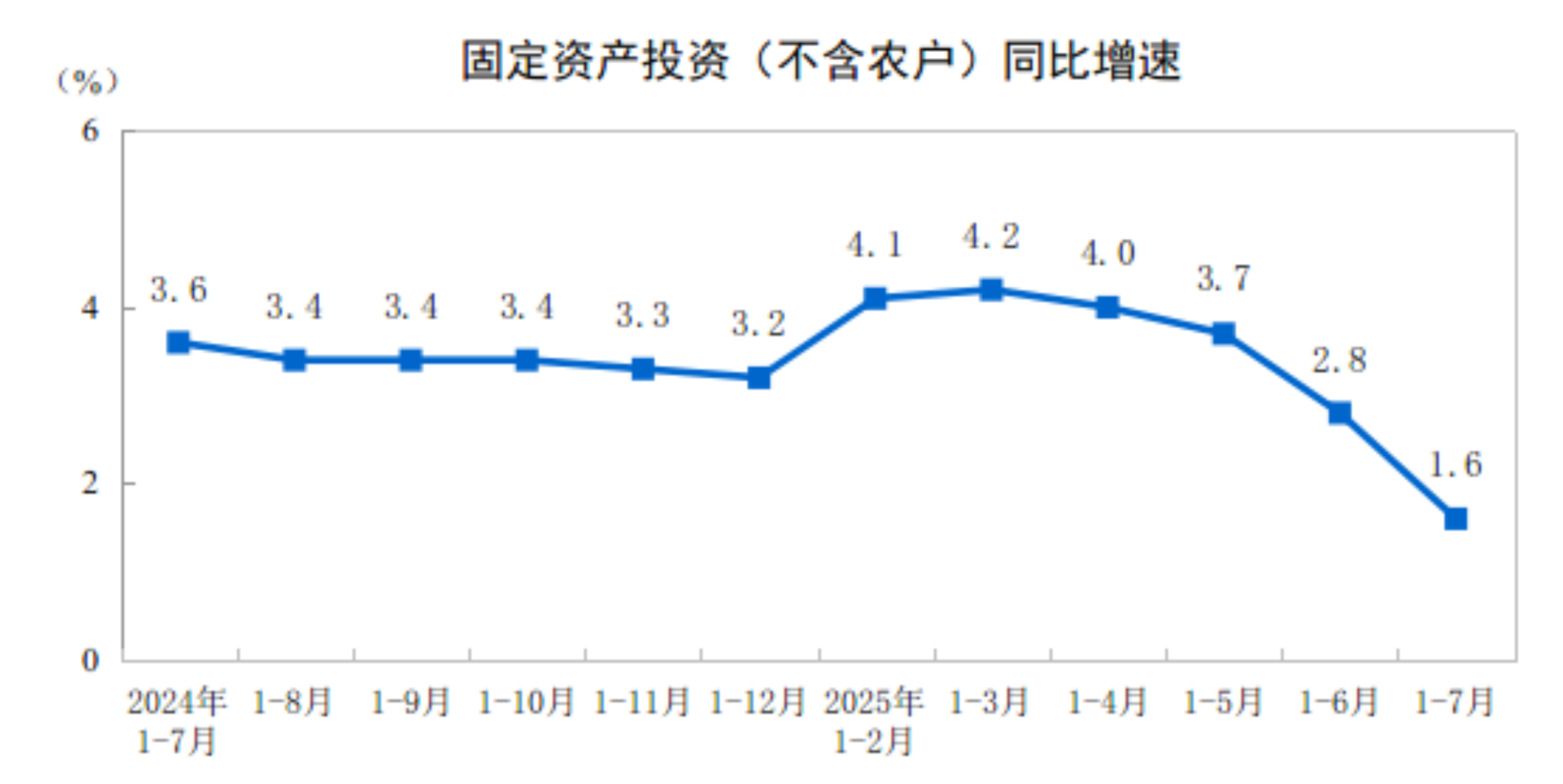
2025年1—7月份全国固定资产投资增长1.6%
Guo Jia Tong Ji Ju· 2025-08-15 02:01
Core Insights - In the first seven months of 2025, China's fixed asset investment (excluding rural households) reached 288,229 billion yuan, showing a year-on-year growth of 1.6% on a comparable basis [1][5][17] - Private fixed asset investment experienced a decline of 1.5% year-on-year [1][5] - In July 2025, fixed asset investment (excluding rural households) decreased by 0.63% month-on-month [1] Investment by Industry - Investment in the primary industry amounted to 5,646 billion yuan, with a year-on-year increase of 5.6% [3][6] - The secondary industry saw an investment of 104,455 billion yuan, growing by 8.9% year-on-year, with industrial investment specifically increasing by 9.0% [3][6] - The tertiary industry experienced a decline in investment, totaling 178,128 billion yuan, down 2.3% year-on-year [3][6] - Within the secondary industry, mining investment grew by 3.0%, manufacturing investment increased by 6.2%, and investment in electricity, heat, gas, and water production and supply surged by 21.5% [3][6] Infrastructure and Regional Investment - Infrastructure investment (excluding electricity, heat, gas, and water production and supply) in the tertiary industry rose by 3.2% year-on-year, with notable increases in water transport (18.9%), water conservancy management (12.6%), and railway transport (5.9%) [3][6] - Investment trends varied by region: eastern regions saw a decline of 2.4%, while central and western regions experienced growth of 3.2% and 3.6%, respectively; northeastern regions faced a decline of 3.0% [3][6] Investment by Ownership Type - Domestic enterprises' fixed asset investment grew by 1.7%, while investment from Hong Kong, Macau, and Taiwan enterprises increased by 3.5%; foreign enterprises, however, saw a significant decline of 15.7% [4][6]

国家统计局:7月各线城市商品住宅销售价格环比下降 同比降幅整体有所收窄
Guo Jia Tong Ji Ju· 2025-08-15 01:57
Core Viewpoint - The data released by the National Bureau of Statistics indicates a decline in the sales prices of commercial residential properties in 70 large and medium-sized cities in July 2025, with a narrowing of the year-on-year decline overall [1]. Group 1: Price Changes in First-Tier Cities - In July 2025, the sales price of newly built commercial residential properties in first-tier cities decreased by 0.2% month-on-month, a reduction of 0.1 percentage points compared to the previous month [1]. - The year-on-year decline for newly built commercial residential properties in first-tier cities was 1.1%, with a narrowing of 0.3 percentage points from the previous month [1]. - The sales price of second-hand residential properties in first-tier cities fell by 1.0% month-on-month, with an increase in the decline of 0.3 percentage points compared to the previous month [1]. - The year-on-year decline for second-hand residential properties in first-tier cities was 3.4%, with an increase in the decline of 0.4 percentage points from the previous month [1]. Group 2: Price Index Data for Various Cities - The price index for newly built commercial residential properties in Beijing was 100.0 month-on-month and 95.1 year-on-year [2]. - In Shanghai, the price index for newly built commercial residential properties was 99.3 month-on-month and 97.5 year-on-year [2]. - The price index for second-hand residential properties in Beijing was 98.9 month-on-month and 97.1 year-on-year [4]. - In Guangzhou, the price index for second-hand residential properties was 99.0 month-on-month and 90.8 year-on-year [4]. Group 3: Price Changes by Property Size - For newly built commercial residential properties, the price index for properties 90m² and below in Beijing was 99.8 month-on-month and 96.7 year-on-year [5]. - The price index for properties between 90-144m² in Shanghai was 99.8 month-on-month and 98.3 year-on-year [5]. - For properties larger than 144m² in Beijing, the price index was 100.2 month-on-month and 96.5 year-on-year [5].
7月70城房价数据出炉!官方解读
Guo Jia Tong Ji Ju· 2025-08-15 01:45
Group 1 - In July 2025, the sales prices of new residential properties in first-tier cities decreased by 0.2% month-on-month, with the decline narrowing by 0.1 percentage points compared to the previous month [3] - The month-on-month sales prices of new residential properties in second-tier cities fell by 0.4%, with the decline expanding by 0.2 percentage points [3] - The month-on-month sales prices of new residential properties in third-tier cities decreased by 0.3%, with the decline remaining the same as the previous month [3] Group 2 - Year-on-year, the sales prices of new residential properties in first-tier cities dropped by 1.1%, with the decline narrowing by 0.3 percentage points compared to the previous month [4] - In July, the year-on-year sales prices of new residential properties in second-tier cities decreased by 2.8%, with the decline narrowing by 0.2 percentage points [4] - The year-on-year sales prices of new residential properties in third-tier cities fell by 4.2%, with the decline narrowing by 0.4 percentage points [4] Group 3 - In July, the month-on-month sales prices of second-hand residential properties in first-tier cities decreased by 1.0%, with the decline expanding by 0.3 percentage points compared to the previous month [3] - The month-on-month sales prices of second-hand residential properties in second-tier cities fell by 0.5%, with the decline narrowing by 0.1 percentage points [3] - The month-on-month sales prices of second-hand residential properties in third-tier cities also decreased by 0.5%, with the decline narrowing by 0.1 percentage points [3] Group 4 - Year-on-year, the sales prices of second-hand residential properties in first-tier cities dropped by 3.4%, with the decline expanding by 0.4 percentage points compared to the previous month [4] - The year-on-year sales prices of second-hand residential properties in second-tier cities decreased by 5.6%, with the decline narrowing by 0.2 percentage points [4] - The year-on-year sales prices of second-hand residential properties in third-tier cities fell by 6.4%, with the decline narrowing by 0.3 percentage points [4]
国家统计局:7月70大中城市房价出炉
Guo Jia Tong Ji Ju· 2025-08-15 01:39
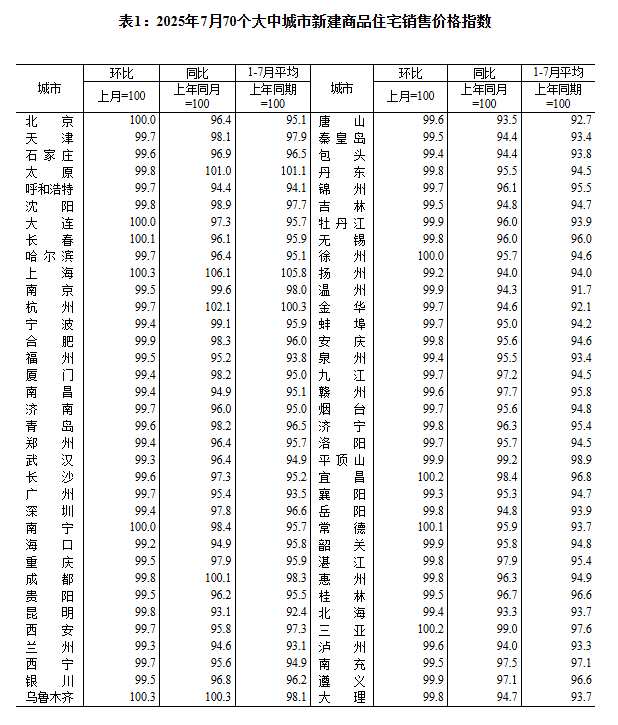
Core Viewpoint - The new residential sales price index for 70 large and medium-sized cities in July 2025 shows a mixed trend, with some cities experiencing price increases while others see declines, indicating a varied real estate market across different regions [1][4][7]. Price Index Summary - The price index for Beijing remains stable at 100.0, with a year-on-year decrease of 3.6% [1]. - Cities like Fuzhou and Urumqi show significant increases in their price indices, with Fuzhou at 100.5 and Urumqi at 100.3, indicating a strong demand in these areas [6][10]. - Conversely, cities such as Shijiazhuang and Taiyuan show declines, with indices at 99.3 and 99.2 respectively, reflecting weaker market conditions [4][8]. Price Category Breakdown - For residential properties under 90m², the average price index is 99.7, with a year-on-year decrease of 5.5% [7]. - The 90-144m² category shows a similar trend, with an index of 99.8 and a year-on-year decrease of 4.4% [8]. - Larger properties over 144m² have a slightly better performance, with an index of 100.0, indicating stability in this segment [7][10]. Regional Variations - Eastern cities like Hangzhou and Nanjing show resilience with indices of 99.7 and 99.6 respectively, while cities in the north like Harbin and Hohhot are experiencing declines [6][9]. - Southern cities such as Guangzhou and Shenzhen maintain stable indices around 99.4, suggesting a balanced market in these regions [5][10]. Overall Market Sentiment - The overall sentiment in the real estate market remains cautious, with fluctuations in prices reflecting local economic conditions and demand-supply dynamics [1][4][6].

国家统计局:7月份各线城市商品住宅销售价格环比下降 同比降幅整体有所收窄
Guo Jia Tong Ji Ju· 2025-08-15 01:33
2025年7月份,70个大中城市中,各线城市商品住宅销售价格环比下降,同比降幅整体有所收窄。 一、各线城市商品住宅销售价格环比下降 7月份,一线城市新建商品住宅销售价格环比下降0.2%,降幅比上月收窄0.1个百分点。其中,北京持 平,上海上涨0.3%,广州和深圳分别下降0.3%和0.6%。二线城市新建商品住宅销售价格环比下降 0.4%,降幅扩大0.2个百分点。三线城市新建商品住宅销售价格环比下降0.3%,降幅与上月相同。 70个大中城市房地产价格统计一二三线城市划分:一线城市指北京、上海、广州、深圳等4个城市;二 线城市指天津、石家庄、太原、呼和浩特、沈阳、大连、长春、哈尔滨、南京、杭州、宁波、合肥、福 州、厦门、南昌、济南、青岛、郑州、武汉、长沙、南宁、海口、重庆、成都、贵阳、昆明、西安、兰 州、西宁、银川、乌鲁木齐等31个城市;三线城市指唐山、秦皇岛、包头、丹东、锦州、吉林、牡丹 江、无锡、徐州、扬州、温州、金华、蚌埠、安庆、泉州、九江、赣州、烟台、济宁、洛阳、平顶山、 宜昌、襄阳、岳阳、常德、韶关、湛江、惠州、桂林、北海、三亚、泸州、南充、遵义、大理等35个城 市。 (文章来源:国家统计局) 二、各线城 ...
国家统计局:7月各线城市商品住宅销售价格环比下降
Guo Jia Tong Ji Ju· 2025-08-15 01:32
2025年7月份,70个大中城市中,各线城市商品住宅销售价格环比下降,同比降幅整体有所收窄。 一、各线城市商品住宅销售价格环比下降 7月份,一线城市新建商品住宅销售价格环比下降0.2%,降幅比上月收窄0.1个百分点。其中,北京持 平,上海上涨0.3%,广州和深圳分别下降0.3%和0.6%。二线城市新建商品住宅销售价格环比下降 0.4%,降幅扩大0.2个百分点。三线城市新建商品住宅销售价格环比下降0.3%,降幅与上月相同。 7月份,一线城市二手住宅销售价格环比下降1.0%,降幅比上月扩大0.3个百分点。其中,北京、上海、 广州和深圳分别下降1.1%、0.9%、1.0%和0.9%。二、三线城市二手住宅销售价格环比均下降0.5%,降 幅均收窄0.1个百分点。 二、各线城市商品住宅销售价格同比降幅整体有所收窄 7月份,一线城市新建商品住宅销售价格同比下降1.1%,降幅比上月收窄0.3个百分点。其中,上海上涨 6.1%,北京、广州和深圳分别下降3.6%、4.6%和2.2%。二、三线城市新建商品住宅销售价格同比分别 下降2.8%和4.2%,降幅分别收窄0.2个和0.4个百分点。70个大中城市中,新建商品住宅销售价格同比上 ...
2025年7月份70个大中城市商品住宅销售价格变动情况
Guo Jia Tong Ji Ju· 2025-08-15 01:31
Core Insights - The residential property market in 70 major cities in China shows a mixed trend in new and second-hand housing prices as of July 2025, with some cities experiencing slight declines while others see increases in prices [1][3][4]. New Residential Property Price Index - In July 2025, the new residential property price index for Beijing is at 100.0, with a year-on-year decrease of 3.6% [1]. - Shanghai's index increased to 100.3, reflecting a year-on-year increase of 6.1% [1]. - Cities like Shenzhen and Guangzhou show slight declines in their indices, with Shenzhen at 99.4 and Guangzhou at 99.7, indicating year-on-year decreases of 2.2% and 4.6% respectively [1]. Second-Hand Residential Property Price Index - The second-hand residential property price index for Beijing is at 98.9, with a year-on-year decrease of 2.9% [3]. - Shanghai's index stands at 99.1, reflecting a year-on-year decrease of 2.2% [4]. - Cities such as Tianjin and Chengdu show resilience, with Tianjin at 99.4 and Chengdu at 99.9, indicating year-on-year decreases of 3.2% and 0.1% respectively [3][4]. Price Trends by Property Size - For new residential properties, the price index for units smaller than 90m² in Beijing is at 99.8, with a year-on-year decrease of 3.3% [6]. - In contrast, properties larger than 144m² in Shanghai have an index of 100.3, showing a year-on-year increase of 7.1% [6]. - The average price index for properties between 90-144m² in cities like Hangzhou is at 99.8, reflecting a year-on-year increase of 2.4% [6]. Regional Variations - Cities like Urumqi and Xi'an show strong performance in new residential prices, with Urumqi at 100.3 and Xi'an at 99.7, indicating year-on-year increases of 0.3% and 0.2% respectively [1][5]. - Conversely, cities such as Tangshan and Hohhot are experiencing declines, with Tangshan at 99.3 and Hohhot at 99.4, reflecting year-on-year decreases of 7.6% and 8.7% respectively [1][5].
国家统计局:2025年8月上旬流通领域棉花价格下跌3.5%
Guo Jia Tong Ji Ju· 2025-08-14 10:36
Core Insights - The monitoring of prices for 50 important production materials across 9 categories in the national circulation market indicates a mixed trend in prices for August 2025 compared to late July 2025 [1] Price Trends - 18 products experienced price increases, while 29 products saw price declines, and 3 products remained stable [1] - Cotton (specifically, white cotton grade three) recorded a price of 14,388.5 yuan per ton, which represents a decrease of 527.8 yuan per ton, equating to a decline of 3.5% from the previous period [1]
2025年8月上旬流通领域重要生产资料市场价格变动情况
Guo Jia Tong Ji Ju· 2025-08-14 01:30
Core Viewpoint - The monitoring of market prices for 50 important production materials in China shows a mixed trend, with 18 products experiencing price increases, 29 seeing declines, and 3 remaining stable in early August 2025 compared to late July 2025 [2]. Group 1: Price Changes in Major Categories - In the black metal category, prices for rebar and wire rod decreased by 1.1% and 1.3% respectively, while seamless steel pipes saw a slight increase of 0.1% [4]. - The non-ferrous metals category experienced declines in prices for electrolytic copper, aluminum ingots, lead ingots, and zinc ingots, with decreases ranging from 0.5% to 1.7% [4]. - Chemical products showed a mixed performance, with sulfuric acid and methanol prices increasing by 1.7% and 0.6% respectively, while other products like styrene and polyvinyl chloride saw significant declines [4]. Group 2: Energy and Coal Prices - In the petroleum and natural gas sector, liquefied natural gas (LNG) and liquefied petroleum gas (LPG) prices fell by 2.2% and 1.7% respectively, while gasoline prices remained relatively stable [4]. - Coal prices showed an upward trend, with prices for various types of coal, including anthracite and coking coal, increasing by 2.5% to 9.6% [4]. Group 3: Agricultural and Forestry Products - Agricultural products such as corn, cotton, and live pigs experienced price declines, with cotton prices dropping by 3.5% and corn by 0.5% [5]. - Conversely, soybean meal prices increased by 1.3%, indicating some resilience in the agricultural sector [5]. - In forestry products, natural rubber and paper pulp prices fell, while corrugated paper prices increased by 1.7% [5]. Group 4: Monitoring Methodology - The price monitoring encompasses 9 major categories and 50 products, with data collected from over 2,000 wholesalers and dealers across 31 provinces [8][9]. - The methodology includes on-site price collection, telephone inquiries, and electronic communications to ensure comprehensive data gathering [9]. Group 5: Price Fluctuation Statistics - The statistics on price fluctuations indicate that the number of products with rising prices is significantly lower than those with declining prices, reflecting a broader trend of price reductions in the monitored categories [10].
绿色液体燃料技术攻关和产业化试点项目(第一批)公示
Guo Jia Tong Ji Ju· 2025-08-13 01:21
Core Viewpoint - The National Energy Administration is promoting the development of new technologies, models, and industries in the green liquid fuel sector to ensure energy security and facilitate green transformation [1] Group 1: Project Support - The National Energy Administration plans to support nine projects, including a 30,000 tons/year cellulose fuel ethanol project by Guotou Bio [1] - The projects aim to advance green liquid fuel technology and industrialization [1] Group 2: Project Details - The first batch of pilot projects includes: 1. Guotou Bio's 30,000 tons/year cellulose fuel ethanol project [1] 2. Integrated wind power and biomass green methanol project in Tiaonan City by Shanghai Electric Green Source Technology [1] 3. Jin Feng Technology's green methanol project with a capacity of 500,000 tons (Phase 1: 250,000 tons/year) [1] 4. Integrated wind-solar-storage hydrogen ammonia methanol project in Anda City [1] 5. Liaoning Huadian's 450,000 kW wind power hydrogen coupling green methanol project [1] 6. Jiangsu Lanze's 300,000 tons/year green methanol project [1] 7. 1.52 million tons/year zero-carbon hydrogen ammonia project by Envision Zero Carbon Technology [1] 8. Green hydrogen ammonia methanol integrated project by China Energy Construction Group [1] 9. Green hydrogen synthesis ammonia integrated project by State Power Investment Corporation [1]