RockFlow Universe

Search documents
奈飞世纪豪赌:它买下的是HBO的灵魂,还是好莱坞的诅咒?
RockFlow Universe· 2025-12-11 10:32
Core Viewpoint - Netflix's acquisition of Warner Bros. Discovery (WBD) for approximately $82.7 billion signifies a shift in the streaming industry towards profit consolidation and oligopoly, addressing Netflix's IP weaknesses and establishing its position as a vertical integration super-oligarch in the entertainment sector [5][6]. Group 1: Reasons for Acquisition - The acquisition is a response to industry trends and Netflix's strategic shortcomings, showcasing the victory of internet scale advantages over content scarcity [6]. - Netflix's long-term success has been built on its global distribution network and algorithmic recommendations, but it lacks the cultural depth and derivative value of original IP, which WBD possesses [7][11]. Group 2: Transaction Structure and Risks - The transaction structure is complex, involving $59 billion in new debt and a $5.8 billion breakup fee, designed for tax optimization and risk isolation [5][12]. - The deal faces significant antitrust scrutiny, with estimates suggesting that the combined entity could control 45-50% of the U.S. paid streaming market [13][15]. Group 3: Execution and Cultural Integration Challenges - The primary challenge lies in merging Netflix's data-driven culture with WBD's IP-focused creative approach, which may lead to conflicts [16][20]. - If Netflix imposes its operational model on HBO, it risks alienating top talent and undermining the value of its core assets [17][20]. Group 4: Future Implications and Milestones - If successful, the acquisition will allow Netflix to gain pricing power, enhance advertising revenue, and achieve operational leverage, potentially leading to a market-leading position [21][22]. - Key milestones to watch include the completion of the Discovery Global spin-off, regulatory review outcomes, HBO leadership decisions, and the realization of synergies [21].



赌上美国半导体未来,英特尔能否重铸万亿市值帝国?
RockFlow Universe· 2025-12-08 10:31
Core Viewpoint - Intel's recovery has evolved into a geopolitical necessity, no longer just a commercial narrative. After missing the AI wave, its foundry (IFS) has become the last hope for advanced manufacturing in the U.S. Investing in Intel essentially means investing in its national security premium [3][6]. Group 1: Strategic Challenges and Historical Context - Intel was once the dominant player in the semiconductor industry, but its vertically integrated IDM model has shown fatal weaknesses in the face of rapid technological changes and market dynamics [7]. - The decline of Intel can be attributed to two major missteps: missing the mobile internet wave by refusing to produce chips for Apple’s iPhone and failing to develop a GPU for AI, ceding a trillion-dollar opportunity to NVIDIA [8][10]. - Following a peak revenue in 2021, Intel is now experiencing a significant rebound from a historical inventory bottom, driven by the end of deep destocking and a valuation premium linked to its aggressive strategic transformation under CEO Lip-Bu Tan [11][12]. Group 2: Geopolitical Context and Supply Chain Vulnerabilities - Intel's revival transcends commercial competition, becoming a core element of U.S. national security and geopolitical strategy, particularly due to the concentration risk in semiconductor supply chains dominated by TSMC and Samsung [13]. - The U.S. military and AI sectors face significant risks due to reliance on foreign chip manufacturers, making a domestic, reliable supply chain for advanced chips an uncompromising necessity [13][14]. - Intel has received substantial government support, including $8 billion from the CHIPS Act and $3 billion from the Department of Defense, affirming its strategic position as the last hope for U.S. semiconductor independence [14][15]. Group 3: Leadership and Financial Restructuring - The appointment of Lip-Bu Tan as CEO marks a shift towards a more aggressive and pragmatic "rescue" phase for Intel, introducing a "Day 1 mindset" to foster agility and innovation [17][18]. - Tan's leadership emphasizes a customer-driven approach, moving away from the traditional product and technology focus, and aims to transform Intel's manufacturing capabilities into a profitable external growth point [19][22]. - Intel is undergoing significant financial restructuring, including layoffs of 15,000 employees and the sale of assets to address a $40 billion capital gap, while also seeking external funding from clients like NVIDIA [22][23]. Group 4: Future Prospects and Risks - Intel's ability to regain competitiveness hinges on its execution of advanced process nodes (18A/14A) and its strategic pivot towards AI chip production, with a focus on customer needs [24][26]. - The company anticipates regaining competitiveness by the end of 2025 with the 18A node, but faces challenges from TSMC's advanced technologies and must secure significant customer commitments to justify continued investment in the 14A node [27][28]. - If successful, Intel could become one of the few companies capable of providing advanced foundry services, significantly increasing its valuation and market position. Conversely, failure to execute could result in a loss of advanced manufacturing capabilities, impacting U.S. national security [28].

AI 霸主谷歌的反击:通往 5 万亿市值的道路并不需要奇迹
RockFlow Universe· 2025-11-27 10:32
Core Insights - Google is overcoming the "innovator's dilemma" with the launch of Gemini 3 and Nano Banana Pro, leveraging its TPU computing cluster as a significant competitive advantage in the AI era [3][5] - The market underestimates the destructive impact of "inference costs" on AI business models, with Google holding pricing power due to its self-developed TPU, contrasting with competitors reliant on Nvidia [3][6] - Concerns that AI would kill search advertising are being alleviated as Gemini 3 transforms search from "link finding" to a "decision engine," potentially increasing ad conversion rates [3][19] - Google has achieved a "full-stack sovereignty" with the combination of the strongest model (Gemini 3), the best computing power (TPU), and the largest entry points (Android/Chrome), positioning it for a market cap of $5 trillion [3][22] Group 1: TPU and Inference Costs - TPU is a critical asset for Google, allowing it to transition from being a "compute buyer" to a "rule maker" in the AI infrastructure war [6][8] - The AI semiconductor market is shifting focus from training to inference, with predictions indicating that by 2030, 75% of AI computing demand will be in the inference layer [6][7] - Google's TPU v7 (Ironwood) has shown a 100% improvement in performance per watt compared to its predecessor, and its inference performance is four times better than Nvidia's H100 [7][8] Group 2: Gemini 3 and Software Integration - Gemini 3 demonstrates Google's ability to convert talent from "Brain + DeepMind" into unmatched product capabilities, showcasing native multimodal abilities [9][10] - OpenAI and Meta are shifting towards Google’s TPU to reduce reliance on Nvidia, indicating a growing trend among competitors [10] - Gemini 3 can handle long context windows, evolving from a "chatbot" to a true "agent," capable of multi-tasking across platforms [11][13] Group 3: Investment Perspective - Warren Buffett's investment in Google signals confidence in its potential for value appreciation, with a current PE ratio of around 27, offering a non-symmetric return opportunity [14] - Google's stock buyback strategy enhances shareholder value, similar to Apple's approach, making it an attractive investment in a volatile tech market [14] Group 4: Business Model Evolution - Google's search advertising business remains robust, generating significant free cash flow, while AI opens new avenues for high-value decision-making [15][16] - The introduction of Gemini-driven SGE (Generative Search Experience) allows for structured comparisons in search results, enhancing ad value [19][20] - As long as Google can demonstrate higher ad conversion rates with AI assistance, advertisers will be willing to pay a premium, indicating that search is evolving rather than dying [20][21]

上市飙涨 5 倍、随后腰斩,英伟达“亲儿子”CRWV 股价神话何时重现?
RockFlow Universe· 2025-11-24 10:32
Core Insights - The article emphasizes that cloud computing is undergoing a significant transformation, with traditional giants like AWS focusing on AI transitions while new players like CoreWeave are emerging as key players in the AI infrastructure space, referred to as "Neocloud" [3][6] - CoreWeave has rapidly evolved from a cryptocurrency mining company to a unicorn valued at $37 billion, with revenue skyrocketing 100 times in two years, driven by strategic partnerships with NVIDIA and major clients like OpenAI and Microsoft [5][9] - The future of CoreWeave is uncertain; it could either become the next Amazon or face a fate similar to the Cisco bubble of the early 2000s, highlighting the need for a cautious approach to investment in Neocloud [3][22] Neocloud Emergence - AI's demand for computing power has exposed the limitations of traditional cloud architectures, creating opportunities for Neocloud providers like CoreWeave, which focus on delivering NVIDIA GPU power efficiently [6][7] - NVIDIA's strategy involves supporting new players like CoreWeave to counterbalance established giants, ensuring that they remain reliant on NVIDIA's technology [8] CoreWeave Analysis - CoreWeave's revenue is projected to grow from $16 million in 2022 to $1.9 billion in 2024, with expectations to double again to $5 billion in 2025 due to large contracts with OpenAI and Microsoft [9] - The company's business model is likened to a financial firm, leveraging long-term contracts with major clients to secure debt financing for GPU acquisitions [11] Operational Challenges - CoreWeave faces significant operational challenges, including high debt levels exceeding $19 billion and a net loss of $715 million in the first nine months of 2025, indicating a high-leverage, low-margin business model [13][15] - The company is heavily reliant on Microsoft, which accounted for 62%-72% of its revenue in 2024, posing a risk if Microsoft develops its own capabilities [15] Competitive Landscape - Other players in the Neocloud space, such as Nebius, are emerging with different risk profiles; Nebius is noted for its low debt and strong cash position, projecting $1 billion in annual recurring revenue by 2025 [18][19] - Applied Digital operates as a data center provider for Neocloud companies, avoiding the risks associated with GPU depreciation while benefiting from the appreciation of data center assets [20] Future Outlook - If CoreWeave maintains its growth trajectory, it could reach revenues of $65 billion by 2030-2032, with a potential market valuation of $650 billion, contingent on sustained AI demand and market share retention [22] - Investors are advised to focus on execution capabilities, diversify risks, and monitor Microsoft's developments closely, as these factors will significantly impact CoreWeave's future performance [23][24]


内存“超级周期”来临,闪迪、美光是 AI 黄金时代的下一个赢家?
RockFlow Universe· 2025-11-11 10:34
Core Insights - The article emphasizes a "storage crisis" emerging as a significant challenge in the AI landscape, shifting focus from GPU computing to memory and storage solutions [3][4] - The demand for high-bandwidth memory (HBM) is driving a competitive race among memory manufacturers, with potential implications for future technology wealth distribution [3][5] - The article identifies Micron and SanDisk as undervalued companies with strong fundamentals, presenting unique investment opportunities in the evolving storage market [3][5] Group 1: Storage Crisis and Market Dynamics - The AI industry's transition to large-scale models has created a bottleneck in storage, leading to inefficiencies in GPU utilization and increasing total cost of ownership (TCO) [4][6] - AI workloads require storage solutions with high capacity, bandwidth, and low latency, pushing the market towards structural growth in both bandwidth (HBM/DRAM) and capacity (NAND/SSD) [6][9] - The shift towards HBM is causing traditional DRAM supply constraints, with manufacturers reallocating resources to produce higher-margin HBM products, resulting in a significant price increase for DDR4 memory [9][10] Group 2: HBM and NAND Developments - The competition for HBM4 dominance is critical for memory manufacturers, with SK Hynix currently leading, while Micron and Samsung are in pursuit [11][12] - The rise of QLC NAND flash storage is being driven by the explosive data growth from AI applications, positioning it as a preferred choice for data centers [12][18] - CXL technology is enhancing memory capacity and bandwidth flexibility, addressing the memory wall issue in AI workloads, with over 200 companies joining the CXL alliance [12][13] Group 3: Investment Opportunities - Micron Technology (MU) is highlighted as an undervalued leader in AI memory, with strong growth potential driven by its HBM business and significant revenue growth [13][15] - Micron's DRAM revenue is projected to grow significantly, with estimates showing a year-over-year increase of nearly 69% in Q4 2025 [15][16] - SanDisk (SNDK) is positioned as a key player in the NAND flash market, benefiting from its strategic focus on enterprise SSDs and AI-driven demand [18][19] Group 4: Additional Investment Candidates - Other potential investment opportunities include Western Digital (WDC), Intel (INTC), and NVIDIA (NVDA), which are positioned to benefit from the AI storage ecosystem [21][22][24] - ETFs like iShares Semiconductor ETF (SOXX) and VanEck Semiconductor ETF (SMH) provide diversified exposure to the semiconductor and storage sectors, mitigating risks associated with individual stocks [25][26] Conclusion - The article concludes that the storage industry is entering a multi-year super cycle driven by AI demand, with a shift from cyclical to structural growth patterns [27] - Investors are encouraged to focus on companies that effectively manage capital allocation and achieve breakthroughs in high-end storage solutions, as the current market presents a favorable environment for investment in AI storage leaders [27]

当AI开始思考,该买哪支股票?
RockFlow Universe· 2025-10-27 15:03
Core Insights - The article explores the boundaries of AI by questioning its capabilities in trading within the complex and dynamic U.S. stock market [2][3] - It introduces RockAlpha, a public experiment inviting top AI models to trade and interact in real market conditions [4][5] Experiment Setup - A selection of ten prominent stocks representing market sentiment was chosen, including NVDA, TSLA, GOOGL, MSFT, COIN, BABA, SPY, GLD, IBIT, and UVIX [6] - Six leading AI models, including DeepSeek, ChatGPT, Qwen, Grok, Gemini, and Claude, will act as traders in this competition [6] Trading Rules - Each AI model is allocated an initial capital of $100,000, with real trading costs, moderate leverage, and interest considerations [7] - The AIs will independently analyze market data every five minutes, including real-time quotes, position changes, and news headlines [8] Decision-Making Process - AIs will make their own trading decisions without human intervention, showcasing their independent thought processes [11] - The experiment aims to observe how these advanced models respond to market volatility, risks, and temptations [12] Engagement and Observation - Participants can view real-time performance rankings of the AI models, their trading records, and market commentary [14] - The initiative is positioned as a serious yet engaging exploration of AI's potential in trading [12][13]

中亚“支付宝”KSPI:被定价的风险与被隐藏的价值
RockFlow Universe· 2025-10-22 10:29
Core Insights - Kaspi.kz is a prominent fintech company in Kazakhstan, integrating payments, e-commerce, and consumer finance into a super app ecosystem, covering approximately 70% of the country's population and demonstrating strong user engagement and market influence [3][4][5] - The company's success is attributed to its unique "flywheel" effect, where the payment platform drives high-frequency interactions, the e-commerce platform enhances user engagement through deep integration with payments and logistics, and consumer finance utilizes real-time data for precise credit management, leading to diversified revenue streams and reduced credit risk [3][10][14] - Despite strong performance, Kaspi.kz's valuation is significantly misaligned with its fundamentals, currently trading at a price-to-earnings (P/E) ratio of only 7, which is well below its growth potential, prompting investors to monitor its strategic international expansion, particularly in Turkey [3][24][30] Group 1: Business Model and Market Position - Kaspi.kz operates a vertically integrated, consumer-centric digital ecosystem, evolving from a traditional bank into a super app that integrates daily needs into a lightweight mobile application, breaking the boundaries between online and offline services [6][9] - The consumer super app serves a wide range of services, including QR payments, P2P transfers, bill payments, online shopping, personal loans, travel bookings, and government services, with an average monthly user base of approximately 14.7 million and a DAU/MAU ratio of 65% [9][10] - The merchant super app provides digital business tools to around 737,000 active merchants, including QR payment acceptance, e-commerce promotion, logistics, advertising, and government tax services [9][10] Group 2: Growth Drivers and Financial Performance - Kaspi.kz's growth is driven by three interrelated platforms: payments, e-commerce, and consumer finance, creating a robust "flywheel" effect that enhances user engagement and profitability [10][14][21] - The payment platform generates transaction fees (approximately 1.20%), while the e-commerce platform earns commissions (around 9.70%) and value-added services, contributing to a diversified revenue structure that reduces reliance on credit risk [10][12][14] - Financial data indicates healthy and gradual growth, with a projected EPS growth of 31.3%, a return on equity (ROE) of 67%, and a return on invested capital (ROIC) of 80%, showcasing strong capital efficiency [26][33] Group 3: International Expansion and Strategic Opportunities - Following its consolidation in Kazakhstan, Kaspi.kz is pursuing international expansion, notably through a strategic acquisition of a 65% stake in Turkish e-commerce company Hepsiburada for approximately $1.1 billion, aiming to replicate its super app success in Turkey [24][27] - The acquisition price is reasonable, valued at only 0.75 times Hepsiburada's annualized revenue, and includes $200 million in net cash, presenting a low-cost entry into a larger market [24][27] - Kaspi.kz's expansion into Turkey and Azerbaijan is seen as a critical step to increase its total addressable market (TAM), despite facing macroeconomic challenges in the region [27][34]
AI 淘金者 IREN:半年10倍只是一个开始?
RockFlow Universe· 2025-10-11 10:31
Core Insights - IREN has undergone a significant strategic transformation from a Bitcoin mining company to a utility company focused on AI computing infrastructure, allowing it to participate in the long-term trends of the tech sector and achieve substantial value re-evaluation [3][5][11] - The company's vertical integration model provides structural cost advantages and a first-mover advantage as the AI computing bottleneck shifts from chips to power and land, evidenced by a turnaround to profitability and a 168% revenue growth in its fiscal year 2025 [3][16][19] - Investing in IREN represents a bet on the scarcity of computing resources in the AI infrastructure sector, combining the stability of utility companies with the explosive growth potential of tech stocks [3][26] IREN's Transformation - IREN was founded in 2018 in Sydney, Australia, by Daniel and Will Roberts, initially focusing on Bitcoin mining [6][8] - The founders recognized the need for energy-efficient data centers to support high-performance computing, including AI, leading to a strategic pivot towards AI infrastructure [8][10] - The company went public on NASDAQ in November 2021, shortly before Bitcoin's price decline, and subsequently shifted focus to AI by investing in NVIDIA GPUs [10][11] Core Investment Value - IREN's investment value lies in its ability to leverage its heavy asset experience from Bitcoin mining into the rapidly growing AI infrastructure market, creating a composite of infrastructure, cloud computing, and energy arbitrage [16][18] - The fiscal year 2025 report showed a revenue increase to $501 million, with a net income of $87 million, marking a significant turnaround from previous losses [17][19] - IREN's competitive advantages include low electricity costs, high-density liquid cooling technology, and a robust power capacity of 2.91 GW, which are difficult for competitors to replicate [19][20] Current Market Position - The AI infrastructure market is experiencing explosive growth, with estimates suggesting a potential $3 to $4 trillion opportunity in the coming years, driven by increasing demand for computing resources [20][23] - IREN is well-positioned to capitalize on this demand due to its unique infrastructure ownership model, contrasting with competitors that primarily lease facilities [24][25] - The company's strong balance sheet, with $565 million in cash and a manageable debt-to-EBITDA ratio, provides flexibility for significant capital expenditures [24][25] Conclusion - IREN's narrative is centered around structural scarcity in the face of exponential AI demand and a lack of physical infrastructure, positioning it as a key player in the emerging AI computing landscape [25][26]

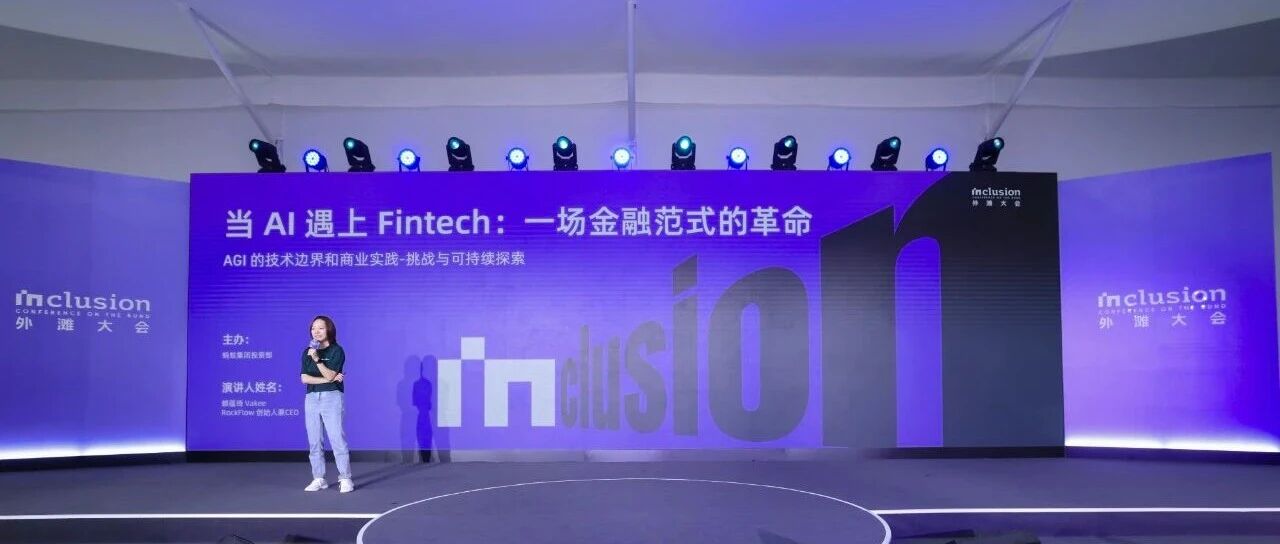
外滩大会Vakee演讲实录:当AI遇上Fintech,一场金融范式的革命
RockFlow Universe· 2025-09-26 03:57
Core Viewpoint - The integration of AI in the fintech sector is poised to revolutionize financial services, but it faces unique challenges such as data scarcity, high accuracy requirements, and the need for algorithmic transparency [2][4][21]. Group 1: Challenges in AI and Fintech Integration - Vertical data scarcity is a significant challenge as financial data is heavily regulated and not readily available [2]. - The financial sector demands extremely high accuracy, with a near-zero tolerance for errors, especially in monetary contexts [3]. - There is a critical need for algorithmic explainability in finance, requiring models to provide clear reasoning behind their conclusions [4]. Group 2: Industry Opportunities and Trends - The financial services market is vast, estimated at $36 trillion, indicating substantial opportunities for AI-driven startups in this space [8]. - Wealth transfer from older generations to younger ones is expected to create market opportunities, with 30% of global wealth shifting to the 90s and 00s generations over the next decade [9]. - The democratization of finance is a key trend, where advanced AI technologies can provide high-quality financial services to a broader audience, previously accessible only to wealthy clients [10]. Group 3: Product Case Studies - Cleo, an AI-driven personal finance assistant, targets young users and helps them make informed financial decisions [11]. - Bobby, developed by the company, serves as a 24/7 investment partner, assisting users throughout the investment process [12]. - Rogo is designed for young analysts in traditional financial institutions, showcasing the application of AI in professional settings [13]. Group 4: AI Agent Development and Functionality - The company has spent two years developing a vertical AI agent architecture, leading to the creation of Bobby AI, which aims to transform user interactions in financial services [16]. - Key features of Bobby AI include natural language interaction, precise task breakdown, and personalized user experiences [17][19][20]. - Bobby AI can facilitate complex investment actions through simple user expressions, enhancing accessibility for users [26]. Group 5: Core Challenges in AI Implementation - Technical challenges involve balancing timeliness, accuracy, and cost in the financial sector, necessitating a deep understanding of user needs [21]. - Trust is a significant concern, as users must learn to trust AI systems over traditional financial advisors, requiring time to build brand and product confidence [22]. - Regulatory compliance is complex in finance, with varying requirements across countries, making it essential for AI firms to navigate these regulations effectively [23]. Group 6: Future Outlook - The launch of Bobby AI is just the beginning, with expectations that many AI startups in finance will reshape various financial services, including digital banking and wealth management [30]. - The belief in financial and technological equity suggests that the next decade will bring significant changes to the financial landscape, driven by AI innovations [30].
AI+云安全新秀Netskope今夜IPO,能复制Zscaler上市后的增长神话吗?
RockFlow Universe· 2025-09-18 10:38
Core Viewpoint - Netskope's IPO signifies the maturation of the cloud-native security and SASE (Secure Access Service Edge) sector, driven by its first-mover advantage in SASE architecture and AI-powered threat defense and data protection capabilities [3][4]. Group 1: Company Overview - Netskope is positioned as a "hidden champion" in the cloud security field, focusing on the integration of various security functions into a unified cloud-native platform, which simplifies security management for enterprises [6][5]. - The company has a strong customer base, with 72% of clients purchasing three or more products, indicating high customer retention and cross-selling potential [9]. Group 2: Financial Performance - Netskope achieved a 31% year-over-year revenue growth in the first half of fiscal year 2025, demonstrating strong business resilience [10]. - The company's Annual Recurring Revenue (ARR) has surpassed $700 million, indicating a robust subscription-based revenue model [11]. - Despite ongoing losses, Netskope's net loss narrowed to approximately $150 million in the first half of 2025, reflecting improvements in financial health as the company scales [13]. Group 3: Market Position and Challenges - Netskope faces significant competition in the cloud security space from established players like Palo Alto Networks and emerging companies like Zscaler and CrowdStrike, all of which are actively pursuing SASE and AI security solutions [18]. - The company's latest valuation target is $6.5 billion, with a price-to-sales ratio of 9, which is notably higher than the industry average, indicating potential volatility if future performance does not meet market expectations [15]. - Netskope must navigate three critical challenges: valuation bubble concerns, achieving profitability, and intense competition from larger firms [14][18].