中关村储能产业技术联盟

Search documents
欣旺达H1储能出货8.91GWh,同比增长133.25%,储能营收10亿
中关村储能产业技术联盟· 2025-09-01 05:17
Core Viewpoint - The company, XINWANDA, reported a revenue of 26.985 billion yuan for the first half of 2025, reflecting a year-on-year growth of 12.82%, while the net profit attributable to shareholders was 856 million yuan, up 3.88% year-on-year. However, the net profit excluding non-recurring items decreased by 28.03% to 583 million yuan [2][3]. Revenue Breakdown - The revenue from energy storage systems reached 1 billion yuan, showing a significant growth of 68.85% [3]. - Revenue from consumer batteries was 13.890 billion yuan, with a year-on-year increase of 5.22% and a gross margin of 19.63%, up 1.56% [3]. - Revenue from electric vehicle batteries was 7.604 billion yuan, growing by 22.63%, but the gross margin decreased by 1.89% to 9.77% [3]. - The gross margin for energy storage systems was 20.26%, down 7.86% year-on-year [3]. Regional Performance - Domestic revenue was 16.304 billion yuan, up 14.55%, with a gross margin of 19.89%, down 1.70% [4]. - International revenue reached 10.681 billion yuan, growing by 10.29%, with a gross margin of 9.54%, which increased by 0.31% [4]. Production and R&D - The company has become one of the leading manufacturers of lithium-ion battery modules in China, with strong design and manufacturing capabilities [7]. - In the first half of 2025, the company shipped 8.91 GWh of energy storage systems, marking a year-on-year increase of 133.25% [8]. - The company is expanding its global production bases, with projects in various provinces in China and countries like India, Vietnam, Hungary, Morocco, and Thailand [8]. - The company is increasing R&D investments in various fields, including consumer battery cells, electric vehicle cells, energy storage cells, new materials, hydrogen technology, and green shipping [9].



夏清:电力体制改革成效与展望
中关村储能产业技术联盟· 2025-08-30 15:04
Core Viewpoint - The article emphasizes the significant achievements and ongoing challenges of China's electricity system reform during the "14th Five-Year Plan" period, highlighting the transition from a planned to a market-oriented electricity production organization, and the need for further reforms to adapt to the new energy system and high proportion of renewable energy integration [2][6]. Group 1: Achievements of Electricity System Reform - The reform has led to a remarkable increase in market-oriented electricity transactions, with national market transactions rising from 1 trillion kWh in 2016 to 6.2 trillion kWh in 2024, accounting for 63% of total electricity consumption [3]. - The volume of cross-provincial and cross-regional market transactions reached 1.4 trillion kWh in 2024, growing more than tenfold since 2016 [3]. - The trading volume of green certificates in 2024 reached 446 million, a staggering increase of 364% year-on-year, while green electricity trading exceeded 230 billion kWh, up 235.2% [3]. - Over 50% of renewable energy generation is now consumed through market mechanisms, maintaining a utilization rate of over 95% despite rapid growth in installed renewable capacity [3]. Group 2: Market Structure and Competition - A unified market system covering inter-provincial, provincial, mid-to-long-term, spot, and ancillary service markets has been preliminarily established, with seven provinces having transitioned to formal operation of their electricity spot markets [4]. - The number of market participants has surged from 42,000 in 2016 to 970,000 by 2025, creating a diverse and competitive market landscape [5]. - Various types of power sources, including gas, nuclear, and hydropower, are now participating in market bidding, enhancing competition and optimizing generation behavior [5]. Group 3: Challenges Ahead - Despite significant progress, further reforms are needed in market rule design and pricing mechanisms to better accommodate the integration of high proportions of renewable energy and the rapid development of new market entities [6]. - The current electricity market theory based on marginal cost needs refinement to reflect the multi-dimensional value of electricity, including flexibility, safety, and environmental considerations [6]. - The demand-side market remains partially closed, and electricity pricing does not adequately reflect the cost differences across time periods, limiting the effectiveness of price signals in guiding user behavior [6]. Group 4: Future Outlook for Reform - Future reforms should prioritize the security of the electricity system while promoting a clean and low-carbon energy transition, focusing on continuous innovation in institutional mechanisms to support high-quality development of the new electricity system [7]. - Price optimization is essential for resource allocation, requiring orderly competition to avoid price distortions and incentivize cost reduction and efficiency [8]. - Innovative trading mechanisms for renewable energy should be explored to stabilize revenue levels and encourage participation in the spot market [9][10]. - The construction of a capacity market should be accelerated to reflect the long-term marginal costs of various power sources and ensure reliable supply [11]. - A transparent cost-sharing mechanism for transmission and distribution should be established to enhance resource allocation efficiency and support renewable energy consumption [12]. - A precise cost transmission pricing mechanism is needed to help end-users understand the true costs of electricity, encouraging demand-side response and optimizing resource utilization [13].

1.7GWh储能系统采购中标人公示!
中关村储能产业技术联盟· 2025-08-30 15:04
Group 1 - The article highlights the successful bid announcement for the EPC project of a 500kV substation and an independent energy storage station with a capacity of 50MW/200MWh, indicating significant developments in the energy storage sector in China [2] - The winning bidder, Inner Mongolia Zhongdian Energy Storage Technology Co., Ltd., was established in 2021 and is primarily engaged in the manufacturing of electrical machinery and equipment, showcasing the growth of new players in the energy storage market [2] - The project is part of a broader trend in the energy sector, emphasizing the increasing importance of energy storage systems in enhancing grid stability and supporting renewable energy integration [2] Group 2 - The article references the significant price differences in electricity purchasing, with the maximum peak-valley price difference recorded at 1.3136 yuan/kWh, indicating market volatility and potential opportunities for energy storage solutions [8] - It notes that the mid-to-long-term trading volume of energy storage in Guangdong's electricity market reached 210GWh, with an average monthly trading price of 374.2 cents/kWh, reflecting the growing adoption of energy storage technologies [8] - The article also mentions a year-on-year increase of 9% in newly operational user-side energy storage projects in July, although there was a 41% decrease compared to the previous month, highlighting the fluctuating dynamics of the energy storage market [8]

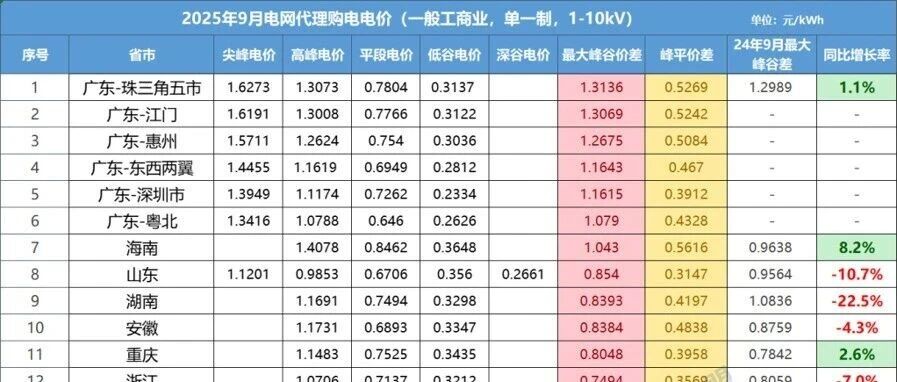
9月电网代购电价:最大峰谷价差1.3136元/kWh!黑龙江/江苏/辽宁/湖南降幅明显
中关村储能产业技术联盟· 2025-08-29 08:47
Core Viewpoint - The article discusses the electricity purchasing prices for September 2025 across various regions in China, highlighting the changes in peak and valley pricing, and the impact of time-of-use pricing policies on energy storage profitability [2][4]. Summary by Sections Electricity Purchasing Prices Overview - As of September 2025, most regions have released their electricity purchasing prices, with the exception of Inner Mongolia West, Jilin, and Xinjiang [2]. - No new time-of-use pricing policies have been announced for this month [4]. Peak and Valley Pricing - In September, 18 regions have a peak-valley price difference exceeding 0.6 yuan/kWh, while 16 regions have a peak segment price difference exceeding 0.3 yuan/kWh [4]. - Guangdong has the highest peak-valley price difference at 1.3136 yuan/kWh, followed by Hainan at 1.043 yuan/kWh and Shandong at 0.854 yuan/kWh [4]. Year-on-Year Comparison - Compared to the same period last year, the maximum price differences have generally decreased, with only 9 regions experiencing an increase [4]. - Notable decreases in price differences were observed in Heilongjiang (-57.4%), Jiangsu (-40.6%), and Liaoning (-35.2%) due to adjustments in time-of-use pricing policies [4]. Regional Pricing Details - The article provides detailed tables of electricity prices for various regions, including peak, flat, and valley pricing for different voltage levels [5][6][10][19]. - For example, in Guangdong, the non-time-of-use price for 1-10 kV is 0.6893 yuan/kWh, while the peak price is significantly higher during peak hours [5][10]. Impact on Energy Storage - The changes in time-of-use pricing policies significantly affect the profitability of user-side energy storage systems, with ongoing monitoring by CNESA [4]. Future Data Availability - CNESA will continue to track electricity price trends, with detailed summaries and data analysis available in their global energy storage database [4].
宁德时代/海辰储能入围!中国石油电芯采购
中关村储能产业技术联盟· 2025-08-29 08:47
Core Insights - The article highlights the procurement of 500,000 units of 314Ah battery cells by China National Petroleum Corporation (CNPC) from leading battery manufacturers, indicating a significant demand in the energy storage sector [2][3]. Group 1: Procurement Details - The first bidder, Contemporary Amperex Technology Co., Limited (CATL), won the bid with a total price of 160,768,000 yuan, translating to a unit price of 0.32 yuan/Wh [2][3]. - The second candidate, Xiamen Hicharge Energy Technology Co., Ltd., had a bid of 140,670,000 yuan, with a unit price of 0.28 yuan/Wh [2][3]. Group 2: Market Context - CATL reported a revenue of 28.4 billion yuan in the first half of 2025 from energy storage, with a gross margin of 25.52% [4]. - Other companies such as Chuangneng New Energy, Trina Storage, Hicharge Energy, and Guoxuan High-Tech have also secured significant orders totaling 7.2 GWh for energy storage battery cells [4].


豫能控股公告:放弃已获用户侧储能,聚焦规模化新能源开发
中关村储能产业技术联盟· 2025-08-29 08:47
Group 1 - The core viewpoint of the article is that YN Holdings has decided to abandon investments and acquisition opportunities in distributed photovoltaics, user-side energy storage, and charging pile projects due to a lack of competitive advantage and insufficient investment returns [2] - YN Holdings cited the National Development and Reform Commission's notice on promoting market-oriented pricing for renewable energy as a reason for this strategic shift [2] - The company aims to focus on large-scale development in the renewable energy sector, aligning with its operational status and future transformation plans [2] Group 2 - In related news, Haibo Sichuang reported a 22.66% year-on-year increase in revenue for the first half of 2025, with a net profit of 316 million yuan [3] - The user-side new energy storage projects saw a year-on-year increase of 9% in newly operational models, but a 41% decrease compared to the previous month, with the East China region holding the largest market share [3] - The National Energy Administration is promoting shared energy storage and renewable energy joint operations, exploring the establishment of a capacity compensation mechanism on the generation side [3]


广东电力市场半年报:储能中长期交易电量210GWh,月度交易均价374.2厘/kWh
中关村储能产业技术联盟· 2025-08-29 08:47
Core Viewpoint - The Guangdong Power Market has shown steady growth in the first half of 2025, with significant increases in both electricity trading volumes and the integration of renewable energy sources, indicating a positive trend towards a low-carbon economy [19][15][16]. Power Supply and Demand Situation - As of June 2025, the total installed capacity of the Guangdong power grid reached 242.3 million kW, a year-on-year increase of 18% [20][21]. - The installed capacity of energy storage (including storage) was 1,048.5 MW, representing a year-on-year growth of 4.43% [3][21]. Market Trading Overview - From January to June 2025, the total trading volume in the Guangdong power medium- and long-term market was 1,835.0 billion kWh, with an average transaction price of 384.0 cents/kWh [42][49]. - The annual trading volume accounted for 1,536.7 billion kWh, while monthly trading volume was 295.3 billion kWh [42][49]. Renewable Green Electricity Trading - In the first half of 2025, renewable green electricity trading totaled 58.4 billion kWh, with an average energy price of 385.5 cents/kWh [59]. - The green electricity trading volume increased by 81.7% year-on-year, contributing to the development of a low-carbon economy [19][15]. Spot Market Trading - The spot market saw a total of 239.7 billion kWh in deviation electricity, accounting for 11.5% of the total electricity consumption [60][68]. - The average price in the spot market fluctuated between 0.088 and 0.547 yuan/kWh, reflecting the changes in primary energy prices and supply-demand dynamics [19][62]. Market Structure - The market concentration index (HHI) for the generation side ranged from 1115 to 1186, indicating a "low concentration oligopoly" market structure, while the consumption side was classified as "competitive" with an HHI of 382 to 417 [35][38]. Operational Performance - The Guangdong power market achieved a total trading volume of 2,944.8 billion kWh in the first half of 2025, with direct trading accounting for 2,076.0 billion kWh, marking a year-on-year growth of 14.3% [19][68]. - The market operated smoothly and met all construction goals during this period [19][15].
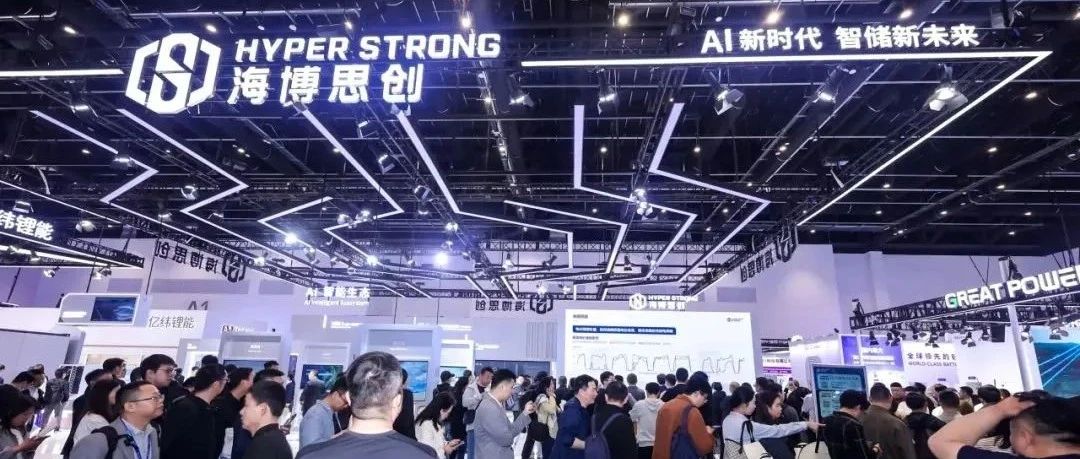
海博思创2025上半年营收同比增长22.66%,净利润3.16亿元
中关村储能产业技术联盟· 2025-08-28 16:34
Core Viewpoint - The company reported a significant increase in revenue and net profit for the first half of 2025, indicating strong growth in the energy storage sector, particularly in the domestic market [2][3][5]. Financial Performance - The company achieved operating revenue of 4.52 billion yuan, a year-on-year increase of 22.66% [3][5]. - The net profit attributable to shareholders was 316 million yuan, up 12.05% from the previous year [3][5]. - The net profit after deducting non-recurring gains and losses was 260 million yuan, reflecting a decrease of 8.38% [3][5]. - Total assets reached 12.06 billion yuan, growing by 9.91% since the beginning of the year [3][5]. - The net assets attributable to shareholders increased to 4.08 billion yuan, a rise of 29.95% [3][5]. Revenue Breakdown - Revenue from energy storage systems was 4.51 billion yuan, making up the majority of total revenue [5]. - Domestic sales accounted for 4.22 billion yuan, while international sales were 298 million yuan [5]. Market Strategy - The company is actively exploring various energy storage application scenarios, focusing on market-oriented reforms and enhancing the economic viability of energy storage assets [6]. - It has established deep collaborations with major domestic power generation groups and is expanding its presence in international markets through successful projects in Sweden and Germany [7][8]. Technological Integration - The company is leveraging AI and big data to enhance the lifecycle management of energy storage systems, improving operational safety and asset value [9]. - Strategic partnerships with leading companies in the industry aim to foster innovation in zero-carbon energy, smart manufacturing, and resource integration [10]. Industry Context - The energy storage sector is experiencing rapid growth, with other companies in the industry also reporting significant increases in revenue, indicating a robust market environment [12].
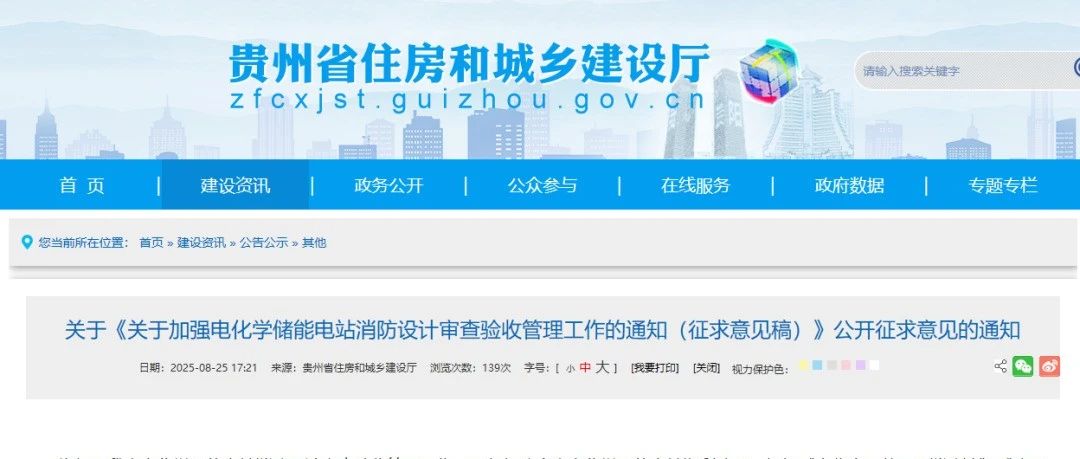
贵州加强储能消防审查!330kV及以上未经消防验收禁止投用
中关村储能产业技术联盟· 2025-08-28 07:44
Core Viewpoint - The article discusses the management and regulatory framework for fire safety design review and acceptance of electrochemical energy storage stations in Guizhou Province, emphasizing the need for strict compliance with fire safety standards and regulations to ensure safe construction and operation of these facilities [2][3]. Summary by Sections Notification Overview - The Guizhou Provincial Department of Housing and Urban-Rural Development issued a notice on August 26, 2025, regarding the fire safety design review and acceptance management for electrochemical energy storage stations, inviting public feedback until September 25, 2025 [3][4]. Fire Safety Design Review Scope - The notice specifies that electrochemical energy storage stations with a voltage level of 330kV and above are classified as special construction projects, requiring fire safety design review and acceptance [5][6]. - For energy storage stations with a rated capacity of 100 MW·h and above, the sampling rate for inspections should not be less than 50% [6]. Application for Fire Safety Review - Construction units must apply for fire safety design review and acceptance through local housing and urban-rural development authorities, and construction cannot commence without passing these reviews [7][8]. Strengthening Design Review - Construction units are required to engage qualified design firms to conduct fire safety designs according to national and local standards, and the design review must include a comprehensive technical assessment of fire safety [8][9]. Fire Safety Acceptance and Inspection - Upon project completion, construction units must apply for fire safety acceptance, submitting necessary documentation including acceptance reports and design drawings [11][12]. - The acceptance process for special construction projects includes a site evaluation by the housing and urban-rural development authority, which must issue a fire safety acceptance opinion within 15 days of application [11]. Responsibilities and Collaboration - The notice emphasizes the importance of accountability among construction units and related personnel for fire safety design and construction quality, and it calls for enhanced collaboration between energy and housing authorities to ensure effective implementation of the regulations [12][13].
中创新航2025H1储能收入57.57亿,同比增长109.7%!
中关村储能产业技术联盟· 2025-08-28 05:43
Core Viewpoint - The company reported a significant increase in revenue and profit for the first half of 2025, driven by strong performance in both power battery and energy storage system products [2][3]. Revenue Summary - Total revenue reached 16.42 billion RMB, a year-on-year increase of 31.68% - Gross margin improved to 17.5%, up by 1.9% - Net profit for the period was 753 million RMB, reflecting a year-on-year growth of 80.44% [2][3][4]. Product Breakdown - Revenue from power batteries was 10.66 billion RMB, a growth of 9.7% - Revenue from energy storage systems and other products surged to 5.76 billion RMB, marking a 109.7% increase [3][4]. Market Performance - The company achieved substantial growth in shipment volume and operational efficiency in energy storage projects - It successfully entered the supplier lists of major developers and grid companies in Latin America and South Africa, marking a breakthrough in overseas business [10][11]. Strategic Collaborations - The company deepened strategic partnerships with major state-owned enterprises and energy groups, leading to multiple energy storage projects being operationalized [10]. - Collaborations with system integrators and leading companies in wind and solar energy sectors have been established, enhancing market share and recognition [10]. Product Innovations - The company launched advanced energy storage products, including a 314Ah battery cell with a lifespan of 15,000 cycles and a new generation 600Ah cell with high energy density [6][7]. - The commercial energy storage solutions have been deployed in various applications, including enterprises, parks, and data centers, with successful market penetration in Europe and the US [8][9]. International Expansion - The company has achieved significant breakthroughs in international markets, covering residential, commercial, and large-scale energy storage needs [11]. - It has secured orders for long-cycle energy storage batteries from overseas clients, further solidifying its market position [11].