digihuman(835670)

Search documents
怡亚通(002183.SZ):公司跨境支付及国内供销服务环节暂未涉及数字人民币支付场景
Ge Long Hui· 2026-01-05 01:12
Group 1 - The company, Yiatong (002183.SZ), stated that it currently does not involve digital RMB payment scenarios in its cross-border payment and domestic supply chain service segments [1] - The company will continue to monitor digital RMB policies and market dynamics, while also reserving relevant technical adaptation capabilities [1] - The company is exploring the feasibility of applying digital RMB in cross-border settlement and other scenarios [1]


怡亚通:公司跨境支付及国内供销服务环节暂未涉及数字人民币支付场景
Ge Long Hui· 2026-01-05 01:12
Core Viewpoint - The company, Yiatong (002183.SZ), has indicated that it currently does not involve digital RMB payment scenarios in its cross-border payment and domestic supply chain services. The company will continue to monitor digital RMB policies and market dynamics, while also preparing relevant technical capabilities to explore the feasibility of its application in cross-border settlement scenarios [1] Group 1 - The company is not currently utilizing digital RMB in its payment services [1] - The company is committed to tracking digital RMB policies and market trends [1] - The company is exploring the feasibility of digital RMB in cross-border settlement applications [1]
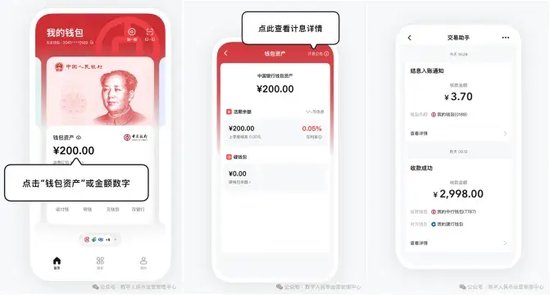
数字人民币进入2.0时代:年利率0.05%开始生息,App已同步升级
Xin Lang Cai Jing· 2026-01-05 00:56
Core Viewpoint - The digital renminbi is officially upgraded to version 2.0 on January 1, 2026, transitioning from "digital cash" to "digital deposits," allowing for interest payments on wallet balances similar to traditional bank deposits [1][7][17]. Group 1: Interest Payment Mechanism - Ten operational institutions, including major banks, will pay interest on the balances of real-name digital renminbi wallets at the current savings account rate of 0.05% [3][4]. - The interest calculation rules will align with those of traditional bank savings accounts, with quarterly interest payments on specific dates [4][10]. - Only real-name wallets will benefit from interest payments, while non-real-name wallets will prompt users to upgrade for earning interest [2][4]. Group 2: Digital Renminbi App Upgrade - The digital renminbi App has been upgraded to version 2.0, enhancing functionality and user experience, including personalized features and better management of deposit-type digital renminbi [3][4]. - Users can check their wallet assets, including interest rates and quarterly interest information, through the app [4][10]. Group 3: Regulatory Framework and Operational Changes - The upgrade is driven by the People's Bank of China's action plan to strengthen the management and service system for digital renminbi [8][9]. - The digital renminbi will now be considered a liability of commercial banks, allowing them to manage it as part of their asset-liability operations, thus providing similar safety guarantees as traditional deposits [10][11]. - The action plan also emphasizes the importance of compliance with anti-money laundering regulations and the establishment of a robust digital currency infrastructure [9][10]. Group 4: Future Prospects and Applications - The digital renminbi is expected to expand its functionality beyond payments to include the purchase of traditional financial products [1][17]. - The transition to digital deposits will enhance the digital renminbi's role in the financial ecosystem, allowing for broader applications and integration with emerging technologies [11][17]. - The digital renminbi supports offline payments, ensuring transaction capabilities without internet access, which distinguishes it from traditional payment methods [16].

银行今十条:数字人民币1月1日起计付利息;农商行头部阵营形成“五强”格局;新疆银行注册资本增至122亿元...
Jin Rong Jie· 2026-01-04 14:13
Group 1 - The People's Bank of China conducted a 365 billion yuan 7-day reverse repurchase operation, resulting in a net withdrawal of 433.6 billion yuan [1] - The People's Bank of China issued the "Non-Bank Payment Institutions Classification Rating Management Measures" to enhance supervision of non-bank payment institutions, effective from February 1, 2026 [2] - In 2025, the banking sector saw a net increase of 623 physical bank branches, marking the first positive growth in three years despite the closure of 7,871 branches [3] Group 2 - Ten digital RMB operating banks announced that starting January 1, 2026, they will pay interest on digital RMB wallets at the same rate as their demand deposit rates [4] - Chengdu Rural Commercial Bank announced that its total assets have surpassed 1 trillion yuan, becoming the fifth rural commercial bank in China to reach this milestone [5] - Xinjiang Bank received approval to increase its registered capital from 7.906 billion yuan to 12.222 billion yuan [6] Group 3 - Baoding Bank's plan to change its registered capital was approved, allowing it to raise 250 million shares [7] - Ningbo Tongshang Bank was approved to issue capital instruments not exceeding 2 billion yuan, including perpetual bonds and subordinated bonds [8][9] - The Dongguan Financial Regulatory Bureau and other departments will pilot real estate trust property registration in Dongguan to support the transformation of the trust business [10] Group 4 - New Era Trust's 100% equity is being offered for transfer for the third time, with a base price of approximately 1.851 billion yuan, consistent with previous offers [11]





亲测有效!数字人民币能“生息” 理财、信贷等服务可期
Bei Jing Shang Bao· 2026-01-04 13:53
Core Viewpoint - The digital renminbi is set to transition to version 2.0 on January 1, 2026, evolving from "digital cash" to "digital deposits," which will enhance consumer engagement and have significant implications for the financial market [1][4]. Group 1: Key Changes in Digital Renminbi 2.0 - The most significant change is that the balance in real-name digital renminbi wallets will earn interest at the rate of current deposits starting January 1, 2026 [4][5]. - Major banks, including ICBC, ABC, BOC, and others, have announced that the interest rate for digital renminbi will be 0.05%, similar to current deposit rates [4][5]. - Consumers can expect quarterly interest payments on their wallet balances, with specific dates for interest calculation [4][5]. Group 2: Consumer Benefits and Security - Only real-name wallets will earn interest, while anonymous wallets will not be eligible [5]. - Digital renminbi deposits will be covered by deposit insurance, providing a safety net of up to 500,000 yuan, similar to traditional bank deposits [5][8]. - The upgrade aims to enhance the attractiveness of funding digital wallets, as idle funds can now generate interest with no operational costs [4][5]. Group 3: Implications for Financial Institutions - The upgrade allows banks to actively manage digital renminbi as part of their asset-liability management, potentially leading to new financial services such as loans and investment products [8][10]. - Non-bank payment institutions will need to adapt to new regulations, including a requirement to deposit 100% of digital renminbi as collateral, which may impact their liquidity [9][10]. - The integration of digital renminbi into existing financial systems is expected to enhance customer retention and create a closed-loop system for financial services [10][12]. Group 4: Market Impact and Future Prospects - The digital renminbi's inclusion in general deposit assessments will shift banks from passive to active deposit acquisition strategies [10][12]. - The upgrade is seen as a milestone, marking a new phase in the standardization of digital currency operations, which will improve regulatory efficiency and enhance user experience [11][12]. - The potential for smart contracts and programmable currency capabilities is anticipated to drive future growth and innovation across various sectors [12].
管涛:数字人民币2.0时代的“变”与“不变”
Di Yi Cai Jing· 2026-01-04 13:15
Core Viewpoint - The digital renminbi is transitioning from the 1.0 era of digital cash to the 2.0 era of digital deposit currency, with a new management and service framework set to be implemented by January 1, 2026 [1] Group 1: Digital Currency Development - China is a pioneer in digital currency exploration, having initiated theoretical research and closed testing of the digital renminbi in 2014, with pilot programs starting in 2019 [3] - The digital renminbi ecosystem has been preliminarily established, following a path that relies on central bank leadership and integration with commercial financial institutions [3] - The digital renminbi 2.0 will be a modern digital payment and circulation method, issued and circulated within the financial system, featuring functions such as value measurement, value storage, and cross-border payment [3][4] Group 2: Operational Framework - The transition to digital renminbi 2.0 retains the successful core elements of the previous phase, particularly the dual-layer operational structure that separates management and operation [4] - The People's Bank of China will establish a digital renminbi management committee to oversee relevant business lines and ensure comprehensive functional regulation [5] - The operational management centers for digital renminbi will be located in Beijing and Shanghai, focusing on system security and cross-border business operations [5] Group 3: Technological Integration - Digital renminbi 2.0 will combine account-based management with blockchain efficiency, utilizing a hybrid architecture that incorporates both account and blockchain characteristics [6] - The digital renminbi will leverage smart contracts and digital technologies to enhance payment services, moving from electronic to digital payment [8][10] - Blockchain technology will be applied not only in cross-border payments but also in the digitalization of real-world assets, with platforms established for various financial services [11] Group 4: Changes in Currency Structure - The digital renminbi will shift from being a central bank liability to a digital deposit currency, allowing banks to manage digital renminbi wallet balances as part of their asset-liability operations [8] - Digital renminbi wallet balances will earn interest and be included in the banks' balance sheets, enhancing the stability of commercial banks' liabilities [8][9] - The digital renminbi will maintain its equivalence to fiat currency, ensuring interoperability and convenience for users [9]
加快推进数字人民币发展
2 1 Shi Ji Jing Ji Bao Dao· 2026-01-04 12:22
Core Viewpoint - The People's Bank of China has introduced an action plan to enhance the management and service system of the digital renminbi, marking a significant shift from a cash-based model to a deposit currency model, effective January 1, 2026 [1][5]. Group 1: Digital Renminbi Development - China is one of the earliest countries to initiate central bank digital currency (CBDC) research, with the digital renminbi undergoing over ten years of development and achieving significant progress, including 3.48 billion transactions totaling 16.7 trillion yuan by November 2025 [3]. - The digital renminbi has expanded its application scenarios, covering retail payments and gradually moving into wholesale and cross-border payments, with 95.3% of cross-border payment transactions processed using digital renminbi [3][4]. Group 2: Transition to Digital Currency 2.0 - The transition from a cash-based digital currency (1.0 version) to a deposit currency (2.0 version) will allow users to earn interest on their digital renminbi wallet balances, enhancing user engagement and promoting broader acceptance among merchants [5][7]. - The new model positions digital renminbi as a liability of commercial banks rather than the central bank, which will incentivize banks to promote its use and develop related financial products [6][7]. Group 3: Regulatory and Legal Framework - There is a need to establish a clear legal framework for digital renminbi, including amendments to existing laws to define its status as legal tender and clarify the rights and responsibilities of all parties involved [9][10]. - The digital renminbi will be integrated into the regulatory framework for reserve requirements and interest rates, which will help mitigate risks associated with financial disintermediation and shadow banking [8]. Group 4: Future Recommendations - Recommendations include expanding the pilot program nationwide, enhancing user incentives, and increasing the variety of application scenarios to ensure comprehensive coverage in both online and offline environments [10][11]. - Strengthening international cooperation and governance in digital finance will enhance China's influence in global discussions on CBDC standards and regulations [11].
今年1月1日起 六大银行数字人民币计利息收益
Sou Hu Cai Jing· 2026-01-04 11:48
Group 1 - From January 1, 2026, digital RMB real-name wallet balances will earn interest based on the current demand deposit rate set by the respective banks, which is currently 0.05% [1] - The digital RMB is categorized into four types of wallets, with only the first three types (real-name wallets) eligible for interest, while the fourth type (anonymous wallet) will not earn interest [1] - The interest will be calculated according to the People's Bank of China’s demand deposit interest rules, with interest credited on the 20th of each quarter's last month [1] Group 2 - There are currently 10 designated operating institutions for digital RMB, including six state-owned commercial banks, two joint-stock commercial banks, and two internet banks [2] - The central bank is working on expanding the number of operating institutions and has introduced a new action plan to enhance the management and service system for digital RMB, set to be implemented on January 1, 2026 [2] - Banks will manage the digital RMB wallet balances autonomously and provide the same level of security as traditional deposits through deposit insurance [2]
亲测有效!数字人民币能“生息”,理财、信贷等服务可期
Bei Jing Shang Bao· 2026-01-04 11:43
Core Viewpoint - The digital renminbi is set to transition into its 2.0 era on January 1, 2026, evolving from "digital cash" to "digital deposits," which will significantly impact everyday payments and consumer behavior [1][5]. Group 1: Key Features of Digital Renminbi 2.0 - From January 1, 2026, the balance in real-name digital renminbi wallets will earn interest at the same rate as demand deposits, with a current annual interest rate of 0.05% as observed from banks like China Merchants Bank [5][6]. - Interest will be calculated quarterly, with specific dates for interest payment, allowing consumers to earn passive income on idle funds [5][6]. - Only real-name wallets will be eligible for interest; anonymous wallets will not receive this benefit [6]. Group 2: Security and Insurance - Digital renminbi deposits will be included in the deposit insurance scheme, providing a safety net of up to 500,000 yuan, similar to traditional bank deposits [6][9]. - This inclusion aims to alleviate consumer concerns regarding the safety of their funds, enhancing the attractiveness of digital renminbi [10]. Group 3: Implications for Financial Institutions - The upgrade will encourage banks to integrate digital renminbi into their asset-liability management, enabling them to offer additional financial services such as loans and investment products [9][12]. - Banks can leverage the interest-bearing feature to attract more customers and create a closed-loop business model around digital wallets [9][10]. Group 4: Market Impact and Future Prospects - The digital renminbi's evolution is expected to have profound effects on the financial market, allowing banks to shift from passive to active deposit strategies [10][12]. - The introduction of smart contracts and programmable currency capabilities will facilitate innovative financial solutions, potentially increasing the frequency of digital renminbi usage in various sectors [11][12]. - The digital renminbi has already processed transactions worth 16.7 trillion yuan since its launch, indicating strong market adoption and a diverse range of applications [11].
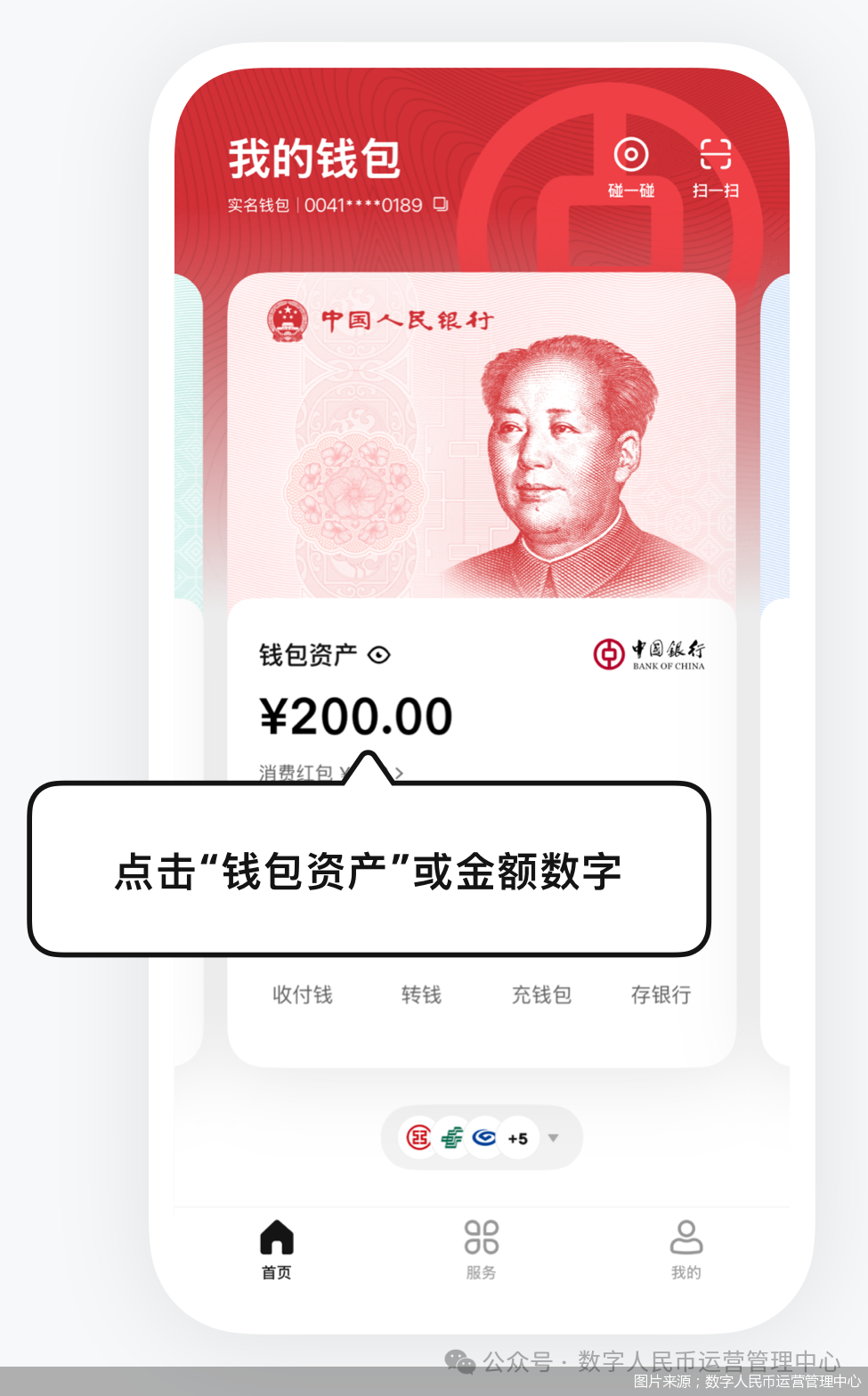
数字人民币开始生息,工、农、中、建等大行集体公告
Sou Hu Cai Jing· 2026-01-04 07:58
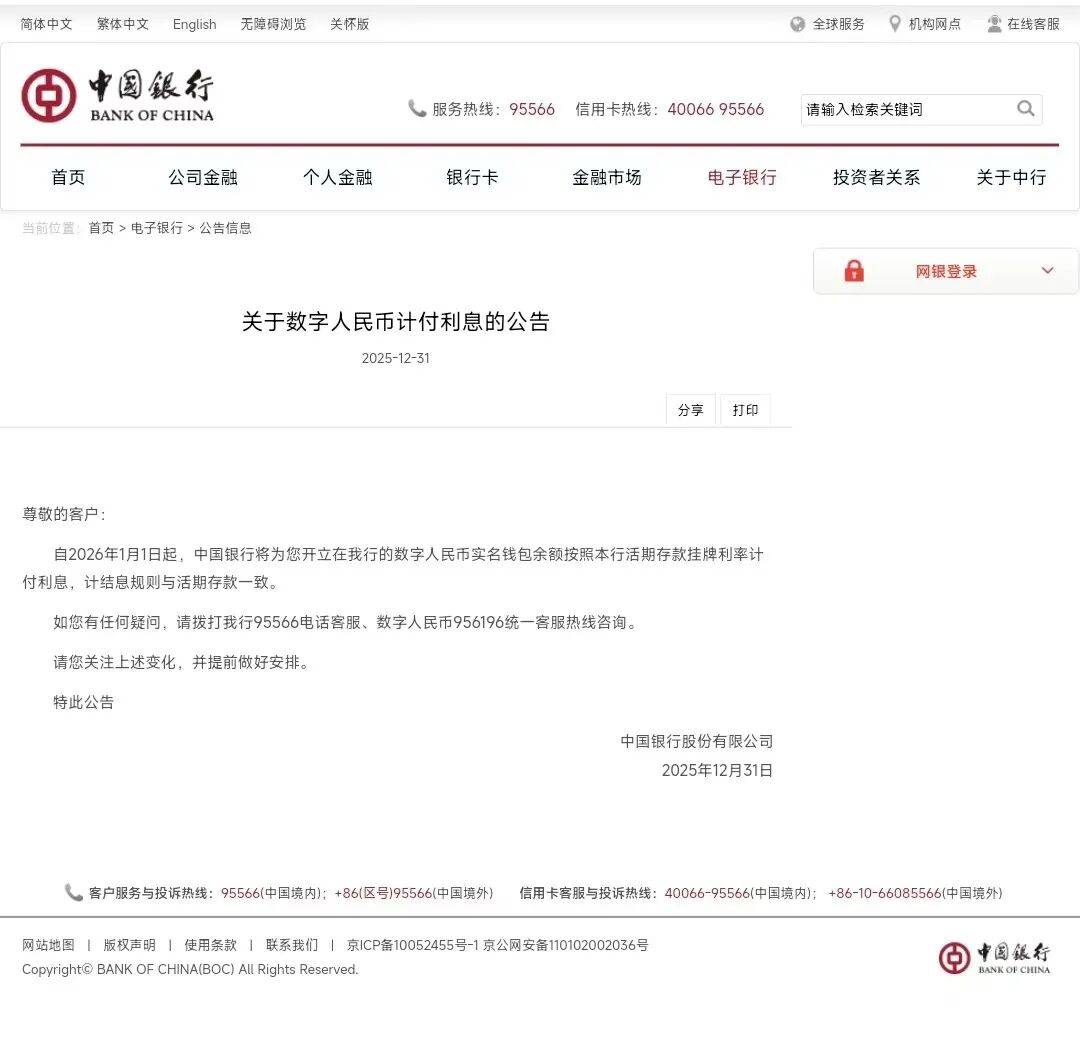
从2026年1月1日起,数字人民币钱包余额将按照活期存款计付利息。这也意味着,经过十年研发试点,数字人民币将从"数字现金时代"迈入"数字存款货 币"时代。 数字人民币计息有何意义? 工商银行、农业银行、中国银行、建设银行、交通银行、邮储银行在2025年12月31日相继发布公告,将开立在该行的数字人民币实名钱包余额按照银行活 期存款挂牌利率计付利息,计结息规则与活期存款一致。 六大国有银行率先响应,其余银行类运营机构遵循统一政策。这一举动的背后,并非简单的"加利息",而是数字人民币将从现金型1.0版步入存款货币型 2.0版的变化。 目前,数字人民币已在批发零售、餐饮文旅、教育医疗、公共服务、社会治理、乡村振兴等领域形成覆盖线上线下、可复制推广的应用模式,兼具账户与 区块链双重模式、软硬件钱包适配、线上线下及离线支付兼容的通用混合型货币能力。 △2025年12月26日,上海黄浦区一超市外张贴了店内支持的付款方式列表,包括微信、支付宝、数字人民币等,共有十余种。 新闻多看点 NEWS MORE 专家表示,对数字人民币钱包余额计付利息后,中国将成为首个为央行数字货币计息的经济体。这将有助于提高用户使用数字人民币的意愿 ...