digihuman(835670)

Search documents
浙文互联:公司旗下“派智”数字人业务产生的收入和利润占比较小
Mei Ri Jing Ji Xin Wen· 2026-01-26 13:16
Core Viewpoint - Zhejiang Wen Internet (浙文互联) has experienced a significant stock price increase of 69.57% from January 5 to January 26, despite no major changes in its core business, indicating potential market overreaction and irrational speculation [1] Company Performance - The company's main business has not undergone any significant changes during the observed period [1] - The revenue and profit generated from the "Paizhi" digital human business account for less than 1% of the company's total operating revenue and net profit, indicating a minimal impact on overall business performance [1] Market Context - The stock price increase is notably higher than the growth rates of the industry and the Shanghai Composite Index during the same period, suggesting a significant deviation from the company's fundamentals [1] - There is a risk of a rapid decline in stock price due to the current market sentiment being overly optimistic [1]


2连板浙文互联:公司旗下“派智”数字人业务产生的收入和利润占比较小 对公司经营业绩无重大影响
Ge Long Hui· 2026-01-26 13:13
Core Viewpoint - The stock price of Zhejiang Wen Internet has experienced a significant increase, with a cumulative rise of 69.57% from January 5 to January 26, 2026, leading to concerns about market overreaction and irrational speculation [1] Financial Performance - For the first three quarters of 2025, the company reported operating revenue of 5.605 billion yuan and a net profit attributable to shareholders of 127 million yuan, representing a year-on-year decline of 19.68% [1] - The net profit attributable to shareholders after deducting non-recurring gains and losses was 18.6948 million yuan, showing a substantial year-on-year decrease of 78.62% [1] Business Segment Analysis - The revenue and profit generated from the company's "Pai Zhi" digital human business account for less than 1% of the total operating revenue and net profit, indicating that it has a minimal impact on the overall business performance [1]
【微聚焦】青岛数字人民币试点持续“深一度”
Xin Lang Cai Jing· 2026-01-26 11:09
Core Insights - The digital RMB pilot in Qingdao is set to deepen its integration into various payment scenarios by 2025, creating a comprehensive application landscape that enhances urban living through digital currency [1][8] - By the end of 2025, Qingdao is expected to have 620,000 merchants accepting digital RMB, with a total of 8.07 million personal wallets and 1.91 million corporate wallets, facilitating transactions amounting to 23.3 billion RMB [1][8] Prepaid Consumption Management - The Qingdao pilot emphasizes prepaid consumption management through digital RMB smart contracts, introducing various prepaid products on the "Smart Gold Guardian" platform [2][9] - As of December 2025, nearly 2,000 merchants will manage digital RMB prepaid funds, offering around 5,000 prepaid products across multiple sectors, with a sevenfold increase in the number of merchants [2][9] Supply Chain and Cross-Border Payment Solutions - Qingdao has implemented the first digital RMB customs tax withholding service in the country, allowing businesses to pay customs duties online without submitting physical documents [3][11] - The city has facilitated cross-border payment transactions totaling 1 billion RMB through a multilateral central bank digital currency bridge, reducing transaction costs and enhancing efficiency for enterprises [3][11] Daily Life Integration - By 2025, digital RMB will be integrated into daily life in Qingdao, with public transportation and various retail sectors supporting digital RMB payments, enhancing convenience for citizens [6][13] - Major public transport systems, including over 4,400 buses and 314 unmanned routes, will support digital RMB payment methods, contributing to a seamless payment experience [6][13] Future Developments - The digital RMB is expected to evolve into a digital deposit currency by 2026, with a new framework and ecosystem being established to enhance its role in the financial system [7][14] - Qingdao aims to continue improving the digital RMB ecosystem, focusing on prepaid operations, cross-border payments, and corporate fund management [7][14]
数字人浙小景播报:海康威视受机构券商关注最高
Quan Jing Wang· 2026-01-26 06:55
Core Viewpoint - The article emphasizes the importance of rational investment and warns against the allure of "high returns," which often come with high risks and potential scams [1] Group 1: Investment Risks - High returns are often associated with hidden risks and can be part of well-crafted scams [1] - Many investors have lost money due to promises of guaranteed returns, such as "no risk" or "monthly returns of 10%" [1] Group 2: Investor Education - The Zhejiang Investor Education Base promotes the idea that communication creates value, focusing on interactive investor relations [1] - The organization explores the "Internet + Investor Education" model, combining online and offline methods to make investor education services more accessible [1]
2026年数字人民币再提速,可算利息,能理财,跨境支付更方便?
Sou Hu Cai Jing· 2026-01-25 03:44
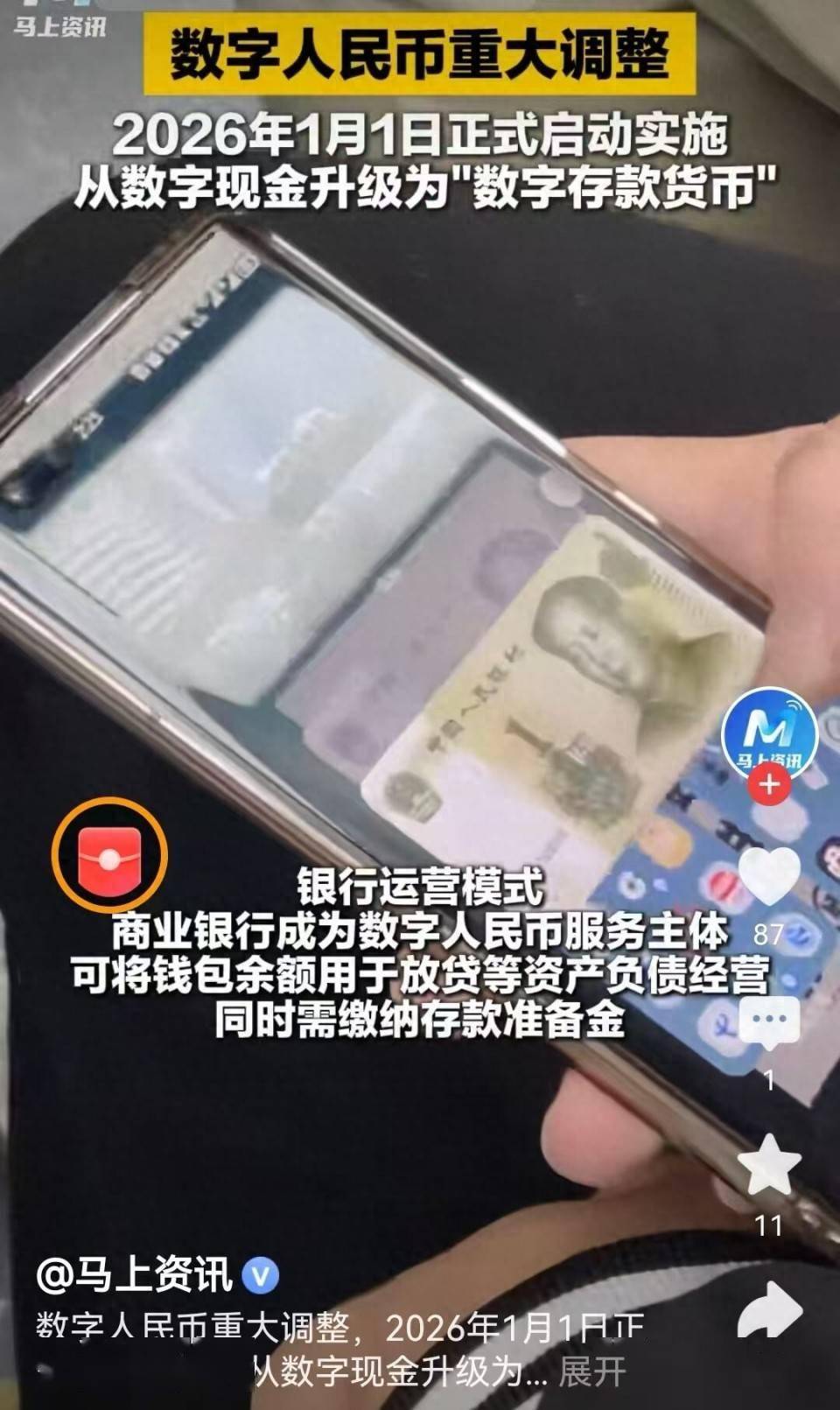
Core Insights - The digital RMB has been gradually introduced since 2019, with significant milestones including the launch of the digital RMB app in 2022 and the establishment of 225 million personal wallets by September 2025, facilitating transactions totaling 14.2 trillion yuan [1][4] - Starting in 2026, the digital RMB will undergo a major transformation, with the implementation of a new management and operational framework, marking a significant shift towards widespread adoption and usage [4] - The digital RMB will be integrated into deposit insurance, allowing users to earn interest on their digital currency deposits and providing enhanced security and convenience in transactions [7][9] Digital RMB Features - Users can access digital RMB without internet connectivity, similar to cash, and can transfer funds between their digital RMB accounts and traditional bank accounts [7][9] - The digital RMB will support both hard wallets and soft wallets, with the latter being accessible through various applications, enhancing user flexibility [9] - Enhanced cross-border payment capabilities will be introduced, making international transactions easier and faster for individuals and businesses engaged in trade [10] Future Implications - The digital RMB is expected to become the predominant form of currency, reducing the reliance on physical cash and transforming the monetary landscape [4] - The integration of digital RMB into the banking system will allow for various financial activities, including savings, investments, and payments, streamlining the user experience [10]

将实现“一人一码”,工信部拟制定标准规范数字人身份标识
Xin Hua She· 2026-01-23 23:59
Core Viewpoint - The Ministry of Industry and Information Technology of China is seeking public opinion on the revision plan for the mandatory national standard titled "Metaverse Classification and Identification: Requirements for Digital Human Identity Identification" [1] Group 1: Industry Development - The digital human industry in China has developed rapidly, with applications in performance hosting, e-commerce live streaming, brand marketing, customer service, and education training [1] - There are over 1.14 million companies related to digital humans in China [1] Group 2: Regulatory Needs - The lack of an effective management mechanism for digital human identity has led to issues such as identity theft and the dissemination of illegal information [1] - The proposed standard aims to enable quick traceability of problematic digital human information, facilitating industry regulation [1] Group 3: Standard Implementation - The standard will establish a unified digital human identity identification certification system, promoting the industry towards standardization, clustering, and refinement [1] - All digital humans used for commercial and communication purposes will be assigned a unique identification code, which will help reduce and prevent security risks associated with digital humans [1] Group 4: Market Potential - It is estimated that by 2025, the scale of China's digital human industry will exceed 40 billion yuan, driving the surrounding industry scale to over 600 billion yuan [1]
工信部拟制定标准规范数字人身份标识
Xin Lang Cai Jing· 2026-01-23 18:53
Core Viewpoint - The Ministry of Industry and Information Technology of China plans to establish mandatory national standards for digital human identity identification, aiming to regulate the digital human industry and enhance management mechanisms to prevent misuse and fraud [1][2]. Group 1: Regulatory Standards - The proposed standard will define the identification system, registration, management, and identification requirements for digital human identities [1]. - The standard aims to facilitate rapid tracing of problematic digital human information, aiding industry regulation and reducing fraud risks [1]. Group 2: Industry Growth and Impact - The digital human industry in China has seen rapid growth, with over 1.14 million related enterprises established [2]. - Projections indicate that by 2025, the scale of China's digital human industry will exceed 40 billion yuan, driving surrounding industries to surpass 600 billion yuan [2]. Group 3: Security and Compliance - The standard will implement a "one person, one code" system for all digital humans used for commercial and communication purposes, which will help mitigate security risks associated with digital humans [1]. - Establishing a unified digital human identity certification system will promote the standardized, clustered, and refined development of the industry [1].
工业和信息化部拟制定标准 规范数字人身份标识
Xin Lang Cai Jing· 2026-01-23 17:51
Group 1 - The Ministry of Industry and Information Technology of China has announced a public consultation for the mandatory national standard on "Classification and Identification Requirements for Digital Human Identity" [1] - The proposed standard aims to establish a management mechanism for digital human identity, addressing issues such as identity theft and the dissemination of illegal information [1] - The standard will facilitate rapid tracing of problematic digital human information, enhance industry regulation, and reduce fraud risks by creating a unified digital human identity certification system [1] Group 2 - There are over 1.14 million companies related to the digital human industry in China [2] - It is projected that by 2025, the scale of China's digital human industry will exceed 40 billion yuan, driving the surrounding industry scale to over 600 billion yuan [2]
新国都:公司一直密切关注数字人民币、跨境支付相关政策和业务场景创新方向
Zheng Quan Ri Bao Wang· 2026-01-23 13:41
Core Viewpoint - The company is actively monitoring policies and innovations related to digital RMB and cross-border payments, aiming to develop business opportunities within the regulatory framework [1] Group 1: Business Development - The company has been increasing its investment in the cross-border payment brand PayKKa, focusing on resource allocation, product development, and banking channel construction [1] - The company is optimizing its B2B cross-border trade and B2C cross-border e-commerce payment capabilities, enhancing local account construction in various countries [1] - Local account coverage includes major regions such as the United States, Canada, the United Kingdom, the European Union, Australia, Singapore, Hong Kong, Indonesia, the Philippines, Thailand, and Vietnam [1] Group 2: Payment Solutions - The company has successfully enabled clients to receive payments on major global e-commerce platforms like Amazon, Etsy, Lazada, Shopee, and TikTok [1] - The company has launched a global acquiring product for independent stations, strengthening partnerships with acquiring banks and institutions [1] - The company offers multiple digital RMB acceptance solutions for domestic scenarios, including aggregation payment codes, digital currency collection codes, and POS scanning payment codes [1]

京东披露2025消费数据,AI搜索量激增百倍、5万商家开启数字人直播
Zhong Guo Jing Ying Bao· 2026-01-23 11:40
Core Insights - JD Group's CEO Xu Ran revealed that by 2025, the search volume related to "AI" on JD's platform is expected to increase over 100 times year-on-year, marking 2025 as the "explosion year" for AI consumption [1] - The acceptance of AI functionalities among consumers has significantly risen, with nearly half (46.8%) of consumers believing that products must integrate AI capabilities [1] - JD is leveraging the C2M (Customer-to-Manufacturer) model and its "super supply chain" to convey consumer insights to brands, accelerating product iteration [1] AI Consumption Trends - Sales of smart glasses and smart robots are projected to grow by 10 times and 3 times, respectively, in 2025 [1] - AI technology is being integrated into various applications, including AI shopping assistants and digital human live streaming, generating tangible benefits in e-commerce operations [1] Digital Human Live Streaming - During the 2025 "JD 11.11" shopping festival, the total transaction volume from digital human live streaming exceeded 2.4 billion yuan, with 50,000 merchants utilizing digital human hosts for 24-hour continuous streaming, leading to a 30% increase in overall platform conversion rates [1] AI in Customer Service and Logistics - JD's AI robots in customer service and logistics have achieved large-scale application, enhancing operational efficiency [1] Skills Reskilling Initiative - JD announced its participation in the World Economic Forum's "Reskilling Initiative," becoming the first Chinese company to join this program aimed at training employees to meet the new skill demands of the AI era [2]