Gaishi Food(836826)

Search documents
大消费板块,午后大涨
Di Yi Cai Jing Zi Xun· 2025-11-10 05:58
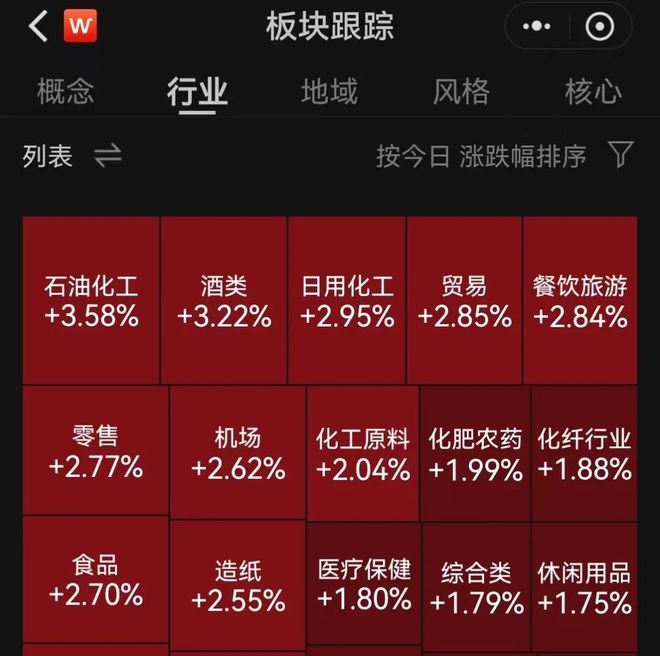
Core Viewpoint - The consumer sector is experiencing a significant rise, particularly in the liquor, restaurant, tourism, and food industries, as evidenced by the performance of various stocks and indices [1][2]. Group 1: Sector Performance - The oil and chemical sector increased by 3.58%, while the liquor sector rose by 3.22% and the restaurant and tourism sector by 2.84% [2]. - Other notable sectors include retail (+2.77%), food (+2.70%), and healthcare (+1.80%) [2]. Group 2: Stock Highlights - Several stocks reached their daily limit, including Shede Liquor, Kweichow Moutai, and Jinjiang Hotels, indicating strong investor interest [2]. - Specific stock performances include: - Shede Liquor at 65.63, up 10.01% - Kweichow Moutai at 23.57, up 9.99% - Luzhou Laojiao at 142.25, up 8.05% [3]. Group 3: Food Sector Insights - The food index increased by 2.80%, with stocks like Gais Food and Sanyuan Holdings showing significant gains of 10.07% and 10.06%, respectively [4]. - The Ministry of Finance announced plans to continue implementing policies to boost consumption, particularly in key areas such as personal consumption loans [4].




大消费概念异动拉升 欢乐家、会稽山涨停
Mei Ri Jing Ji Xin Wen· 2025-11-10 02:56
Group 1 - The consumer sector experienced significant upward movement, particularly in food and beverage and duty-free segments [1] - Notable stocks that reached their daily limit include Huanlejia and Kuaijishan, while Dongbai Group also hit its limit [1] - China Duty Free Group approached its daily limit, with other companies like Cuihua Jewelry, Zhuangyuan Pasture, Huifa Food, Gais Food, and Yingjia Gongjiu showing strong gains [1]



盖世食品换手率23.88%,龙虎榜上榜营业部合计净卖出1201.94万元
Zheng Quan Shi Bao Wang· 2025-11-05 15:22
Group 1 - The stock of Gaisi Food (920826) increased by 3.67% with a turnover rate of 23.88% and a trading volume of 213 million yuan, showing a volatility of 10.63% [1] - The stock was listed on the daily trading board due to its turnover rate, with a net sell of 12.01 million yuan from brokerage seats [2] - In the last six months, the stock has appeared on the trading board six times, with an average price drop of 3.00% the day after and an average decline of 6.97% over the following five days [3] Group 2 - The top five brokerage firms involved in trading on this day had a total transaction amount of 53.03 million yuan, with buying amounting to 20.51 million yuan and selling amounting to 32.52 million yuan, resulting in a net sell of 12.01 million yuan [2] - The largest buying brokerage was Guosen Securities with a purchase amount of 4.78 million yuan, while the largest selling brokerage was CITIC Securities with a selling amount of 8.74 million yuan [3]
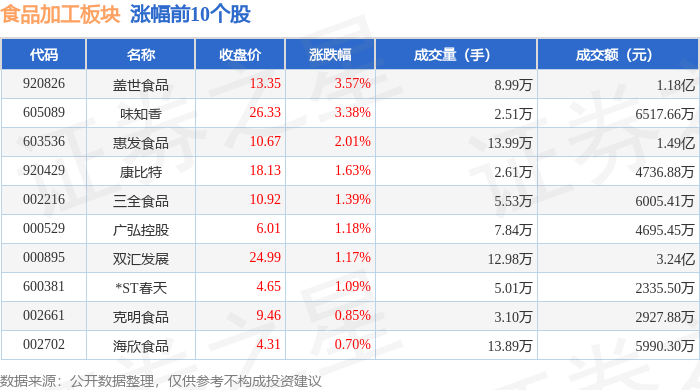
食品加工板块10月14日涨0.04%,盖世食品领涨,主力资金净流出1.25亿元
Zheng Xing Xing Ye Ri Bao· 2025-10-14 08:39
Market Overview - On October 14, the food processing sector rose by 0.04% compared to the previous trading day, with Gai Shi Food leading the gains [1] - The Shanghai Composite Index closed at 3865.23, down 0.62%, while the Shenzhen Component Index closed at 12895.11, down 2.54% [1] Stock Performance - Gai Shi Food (code: 920826) closed at 13.35, up 3.57% with a trading volume of 89,900 shares and a turnover of 118 million yuan [1] - Wei Zhi Xiang (code: 605089) closed at 26.33, up 3.38% with a trading volume of 25,100 shares and a turnover of 65.18 million yuan [1] - Hui Fa Food (code: 603536) closed at 10.67, up 2.01% with a trading volume of 139,900 shares and a turnover of 149 million yuan [1] - Other notable performers include Kang Bi Te (code: 920429) up 1.63% and Shuanghui Development (code: 000895) up 1.17% [1] Capital Flow - The food processing sector experienced a net outflow of 125 million yuan from institutional investors, while retail investors saw a net inflow of 140 million yuan [2] - The overall capital flow indicates a mixed sentiment, with institutional investors pulling back while retail investors are more active [2] Individual Stock Capital Flow - ST Chuntian (code: 600381) had a net inflow of 3.86 million yuan from institutional investors, while it faced a net outflow of 3.76 million yuan from speculative funds [3] - Hui Fa Food (code: 603536) saw a net inflow of 2.40 million yuan from institutional investors, but a net outflow of 2.55 million yuan from retail investors [3] - Shuanghui Development (code: 000895) had a net inflow of 1.87 million yuan from institutional investors, with a significant outflow of 38.42 million yuan from speculative funds [3]


盖世食品董事长盖泉泓:双轮驱动 打造开胃凉菜龙头企业
Zhong Guo Zheng Quan Bao· 2025-10-13 00:13
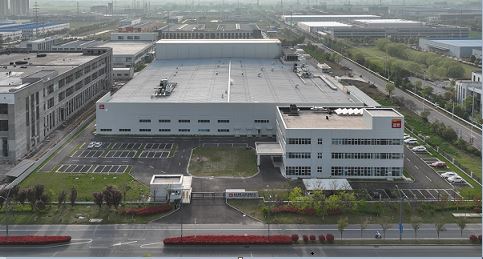
Core Insights - The chairman of the company, Gai Quan Hong, emphasized the establishment of a strong competitive moat in the appetizer cold dish sector, aiming to become a leading brand in China [1] - Despite fierce competition in the market, there remains significant growth potential, and the company plans to enhance its organizational and human resource capabilities while expanding both domestic and international markets [1][5] Company Strategy - The company has maintained efficient operations at its Dalian and Huai'an bases, leveraging local natural and agricultural advantages to grow its market presence [2] - The focus on R&D is crucial, with the company adopting a triangular R&D model to enhance product quality and innovation, ensuring a diverse product lineup beyond traditional offerings [3] - Collaborations with universities and research centers have been established to bolster R&D efforts in cold dish products, leading to successful outcomes in marine and edible fungi products [3] Market Dynamics - The cold dish market has evolved from informal production methods to a more professional approach, driven by rising labor costs and increasing consumer demands for food safety and quality [4] - The company is positioned to benefit from the growing trend of large restaurant chains outsourcing cold dish production to specialized companies, enhancing supply chain stability and cost efficiency [4] Expansion Plans - The company is actively expanding its national footprint, with the Huai'an base enhancing production capacity and market reach, particularly in economically developed regions [8] - Future plans include establishing multiple "satellite factories" around core markets to optimize production and reduce transportation costs [8][9] - The company is also advancing its Shanghai headquarters to leverage regional advantages for further business growth [9] Financial Support - The company has successfully navigated the capital markets, transitioning from the New Third Board to the Beijing Stock Exchange, which has provided significant support for its growth initiatives [10] - The construction of the Huai'an base was funded through capital raised during its listing, and the company is now planning to issue convertible bonds to support further expansion into the meat and seafood pre-prepared dish sectors [10]
盖世食品董事长盖泉泓: 双轮驱动 打造开胃凉菜龙头企业
Zhong Guo Zheng Quan Bao· 2025-10-12 20:52
Core Viewpoint - The company has established a strong competitive advantage in the appetizer cold dish sector and aims to become a leading brand in China, despite fierce competition and significant market potential [1][2]. Company Strategy - The company plans to enhance its organizational and human resource capabilities while pursuing a dual-driven strategy to expand both domestic and international markets [1][2]. - The company emphasizes the importance of research and development (R&D) in food processing, aiming to become a R&D-driven enterprise with a focus on product innovation and safety [2][3]. Market Performance - The company has seen significant growth in product sales, particularly in fish roe and marine delicacies, with overall revenue and net profit continuing to show steady growth [3][4]. - The increasing popularity of appetizer cold dishes is attributed to rising labor costs and food safety concerns, leading many large restaurant chains to outsource production to specialized companies [4]. Production and Supply Chain - The company operates two main production bases in Dalian and Huai'an, optimizing its supply chain and reducing transportation costs by being closer to raw material sources [5][6]. - The Huai'an base focuses on mushroom and vegetable products, while the Dalian base specializes in algae, fish roe, and marine delicacies, enhancing overall production capacity [5][6]. Expansion Plans - The company is actively expanding its national footprint, planning to establish multiple "satellite factories" around key markets to improve market responsiveness and reduce costs [6][7]. - The company is also developing a second phase of the Huai'an base to enhance its product offerings in the meat and seafood pre-prepared dish sector, aiming to create a comprehensive product matrix [8]. Capital Market Support - The company has benefited from its listing on the stock market, which has provided significant support for its growth and development initiatives, including the construction of the Huai'an base [7][8].
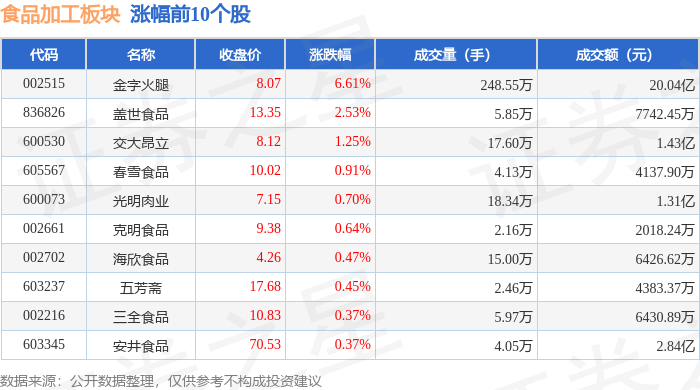
食品加工板块9月26日跌0.04%,味知香领跌,主力资金净流出1835.41万元
Zheng Xing Xing Ye Ri Bao· 2025-09-26 08:42
Market Overview - On September 26, the food processing sector experienced a slight decline of 0.04% compared to the previous trading day, with Wei Zhi Xiang leading the drop [1] - The Shanghai Composite Index closed at 3828.11, down 0.65%, while the Shenzhen Component Index closed at 13209.0, down 1.76% [1] Stock Performance - Jinzi Ham (002515) saw a significant increase of 6.61%, closing at 8.07 with a trading volume of 2.4855 million shares and a transaction value of 2.004 billion [1] - Wei Zhi Xiang (605089) led the declines with a drop of 4.53%, closing at 27.61 with a trading volume of 41,000 shares and a transaction value of 115 million [2] - Other notable performers included Gai Shi Food (836826) with a 2.53% increase and Longda Meishi (002726) with a 2.42% decrease [2] Capital Flow Analysis - The food processing sector experienced a net outflow of 18.3541 million from institutional investors, while retail investors saw a net inflow of 65.5132 million [2] - The capital flow data indicates that Jinzi Ham had a net inflow of 94.3197 million from institutional investors, while it faced a net outflow of 56.9452 million from speculative funds [3] - The overall trend shows that while institutional and speculative funds are withdrawing, retail investors are actively buying into the sector [2][3]


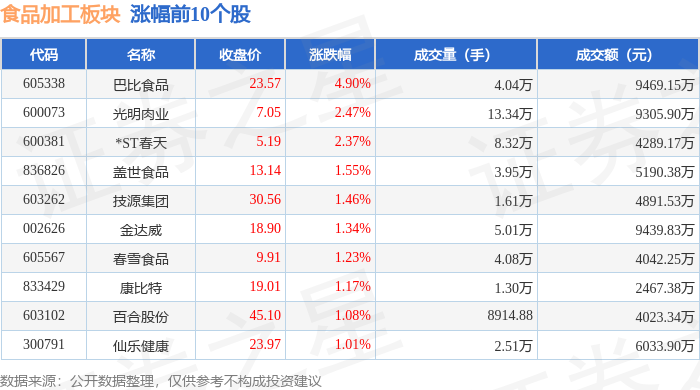
食品加工板块9月24日跌0.16%,味知香领跌,主力资金净流出5.67亿元
Zheng Xing Xing Ye Ri Bao· 2025-09-24 08:39
Core Insights - The food processing sector experienced a slight decline of 0.16% on September 24, with Weizhi Xiang leading the drop [1][2] - The Shanghai Composite Index closed at 3853.64, up 0.83%, while the Shenzhen Component Index closed at 13356.14, up 1.8% [1] Stock Performance - Notable gainers in the food processing sector included: - Baba Foods (605338) with a closing price of 23.57, up 4.90% [1] - Guangming Meat (600073) at 7.05, up 2.47% [1] - ST Chuntian (600381) at 5.19, up 2.37% [1] - Conversely, Weizhi Xiang (605089) closed at 28.11, down 1.54% [2] - The sector saw a total trading volume of 5.67 billion yuan in net outflow from major funds, while retail investors contributed a net inflow of 2.49 billion yuan [2][3] Fund Flow Analysis - Major funds showed a net outflow of 5.67 billion yuan, while speculative funds had a net inflow of 3.18 billion yuan [2] - Retail investors contributed a net inflow of 2.49 billion yuan [2] - Specific stock fund flows included: - Guangming Meat (600073) with a net inflow of 17.05 million yuan from major funds [3] - Jindawi (002626) with a net inflow of 11.20 million yuan from major funds [3] - Xianle Health (300791) had a net inflow of 2.03 million yuan from retail investors [3]

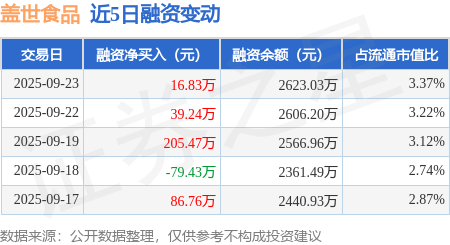
盖世食品:9月23日融资净买入16.83万元,连续3日累计净买入261.54万元
Sou Hu Cai Jing· 2025-09-24 02:47
Group 1 - The core point of the news is that Gais Food (836826) has seen a net financing inflow of 16.83 million yuan on September 23, 2025, following a trend of continuous net buying over the past three trading days, totaling 261.54 million yuan [1][2][3] - The financing balance for Gais Food reached 26.23 million yuan on September 23, 2025, reflecting a 0.65% increase from the previous day [2][3] - Over the last 20 trading days, Gais Food experienced net financing inflows on 12 occasions, indicating a positive sentiment among investors [1]
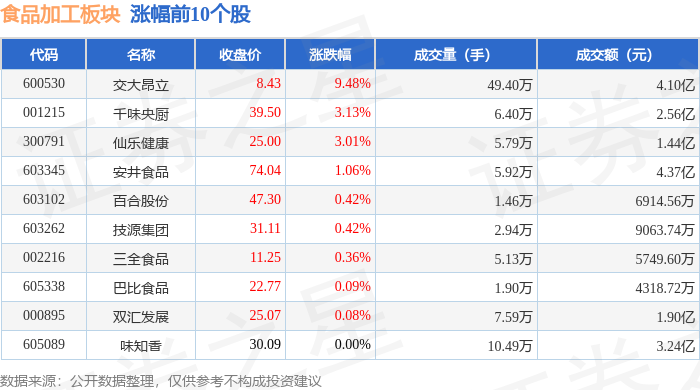
食品加工板块9月19日涨0.15%,交大昂立领涨,主力资金净流出3488.1万元
Zheng Xing Xing Ye Ri Bao· 2025-09-19 08:47
Market Overview - On September 19, the food processing sector rose by 0.15% compared to the previous trading day, with Jiaoda Onlly leading the gains [1] - The Shanghai Composite Index closed at 3820.09, down 0.3%, while the Shenzhen Component Index closed at 13070.86, down 0.04% [1] Top Performers - Jiaoda Onlly (600530) closed at 8.43, up 9.48%, with a trading volume of 494,000 shares and a turnover of 410 million yuan [1] - Qianwei Yangchu (001215) closed at 39.50, up 3.13%, with a trading volume of 64,000 shares and a turnover of 256 million yuan [1] - Xianle Health (300791) closed at 25.00, up 3.01%, with a trading volume of 57,900 shares and a turnover of 144 million yuan [1] Underperformers - Gais Food (836826) closed at 13.67, down 4.54%, with a trading volume of 91,200 shares and a turnover of 127 million yuan [2] - Deli Foods (002330) closed at 5.00, down 2.72%, with a trading volume of 377,600 shares and a turnover of 190 million yuan [2] - Xiwang Foods (000639) closed at 3.25, down 2.69%, with a trading volume of 364,800 shares and a turnover of 119 million yuan [2] Capital Flow - The food processing sector experienced a net outflow of 34.88 million yuan from institutional investors, while retail investors saw a net inflow of 68.44 million yuan [2] - The main capital flow data indicates that Jiaoda Onlly had a net inflow of 94.27 million yuan from institutional investors, while retail investors had a net outflow of 48.85 million yuan [3]