
Shandong Luscious Pet Food Inc.(920419)

Search documents
路斯股份(920419) - 股票解除限售公告
2026-03-25 10:03
证券代码:920419 证券简称:路斯股份 公告编号:2026-003 山东路斯宠物食品股份有限公司股票解除限售公告 本公司及董事会全体成员保证公告内容的真实、准确和完整,没有虚假记载、 误导性陈述或者重大遗漏,并对其内容的真实性、准确性和完整性承担个别及连 带法律责任。 一、本次股票解除限售数量总额为 77,850 股,占公司总股本 0.0754%,可交易 时间为 2026 年 3 月 30 日。 二、本次股票解除限售的明细情况及原因 单位:股 | | 1、高管股份 | 6,381,576 | 6.1773% | | --- | --- | --- | --- | | | 2、个人或基金 | 233,550 | 0.2261% | | 有限售条件的 | 3、其他法人 | 0 | 0.0000% | | 股份 | 4、限制性股票 | 0 | 0.0000% | | | 5、其他 | 0 | 0.0000% | | | 有限售条件股份合计 | 6,615,126 | 6.4034% | | | 总股本 | 103,306,400 | 100.0000% | 四、其它情况 本次解除限售的股东如属于《北京证券交易所 ...
路斯股份(920419) - 对外投资设立控股孙公司并取得营业执照的公告
2026-03-17 09:15
证券代码:920419 证券简称:路斯股份 公告编号:2026-002 山东路斯宠物食品股份有限公司 对外投资设立控股孙公司并取得营业执照的公告 本公司及董事会全体成员保证公告内容的真实、准确和完整,没有虚假记载、 误导性陈述或者重大遗漏,并对其内容的真实性、准确性和完整性承担个别及连 带法律责任。 一、对外投资概述 (一)基本情况 为进一步提高原料采购效率,保障生产经营需要,山东路斯宠物食品股份有 限公司(以下简称"公司")控股子公司柬埔寨路恒宠物食品有限公司(以下简 称"柬埔寨路恒")在中国境内以自有资金全资设立寿光路恒国际贸易有限公司。 注册地为山东省寿光市,注册资本为 20 万美元。 近日,上述新设公司已完成工商注册登记,并取得由寿光市市场监督管理局 核发的营业执照。 (二)是否构成重大资产重组 本次交易不构成重大资产重组。 根据《上市公司重大资产重组管理办法》的相关规定,公司本次对外投资设 立控股孙公司不构成重大资产重组。 (三)是否构成关联交易 本次交易不构成关联交易。 (四)决策与审议程序 根据《北京证券交易所股票上市规则》《山东路斯宠物食品股份有限公司章 (七)投资对象是否开展或拟开展私募投资 ...
路斯股份(920419) - 2025 Q4 - 年度业绩
2026-02-27 10:35
Financial Performance - The company achieved operating revenue of ¥861,050,538.41, a year-on-year increase of 10.73%[3] - Net profit attributable to shareholders decreased by 21.02% to ¥61,886,941.32[3] - Basic earnings per share fell to ¥0.60, down 21.05% compared to the previous year[3] - Total assets increased by 11.25% to ¥863,104,524.99 at the end of the reporting period[3] - Shareholders' equity attributable to the company rose by 11.85% to ¥617,516,536.87[3] Profitability and Margins - The company's gross profit margin declined due to lower margins on jerky and canned products, as well as reduced exchange gains[5] - The company reported a decrease in gross profit margin primarily due to the high proportion of low-margin jerky products[5] Revenue Drivers - Revenue growth was driven by significant orders from the U.S. and Russia, particularly in jerky and canned products[5] Market Development - The Cambodian subsidiary's pet snack project is still in the market development phase, impacting overall profitability[4] Risk Management - The company emphasizes the importance of monitoring investment risks as the financial data is preliminary and unaudited[7]
北交所投资框架工具书:北交所市场大消费投资框架及核心标的的梳理-20260213
Hua Yuan Zheng Quan· 2026-02-13 03:34
Consumption Trends - The emotional economy market in China is expected to exceed 20 trillion yuan in 2024, with a projected CAGR of 14% from 2025 to 2029[3][60]. - The beauty consumption market is projected to reach nearly 370 billion yuan by 2025, with the retail sales of cosmetics in China estimated at 465.3 billion yuan in 2025, reflecting a year-on-year growth of 5.1%[5][51]. - The health food market is anticipated to reach 720.3 billion yuan by 2029, driven by increasing health awareness and aging population[5]. Policy and Market Dynamics - The Chinese government has prioritized boosting consumption as a key task for 2025, with policies supporting consumption upgrades and equipment renewal[5][9]. - Changing consumer behavior emphasizes emotional value, health, and personalized consumption, indicating a shift towards emotional and social fulfillment in purchasing decisions[5][9]. Key Industry Insights - The maternal and infant food market is projected to reach approximately 55.91 billion yuan in 2024, with the number of maternal and infant chain stores increasing from 21,000 in 2019 to 32,000 in 2024[5]. - The pet economy is expected to grow significantly, with the market size reaching 701.3 billion yuan in 2024, reflecting an 18% year-on-year increase[58]. Investment Opportunities - Companies in the North Exchange related to beauty consumption include Jinbo Biological, Bawei Co., and Vicky Technology, which are positioned to benefit from the ongoing growth in the beauty sector[5][52]. - The health food sector includes leading brands like Kangbiter and Yizhi Konjac, which are well-placed to capitalize on the rising demand for health-oriented products[5].
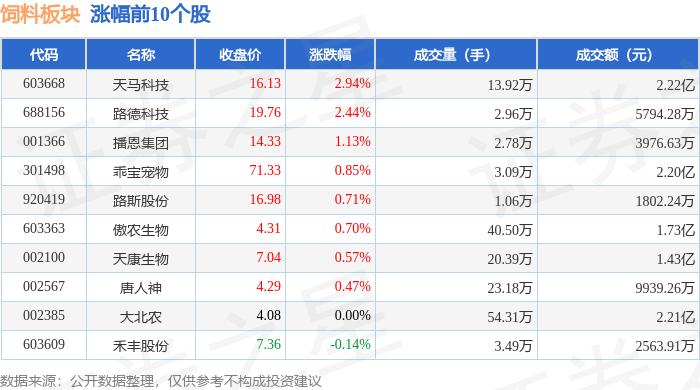
饲料板块1月23日跌0.29%,中宠股份领跌,主力资金净流出7063.74万元
Zheng Xing Xing Ye Ri Bao· 2026-01-23 09:04
Group 1 - The feed sector experienced a decline of 0.29% on January 23, with Zhongchong Co., Ltd. leading the drop [1] - The Shanghai Composite Index closed at 4136.16, up 0.33%, while the Shenzhen Component Index closed at 14439.66, up 0.79% [1] - Key stocks in the feed sector showed varied performance, with Tianma Technology rising by 2.94% to a closing price of 16.13, while Zhongchong Co., Ltd. fell by 1.55% to 49.52 [2] Group 2 - The feed sector saw a net outflow of 70.64 million yuan from institutional investors, while retail investors had a net inflow of 90.51 million yuan [2] - The trading volume and turnover for major stocks in the feed sector varied, with major stocks like Tianma Technology and Haida Group showing significant trading activity [3] - The net inflow and outflow of funds for specific stocks indicated a mixed sentiment among investors, with some stocks like Haida Group experiencing a net inflow of 13.67 million yuan from institutional investors [3]



饲料板块1月20日跌0.59%,天马科技领跌,主力资金净流出3544.89万元
Zheng Xing Xing Ye Ri Bao· 2026-01-20 08:51
Group 1 - The feed sector experienced a decline of 0.59% on January 20, with Tianma Technology leading the drop [1] - The Shanghai Composite Index closed at 4113.65, down 0.01%, while the Shenzhen Component Index closed at 14155.63, down 0.97% [1] - Notable gainers in the feed sector included Aonong Biological, which rose by 3.08% to a closing price of 4.35, and Kesi Thought, which increased by 1.66% to 7.94 [1] Group 2 - Tianma Technology saw a significant decline of 3.57%, closing at 15.66, with a trading volume of 162,400 shares and a transaction value of 258 million [2] - Other notable decliners included Jin Xin Nong, down 2.14% to 6.41, and Peidi Co., down 1.59% to 19.15 [2] - The feed sector experienced a net outflow of 35.44 million from main funds, while retail investors saw a net inflow of 20.64 million [2] Group 3 - Aonong Biological had a net inflow of 27.32 million from main funds, representing 7.51% of its trading volume, while it faced a net outflow of 14.44 million from retail investors [3] - The net inflow for Guai Bao Pet was 9.77 million from main funds, with a net outflow of 1.67 million from retail investors [3] - The overall trend showed that while main funds were withdrawing, retail investors were actively buying into certain stocks within the feed sector [3]


北交所新消费产业研究系列(五):情绪为核+消费新生,中国情绪经济有望重塑万亿消费生态
Hua Yuan Zheng Quan· 2026-01-19 14:02
Group 1: Emotional Economy - The emotional economy in China is projected to exceed 20 trillion yuan by 2024, with a significant growth trajectory expected to continue, reaching approximately 45 trillion yuan by 2029 [2][23][26] - Emotional consumption is characterized by a willingness to pay for emotional value, with over 60% of consumers viewing it as an effective way to relieve stress, and nearly half recognizing it as a means to alleviate emotions [8][20][23] - The emotional economy encompasses various sectors, including trendy toys, pets, emotional health, cultural entertainment, stress relief products, and fragrances, indicating a multi-faceted development landscape [2][24] Group 2: Trendy Toy Economy - The trendy toy market is shifting from functional to emotional consumption, with a projected CAGR of 21% from 2025 to 2030 [2][31] - The retail sales of trendy toys in China are expected to grow from 20.7 billion yuan in 2019 to 58.7 billion yuan in 2024, reflecting a compound annual growth rate of 23.2% [2][37] - The growth of the trendy toy industry is driven by increasing emotional consumption, with these products becoming vehicles for personal identity and cultural belonging [2][37] Group 3: Pet Economy - The pet economy in China is anticipated to surpass 1 trillion yuan by 2027, driven by emotional attachment and companionship needs [2][56] - The pet industry is experiencing steady growth, with the market size expected to reach 701.3 billion yuan in 2024, reflecting an 18.3% year-on-year increase [2][64] - Pet food remains the dominant segment, accounting for 52.8% of the pet consumption market in 2024, with a notable increase in the average spending per pet owner expected in the coming years [2][64][68] Group 4: Fragrance Economy - The fragrance market in China is projected to grow at a CAGR of 15% from 2018 to 2024, with the market size expected to reach approximately 32.9 billion yuan by 2025 [2][81][86] - Emotional benefits are prioritized over functional needs in fragrance consumption, with 59.7% of consumers purchasing fragrances to enhance their emotional experience [2][81][92] - The fragrance market is characterized by a blend of online and offline channels, with online sales expected to grow significantly, reflecting a shift in consumer purchasing behavior [2][88]
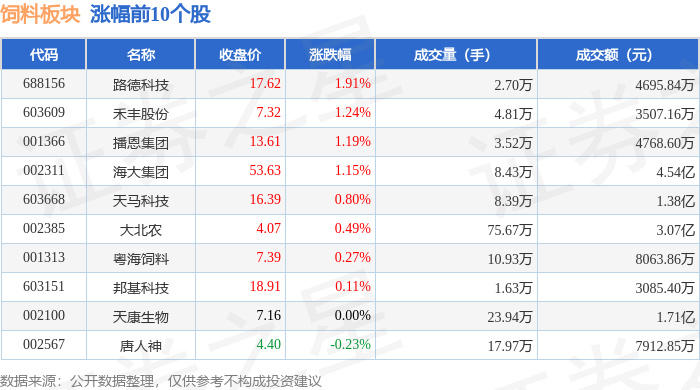
饲料板块1月15日涨0.13%,路德科技领涨,主力资金净流出1.16亿元
Zheng Xing Xing Ye Ri Bao· 2026-01-15 08:53
Group 1 - The feed sector experienced a slight increase of 0.13% on January 15, with Lude Technology leading the gains [1] - The Shanghai Composite Index closed at 4112.6, down 0.33%, while the Shenzhen Component Index closed at 14306.73, up 0.41% [1] - Key stocks in the feed sector showed varied performance, with Lude Technology closing at 17.62, up 1.91%, and Tangrenshen closing at 4.40, down 0.23% [1] Group 2 - The feed sector saw a net outflow of 116 million yuan from institutional investors, while retail investors contributed a net inflow of 116 million yuan [2] - The trading volume for Lude Technology was 27,000 hands, with a transaction amount of 46.9584 million yuan [1] - The stock performance of major companies included Hada Group with a closing price of 53.63, up 1.15%, and Petty Co. with a closing price of 18.75, down 2.09% [2][3] Group 3 - The net inflow from retail investors for TianKang Biological was 17.1 million yuan, while the net outflow from institutional investors was 18.4821 million yuan [3] - The net inflow for GuaiBao Pet was 6.3998 million yuan from institutional investors, while it faced a net outflow of 10.7891 million yuan from retail investors [3] - The overall sentiment in the feed sector indicates mixed investor behavior, with some stocks attracting retail interest while others faced institutional selling pressure [2][3]


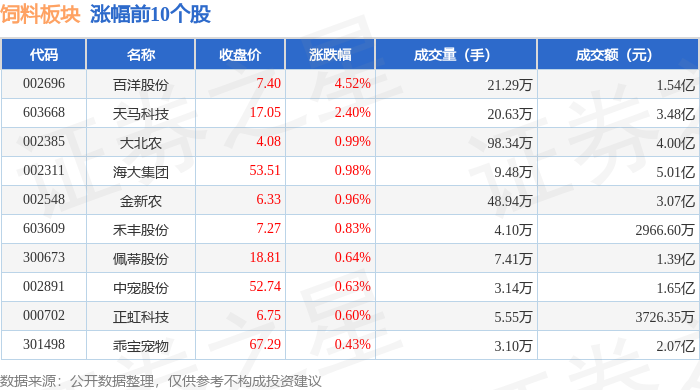
饲料板块1月9日涨0.74%,百洋股份领涨,主力资金净流出933.03万元
Zheng Xing Xing Ye Ri Bao· 2026-01-09 08:52
Core Insights - The feed sector experienced a rise of 0.74% on January 9, with Baiyang Co., Ltd. leading the gains [1] - The Shanghai Composite Index closed at 4120.43, up 0.92%, while the Shenzhen Component Index closed at 14120.15, up 1.15% [1] Feed Sector Performance - Baiyang Co., Ltd. (002696) closed at 7.40, with a gain of 4.52% and a trading volume of 212,900 shares, amounting to a transaction value of 154 million yuan [1] - Tianma Technology (603668) closed at 17.05, up 2.40%, with a trading volume of 206,300 shares and a transaction value of 348 million yuan [1] - Dabeinong (002385) closed at 4.08, up 0.99%, with a trading volume of 983,400 shares and a transaction value of 400 million yuan [1] - Haida Group (002311) closed at 53.51, up 0.98%, with a trading volume of 94,800 shares and a transaction value of 501 million yuan [1] - Other notable companies include Jinxinnong (002548), Hefeng Co., Ltd. (603609), and Petty Co., Ltd. (300673), with respective closing prices and gains [1] Capital Flow Analysis - The feed sector saw a net outflow of 9.33 million yuan from main funds, while retail funds experienced a net inflow of 30.09 million yuan [2] - Dabeinong had a main fund net inflow of 42.81 million yuan, while Haida Group saw a net outflow of 60.89 million yuan from retail investors [3] - Baiyang Co., Ltd. had a main fund net inflow of 16.28 million yuan, with retail investors also showing a net outflow [3]


2025年中国狗粮行业发展历程、发展背景、产业链图谱、销售规模、竞争格局及发展趋势分析:TOP10品牌市场占有率仅24.6%[图]
Chan Ye Xin Xi Wang· 2025-12-25 01:33
Overview - The perception of pets as family members has deepened, leading to a shift in dog food consumption from "optional" to "essential," providing stable demand for the dog food market in China [1][5] - The rise of single economy, aging population, and emotional companionship needs have expanded the dog owner demographic, increasing both the frequency of dog food purchases and average spending per customer [1][4] Market Statistics - In 2024, China's dog food sales are projected to reach 607,300 tons, with an average selling price of 35,800 yuan per ton, resulting in total sales of 21.738 billion yuan [1][5] - Dry dog food accounts for 83.82% of sales, while wet dog food represents 3.74% [1][5] Industry Development - The dog food industry in China has evolved from informal feeding practices to industrialized production, with domestic brands now competing with international ones [3][4] - Increased regulation and rising costs have led to the elimination of smaller brands lacking core technology and funding, while leading companies are expanding market share through mergers and supply chain upgrades [3][4] Consumer Trends - The aging population and rising divorce rates have increased the number of people seeking companionship from pets, driving growth in the pet economy [4][8] - The average annual spending per pet dog in China is expected to reach 2,961 yuan in 2024, reflecting a 3.0% year-on-year increase [4][5] Supply Chain - The upstream supply chain includes core raw material suppliers such as meat, grains, and fats, which account for over 70% of production costs [6] - In 2024, China's grain production is projected to reach 652.29 million tons, with meat production at 97.80 million tons, ensuring a stable supply of raw materials for the dog food industry [6] Competitive Landscape - The dog food market in China is highly competitive, with numerous brands including international players like Royal Canin and local brands like MaiFuDi and WanPi [9][10] - The top 10 brands in the market hold only 24.60% of the market share, indicating a fragmented competitive environment [9] Future Trends - The focus on pet health will drive dog food products towards natural, grain-free, and functional formulations, with an emphasis on ingredient traceability and safety [13] - Customizable dog food tailored to specific breeds, ages, and health conditions is expected to become more prevalent, including options based on genetic testing [13]
