
HKEX(00388)

Search documents
香港交易所(00388) - 截至2025年8月31日止月份之股份发行人的证券变动月报表
2025-09-02 08:30
股份發行人及根據《上市規則》第十九B章上市的香港預託證券發行人的證券變動月報表 截至月份: 2025年8月31日 狀態: 新提交 致:香港交易及結算所有限公司 公司名稱: 香港交易及結算所有限公司 呈交日期: 2025年9月2日 I. 法定/註冊股本變動 不適用 備註: 香港交易所並無法定股本,及其股本並無股份面值。 FF301 第 1 頁 共 10 頁 v 1.1.1 FF301 II. 已發行股份及/或庫存股份變動 | 1. 股份分類 | 普通股 | | 股份類別 | 不適用 | | 於香港聯交所上市 (註1) | 是 | | | --- | --- | --- | --- | --- | --- | --- | --- | --- | | 證券代號 (如上市) | 00388 | | 說明 | 股份 | | | | | | 多櫃檯證券代號 | 80388 | RMB 說明 | | 股份 | | | | | | | | 已發行股份(不包括庫存股份)數目 | | | 庫存股份數目 | | 已發行股份總數 | | | 上月底結存 | | | | 1,267,836,895 | | 0 | | 1,267,83 ...
下调!港交所宣布!
券商中国· 2025-09-02 04:07
Core Viewpoint - Hong Kong Stock Exchange (HKEX) announced an optimization of its securities and derivatives clearing house margin collateral arrangements to enhance market efficiency and reduce costs for market participants [1] Group 1: New Margin Collateral Arrangements - The new arrangement includes a calculation method for cash collateral interest payments based on the overnight reference rate minus fees, applicable to all accepted currencies including RMB, HKD, and USD [2][3] - Cash collateral fees will be reduced from 0.8% to 0.5% over three years, with a 10 basis points reduction each year starting from October 2025 [4] - Non-cash collateral financing fees will be lowered from 0.5% to 0.25% [5] Group 2: Efficiency and Cost Reduction - HKEX previously introduced measures to increase stock options and index derivatives position limits, enhancing the capital efficiency of settled positions [6] - The Chief Operating Officer of HKEX emphasized the commitment to enhancing the vitality, resilience, and competitiveness of the Hong Kong market through these new arrangements [6]


港交所优化按金抵押品安排,长线稳定型外资机构资金持续流入
Huan Qiu Wang· 2025-09-02 00:49
Group 1 - The Hong Kong Stock Exchange (HKEX) announced an optimization of margin collateral arrangements, adjusting interest payments on cash collateral and related fees to be calculated daily based on international market standards, specifically the overnight reference rate minus handling fees [1] - The financing cost for non-cash collateral has been reduced from 0.5% per annum to 0.25% per annum [1] - The Hong Kong stock market has shown strong performance this year, with the Hang Seng Index and the Hang Seng Tech Index rising by 27.70% and 29.79% respectively as of September 1 [1] Group 2 - According to HKEX data, from May to the end of July, long-term stable foreign institutional funds inflow totaled approximately 67.7 billion HKD, while short-term flexible foreign institutional funds inflow was about 16.2 billion HKD [3] - Many quality Hong Kong stocks have seen significant accumulation by foreign institutional investors [3]
智通港股早知道 | 香港稳定币条例实施首月收获77宗申请意向 港交所(00388)优化按金抵押品安排
Zhi Tong Cai Jing· 2025-09-01 23:44
Group 1: Stablecoin Regulation in Hong Kong - The implementation of the Stablecoin Regulation began on August 1, with 77 applications received by the Hong Kong Monetary Authority (HKMA) by August 31, from various sectors including banks, tech companies, and e-commerce [1] - The HKMA reiterated that only a limited number of stablecoin licenses will be issued in the initial phase of the regulation [1] Group 2: Market Developments - Hong Kong Exchanges and Clearing Limited (HKEX) announced an optimization of its collateral arrangements, reducing the financing cost for non-cash collateral from 0.5% to 0.25% [3] - The total trading amount of Hong Kong Stock Connect by brokers reached HKD 12.76 trillion in the first half of 2025, with cross-border business stock reaching CNY 19.7 trillion [4] Group 3: Corporate Actions - JD Group announced a voluntary public acquisition offer for CECONOMY AG at a price of €4.60 per share [5] - New World Development's controlling shareholder is considering injecting approximately HKD 10 billion into the company, seeking partners for a joint venture [6] - Weihai Bank entered into a conditional agreement to issue up to 430 million domestic shares [7][8] - Zheshang Bank plans to invest CNY 9.94 billion to increase its stake in Zheshang Financial Leasing to 54.04% [9] Group 4: Industry Performance - BYD reported August sales of 373,600 new energy vehicles, a slight increase from 373,100 units year-on-year, with a cumulative sales growth of 23% for the first eight months [13] - Geely's total vehicle sales in August reached 250,200 units, a year-on-year increase of approximately 38% [14] - NIO delivered 31,305 vehicles in August, marking a 55.2% year-on-year growth [16] - XPeng Motors achieved a record delivery of 37,709 smart electric vehicles in August, a 169% increase year-on-year [16] Group 5: Regulatory Approvals - Fuhong Hanlin received FDA approval for two products, BILDYOS® and BILPREVDA®, for specific osteoporosis treatments, marking a significant milestone in the company's international market presence [18][19]



智通ADR统计 | 9月2日
智通财经网· 2025-09-01 22:44
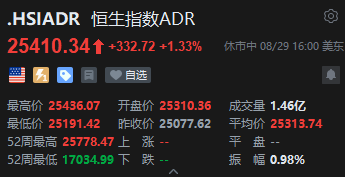
Market Overview - On Monday, US stock indices collectively declined while the Hang Seng Index ADR rose, closing at 25,410.34 points, an increase of 332.72 points or 1.33% compared to the Hong Kong closing [1]. ADR Performance - The Hang Seng Index ADR reached a high of 25,436.07 and opened at 25,310.36, with a trading volume of 146 million. The lowest point was 25,191.42, and the previous close was 25,077.62, with an average price of 25,313.74 [2]. Major Blue-Chip Stocks - HSBC Holdings closed at 100.534 HKD, up 0.53% from the Hong Kong close. Tencent Holdings closed at 604.965 HKD, down 0.01% from the Hong Kong close [3][4].






中报业绩表现强势,看好板块后续弹性空间
Changjiang Securities· 2025-09-01 14:42
Investment Rating - The report maintains a "Positive" investment rating for the investment banking and brokerage industry [7] Core Insights - The report highlights strong mid-year performance from 42 listed brokerages, with total revenue and net profit attributable to shareholders reaching CNY 251.89 billion and CNY 103.61 billion, respectively, reflecting year-on-year increases of 11.3% and 65.6% [2][4] - The insurance sector's mid-year disclosures confirm trends of deposit migration, increased equity allocation, and improved new policy costs, enhancing the certainty of long-term ROE improvement and potential valuation recovery [4] - Recommendations include focusing on high-performing stocks such as New China Life, China Life, Hong Kong Exchanges and Clearing, CITIC Securities, Eastmoney, Tonghuashun, and Jiufang Zhitu Holdings based on performance elasticity and valuation levels [4] Summary by Sections Industry Overview - The non-bank financial index decreased by 0.8% this week, underperforming the CSI 300 by 3.5%, ranking 23rd out of 31 sectors [5] - Year-to-date, the non-bank financial index has increased by 13.5%, with a relative underperformance of 0.8% against the CSI 300, ranking 19th out of 31 sectors [5] Market Performance - Market activity has shown signs of recovery, with average daily trading volume across both exchanges reaching CNY 298.31 billion, up 15.29% week-on-week [5][36] - The margin financing balance increased to CNY 2.24 trillion, reflecting a week-on-week rise of 4.52% [5][42] Brokerage Data Tracking - The report notes a recovery in trading activity, with the average daily trading volume exceeding the 2024 average, indicating a gradual improvement in brokerage business profitability [36] - The report emphasizes the importance of monitoring the stock and bond market fluctuations for brokerage self-operated income [40] Insurance Sector Insights - The insurance industry reported a cumulative premium income of CNY 420.85 billion in July 2025, marking a year-on-year increase of 6.75% [20][21] - The total assets of the insurance sector reached CNY 39.59 trillion, with a month-on-month increase of 0.95% [25][26] Investment Banking Activity - In July 2025, equity financing decreased significantly to CNY 53.38 billion, down 90.2% month-on-month, while bond financing totaled CNY 783 billion, down 11.3% [44] - The report anticipates an increase in stock underwriting scale due to the advancement of refinancing regulations [47] Asset Management and Derivatives - The report indicates a decline in new issuance of collective asset management products, with July 2025 issuance at 5.489 billion units, down 43.6% [49] - The futures market saw a significant increase in trading volume, with July 2025 transactions reaching CNY 62.23 trillion, up 34.02% [54]



港交所优化按金抵押品安排 非现金抵押品融通费用将降至0.25%
Zhi Tong Cai Jing· 2025-09-01 10:38
Group 1 - Hong Kong Stock Exchange (HKEX) announced optimization of collateral arrangements for its securities and derivatives clearing houses to enhance market efficiency and reduce costs for participants [1] - The interest calculation method for cash collateral will be adjusted to align with international market standards, calculated daily as the overnight reference rate minus a fee [1] - The financing cost for non-cash collateral will be reduced from 0.5% per annum to 0.25% [1] Group 2 - The new interest payment and fee policies will be uniformly adopted by the Central Clearing and Settlement System, Hong Kong Futures Clearing Company, and Hong Kong Options Clearing Company [1] - The fee for the period from October 2025 to December 2026 will be set at 0.8%, decreasing by 10 basis points annually until it reaches 0.5% by the end of 2028 [1] - HKEX aims to enhance the efficiency of collateral usage, facilitating market participants in executing various trading strategies and managing investment risks [2]
港交所(00388)优化按金抵押品安排 非现金抵押品融通费用将降至0.25%
智通财经网· 2025-09-01 10:37
Group 1 - Hong Kong Stock Exchange (HKEX) announced optimization of collateral arrangements for its securities and derivatives clearing houses to enhance market efficiency and reduce costs for participants [1] - The interest calculation method for cash collateral will be adjusted to align with international market standards, calculated daily as the overnight reference rate minus fees [1] - The financing cost for non-cash collateral will be reduced from 0.5% per annum to 0.25% [1] Group 2 - The new arrangements will be uniformly adopted by the Central Clearing and Settlement System, Hong Kong Futures Clearing Corporation, and Hong Kong Stock Options Clearing Limited, applicable to all accepted currencies [1] - The fee for the period from October 2025 to December 2026 will be set at 0.8%, decreasing by 10 basis points annually until it reaches 0.5% by the end of 2028 [1] - The new policies have been approved by the Hong Kong Securities and Futures Commission and will take effect on October 2, 2025 [1] Group 3 - HKEX's Chief Operating Officer emphasized the commitment to enhancing the vitality, resilience, and competitiveness of the Hong Kong market through these new arrangements [2] - The measures aim to improve the efficiency of collateral usage, facilitating participants in executing various trading strategies and managing investment risks [2] - Recent initiatives to increase position limits for stock options and index derivatives have significantly enhanced the capital efficiency of settled positions [2]
上半年港股新股集资额同比大涨8倍 助力港交所收入创历史新高超140亿港元
Mei Ri Jing Ji Xin Wen· 2025-09-01 10:04
Core Viewpoint - Hong Kong Stock Exchange (HKEX) reported record high revenue and profit for the first half of 2025, with a significant increase in various business segments, indicating strong market performance and growth potential [1][2] Financial Performance - HKEX's revenue and other income for the first half of 2025 reached HKD 14.076 billion, a 33% increase compared to the first half of 2024 [1] - Shareholder profit attributable to the company was HKD 8.519 billion, up 39% from the previous year [1] - The main business revenue increased by 34% year-on-year, driven by record trading volumes in the cash and stock options markets [1] Business Growth - New stock fundraising in the first half of 2025 grew over eight times compared to the same period in 2024 [2] - Trading and settlement fees increased by 33% due to a significant rise in trading volumes [2] - The average daily trading amount for the Shanghai-Hong Kong Stock Connect reached RMB 171.3 billion, a 32% increase year-on-year [2] Market Initiatives - HKEX plans to implement several measures to enhance market competitiveness, including shortening the settlement cycle for the cash market and expanding the paperless listing mechanism [1] - The company aims to optimize IPO pricing regulations and introduce a phased reduction in the minimum tick size for securities trading [1] Investor Engagement - The participation of mainland investors in offshore markets is increasing, with the average daily trading amount for the Hong Kong Stock Connect reaching HKD 111 billion, nearly three times that of the previous year [2] - Revenue from the Shanghai-Hong Kong Stock Connect rose to HKD 18.13 billion, a record high for the first half of the year [2] Stock Performance - As of the report date, HKEX's stock price was HKD 453.4, reflecting a year-to-date increase of over 56%, with a total market capitalization of HKD 574.6 billion [2]
港交所将优化旗下证券及衍生产品结算所的按金抵押品安排
Zheng Quan Shi Bao Wang· 2025-09-01 09:57
人民财讯9月1日电,香港交易所今天宣布,将优化旗下证券及衍生产品结算所的按金抵押品安排。有关 措施是香港交易所致力提升市场效率及降低市场参与者成本的工作之一。香港交易所将调整旗下结算所 向其参与者支付的现金抵押品利息的计算方法,并下调对非现金抵押品的融通费用。在新的安排下,现 金抵押品的利息支付及相关收费将根据国际市场标准按日计算,计算方式为隔夜参考利率减去手续费。 此计算方式将被香港中央结算有限公司(中央结算)、香港期货结算有限公司(期货结算)和香港联合交易 所期权结算所有限公司(期权结算)统一采用,且适用于所有获接纳为抵押品的货币种类。2025年10月至 2026年12月的手续费将设定为0.8%,其后每年下调10个基点,直至2028年底降至0.5%。非现金抵押品 的融通费用亦将由每年0.5%下调至0.25%。 ...