
SHOUGANG RES(00639)

Search documents
煤炭股逆势上涨 易大宗涨超2% 机构指“反内卷”重塑煤炭核心价值
Ge Long Hui· 2025-12-18 02:40
Group 1 - The coal sector in Hong Kong experienced a rally, with notable increases in stock prices for companies such as Yida Zong (up 2.20%), Yanzhou Coal (up 1.11%), and Mongolia Energy (up 1.28%) [1][2] - The National Development and Reform Commission, along with five other departments, released the "Key Areas for Clean and Efficient Utilization of Coal Benchmark Levels and Baseline Levels (2025 Edition)" [1] - According to Cinda Securities, the coal sector is characterized by "anti-involution" properties and has not fully reflected profit recovery expectations, indicating a strategic investment opportunity in high-quality coal companies [1] Group 2 - The coal sector is supported by high dividend safety margins and potential for price increases and valuation recovery, suggesting medium to long-term investment opportunities [1] - Open Source Securities believes that the "anti-involution" trend is reshaping the core value of coal, balancing both cyclical and dividend advantages [1]

港股异动丨煤炭股逆势上涨 易大宗涨超2% 机构指“反内卷”重塑煤炭核心价值
Ge Long Hui· 2025-12-18 02:08
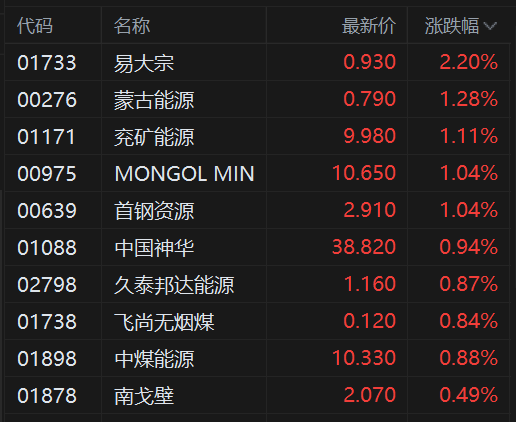
Group 1 - The coal sector in Hong Kong has experienced a rally, with companies like Yida Zong rising over 2%, and Yancoal Energy, Mongolian Energy, and Shougang Resources increasing by more than 1% [1] - The National Development and Reform Commission, along with five other departments, has released the "Key Benchmark Levels and Baseline Levels for Clean and Efficient Utilization of Coal (2025 Edition)" [1] - According to Cinda Securities, the coal sector has a "reverse involution" characteristic and is not fully reflecting profit recovery expectations, indicating a strategic investment opportunity in the medium to long term [1] Group 2 - The stock performance of various coal companies includes: Yida Zong at 0.930 with a 2.20% increase, Mongolian Energy at 0.790 with a 1.28% increase, and Yancoal Energy at 9.980 with a 1.11% increase [2] - Other notable performances include Shougang Resources at 2.910 with a 1.04% increase, China Shenhua at 38.820 with a 0.94% increase, and Zhongmei Energy at 10.330 with a 0.88% increase [2] - The overall market sentiment is supported by ample liquidity and an adjustment in risk premiums, which enhances the attractiveness of the coal sector [1]

钢铁2026年度策略:破内卷启新篇
Xinda Securities· 2025-12-12 03:25
Core Insights - The steel industry is experiencing a dual decline in supply and demand, with structural optimization and marginal profit improvement. Supply side: total contraction and structural differentiation, with capital expenditure continuing to show weak growth. The steel industry's capital expenditure has been slowing for four consecutive years, entering negative growth in 2025 due to multiple factors including "anti-involution" policies, a downturn in the real estate sector, and limited infrastructure support [2][10] - The domestic crude steel consumption has decreased significantly, with a 6.4% year-on-year decline in demand from January to October 2025, amounting to 710 million tons. The demand in traditional steel usage areas remains weak, particularly in real estate and infrastructure [2][32] - Exports have become a crucial support for the steel industry, with steel exports reaching 97.74 million tons from January to October 2025, a 6.4% increase year-on-year. The total annual export volume is expected to exceed 110 million tons, effectively offsetting the pressure from declining domestic demand [2][48] Group 1: Marginal Improvement in the Steel Industry - The average steel price has continued to decline, with the comprehensive price index for ordinary steel dropping to 3,447 yuan/ton as of November 24, 2025, down approximately 200 yuan from the year's peak [10][60] - The profit margin of the steel industry has shown significant improvement, with the gross profit margin reaching 6.4% in Q3 2025, marking a recovery from the low levels seen since 2022 [13][15] - The proportion of loss-making enterprises in the steel industry has slightly decreased but remains high at 37.18%, indicating ongoing challenges within the industry [17] Group 2: PPI Turnaround Expectations - The Producer Price Index (PPI) for the steel industry is expected to turn positive by Q2 2026, driven by improvements in supply structure and demand dynamics [53][60] - Historical data shows that the steel industry plays a significant role in PPI fluctuations, with past PPI turnarounds in 2016 and 2021 coinciding with significant steel industry performance [54][60] - The steel industry accounts for approximately 5.9% of the PPI, making its price movements critical for overall industrial price trends [53][54] Group 3: Investment Recommendations - The report suggests focusing on high-efficiency, low-emission regional leading enterprises such as Hualing Steel, Shougang, and Shandong Steel, as well as companies with strong growth potential like Baosteel and Nanjing Steel [4][60] - The steel sector is viewed as having strong "anti-involution" attributes and significant profit recovery potential, making it a strategic investment opportunity for the medium to long term [4][60] - The report emphasizes the importance of monitoring the performance of small and medium-sized steel companies, particularly those with strong earnings growth and valuation appeal [4][60]


广发证券:11月煤炭进口同比下滑12% 旺季需求仍有提升空间
Zhi Tong Cai Jing· 2025-12-11 05:57
Core Viewpoint - The coal market is expected to stabilize and recover in price due to seasonal demand increases and supply constraints as the year-end safety inspections become stricter [1][2]. Group 1: Market Overview - In October, electricity consumption exceeded expectations with a growth of 10.4%, while non-electric demand remained weak, leading to a 9.7% year-on-year decline in coal imports [1]. - Domestic coal prices saw fluctuations in November, with a rise followed by a decline, while long-term contract prices were adjusted upwards [1]. - International coal prices, particularly for Australian thermal and coking coal, continued to rise in November [2]. Group 2: Supply and Demand Dynamics - Domestic coal production decreased by 2.3% year-on-year in October, and coal imports fell by 12.0% in November [1]. - The global seaborne coal loading volume dropped by 3.6% year-on-year in the first ten months, but demand from emerging markets remained strong [1]. - Seasonal demand is expected to increase from December to January, supporting coal prices as supply remains relatively low due to stricter safety regulations [2]. Group 3: Key Companies - Companies with stable earnings and dividends include China Shenhua (601008.SH), Shaanxi Coal and Chemical Industry (601225.SH), and China Coal Energy (601898.SH) [3]. - Companies likely to benefit from improved demand expectations and supply reductions include Shanxi Coking Coal (000983.SZ) and Lu'an Environmental Energy (601699.SH) [3]. - Companies with notable long-term growth potential include Baofeng Energy (600989.SH) and China Qinfa (00866) [3].



首钢资源获股东蔡伟贤增持8万股 每股作价约2.90港元
Xin Lang Cai Jing· 2025-12-10 00:27
香港联交所最新资料显示,12月5日,股东蔡伟贤增持首钢资源(00639)8万股,每股作价2.895港元, 总金额为23.16万港元。增持后最新持股数目约为80.74万股,最新持股比例为0.02%。 责任编辑:卢昱君 香港联交所最新资料显示,12月5日,股东蔡伟贤增持首钢资源(00639)8万股,每股作价2.895港元, 总金额为23.16万港元。增持后最新持股数目约为80.74万股,最新持股比例为0.02%。 责任编辑:卢昱君 热点栏目 自选股 数据中心 行情中心 资金流向 模拟交易 客户端 热点栏目 自选股 数据中心 行情中心 资金流向 模拟交易 客户端 ...
港股异动丨煤炭股走低 兖煤澳大利亚跌近4% 煤价延续弱势
Ge Long Hui A P P· 2025-12-08 02:12
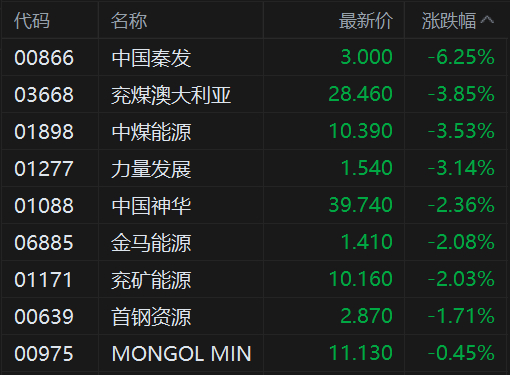
Group 1 - The coal stocks in Hong Kong are experiencing a decline, with notable drops in companies such as Qinfa down over 6%, Yancoal Australia down nearly 4%, and China Coal Energy down 3.5% [1] - The price of thermal coal has decreased, with the Qinhuangdao port price for Q5500 thermal coal at 791 RMB per ton as of December 6, reflecting a week-on-week drop of 27 RMB per ton [1] - According to a report from Cinda Securities, weak coal demand is expected to continue, and supply constraints are unlikely to provide significant support. The current phase is seen as the early stage of a new upward cycle for the coal economy, suggesting that it may be a good time to accumulate coal sector stocks [1] Group 2 - The daily coal consumption at power plants remains below expectations due to higher-than-normal temperatures across the country, putting pressure on port and production prices [1] - The forecast for the next 1-2 weeks indicates that temperatures will continue to be higher than usual, limiting demand release and suggesting that coal prices are likely to continue their weak adjustment trend [1]
首钢资源(00639) - 截至2025年11月30日股份发行人的证券变动月报表
2025-12-01 10:04
股份發行人及根據《上市規則》第十九B章上市的香港預託證券發行人的證券變動月報表 截至月份: 2025年11月30日 狀態: 新提交 致:香港交易及結算所有限公司 公司名稱: 首鋼福山資源集團有限公司 呈交日期: 2025年12月1日 I. 法定/註冊股本變動 不適用 FF301 第 1 頁 共 10 頁 v 1.1.1 FF301 II. 已發行股份及/或庫存股份變動 | 1. 股份分類 | 普通股 | 股份類別 | 不適用 | | 於香港聯交所上市 (註1) | 是 | | | --- | --- | --- | --- | --- | --- | --- | --- | | 證券代號 (如上市) | 00639 | 說明 | | | | | | | | | 已發行股份(不包括庫存股份)數目 | | 庫存股份數目 | | 已發行股份總數 | | | 上月底結存 | | | 5,091,065,770 | | 0 | | 5,091,065,770 | | 增加 / 減少 (-) | | | 0 | | | | | | 本月底結存 | | | 5,091,065,770 | | 0 | | 5,091,065 ...
智通港股沽空统计|11月27日
智通财经网· 2025-11-27 00:25
Short Selling Ratios - Geely Automobile-R (80175), Kuaishou-WR (81024), and JD Health-R (86618) have the highest short selling ratios at 100.00% each [1][2] - China Ping An-R (82318) has a short selling ratio of 89.61%, while SenseTime-WR (80020) and China Resources Beer-R (80291) follow with 89.27% and 75.13% respectively [2] Short Selling Amounts - Alibaba-SW (09988) leads in short selling amount with 3.768 billion, followed by Meituan-W (03690) at 2.272 billion and Xiaomi Group-W (01810) at 1.584 billion [3] - Tencent Holdings (00700) and AIA Group (01299) also feature in the top five with short selling amounts of 1.242 billion and 0.582 billion respectively [3] Short Selling Deviation Values - China Ping An-R (82318) has the highest deviation value at 64.42%, indicating significant divergence from its historical short selling average [4] - Geely Automobile-R (80175) and Kuaishou-WR (81024) follow with deviation values of 56.33% and 40.21% respectively [4] - Baidu Group-SWR (89888) also shows a notable deviation value of 36.29% [4]




智通港股沽空统计|11月26日
智通财经网· 2025-11-26 00:26
Summary of Key Points Core Viewpoint - The report highlights the top short-selling stocks in the market, indicating significant investor sentiment and potential market movements based on short-selling ratios and amounts. Group 1: Top Short-Selling Ratios - Great Wall Motor-R (82333) has the highest short-selling ratio at 100.00% [1] - JD Group-SWR (89618) follows with a short-selling ratio of 94.41% [1] - Bank of China Hong Kong-R (82388) ranks third with a short-selling ratio of 93.33% [1] Group 2: Top Short-Selling Amounts - Alibaba-SW (09988) leads in short-selling amount with 4.633 billion [2] - Xiaomi Group-W (01810) has a short-selling amount of 1.448 billion [2] - Tencent Holdings (00700) follows with a short-selling amount of 1.011 billion [2] Group 3: Top Short-Selling Deviation Values - Bank of China Hong Kong-R (82388) has the highest deviation value at 56.68% [1] - China Ping An-R (82318) comes next with a deviation value of 51.38% [1] - China National Offshore Oil Corporation-R (80883) has a deviation value of 48.09% [1]



智通港股沽空统计|11月25日
智通财经网· 2025-11-25 00:26
Core Insights - The article highlights the top short-selling stocks in the market, indicating significant investor skepticism towards these companies [1][2]. Short-Selling Ratios - Lenovo Group-R (80992) has the highest short-selling ratio at 87.71%, followed by Ping An Insurance-R (82318) at 69.65% and Shougang Resources (00639) at 62.81% [1][2]. - The short-selling amounts for Alibaba-SW (09988), Tencent Holdings (00700), and Xiaomi Group-W (01810) are the highest, amounting to 5.06 billion, 1.62 billion, and 1.17 billion respectively [1][2]. Deviation Values - Shougang Resources (00639) leads in deviation value at 48.27%, followed closely by Ping An Insurance-R (82318) at 46.76% and FIH Mobile Limited (02038) at 46.20% [1][2]. - The deviation value indicates the difference between the current short-selling ratio and the average short-selling ratio over the past 30 days, suggesting heightened market volatility for these stocks [3].
