CHINA TELECOM(00728)

Search documents
8月1日汇添富沪深300安中指数A净值下跌0.78%,今年来累计上涨3.61%
Sou Hu Cai Jing· 2025-08-01 12:36
Group 1 - The core point of the article highlights the performance and holdings of the Huatai-PineBridge CSI 300 Anzhong Index A fund, which has a recent net value of 1.9429 yuan and a decline of 0.78% [1] - The fund's one-month return is 4.19%, ranking 724 out of 1620 in its category, while the three-month return is 8.95%, ranking 883 out of 1541 [1] - Year-to-date, the fund has achieved a return of 3.61%, with a ranking of 1108 out of 1423 in its category [1] Group 2 - The top ten stock holdings of the fund account for a total of 22.91%, with significant positions in companies such as China Shenhua (3.43%), China Yangtze Power (3.09%), and Kweichow Moutai (2.90%) [1] - As of June 30, 2025, the fund has a total size of 1.375 billion yuan, and the fund manager is Wu Zhenxiang [1] Group 3 - Wu Zhenxiang has a strong academic background with a PhD in management from the University of Science and Technology of China and a postdoctoral degree in applied mathematics from the Chinese Academy of Sciences [2] - He has extensive experience in fund management, having held various positions at Huatai-PineBridge since March 2008, including senior manager and quantitative investment analyst [2]




中国电信企业战略向\"云改数转智惠\"升级
Zhong Guo Chan Ye Jing Ji Xin Xi Wang· 2025-08-01 12:28
Core Viewpoint - The 2025 World Artificial Intelligence Conference emphasizes the integration of artificial intelligence into various industries, with China Telecom leading the charge in transforming its strategy to embrace AI for economic growth [1][2]. Group 1: Company Strategy - China Telecom is shifting its strategy from "cloud transformation to data transformation" to "cloud transformation to intelligent benefits" [1]. - The company aims to enhance its AI service capabilities and strengthen security measures while promoting open collaboration [1]. - A comprehensive intelligent cloud service system will be developed, integrating computing power, platforms, data, models, and applications to support digital transformation across industries [1]. Group 2: AI Development in Shanghai - Shanghai is positioned as an international technology innovation center, and China Telecom is increasing its AI investments in the city [2]. - The company plans to accelerate the construction of "Smart Cloud Shanghai," transitioning from "cloud for the city" to "intelligent benefits for the city" [2]. - China Telecom will collaborate with local universities and research institutions to tackle cutting-edge AI challenges and support the establishment of an AI hub in Shanghai [2].
中证港股通TMT主题指数报4601.65点,前十大权重包含小米集团-W等
Jin Rong Jie· 2025-08-01 12:24
Core Viewpoint - The China Securities TMT Index has shown significant growth, with a year-to-date increase of 35.09%, reflecting strong performance in the TMT sector [1]. Group 1: Index Performance - The China Securities TMT Index has increased by 5.12% over the past month and 15.24% over the last three months [1]. - The index was established on November 14, 2014, with a base point of 3000.0 [1]. Group 2: Index Composition - The index comprises 50 listed companies in the TMT sector from the Hong Kong Stock Connect, with Tencent Holdings, Xiaomi Group-W, and China Mobile being the top three holdings [1]. - The top ten weightings in the index are as follows: Tencent Holdings (14.42%), Xiaomi Group-W (13.77%), China Mobile (13.69%), SMIC (8.44%), Kuaishou-W (7.88%), CK Hutchison (4.76%), Lenovo Group (3.01%), China Telecom (2.99%), Kingdee International (2.24%), and China Unicom (2.07%) [1]. Group 3: Market and Sector Breakdown - The index is exclusively composed of stocks listed on the Hong Kong Stock Exchange, with a 100% allocation [2]. - In terms of industry distribution, communication services account for 55.81% and information technology for 44.19% of the index [3]. Group 4: Index Adjustment Mechanism - The index samples are adjusted biannually, with changes implemented on the next trading day following the second Friday of June and December [3]. - Special adjustments may occur under certain circumstances, such as delisting or significant corporate actions [3].




33家获评A级 2025年央企采购与供应链管理对标评估结果出炉


Xin Lang Cai Jing· 2025-08-01 11:58
Core Viewpoint - The State-owned Assets Supervision and Administration Commission (SASAC) has completed the benchmarking assessment for procurement and supply chain management of central enterprises for 2025, identifying 33 A-level enterprises, including major companies in the energy and telecommunications sectors [1] Group 1 - The assessment was organized by SASAC to evaluate the procurement and supply chain management practices of central enterprises [1] - A total of 33 enterprises were classified as A-level, indicating high performance in procurement and supply chain management [1] - Notable A-level enterprises include State Grid, China Southern Power Grid, China Mobile, Sinopec, China Unicom, China Telecom, China Huaneng, CRRC, China National Petroleum Corporation, and State Energy Group [1]
中国电信(601728):企业战略全面升级,开放姿态推动产业合作
Great Wall Securities· 2025-08-01 10:34
Investment Rating - The report maintains a "Buy" rating for China Telecom, expecting the stock price to outperform the industry index by more than 15% in the next six months [5][18]. Core Viewpoints - China Telecom is upgrading its corporate strategy to embrace artificial intelligence (AI) and enhance its cloud services, transitioning from "cloud transformation" to "intelligent cloud transformation" [2][3]. - The company is leveraging its cloud-network integration to offer comprehensive computing and networking services, aiming to reduce costs and improve efficiency [2]. - China Telecom has established the "AI Investment Alliance" to support foundational technology research and industry application projects, indicating a commitment to innovation and collaboration [3]. Financial Summary - **Revenue Forecast**: Expected revenues for 2025, 2026, and 2027 are projected at 545.0 billion, 570.7 billion, and 598.0 billion yuan respectively, with growth rates of 4.1%, 4.7%, and 4.8% [3]. - **Net Profit Forecast**: The net profit attributable to the parent company is forecasted to be 35.1 billion, 36.9 billion, and 38.7 billion yuan for 2025, 2026, and 2027 respectively, with year-on-year growth rates of 6.5%, 5.1%, and 4.9% [3]. - **Earnings Per Share (EPS)**: EPS is projected to increase from 0.38 yuan in 2025 to 0.42 yuan in 2027 [3]. - **Valuation Ratios**: The price-to-earnings (P/E) ratio is expected to decrease from 19.0 in 2025 to 17.2 in 2027, while the price-to-book (P/B) ratio is projected to decline from 1.4 to 1.3 over the same period [3].
中国三大基础电信企业规范外呼营销号码
Zhong Guo Xin Wen Wang· 2025-08-01 09:12
Core Viewpoint - The three major telecommunications companies in China have collectively announced standardized telephone marketing measures to address consumer complaints regarding false advertising and inducement in communication service marketing [1] Group 1: Standardized Marketing Measures - The official outbound marketing numbers for the three telecommunications companies are: China Telecom 10001, China Mobile 10085, and China Unicom 10016 [1] - Consumers receiving calls from numbers other than the official ones should be cautious, as these may not be legitimate channels [1] - If a user explicitly refuses marketing calls, the companies are required to cease further calls to that user [1] Group 2: Transparency and Accuracy in Marketing - Telephone marketing must provide comprehensive and accurate information about the marketing content, avoiding false advertising and inducement [1] - Key information such as pricing standards, applicable scenarios, validity periods, and restrictive conditions must not be concealed [1] - All pricing plans promoted to users must be publicly available on the companies' online service platforms and official apps [1] Group 3: Industry Reform Initiatives - In late July, telecommunications operators announced a series of reform measures as part of a campaign to improve industry practices, aligning with the Ministry of Industry and Information Technology's 2025 work deployment [1] - The core focus of these reforms is on "streamlining packages and transparent consumption" [1]

从WAIC2025看行业发展趋势:运营商“AI+”规模化落地,推动行业范式跃迁
Bank of China Securities· 2025-08-01 09:04
Investment Rating - The industry investment rating is "Outperform the Market," indicating that the industry index is expected to perform better than the benchmark index over the next 6-12 months [11]. Core Insights - The report highlights that the three major telecom operators in China—China Mobile, China Telecom, and China Unicom—are transitioning from traditional communication providers to "AI infrastructure providers, industry enablers, and security guardians," significantly contributing to the digital transformation of the economy and society [1][3]. - The integration of AI into various sectors is seen as a key driver of the new technological revolution and industrial transformation, with telecom operators playing a crucial role in this evolution [1]. Summary by Sections Investment Recommendations - The report suggests that telecom operators will significantly benefit from the performance growth and value reassessment brought by intelligent computing services under the AI wave. It recommends focusing on the three major operators: China Mobile, China Telecom, and China Unicom, as well as their partnerships with computing service providers such as Runze Technology, Pingzhi Information, Zhongbei Communication, ZTE, Fenghuo Communication, and Unisplendour [3]. Industry Developments - The report emphasizes the practical AI capabilities demonstrated by the telecom operators at WAIC 2025, showcasing their role as a "digital infrastructure national team" and their technological leadership in building a smart service ecosystem that covers both industry and people's livelihoods [3]. - The collaboration between computing power and network innovation is highlighted as a core logic for the operators' computing infrastructure, leading to significant breakthroughs in computing resource utilization and efficiency [3]. Infrastructure Investment - In 2025, the three major operators are expected to increase their investments in computing infrastructure, with China Mobile planning to invest 37.3 billion RMB in this area. Both China Telecom and China Unicom are projected to see over 20% year-on-year growth in their computing investments [3]. - The report notes that the domestic server procurement by China Unicom has exceeded 90% for domestic servers, while China Mobile has the largest single liquid-cooled intelligent computing center among global operators, with over 85% of its computing power being domestically sourced [3].
中国电信(601728) - 中国电信股份有限公司H股公告-股份发行人的证券变动月报表
2025-08-01 08:45
股份發行人及根據《上市規則》第十九B章上市的香港預託證券發行人的證券變動月報表 | 1. 股份分類 | 普通股 | 股份類別 | H | | 於香港聯交所上市 (註1) | | 是 | | | --- | --- | --- | --- | --- | --- | --- | --- | --- | | 證券代號 (如上市) | 00728 | 說明 | H股 | | | | | | | | | 法定/註冊股份數目 | | | 面值 | | 法定/註冊股本 | | | 上月底結存 | | | 13,877,410,000 | RMB | | 1 RMB | | 13,877,410,000 | | 增加 / 減少 (-) | | | 0 | | | RMB | | 0 | | 本月底結存 | | | 13,877,410,000 | RMB | | 1 RMB | | 13,877,410,000 | | 2. 股份分類 | 普通股 | 股份類別 | A | | 於香港聯交所上市 (註1) | | 否 | | | --- | --- | --- | --- | --- | --- | --- | --- | ...
电信移动联通规范电话营销
Bei Jing Wan Bao· 2025-08-01 07:41
#电信移动联通统一外呼号#【#电信移动联通规范电话营销#】不少消费者都接到过各种营销电话,有的 营销电话还是用普通电话号码打过来的,让人防不胜防。为落实"信息通信暖心服务实事",解决用户反 映突出的通信业务电话营销虚假宣传、诱导消费等问题,三家基础电信企业今天集体发布规范电话营销 举措,统一外呼营销号码。三家基础电信企业唯一官方外呼营销号码分别是:中国电信10001、中国移 动10085、中国联通10016。如果接到其他号码要你办卡办套餐,可以肯定不是正规渠道。(央视新闻 北京日报) 转自:京报网_北京日报官方网站 ...
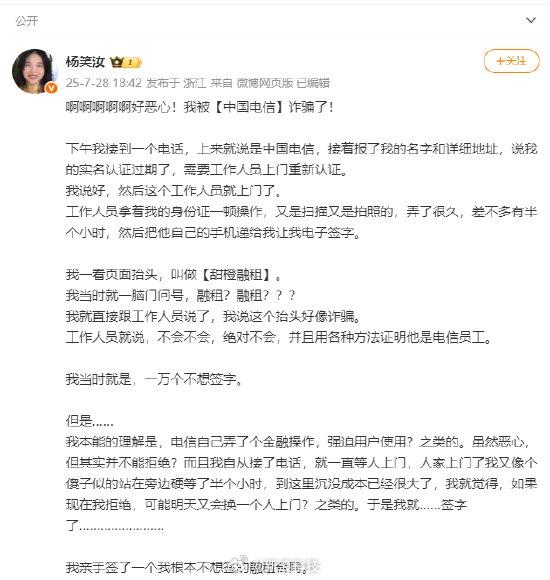
中国电信被指以实名认证为名诱导用户签贷款合同
Xin Lang Ke Ji· 2025-08-01 06:58
【#多网友爆料被中国电信骗签贷款##客服回应中国电信被指骗签贷款#】近日,有微博网友@杨笑汝 爆料称被中国电信"诈骗",网友称接到自称"中国电信"的电话,并报了其名字和详细地址,称其实名认 证过期了,需要工作人员上门重新认证。工作人员上门操作之后,让网友签署抬头为"甜橙融租"的合 同。 杨笑汝表示,签字后查询"甜橙融租"实为中国电信旗下金融产品。原本正常的每月话费缴纳,竟被转换 为用户向"甜橙"贷款支付三年月租费的总额,再分期偿还给"甜橙"的模式。该博主强烈质疑,运营商 以"实名认证"为幌子,诱导用户在不知情下签署金融贷款合同。 公开信息显示,甜橙融租是翼支付旗下全资子公司,设立于2019年。经营范围包含融资租赁、与租赁业 务相关的租赁财产购买、租赁财产残值处理及维修、租赁交易咨询和担保、向第三方机构转让应收账 款、接受租赁保证金等业务。 无独有偶,5D调查在社交平台发现,以中国电信"甜橙套餐"为关键词搜索,多名网友都分享过与@杨 笑汝 相似的经历。 有小红书网友表示,被电信工作人员上门诈骗还办了橙分期贷款。 其表示,是电信199元千兆流量宽带套餐的九年老用户,被电信工作人员以提升网速为由上门又以回馈 老用户 ...