CNOOC(00883)

Search documents
首次突破千万吨油当量
Si Chuan Ri Bao· 2025-12-30 22:05
新华社发(中国海油供图) 中国海油12月30日宣布,环海南岛海上气田群2025年累计生产油气当量突破1000万吨,创历史新 高,较"十三五"末实现产量翻番。 图为"深海一号"二期深水气井放喷测试瞬间(资料照片)。 ...


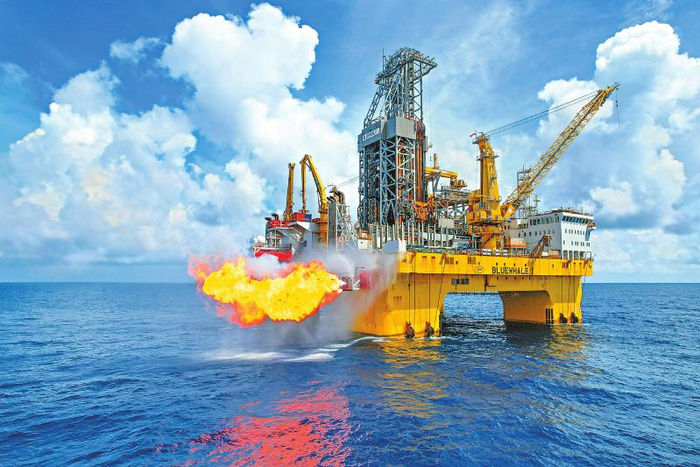
图为“深海一号”二期深水气井放喷测试瞬间(资料照片)。中国海油12月30日宣布,环海南岛海上气田群2025年累计生产油气当量突破1000万吨,创历史新高,较“十三五”末实现产量翻番。
Zhong Guo Zheng Quan Bao· 2025-12-30 21:11
图为"深海一号"二期深水气井放喷测试瞬间(资料照片)。中国海油12月30日宣布,环海南岛海上气田 群2025年累计生产油气当量突破1000万吨,创历史新高,较"十三五"末实现产量翻番。新华社发(中国 海油供图) ...
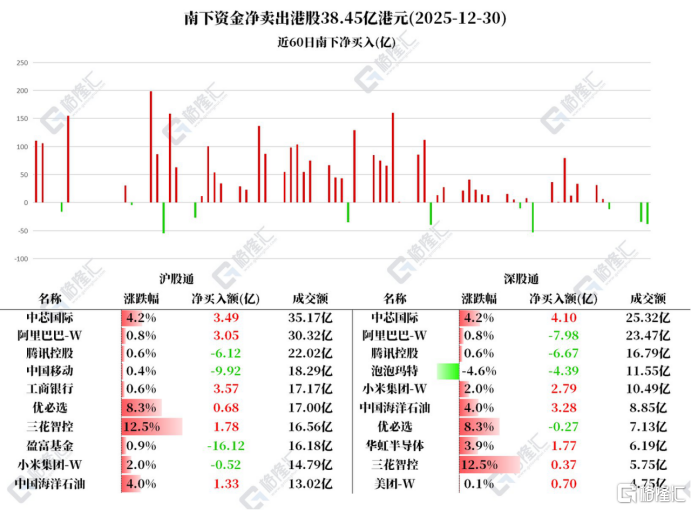
12月30日南向资金净卖出38.45亿港元





Zheng Quan Shi Bao Wang· 2025-12-30 14:51
Market Overview - On December 30, the Hang Seng Index rose by 0.86%, closing at 25,854.60 points, while southbound funds through the Stock Connect recorded a net sell of HKD 3.845 billion [1][3] - The total trading volume for the Stock Connect on the same day was HKD 92.3 billion, with a net sell of HKD 3.845 billion [1][3] Trading Activity - In the Shanghai Stock Connect, the trading volume was HKD 59.138 billion with a net sell of HKD 1.327 billion, while in the Shenzhen Stock Connect, the trading volume was HKD 33.161 billion with a net sell of HKD 2.518 billion [1][3] Active Stocks - The most actively traded stock in the Shanghai Stock Connect was SMIC, with a trading volume of HKD 35.17 billion, followed by Alibaba-W and Tencent Holdings with trading volumes of HKD 30.32 billion and HKD 22.02 billion, respectively [1][2] - In terms of net buying, Industrial and Commercial Bank of China had the highest net buy amount of HKD 357 million, with its stock price increasing by 0.64% [1][2] - The stock with the highest net sell was the Tracker Fund of Hong Kong, with a net sell of HKD 1.612 billion, while its stock price rose by 0.93% [1][2] Shenzhen Stock Connect Highlights - In the Shenzhen Stock Connect, SMIC led with a trading volume of HKD 25.32 billion, followed by Alibaba-W and Tencent Holdings with HKD 23.47 billion and HKD 16.79 billion, respectively [2] - The highest net buy was also for SMIC, with a net buy of HKD 410 million, and its stock price increased by 4.24% [2] - Alibaba-W recorded the highest net sell in this segment, amounting to HKD 798 million, while its stock price rose by 0.84% [2]
南向资金今日净卖出38.45亿港元 盈富基金净卖出16.12亿港元
Zheng Quan Shi Bao Wang· 2025-12-30 14:51
Group 1 - The Hang Seng Index rose by 0.86% on December 30, with a total turnover of southbound funds amounting to HKD 923.00 billion, including buy transactions of HKD 442.28 billion and sell transactions of HKD 480.72 billion, resulting in a net sell of HKD 38.45 billion [1] - The southbound trading through Stock Connect (Shenzhen) had a total turnover of HKD 331.61 billion, with buy transactions of HKD 153.22 billion and sell transactions of HKD 178.40 billion, leading to a net sell of HKD 25.18 billion [1] - The southbound trading through Stock Connect (Shanghai) recorded a total turnover of HKD 591.38 billion, with buy transactions of HKD 289.06 billion and sell transactions of HKD 302.33 billion, resulting in a net sell of HKD 13.27 billion [1] Group 2 - Among the actively traded stocks, SMIC had the highest turnover with a total of HKD 60.49 billion and a net buy of HKD 7.59 billion, closing with a price increase of 4.24% [1][2] - CNOOC had a total turnover of HKD 21.87 billion with a net buy of HKD 4.61 billion, while ICBC recorded a net buy of HKD 3.57 billion [2] - Tencent Holdings had a total turnover of HKD 38.81 billion with a net sell of HKD 12.79 billion, and Alibaba-W had a turnover of HKD 53.79 billion with a net sell of HKD 4.93 billion [2] Group 3 - The stock with the longest consecutive net buy from southbound funds was Huahong Semiconductor, with a total net buy of HKD 5.45 billion over three days [2] - The stocks with the highest consecutive net sell included China Mobile, Tencent Holdings, and Alibaba-W, with total net sells of HKD 96.46 billion, HKD 32.97 billion, and HKD 18.05 billion respectively [2]
南海东部油田年油气产量连续四年稳超2000万吨
Zhong Guo Xin Wen Wang· 2025-12-30 11:49
Core Insights - The Nanhai Eastern Oilfield has maintained an annual oil and gas production exceeding 20 million tons for four consecutive years, contributing over 100 million tons during the 14th Five-Year Plan period [1][2] Group 1: Production Achievements - The oilfield's production surpassed 20 million tons of oil equivalent in 2025, marking a significant milestone since it first achieved this level in 2022 [1] - The oilfield has transitioned from an initial production of several hundred thousand tons to a stable output of over 20 million tons, significantly altering the energy landscape in southern China [1] Group 2: Operational Strategies - In 2025, the oilfield overcame challenges such as ten typhoons, optimizing operational efforts and maximizing production during peak periods [1] - The oilfield implemented a "few wells, high efficiency" exploration strategy, drilling nearly 50 wells and adding over 100 million tons of proven reserves [2] Group 3: Technological Innovations - The oilfield achieved breakthroughs in deep-water exploration and water control, with innovative theories leading to significant discoveries in deep-water oil and gas [2] - The first offshore CCUS project in China was successfully implemented, enhancing the recovery rate at the Liuhua 11-1 oilfield [2] Group 4: Economic Contributions - The oilfield is a key economic driver, ranking among the top three in industrial added value in Shenzhen during the 14th Five-Year Plan, and is projected to be the leading industrial enterprise in Nanshan District in 2024 [2] - The natural gas produced is processed and distributed to cover a large part of the Guangdong-Hong Kong-Macao Greater Bay Area, supplying nearly 5.8 billion cubic meters of clean natural gas annually [2]
中国海油又多一个千万吨级油气阵地!
Xin Lang Cai Jing· 2025-12-30 11:24
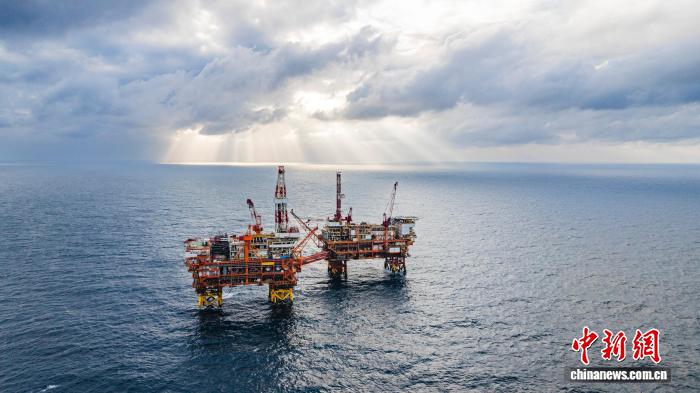
Core Viewpoint - China National Offshore Oil Corporation (CNOOC) announced that its Hainan offshore gas field group will exceed a cumulative production of 10 million tons of oil and gas equivalent by 2025, marking a historical high and doubling production compared to the end of the 13th Five-Year Plan, which is significant for national energy security and supporting the high-quality construction goals of Hainan Free Trade Port [1][3]. Group 1 - The history of exploring and utilizing marine oil and gas resources in Hainan dates back to the 1950s and 1960s, with early efforts including the construction of simple platforms for offshore drilling, paving a new path for China's energy and chemical industry [3]. - Since the 14th Five-Year Plan, CNOOC has focused on increasing domestic oil and gas reserves and production through a "seven-year action plan," analyzing resource conditions in three major oil and gas structures in Hainan and enhancing exploration and development efforts [3][5]. - CNOOC has established the largest offshore natural gas production cluster in China, consisting of 19 offshore platforms, three land terminals, and several underwater production facilities in various Hainan sea areas [3]. Group 2 - The company aims to maintain high and stable production in existing gas fields while ensuring the orderly development of new projects to enhance overall production capacity [5]. - CNOOC's production management team has implemented various lean management measures, including deepening the potential of existing gas fields and ensuring the smooth production of key projects like "Deep Sea No. 1" [5]. - The company has set a production target of 10 million tons for early 2025, coordinating optimal resources and mobilizing over 10,000 industry workers in Hainan to ensure high operational efficiency of oil and gas wells and offshore platforms [5][6]. Group 3 - To achieve significant production increases, CNOOC has established a marine natural gas supply and sales network that covers the South China coastal region, utilizing a 24-hour scheduling mechanism and big data analysis for supply-demand management [6]. - CNOOC has built a complete industrial chain in Hainan, encompassing upstream exploration and development, downstream chemical power generation, and oil service engineering, while also establishing research facilities to foster a modern marine energy industry system [6]. - The company plans to leverage the advantages of the Hainan marine oil and gas industry cluster to create a new pattern of resource development and utilization, aiming to become the largest offshore clean energy supply base in China [6].
资金动向 | 北水抛售港股超38亿港元,连续11日卖出中国移动
Ge Long Hui A P P· 2025-12-30 11:23
Group 1 - Southbound funds recorded a net sell of HKD 3.845 billion in Hong Kong stocks on December 30, marking the third consecutive day of net selling [1] - Notable net purchases included SMIC at HKD 759 million, CNOOC at HKD 460 million, and ICBC at HKD 356 million, while significant net sells included the Tracker Fund at HKD 1.612 billion and Tencent at HKD 1.279 billion [1] - Cumulative net selling by southbound funds over 11 days for China Mobile reached HKD 9.646 billion, while Tencent and Alibaba saw net sells of HKD 3.297 billion and HKD 1.804 billion respectively [5] Group 2 - SMIC announced plans to acquire 49% equity in a subsidiary from five shareholders for a total price of HKD 40.6 billion, which will result in SMIC owning 100% of the subsidiary [4] - CNOOC's stock price volatility has been influenced by geopolitical events, particularly the escalation of the Russia-Ukraine conflict, which has raised concerns over oil supply disruptions [4] - UBTECH Robotics announced the acquisition of 43% of Shenzhen-listed Fenglong Co. through a combination of agreement transfer and tender offer, with a total consideration of HKD 1.665 billion [4]


港股收盘 | 恒指收涨0.86% 百度集团-SW涨近9%领跑蓝筹 机器人概念午后拉升
Zhi Tong Cai Jing· 2025-12-30 10:15
Market Overview - The Hong Kong stock market indices collectively rose, with the Hang Seng Index increasing by 0.86% to close at 25,854.6 points and a total trading volume of HKD 199.69 billion [1] - The Hang Seng Tech Index rose by 1.74%, while the Hang Seng China Enterprises Index increased by 1.12% [1] - Everbright Securities noted that the overall profitability of Hong Kong stocks is relatively strong, with sectors like internet, new consumption, and innovative pharmaceuticals being relatively scarce [1] Blue-Chip Stocks Performance - Baidu Group-SW (09888) led blue-chip stocks, rising by 8.9% to HKD 129.7, contributing 20.99 points to the Hang Seng Index [2] - Other notable blue-chip performances included SMIC (00981) up 4.24% and CNOOC (00883) up 3.97% [2] Sector Highlights Technology Sector - Major tech stocks saw gains, with Baidu rising nearly 9%, Alibaba up 0.84%, and Tencent up 0.59% [3] - The robotics sector surged, with companies like Sihai Zhikong (002050) increasing over 12% amid expectations of Tesla's Optimus project [3][4] Semiconductor Sector - Semiconductor stocks performed well, with InnoSilicon (02577) rising by 15.35% and SMIC (00981) up 4.24% [4] - Nvidia's announcement of partnerships for an 800V direct current architecture marks a significant advancement in AI data centers [4] Oil Sector - Oil stocks generally rose, with CNOOC (00883) increasing by 3.97% and PetroChina (00857) up 2.42% due to rising oil prices amid geopolitical tensions [6] - Everbright Securities anticipates that the "three oil giants" will maintain high capital expenditures and continue to expand in the natural gas market [6] Non-Ferrous Metals Sector - Non-ferrous metal stocks rebounded, with China Aluminum (02600) up 5.27% and Zijin Mining (02899) up 3.63% [6][7] Notable Stock Movements - The Hong Kong Stock Exchange saw significant movements with stocks like InnoSilicon (03696) rising by 24.66% and Wuyi Vision (06651) up 29.9% following their IPOs [8] - Meta's acquisition of an AI startup boosted AI-related stocks, with MaiFushi (02556) rising by 11.07% [9] Company Announcements - SMIC announced plans to acquire a 49% stake in SMIC North for approximately RMB 40.6 billion, focusing on 12-inch integrated circuit wafer foundry services [5] - Ganfeng Lithium (01772) faced pressure after being implicated in insider trading allegations, although the company stated that its operations remain normal [11]


北水动向|北水成交净卖出38.45亿 芯片及机器人概念获加仓 盈富基金(02800)遭内资抛售
智通财经网· 2025-12-30 09:58
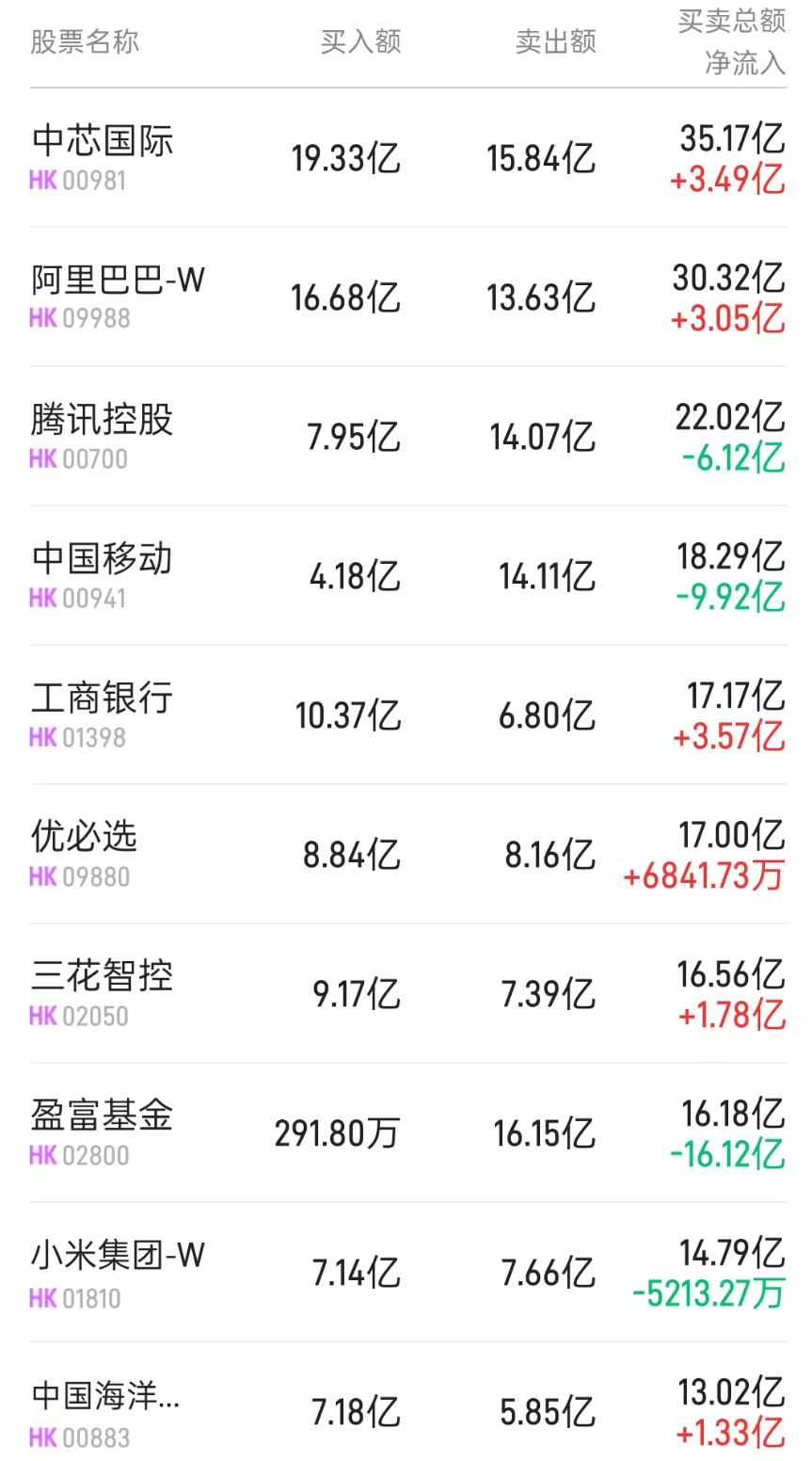
Core Viewpoint - The Hong Kong stock market experienced significant net selling from northbound capital, totaling HKD 38.45 billion, with notable net selling in major stocks like Tencent and China Mobile, while stocks like SMIC and CNOOC saw net buying [1][5]. Group 1: Northbound Capital Flow - Northbound capital had a net selling of HKD 38.45 billion on December 30, with HKD 13.27 billion from the Shanghai Stock Connect and HKD 25.18 billion from the Shenzhen Stock Connect [1]. - The stocks with the highest net buying included SMIC (00981), CNOOC (00883), and ICBC (01398) [1]. - The stocks with the highest net selling included the Tracker Fund of Hong Kong (02800), Tencent (00700), and China Mobile (00941) [1]. Group 2: Individual Stock Performance - SMIC saw a net inflow of HKD 3.49 billion, with a total transaction volume of HKD 35.17 billion [2]. - CNOOC received a net buying of HKD 4.6 billion, with analysts noting a potential stabilization in oil prices due to seasonal demand and OPEC+ production adjustments [5]. - ICBC had a net inflow of HKD 3.56 billion, supported by expectations of stable credit growth in 2026 [5]. Group 3: Sector Trends - The semiconductor sector is gaining attention, with SMIC and Hua Hong Semiconductor receiving significant net buying, driven by positive market sentiment and government support [4]. - The robotics sector is also attracting investment, with stocks like Sihai Intelligent Control and UBTECH Robotics seeing net inflows, amid expectations of upcoming projects in North America [5]. - The technology sector showed mixed results, with Meituan (03690) experiencing net buying, while Alibaba (09988) and Tencent faced substantial net selling [6]. Group 4: Market Sentiment - The market sentiment remains cautious, with analysts suggesting that while there may be short-term opportunities, the overall environment is still under pressure, particularly for the Hong Kong market [7]. - The Tracker Fund of Hong Kong faced significant net selling, indicating a potential lack of confidence in the broader market [7].
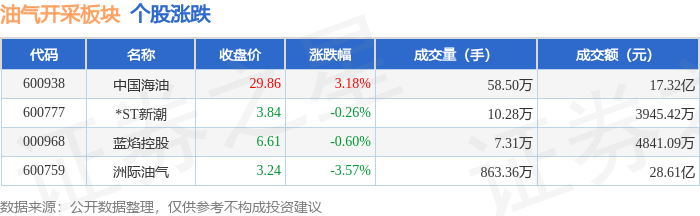
油气开采板块12月30日涨1.64%,中国海油领涨,主力资金净流入1.47亿元
Zheng Xing Xing Ye Ri Bao· 2025-12-30 09:08
Group 1 - The oil and gas extraction sector increased by 1.64% compared to the previous trading day, with China National Offshore Oil Corporation (CNOOC) leading the gains [1] - The Shanghai Composite Index closed at 3965.12, showing no change, while the Shenzhen Component Index closed at 13604.07, up by 0.49% [1] - Major stocks in the oil and gas extraction sector showed varied performance, with the highest gain being 3.18% for Yutong Group and the largest loss being 3.57% for Intercontinental Oil and Gas [1] Group 2 - The net inflow of main funds in the oil and gas extraction sector was 147 million yuan, while retail funds saw a net inflow of 827.97 thousand yuan [1] - CNOOC had a significant net inflow of 314 million yuan, representing 18.13% of the main fund's net flow, while retail funds experienced a net outflow of 1.61 billion yuan [2] - Intercontinental Oil and Gas faced a net outflow of 1.57 billion yuan, indicating a negative sentiment among main funds [2]