CCB(00939)

Search documents
智通港股通资金流向统计(T+2)|10月8日
Zhi Tong Cai Jing· 2025-10-08 00:21
股票名称 净流出(元)↓ 净流出比 收盘价 中国移动(00941) -6.35 亿 -61.43% 85.000(-0.12%) 中国电信 (00728) -3.59 亿 -113.73% 5.390(-0.19%) 建设银行(00939) -3.38 亿 -18.39% 7.380(+1.10%) 中国财险 (02328) -2.86 亿 -110.28% 17.450(+1.28%) 中国石油化工股份(00386) -2.16 亿 -51.00% 4.070(+0.49%) 长飞 光纤光缆(06869) -1.53 亿 -9.24% 50.350(-8.62%) 中国石油股份(00857) -1.42 亿 -28.47% 7.110(+0.42%) 吉 利汽车(00175) -1.33 亿 -13.99% 18.230(-1.19%) 海尔智家(06690) -1.06 亿 -18.20% 24.840(-0.88%) 中国平 安(02318) -1.04 亿 -5.85% 52.400(+0.29%) 前10大净流入比榜 股票名称 净流入比↓ 净流入(元) 收盘价 GX恒生科技(02837) 462.0 ...




智通ADR统计 | 10月8日
智通财经网· 2025-10-07 23:03
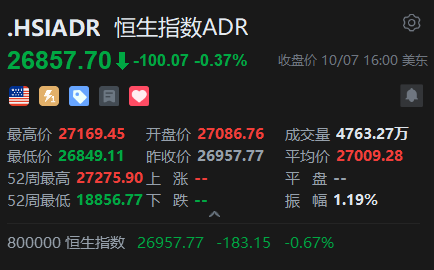
Market Overview - The Hang Seng Index (HSI) closed at 26,857.70, down by 100.07 points or 0.37% as of October 7, 16:00 Eastern Time [1] - The index reached a high of 27,169.45 and a low of 26,849.11 during the trading session, with a trading volume of 47.63 million [1] - The HSI's 52-week high is 27,275.90 and the low is 18,856.77, indicating a trading range of 1.19% [1] Blue-Chip Stocks Performance - Major blue-chip stocks mostly declined, with HSBC Holdings closing at HKD 110.069, down 0.75% from the Hong Kong market close [2] - Tencent Holdings closed at HKD 670.363, down 1.05% compared to the Hong Kong market close [2] Individual Stock Movements - Tencent Holdings (00700) saw a slight increase of 0.59% to HKD 677.500, but its ADR price was HKD 670.363, reflecting a decrease of 7.137 [3] - Alibaba Group (09988) decreased by 2.49% to HKD 180.500, with its ADR price at HKD 176.415, down by 4.085 [3] - HSBC Holdings (00005) increased by 0.91% to HKD 110.900, while its ADR price was HKD 110.069, down by 0.831 [3] - Other notable declines include Xiaomi Group (01810) down 2.09% to HKD 53.850 and JD.com (09618) down 2.14% to HKD 137.200 [3]





智通ADR统计 | 10月7日
智通财经网· 2025-10-06 23:39
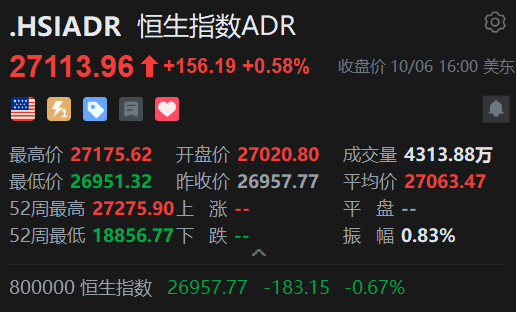
Market Overview - Major indices showed mixed performance, with AMD's surge driving the Nasdaq and S&P 500 to new closing highs [1] - The Hang Seng Index ADR rose, closing at 27,113.96 points, up 156.19 points or 0.58% compared to the Hong Kong close [1] Blue-Chip Stocks Performance - Most large-cap stocks increased, with HSBC Holdings closing at HKD 111.281, up 0.34% from the Hong Kong close [3] - Tencent Holdings closed at HKD 679.689, up 0.32% from the Hong Kong close [3] Stock Price Movements - Tencent Holdings (00700) latest price: HKD 677.500, up HKD 4.000 or 0.59% [4] - Alibaba Group (09988) latest price: HKD 180.500, down HKD 4.600 or 2.49% [4] - HSBC Holdings (00005) latest price: HKD 110.900, up HKD 1.000 or 0.91% [4] - Other notable movements include: - AIA Group (01299) up 1.28% [4] - Meituan (03690) down 0.47% [4] - JD.com (09618) down 2.14% [4]


智通港股通资金流向统计(T+2)|10月7日
智通财经网· 2025-10-06 23:33
Group 1 - On September 26, the top three stocks with net inflows from southbound funds were Alibaba-W (09988) with 34.60 billion, Yingfu Fund (02800) with 14.02 billion, and Tencent Holdings (00700) with 11.06 billion [1][2] - The top three stocks with net outflows were China Mobile (00941) with -6.35 billion, China Telecom (00728) with -3.59 billion, and China Construction Bank (00939) with -3.38 billion [1][2] - In terms of net inflow ratio, GX Hengsheng Technology (02837) led with 462.02%, followed by Green Power Environmental (01330) with 156.44%, and Anjii Food (02648) with 127.61% [1][2] Group 2 - The top ten stocks with the highest net inflows included Xiaomi Group-W (01810) with 11.00 billion and Huahong Semiconductor (01347) with 8.23 billion [2] - The top ten stocks with the highest net outflows included China Petroleum & Chemical Corporation (00386) with -2.16 billion and Changfei Optical Fiber Cable (06869) with -1.53 billion [2] - The net outflow ratios for the top ten stocks included Tianjin Chuangye Environmental Protection (01065) at -123.57% and China Telecom (00728) at -113.73% [3][4]
智通港股通持股解析|10月6日
智通财经网· 2025-10-06 00:31
Core Insights - The top three companies by Hong Kong Stock Connect holding ratios are Green Power Environmental (70.12%), China Telecom (69.73%), and COSCO Shipping Energy (69.52%) [1] - Alibaba-W, Tencent Holdings, and Xiaomi Group-W have seen the largest increases in holding amounts over the last five trading days, with increases of +10.251 billion, +3.501 billion, and +2.657 billion respectively [1] - The largest decreases in holding amounts over the last five trading days were recorded by the Tracker Fund of Hong Kong (-2.866 billion), China Mobile (-1.104 billion), and China Construction Bank (-0.921 billion) [1] Group 1: Top Holding Ratios - Green Power Environmental (01330) holds 284 million shares with a holding ratio of 70.12% [1] - China Telecom (00728) holds 9.678 billion shares with a holding ratio of 69.73% [1] - COSCO Shipping Energy (01138) holds 901 million shares with a holding ratio of 69.52% [1] Group 2: Recent Increases in Holdings - Alibaba-W (09988) saw an increase of +10.251 billion in holding amount, with a change of +55.3786 million shares [1] - Tencent Holdings (00700) experienced an increase of +3.501 billion in holding amount, with a change of +5.1988 million shares [1] - Xiaomi Group-W (01810) had an increase of +2.657 billion in holding amount, with a change of +48.3 million shares [1] Group 3: Recent Decreases in Holdings - Tracker Fund of Hong Kong (02800) had a decrease of -2.866 billion in holding amount, with a change of -103.1727 million shares [3] - China Mobile (00941) recorded a decrease of -1.104 billion in holding amount, with a change of -13.0517 million shares [3] - China Construction Bank (00939) saw a decrease of -0.921 billion in holding amount, with a change of -124.939 million shares [3]
智通港股通资金流向统计(T+2)|10月6日
智通财经网· 2025-10-05 23:34
Key Points - On September 26, 2023, the top three stocks with net inflows from southbound funds were Alibaba-W (09988) with 34.60 billion, Yingfu Fund (02800) with 14.02 billion, and Tencent Holdings (00700) with 11.06 billion [1][2] - The top three stocks with net outflows were China Mobile (00941) with -6.35 billion, China Telecom (00728) with -3.59 billion, and China Construction Bank (00939) with -3.38 billion [1][2] - In terms of net inflow ratio, GX Hang Seng Technology (02837) led with 462.02%, followed by Green Power Environmental (01330) with 156.44%, and Anjuke Food (02648) with 127.61% [1][2] - The top three stocks with the highest net outflow ratios were Tianjin Chuangye Environmental Protection (01065) at -123.57%, China Telecom (00728) at -113.73%, and China Pacific Insurance (02328) at -110.28% [1][2] Net Inflow Rankings - The top ten stocks by net inflow included: - Alibaba-W (09988): 34.60 billion, 13.44% [2] - Yingfu Fund (02800): 14.02 billion, 9.22% [2] - Tencent Holdings (00700): 11.06 billion, 8.77% [2] - Xiaomi Group-W (01810): 11.00 billion, 4.71% [2] - Huahong Semiconductor (01347): 8.23 billion, 15.41% [2] - The top ten stocks by net outflow included: - China Mobile (00941): -6.35 billion, -61.43% [2] - China Telecom (00728): -3.59 billion, -113.73% [2] - China Construction Bank (00939): -3.38 billion, -18.39% [2] - China Pacific Insurance (02328): -2.86 billion, -110.28% [2] - China Petroleum & Chemical Corporation (00386): -2.16 billion, -51.00% [2] Net Inflow Ratio Rankings - The top three stocks by net inflow ratio were: - GX Hang Seng Technology (02837): 462.02%, 16.14 million [3] - Green Power Environmental (01330): 156.44%, 3.21 million [3] - Anjuke Food (02648): 127.61%, 1.14 million [3] - The top three stocks by net outflow ratio were: - Tianjin Chuangye Environmental Protection (01065): -123.57%, -2.42 million [3] - China Telecom (00728): -113.73%, -3.59 billion [3] - China Pacific Insurance (02328): -110.28%, -2.86 billion [3]
银行股,回调到位了吗?
Ge Long Hui A P P· 2025-10-05 10:02
Core Viewpoint - The A-share market has shown a slow upward trend since 2025, with significant gains in the third quarter, while the banking sector has experienced a contrasting decline, raising questions about whether the downturn has reached its bottom [2][3]. Market Performance - The Shanghai Composite Index and Shenzhen Component Index rose by 12.76% and 29.25% respectively in Q3, while the ChiNext Index surged by 50.4%, marking a rare quarterly increase [2]. - In contrast, 38 listed banks have collectively declined for three consecutive months since July, with several banks, including Minsheng Bank and Huaxia Bank, experiencing over 20% cumulative pullbacks [2][3]. Fund Flow Dynamics - The decline in bank stocks is attributed to a shift in capital towards high-growth sectors like AI and biotechnology, which have attracted significant new investments, leading to a "siphoning effect" away from the banking sector [2][3]. - Despite the downturn, state-owned banks have not reduced their holdings, indicating that the primary reason for the adjustment may be the temporary halt in buying by state-backed funds [5]. Historical Context - The average maximum drawdown for the China Securities Banking Index over the past decade is 19.34%, with the current drawdown of 14.78% nearing historical maximum levels during structural bull markets [6][7]. Industry Fundamentals - The banking sector has shown robust performance in H1 2025, with over 60% of listed banks reporting growth in both revenue and net profit, reflecting a 5 percentage point increase from the previous year [8]. - Key risk control indicators remain stable, with a non-performing loan ratio of 1.23% and a provision coverage ratio of 238.6%, indicating strong risk management capabilities [8][9]. Investment Appeal - The banking sector continues to offer attractive dividend yields, with many banks providing yields above 4%, making them appealing in a low-interest-rate environment [14][12]. - Long-term institutional investments in banking stocks have increased, with social security funds raising their holdings to 51.71% and insurance funds actively acquiring bank shares [14][15]. Future Outlook - Historical data suggests that bank stocks tend to perform well after the National Day holiday, with a 79% probability of rising in the week following the holiday [18]. - The fourth quarter is expected to see improved performance for bank stocks, with anticipated returns of 10%-15% due to policy support and increased institutional buying [18].


银行股,回调到位了吗?
格隆汇APP· 2025-10-05 09:58
Core Viewpoint - The A-share market has shown a slow upward trend since 2025, with significant gains in major indices, while the banking sector has experienced a contrasting decline since July, with many banks seeing over 20% pullbacks [2][3]. Market Performance - In Q3, the Shanghai Composite Index and Shenzhen Component Index rose by 12.76% and 29.25%, respectively, while the ChiNext Index surged by 50.4%, marking a rare quarterly increase of over 50% [2]. - The banking sector, however, has faced a collective decline over three months, with the China Securities Banking Index retreating by 15% [2][3]. Fund Flow Dynamics - The decline in bank stocks is attributed to a shift in capital towards high-growth sectors like AI and biotechnology, which have become attractive to investors, leading to a "siphoning effect" from the banking sector [3]. - Since the introduction of the "China Special Valuation" concept in 2022, the banking sector has attracted long-term funds due to its low valuation and high dividend yield, but the risk appetite has shifted towards growth sectors in 2025 [3][6]. Financial Health of the Banking Sector - Despite the stock price declines, the banking sector's fundamentals remain robust, with over 60% of listed banks reporting revenue and net profit growth in the first half of 2025, reflecting a 5% increase from the previous year [8]. - The non-performing loan ratio for banks remained stable at 1.23%, and the provision coverage ratio improved to 238.6%, indicating strong risk management capabilities [9]. Valuation and Investment Appeal - The China Securities Banking Index's price-to-book ratio has fallen to 0.62x, placing it at the 36th percentile historically, suggesting that bank stocks are not overvalued [10]. - The banking sector offers stable dividend yields, with many banks providing yields over 4%, making them attractive in a low-interest-rate environment [12][13]. Long-term Investment Trends - Long-term capital inflows into the banking sector remain strong, with social security funds increasing their holdings in bank stocks to 51.71% and insurance funds actively investing [13][14]. - The market typically sees positive performance for bank stocks after the National Day holiday, with a 79% probability of gains in the week following the holiday [18]. Future Outlook - The upcoming mid-term dividend peak from November to January is expected to attract preemptive capital positioning, with potential returns of 10%-15% for bank stocks [19]. - Focus should be on high-dividend large banks and regional banks with strong performance metrics, as they are likely to provide better resilience and growth potential [19].

寻找“受尊敬”企业系列报道之四:人力资本即核心竞争力,从薪酬榜单看企业长期主义
Jing Ji Guan Cha Bao· 2025-10-05 06:46
Core Insights - The article emphasizes that employee compensation is a crucial indicator of a company's sustainable development capability, reflecting corporate governance, strategic determination, and social responsibility [1][15] - The ongoing increase in employee compensation over three years indicates stable profitability and a reasonable cost allocation mechanism within companies, allowing them to maintain basic employee protections amid external fluctuations [1][15] Industry Overview - A total of 1,291 companies in the A-share market have experienced continuous employee compensation growth from 2022 to 2024, covering 32 industry categories, with a significant presence in the real economy [2] - The mechanical equipment industry leads with 166 companies (12.86%), followed by electronics (122 companies, 9.45%), electrical equipment (115 companies, 8.91%), pharmaceutical biology (113 companies, 8.75%), automotive (109 companies, 8.44%), and basic chemicals (106 companies, 8.21%) [2] - The financial sector, particularly banks and insurance groups, shows a strong trend in employee compensation growth, with 37 companies (2.86%) in banking and non-banking financial services [2] Top Companies by Employee Compensation - The top ten companies by total employee compensation are all from the financial sector, indicating a strong correlation between asset scale, profitability, and employee welfare [3] - Agricultural Bank ranks first with a total employee compensation of 87.803 billion yuan, followed by China Construction Bank (60.661 billion yuan) and Bank of China (58.554 billion yuan) [5][6][7] - These companies demonstrate a commitment to employee welfare through various strategies, including performance-based pay, investment in talent development, and alignment of compensation with business growth [5][6][7][8][9] Trends and Characteristics - The continuous growth in employee compensation is linked to the companies' long-term vision and is indicative of their ability to adapt to macroeconomic conditions and industry upgrades [15] - High industry concentration is observed, with the majority of the top ten companies being financial institutions, reflecting strategic considerations in human resource allocation [15] - The linkage between compensation growth and business transformation is evident, with many companies investing in technology innovation and digital transformation [15] - A trend towards market-oriented incentive mechanisms is noted, with more companies adopting performance-based compensation systems to attract and retain key talent [15]


金融反腐追踪|9月至少8人被查,涉2名中管干部
Xin Lang Cai Jing· 2025-10-03 06:16
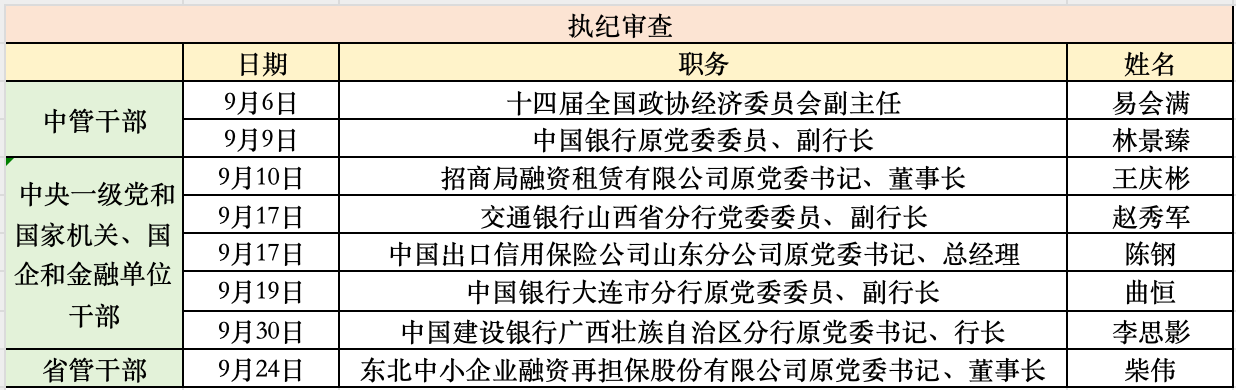
Core Insights - The financial anti-corruption campaign is steadily advancing, with at least 8 individuals investigated in September, including 2 central management cadres and 5 from central-level party and state agencies, state-owned enterprises, and financial institutions [1][4]. Group 1: Investigated Individuals - Among the 8 individuals investigated, 4 are from state-owned banks, including Lin Jingzhen, former Deputy Governor of the Bank of China, and Zhao Xiujun, Deputy Governor of the Shanxi branch of the Bank of Communications [4]. - The central management cadres investigated include Yi Huiman, Vice Chairman of the Economic Committee of the 14th National Committee of the Chinese People's Political Consultative Conference, and Lin Jingzhen, former Deputy Governor of the Bank of China [2][3]. Group 2: Financial Institutions Involved - The institutions involved in the investigations include major state-owned banks such as the Bank of China, Bank of Communications, and China Construction Bank, highlighting the focus on these entities in the anti-corruption efforts [4][5]. - Other financial entities investigated include a leasing company and insurance institutions, with specific individuals from these sectors also being scrutinized [5]. Group 3: Trends in Investigations - A total of 54 individuals have been investigated in the first nine months of this year, with a monthly breakdown showing varying numbers of investigations, indicating a consistent effort in the anti-corruption campaign [5]. - In comparison, at least 74 individuals were investigated in the same period last year, suggesting a sustained or increased focus on financial integrity [5].