
芯片半导体

Search documents
看好境内投资资产!2026年险资配置展望来了
Guang Zhou Ri Bao· 2026-02-26 16:36
Core Insights - The China Banking and Insurance Asset Management Association released a survey indicating the investment intentions of insurance institutions for 2026, highlighting a positive outlook for domestic stocks and securities investment funds [1] Asset Allocation Overview - A total of 127 insurance institutions participated in the survey, including 36 asset management firms and 91 insurance companies [1] - Most insurance institutions plan to maintain their allocation ratios for bank deposits, bonds, securities investment funds, and other financial assets similar to 2025, with some showing a willingness to slightly increase stock investments [1] Detailed Asset Allocation Plans - In terms of bond market outlook, most insurance institutions hold a neutral stance, expecting 10-year government bond yields to be in the range of 1.8% to 1.9% and 30-year yields between 2.2% and 2.4% [3] - Over half of the institutions anticipate high-grade credit bond yields to center around 2.0% to 2.5%, with overall credit spreads expected to fluctuate [3] - The preferred bond types include high-grade industrial bonds, perpetual bonds, secondary capital bonds, and convertible bonds, with a focus on 10 to 30-year maturities [3] A-Share Market Outlook - Most insurance institutions are optimistic about the A-share market for 2026, favoring stocks in indices such as the Sci-Tech 50, CSI 300, and ChiNext [3] - Key sectors of interest include electronics, non-ferrous metals, power equipment, computers, communications, pharmaceuticals, and basic chemicals, with a focus on themes like semiconductor chips, defense, AI computing power, and high dividends [3] Fund Investment Preferences - For 2026, insurance asset management institutions prefer to allocate to equity funds, secondary bond funds, mixed equity funds, index funds, and ETFs, while insurance companies favor secondary bond funds and growth funds [5] - Nearly half of the insurance institutions plan to slightly increase their allocation to public funds [5] Offshore Investment Preferences - Hong Kong stocks are the most favored offshore investment for insurance institutions in 2026, with gold and US stocks also receiving attention [5] - About half of the asset management institutions plan to slightly increase their allocation to Hong Kong stocks, while 40% of insurance companies intend to maintain their current allocation [5]

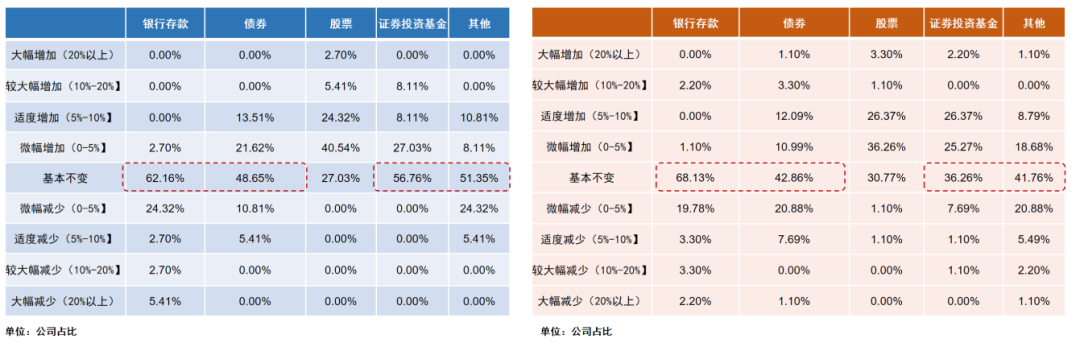
多数保险机构对2026年A股市场持较乐观态度,计划小幅增配A股
Jin Rong Jie· 2026-02-25 03:58
Group 1 - The core viewpoint of the articles indicates that insurance institutions are optimistic about domestic investments in stocks and securities investment funds for 2026, with a tendency to slightly increase stock investments [1] - Most insurance institutions plan to maintain their allocation ratios for bank deposits, bonds, securities investment funds, and other financial assets similar to 2025, with some intending to moderately increase stock investments [1] - In the bond market, insurance institutions hold a neutral outlook for 2026, favoring high-grade corporate bonds, perpetual bonds, subordinated debt, and convertible bonds, primarily focusing on bonds with maturities between 10 to 30 years [1] Group 2 - Regarding the A-share market, insurance institutions are generally optimistic for 2026, favoring indices such as the Sci-Tech Innovation 50, CSI 300, and ChiNext, and industries like electronics, non-ferrous metals, and pharmaceuticals [1] - The main factors influencing the A-share market are expected to be corporate profit recovery and liquidity conditions, with most insurance institutions planning to slightly increase their allocation to A-shares [1] - In terms of fund investments, insurance asset management institutions prefer equity funds, secondary bond funds, and mixed equity funds, with nearly half planning to slightly increase their allocation to public funds [2] Group 3 - For overseas investments, Hong Kong stocks are the most favored by insurance institutions for 2026, with gold and US stocks also receiving attention [2] - About half of the insurance asset management institutions plan to slightly increase their allocation to Hong Kong stocks, while 40% of insurance companies intend to maintain their current allocation levels [2]
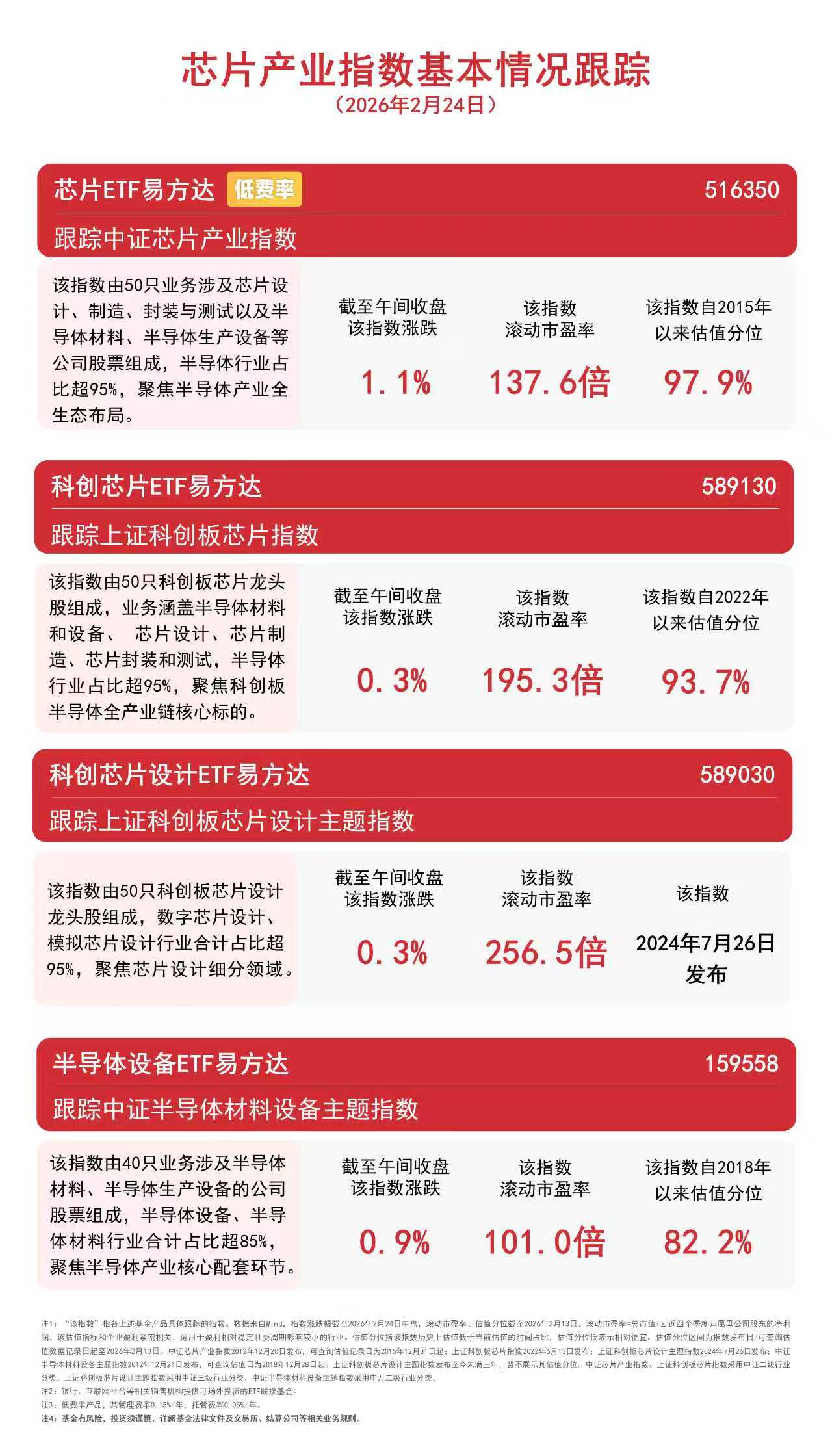
芯片股活跃,半导体设备ETF易方达(159558)、科创芯片设计ETF易方达(589030)助力布局产业龙头
Mei Ri Jing Ji Xin Wen· 2026-02-24 05:00
Core Insights - The article discusses the recent financial performance of a leading company in the technology sector, highlighting significant revenue growth and strategic initiatives aimed at expanding market share [4] Group 1: Financial Performance - The company reported a revenue increase of 25% year-over-year, reaching $5 billion in the last quarter [4] - Net profit rose to $1 billion, reflecting a 30% increase compared to the same period last year [4] - The gross margin improved to 45%, up from 40% in the previous year, indicating better cost management and pricing strategies [4] Group 2: Strategic Initiatives - The company announced plans to invest $500 million in research and development to enhance its product offerings and innovation capabilities [4] - A new partnership with a leading cloud service provider was established to expand its service portfolio and reach new customer segments [4] - The company is focusing on sustainability initiatives, aiming to reduce carbon emissions by 20% over the next five years [4]
开放式基金周报:建议均衡风格配置,重视科技成长风格基金,兼顾内需价值等资产-20260223
GUOTAI HAITONG SECURITIES· 2026-02-23 14:03
Report Industry Investment Rating - Not provided in the content Core Viewpoints of the Report - A shares rose, and the TMT sector performed well. It is recommended to have a balanced style allocation, emphasize technology - growth style funds, and also consider domestic - demand value assets [1][3][17] - For stock - hybrid funds, it is optimistic about the technology - growth and domestic - demand directions benefiting from incremental policies and industry event catalysts; for bond funds, it is suggested to focus on medium - duration interest - rate bond products [3][17] Summary by Relevant Catalogs Past Two - Week Market Review - **A - share Market**: During the pre - holiday week (20260209 - 20260213), A shares continued the previous upward trend. The TMT sector represented by AI applications performed well. The Shanghai Composite Index rose 0.41%, the Shenzhen Component Index rose 1.39%. The growth style outperformed the value style. The trading volume of the two markets decreased by about 146.82 billion yuan compared with the previous week. Among the industries, 18 out of 31 industries rose, with the top - performing industries being comprehensive, computer, etc., and the bottom - performing being textile and apparel, food and beverage, etc. [6] - **Bond Market**: In the pre - holiday week, due to loose funds and increased demand for holding bonds during the holiday, the bond market rose. The yields of 1 - year and 10 - year treasury bonds and national development bonds generally decreased, and the spreads of corporate bonds and urban investment bonds changed. The main bond indexes rose, and the convertible bond index rose 1.08% [7] - **Overseas Market**: In the past two weeks (20260209 - 20260220), the US stocks fell due to factors such as the Fed official's adjustment of the expected interest - rate cut and concerns about private loans. European markets rose, and Asian - Pacific markets showed mixed performance. The US dollar index fell, and commodity prices such as oil and precious metals rose. [8] Pre - holiday Week Fund Market Review - **Stock - type Funds**: Stock - type funds rose 1.27% overall, with active stock - open funds rising 1.42%, outperforming the index. Some funds heavily invested in artificial intelligence, chip semiconductors and other sectors performed well. Index funds tracking artificial intelligence and film and television themes also performed well [9][10] - **Bond - type Funds**: Bond - type funds rose 0.15% overall, with active bond - open funds rising 0.16%, outperforming the index. Partial - debt bond funds and convertible - bond funds with equity assets in chip semiconductors, media and other sectors performed well, and some pure - bond funds with heavy allocation of medium - short - duration interest - rate bonds also performed well [10] - **QDII Funds**: Equity - type QDII funds rose 1.02% overall, and some funds mainly investing in markets such as Japan and South Korea performed well. QDII bond - type funds rose 0.35% [11] - **Other Funds**: The annualized yield of money funds was 1.20%. Gold ETFs and their linked funds rose 1.40%, and commodity - type funds rose 1.65% [10][12] Future Investment Strategy - **Macro - economy**: In January 2026, the social financing stock growth rate was 8.2%, with government bonds being the main contributor. The credit showed a phenomenon of short - term debt. M1 and M2 growth rates both increased, with M2 reaching a two - year high. The financial data at the beginning of the year showed stable credit and strong currency. In the future, corporate foreign exchange settlement and fiscal efforts are expected to promote domestic liquidity expansion [13][14] - **Stock Market**: The trading heat of hot topics declined, and the space - photovoltaic - related topics strengthened. With the convening of local two sessions and the approaching Spring Festival, the technology - growth and domestic - demand directions are favored [15] - **Bond Market**: There are three possible scenarios for the Fed's subsequent policies. Currently, the risk of US long - term bonds may be accumulating, and the allocation strategy should focus on medium - duration varieties [16] - **Fund Investment**: For stock - hybrid funds, a balanced style allocation is recommended, emphasizing technology - growth style funds and considering domestic - demand value assets; for bond funds, it is suggested to focus on medium - duration interest - rate bond products; money funds have no trending investment opportunities; for commodity funds, gold ETFs can be appropriately allocated [17] Fund Market Latest Developments - **Fund Investment Advisers' Adjustment**: Since the beginning of 2026, fund investment advisers have accelerated the pace of portfolio adjustment. Nearly 178 out of 650 portfolios have been adjusted, increasing the allocation of low - valuation value - type funds. The positions of A - shares and bonds have been increased, and cash, US stocks and Hong Kong stocks have been reduced [18] - **New Fund Issuance**: Since the beginning of 2026, new fund issuance has been booming. In January, 169 new funds were issued, reaching the highest level since March 2023. Many funds were sold out in one day, and a 7 - billion - level active equity new product appeared. Institutions are preparing for the post - holiday market [19][20] - **Newly Established Funds in the Past Two Weeks**: A total of 64 new funds were established, with an average subscription period of about 16 days and an average raised share of 911 million. The total raised share was 58.33 billion, with Peng'an Antai Interest - rate Bond raising the largest share of 6 billion [21] - **Next Week's Fund Dividends**: 20 funds will conduct equity registration. Tianhong CSI Central - State - owned Enterprises' Dividend 50 Index is worth noting, with a dividend of 0.1 yuan per 10 shares [22]
“科技牛”拯救发起式基金!首发与持营不再“窘迫”
Sou Hu Cai Jing· 2026-02-09 09:35
Group 1 - The core viewpoint of the articles highlights the significant growth of initiation funds in the "tech bull" market, where many funds have not only increased their net value but also overcome size challenges, transforming from several million to tens of billions in scale due to investments in sectors like artificial intelligence [1][2] - Several initiation funds, such as the China Europe Information Technology fund, have seen remarkable growth, with the fund's size increasing from 24.4 million to 7.433 billion within nine months, demonstrating the potential for rapid expansion in favorable market conditions [2][3] - The "slow bull" market has alleviated the pressure on fund launches, allowing for larger initial fundraising amounts, such as the Penghua Qihang Quantitative Stock Selection fund, which raised 2.98 billion, compared to previous smaller fund sizes [3][4] Group 2 - Despite the favorable market conditions, some initiation funds have struggled to meet the 200 million threshold, leading to several funds announcing their exit after three years due to insufficient scale [6][7] - The operational costs associated with smaller funds can hinder their growth, making them reliant on institutional investments, which may affect their investment strategies [6] - Some funds have managed to "rescue" themselves by temporarily surpassing the 200 million threshold through increased subscriptions, indicating a dynamic market environment where fund performance can fluctuate significantly [7]
“科技牛”拯救发起式基金!首发与持营不再“窘迫”
券商中国· 2026-02-09 09:05
Core Viewpoint - The article discusses the performance of various initiated funds in the context of a "technology bull market" in 2025, highlighting their significant growth in both net value and scale, particularly those focused on artificial intelligence and semiconductor sectors [1][3]. Fund Performance and Growth - Many initiated funds have successfully increased their scale from initial amounts of several million to tens of billions, driven by strong performance in the technology sector [1]. - For instance, the fund "Zhongou Resource Selection" grew from approximately 82 million to 2.649 billion by the end of the year due to its heavy investment in stocks like Zijin Mining and Luoyang Molybdenum [3]. - The "Zhongou Information Technology" fund, launched with 24.4 million, saw its scale rise to 7.433 billion within nine months, while "Yongying Pioneer Semiconductor" grew from 91 million to 9.326 billion in just over a quarter [3]. Market Dynamics and Fund Strategies - The "slow bull" market has alleviated pressure on fund launches, allowing for larger initial scales compared to previous years, with some funds like "Penghua Qihang Quantitative Stock Selection" starting at 2.98 billion [5]. - Fund managers are increasingly adopting initiated fund structures to capture emerging trends in sectors like AI, healthcare, and new energy, reflecting a strategy to avoid missing out on investment opportunities [6]. Challenges and Fund Closures - Despite the overall positive market conditions, some funds have struggled to meet the 200 million threshold for survival, leading to closures, including several pension-type funds [2][7]. - The high operational costs associated with smaller funds often hinder their growth, making them reliant on institutional investments, which can limit their investment strategies [7]. - Some funds have shown signs of "self-rescue," temporarily surpassing the 200 million mark through significant inflows, despite previously low performance [8].

大批知名投资人集聚深圳,2026机遇在哪?
Xin Lang Cai Jing· 2026-01-22 13:38
Core Insights - The Chinese private equity investment industry has reached a historic turning point in 2025, with a total fundraising amount exceeding 1.16 trillion yuan, a year-on-year increase of 8%, and the number of new funds surpassing 3,500, up 18% from the previous year [1][35] - A significant structural change is observed, with state-owned limited partners (LPs) contributing 89% of the funding, and hard technology investments accounting for over 60% of the total [1][36] Group 1: Dominance of State Capital - The role of state capital has been further strengthened, with local guiding funds and state-owned enterprises contributing over 50% of the funding, while the proportion of RMB funds exceeds 99% [2][36] - State-owned LPs are integrating national strategies and regional economic development goals into their investment decisions, focusing 70% of their funds on early-stage technology companies [2][36] - The investment strategy of VC/PE has shifted from broad-based approaches to more targeted investments, with a noticeable decrease in the concentration of large funds exceeding 5 billion yuan [2][36] Group 2: Focus on Hard Technology - Hard technology is identified as the primary investment focus for 2025 and the coming years, encompassing areas such as artificial intelligence, robotics, semiconductors, and renewable energy [3][37] - The establishment of key platforms like the Sci-Tech Innovation Board and the Hong Kong Stock Exchange has created critical windows for capitalizing on hard technology investments [3][37] - Early-stage financing transactions (A-round and earlier) accounted for 62% of total deals, with small investments under 100 million yuan making up over 67% [3][37] Group 3: Diversification of Exits - The exit landscape has improved significantly, particularly in the IPO market, with the number of IPOs in mainland China and Hong Kong accounting for 16% and 33% of the global total, respectively [4][38] - The number of IPO cases for invested companies in Hong Kong increased by 148.1% year-on-year, while A-share IPO cases rose by 26.5% [4][38] - Mergers and acquisitions (M&A) have also seen a surge, with a year-on-year increase of 84% in exit cases, highlighting the growing importance of M&A strategies for VC/PE [4][38] Group 4: Long-term Vision and Future Opportunities - Despite the positive performance in investment and exits, the private equity market faces numerous challenges, necessitating a long-term vision to navigate policy directions and market demands [5][39] - The 15th China Capital Annual Conference, themed "Visionaries Win," aims to gather industry leaders to discuss emerging trends and strategies in the investment landscape [5][39] - The conference will also unveil the "2025 Private Equity Investment Annual Series Rankings," recognizing outstanding institutions and individuals in various sectors [6][40]

深圳办公楼租赁市场显韧性
Zheng Quan Ri Bao Wang· 2026-01-20 12:46
Core Insights - The Shenzhen Grade A office market is undergoing structural adjustments in 2025, characterized by "overall pressure and structural differentiation" due to high levels of new supply and a transformation in corporate leasing demand [1][2] Group 1: Market Dynamics - New demand is increasingly concentrated in high-value, high-growth sectors such as consumer electronics, smart manufacturing, and professional services related to brand expansion [1][2] - The market is expected to see a peak in supply in 2025, with 15 new projects adding nearly 1.16 million square meters, the highest level in three years [2] - Major new supply is concentrated in key sub-markets: Qianhai (approximately 35%), Bao'an Center (approximately 21%), and Houhai (approximately 21%), with over half being self-built headquarters [2] Group 2: Tenant Strategies - Shenzhen tenants are optimizing real estate strategies through flexible leasing arrangements and strict cost control, with lease renewals and cost-driven relocations being dominant strategies [1][2] - Lease restructuring transactions are increasing, with most renewals involving adjustments to key terms such as rental levels and leasing scale [1] Group 3: Future Outlook - In 2026, the market is expected to see over 1.5 million square meters of new supply, with structural supply-demand contradictions likely to persist, leading to continued high competition and pressure on rental prices [3] - Tenants will focus more on the operational support effectiveness of office spaces while landlords will need to enhance flexibility in leasing terms and service capabilities to maintain stable cash flow and sustainable occupancy rates [3]
内蒙新华:目前公司业务未涉及中国航天,芯片半导体新兴产业等产业,未研发人工智能等技术
Ge Long Hui· 2026-01-20 10:36
Group 1 - The company, Inner Mongolia Xinhua (603230.SH), has stated that its current business does not involve the aerospace industry in China, semiconductor emerging industries, or the development of artificial intelligence technologies [1]

内蒙新华(603230.SH):目前公司业务未涉及中国航天,芯片半导体新兴产业等产业,未研发人工智能等技术
Ge Long Hui· 2026-01-20 10:26
Group 1 - The company, Inner Mongolia Xinhua (603230.SH), has stated that its current business does not involve the aerospace industry in China, semiconductor emerging industries, or the development of artificial intelligence technologies [1]