CHINA MOBILE(00941)

Search documents
中国移动终端快充方案在国际电信联盟发布 成为全球标准
Xin Lang Cai Jing· 2025-10-29 05:13
Core Viewpoint - The International Telecommunication Union (ITU) has officially released the global universal fast-charging standard L.1004, led by the China Academy of Information and Communications Technology (CAICT) in collaboration with Huawei, OPPO, and vivo, marking a significant milestone in mobile terminal charging solutions [1] Group 1 - The standard L.1004 is the first global universal fast-charging standard established by ITU [1] - China's independently developed fast-charging solution is the only case recommended in the "best practices" section of the standard [1]

OpenAI完成重组;英伟达入股诺基亚丨新鲜早科技
2 1 Shi Ji Jing Ji Bao Dao· 2025-10-29 01:51
Group 1: OpenAI and Microsoft Partnership - Microsoft and OpenAI have signed a new agreement to support the formation and capital restructuring of OpenAI Group PBC, with Microsoft holding approximately $135 billion in investment rights, equating to about 27% ownership in the profit-making entity [2] - OpenAI's non-profit foundation will continue to control the profit-making organization, with an estimated valuation of $130 billion [2] - OpenAI plans to purchase $250 billion worth of Microsoft Azure cloud services, resulting in Microsoft losing its preferential rights to provide computing services to OpenAI [2] Group 2: Nvidia's Investment in Nokia - Nvidia announced a $1 billion investment in Nokia at a subscription price of $6.01 per share, which will give Nvidia a 2.9% stake in Nokia [3] - The investment aims to accelerate AI-RAN innovation and facilitate the transition from 5G to 6G [3] - Both companies will collaborate on developing next-generation 6G mobile communication technology, with Nokia adapting its software for Nvidia's chips [3] Group 3: Xiaomi's Smart Appliance Factory - Xiaomi's smart appliance factory officially commenced production in Wuhan, marking the company's third large-scale smart factory [6] - The factory can produce a high-end air conditioner every 6.5 seconds, with 100% AI visual inspection for key components [6] - Xiaomi's "Panghuai Smart Manufacturing Platform" enables intelligent control of manufacturing equipment, achieving industry-leading efficiency and quality [6] Group 4: Strategic Developments in the Tech Sector - Xiaopeng Huitian signed a strategic cooperation agreement with the Dunhuang Municipal Government to launch the first low-altitude self-driving tourism route in Northwest China [7] - Baidu's AI glasses will begin pre-sales on November 1, featuring various AI capabilities and stylish designs [8] - Shanghai Xinyang has started construction on a project to produce 50,000 tons of key materials for integrated circuits, with an investment of 1.85 billion yuan [13] Group 5: Mergers and Acquisitions - Skyworks plans to merge with competitor Qorvo in a cash and stock transaction, with a combined valuation of approximately $22 billion [10] - The merger aims to enhance capabilities in high-performance RF, analog, and mixed-signal semiconductor sectors [11] - ChipLink Integration revealed progress in its SiC business, with samples sent to AI companies in Europe and the US, indicating a strong market presence [14]




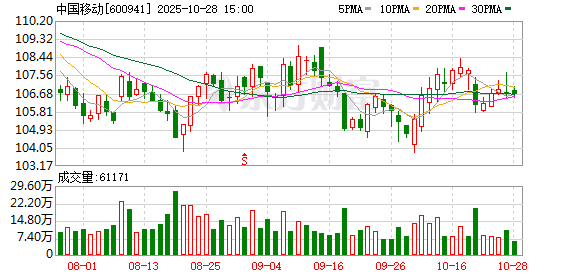
中国移动(600941):利润良好增长 AI业务高速增长
Xin Lang Cai Jing· 2025-10-29 00:27
Core Viewpoint - The company maintained stable revenue and good profit growth in the first three quarters of 2025, despite facing pressure in the personal market due to slowing traffic growth. The family market achieved good growth driven by gigabit upgrades and mobile family plans, while mobile cloud and 5G private network businesses continued to grow rapidly. With a continuous decline in capital expenditure, depreciation and amortization are expected to remain stable or decrease over the next three years. The company guides for steady revenue growth and good profit growth for the full year [1][6]. Financial Performance - In the first three quarters of 2025, the company's operating revenue was 794.7 billion yuan, a year-on-year increase of 0.4%. The main business revenue was 683.1 billion yuan, up 0.8%, and the net profit attributable to shareholders was 115.4 billion yuan, an increase of 4.0% [2][3]. - For Q3 2025, the operating revenue was 250.9 billion yuan, a year-on-year increase of 2.53%. The communication service revenue was 216.2 billion yuan, up 0.8%, and the net profit attributable to shareholders was 31.1 billion yuan, an increase of 1.43% [3]. Cash Flow - In the first three quarters of 2025, the net cash flow from operating activities was 161.0 billion yuan, a decrease of 28.13% year-on-year. For Q3 2025, the net cash flow from operating activities was 77.2 billion yuan, down 16.70% year-on-year. However, the decline in cash flow narrowed in Q3 as the company strengthened cash flow management [4]. Market Segments - In the personal market, as of September 30, 2025, the total number of mobile customers reached 1.009 billion, with 5G network customers at 622 million. In the first three quarters, mobile internet traffic grew by 8.3%, and mobile ARPU was 48.0 yuan, a decrease of 1.5 yuan year-on-year. Despite traffic growth, pricing pressure remains due to promotional activities and number portability [5]. - In the family market, as of September 30, 2025, the total number of fixed broadband customers reached 329 million, with a net increase of 14.2 million in the first three quarters. The comprehensive ARPU for family customers was 44.4 yuan [5]. Profitability Forecast - The company expects steady revenue growth and good profit growth for the full year. The forecast for net profit attributable to shareholders for 2025-2027 is 144.6 billion yuan, 149.8 billion yuan, and 154.8 billion yuan, corresponding to PE ratios of 15.88X, 15.33X, and 14.83X, respectively. The investment rating is maintained as "buy" [6].
eSIM商用试验启动 带动国产软件与系统发展
Xin Lang Cai Jing· 2025-10-28 23:39
Core Viewpoint - The approval for commercial trials of eSIM mobile services has been granted to China Unicom, China Mobile, and China Telecom, highlighting the technological advantages of eSIM cards such as card-free activation and seamless global roaming, which cater to diverse communication needs and present opportunities for domestic software and systems [1] Group 1 - eSIM technology is integrated into mobile chips, eliminating the need for physical SIM cards, thus enhancing convenience and flexibility for users [1] - The adoption of eSIM technology promotes the lightweight design of terminal devices and increases collaboration opportunities within the industry chain [1] - Currently, eSIM phones are utilized in the Internet of Things (IoT) sector, with plans for future expansion to more devices, providing innovative development space for China Mobile, Unicom, and Telecom [1]


中国移动换帅,54岁原中国联通董事长接任
券商中国· 2025-10-28 23:33
Leadership Changes - Yang Jie has resigned as the Chairman of China Mobile, with Chen Zhongyue, the former Chairman of China Unicom, taking over the position [1] - Chen Zhongyue, aged 54, has extensive experience in the telecommunications industry, having previously held various senior roles at China Telecom and China Unicom [1] Financial Performance - For the first three quarters of 2025, China Mobile reported a revenue of 794.7 billion yuan, a year-on-year increase of 0.4%, with a net profit margin of 14.5%, up by 0.5 percentage points [2] - In Q3, China Mobile's revenue reached 250.9 billion yuan, reflecting a 2.5% year-on-year growth, while the net profit attributable to shareholders was 31.1 billion yuan, up by 1.4% [2] - China Unicom reported a revenue of 292.99 billion yuan for the first three quarters, a 1% increase year-on-year, with a net profit of 8.77 billion yuan, up by 5.2% [2] - In Q3, China Unicom's revenue was 92.78 billion yuan, remaining flat compared to the same period last year, while the net profit increased by 5.4% to 2.42 billion yuan [2]


eSIM卡商用能带来啥
Jing Ji Ri Bao· 2025-10-28 22:00
Core Insights - Major Chinese telecom operators, including China Unicom, China Mobile, and China Telecom, have received approval to conduct commercial trials for eSIM mobile services, marking a significant advancement in mobile technology [1][2][3] Group 1: eSIM Technology Overview - eSIM technology allows for a virtual SIM card integrated into the device, enabling users to activate their mobile service without a physical SIM card [1] - The advantages of eSIM include seamless activation, cross-device collaboration, and global roaming capabilities, catering to diverse communication needs [1][2] - eSIM technology can reduce the physical space required for SIM card slots, allowing for thinner devices and improved internal component placement, enhancing features like battery life and waterproofing [2] Group 2: Market and User Experience - Users can enjoy a similar experience with eSIM while roaming internationally as they would with a physical SIM card, with the ability to download local data services when abroad [2] - Over 170,000 users have already expressed interest in eSIM services, indicating strong market demand [2] Group 3: Industry Implications - The approval for eSIM services is expected to create more opportunities for domestic software and systems, as well as for the research and development of domestic eSIM chips [3][4] - The integration of eSIM technology is anticipated to extend beyond mobile phones to various devices, including smartwatches and IoT applications, potentially transforming the telecommunications landscape [3] - China Mobile plans to collaborate with industry partners to offer devices that support both traditional SIM and eSIM, enhancing user choice and experience [4]
乘“数”追“新” 筑“基”引“智”
Zhong Guo Zheng Quan Bao· 2025-10-28 21:11
Core Points - Lhasa is positioning its digital economy as one of its three pillar industries, aiming to enhance regional competitiveness through a dual approach of "bringing in" and "going out" [2][12] - The digital economy in Lhasa has shown significant growth, with revenue from digital economy enterprises reaching 5.753 billion yuan from January to August 2025, and the number of such enterprises totaling 35, accounting for 58.33% of the total in Tibet [1][2] - The establishment of a regional international communication business outlet and the completion of a national internet backbone connection point are key developments in Lhasa's digital infrastructure [1][2] Digital Infrastructure Development - Lhasa has built a data center with an investment of 739 million yuan, which is the only A-level data center in Tibet, designed to support the next generation of low-carbon intelligent data centers [3] - The city has established 7,486 5G base stations, achieving a 98.7% coverage rate in administrative villages [1][3] - The "Future Network Plateau Innovation Laboratory" was established in May 2023 to foster collaboration in digital industries between Lhasa and Jiangsu [1][2] Industry Transformation and Digitalization - Traditional industries in Lhasa are embracing digital transformation, with companies like Tibet Huatai Long Mining developing smart mining plans with an investment of approximately 330 million yuan [5] - The Lhasa Economic Development Zone is actively promoting digital transformation among enterprises, enhancing their market competitiveness and contributing to sustainable economic development [4][5] Government Initiatives and Policies - Lhasa's government has implemented a "1+6+N" policy framework to support businesses, providing comprehensive assistance in areas such as funding, space, cost reduction, and talent support [9][10] - The "Galsang Flower Action" plan offers 71 targeted policies to assist enterprises in areas like listing and financial support [9][10] - The city has signed cooperation agreements with multiple companies, totaling nearly 3 billion yuan, to strengthen the foundation for digital economic development [8][12] Clean Energy and Cost Advantages - Lhasa's clean energy projects, such as the 200 MW photovoltaic power generation project, are crucial for providing low-cost electricity to support digital economy initiatives [11][12] - The city benefits from natural conditions that lower operational costs for data centers, including low temperatures that reduce cooling expenses [12] Future Outlook - Lhasa aims to integrate into the national "East Data West Computing" strategy and advance its "Digital Prosperity City" initiative, focusing on high-quality development of the digital economy [12] - The government plans to enhance the overall digital transformation across various sectors, including economy, politics, culture, society, and ecology [12]



港股通(深)净买入4.46亿港元
Zheng Quan Shi Bao Wang· 2025-10-28 16:00
Market Overview - On October 28, the Hang Seng Index fell by 0.33%, closing at 26,346.14 points, while southbound funds through the Stock Connect recorded a net purchase of HKD 2.258 billion [1][3] - The total trading volume for the Stock Connect on the same day was HKD 104.644 billion, with a net purchase of HKD 2.258 billion [1][3] Stock Performance - In the Shanghai Stock Connect, the total trading volume was HKD 65.545 billion, with a net purchase of HKD 1.812 billion; in the Shenzhen Stock Connect, the trading volume was HKD 39.098 billion, with a net purchase of HKD 0.446 billion [1][3] - The most actively traded stock in the Shanghai Stock Connect was SMIC, with a trading volume of HKD 50.17 billion, followed by Alibaba-W and Xiaomi Group-W, with trading volumes of HKD 45.84 billion and HKD 26.01 billion, respectively [1][2] - In terms of net buying, China Mobile led with a net purchase of HKD 0.513 billion, while Alibaba-W had the highest net selling at HKD 0.405 billion, closing down by 1.50% [1][2] Detailed Stock Data - The top ten actively traded stocks in the Shenzhen Stock Connect included SMIC with a trading volume of HKD 37.90 billion, followed by Alibaba-W and Xiaomi Group-W with HKD 30.78 billion and HKD 18.37 billion, respectively [2] - The stock with the highest net purchase was Huahong Semiconductor, with a net purchase of HKD 0.252 billion, while the stock with the highest net selling was Li Auto-W, with a net selling of HKD 0.292 billion [2]





港股通10月28日成交活跃股名单
Zheng Quan Shi Bao Wang· 2025-10-28 15:56
Market Overview - On October 28, the Hang Seng Index fell by 0.33% with a total southbound trading volume of HKD 1,046.44 billion, comprising HKD 534.51 billion in buy transactions and HKD 511.93 billion in sell transactions, resulting in a net buy of HKD 22.58 billion [1] Southbound Trading Activity - The southbound trading through Stock Connect (Shenzhen) recorded a total trading volume of HKD 390.98 billion, with buy transactions at HKD 197.72 billion and sell transactions at HKD 193.26 billion, leading to a net buy of HKD 4.46 billion [1] - The southbound trading through Stock Connect (Shanghai) had a total trading volume of HKD 655.45 billion, with buy transactions at HKD 336.79 billion and sell transactions at HKD 318.67 billion, resulting in a net buy of HKD 18.12 billion [1] Active Stocks - The most actively traded stock by southbound funds was SMIC, with a total trading volume of HKD 88.06 billion, followed by Alibaba-W at HKD 76.62 billion and Xiaomi Group-W at HKD 44.38 billion [1] - In terms of net buying, China Mobile led with a net buy of HKD 5.13 billion, closing up by 0.41%, followed by Huahong Semiconductor with a net buy of HKD 3.96 billion and Pop Mart with HKD 3.23 billion [1] - The stock with the highest net sell was Alibaba-W, with a net sell of HKD 5.23 billion, closing down by 1.50%, followed by Tencent Holdings and Li Auto-W with net sells of HKD 3.56 billion and HKD 2.92 billion respectively [1] Continuous Net Buying - Two stocks, SMIC and Huahong Semiconductor, experienced continuous net buying for more than three days, with SMIC having a net buy of HKD 30.18 billion over six days and Huahong Semiconductor with HKD 14.52 billion over three days [2]


70后新掌门到任 万亿市值央企换帅
Zheng Quan Shi Bao Wang· 2025-10-28 15:14
Core Viewpoint - The leadership of China Mobile has undergone a significant change with the appointment of Chen Zhongyue as the new Chairman and Party Secretary, replacing Yang Jie, who served for six and a half years [1][3]. Group 1: Leadership Transition - Yang Jie, who has been in charge since March 2019, oversaw substantial revenue growth during his tenure, with China Mobile's revenue increasing from 745.9 billion yuan in 2019 to 1.041 trillion yuan in 2024 [1]. - Chen Zhongyue, the new Chairman, has extensive experience in the telecommunications industry, having previously held positions at China Telecom and China Unicom [5][6]. Group 2: Financial Performance - In the first three quarters of this year, China Mobile reported a revenue of 794.7 billion yuan, a year-on-year increase of 0.4%, and a net profit of 115.4 billion yuan, up 4.0% [1]. - The company has also seen growth in its mobile customer base, reaching a total of 1.009 billion customers, with 622 million being 5G network users [2]. Group 3: Business Growth and Strategy - China Mobile's fixed broadband customers reached 329 million, with a net increase of 14.2 million in the first three quarters [4]. - The company is focusing on digital transformation, particularly in AI and computing power, aiming to enhance its service offerings and operational efficiency [5][6].