CHINA MOBILE(00941)

Search documents
特朗普:或在未来两周内与普京会面;再创新高!现货黄金涨破4300美元;商务部:适时推出新的稳外贸政策;提前辞任董事长,曹德旺回应丨每经早参
Mei Ri Jing Ji Xin Wen· 2025-10-16 21:57
Group 1 - Eurozone's harmonized CPI for September has been released [2] - US import price index for September has been published [2] - EIA refined oil inventory data for the week of October 10 is set to be released [2] - Huawei Software (Chengdu) Ecosystem Conference will be held on October 17 [2] - Apple will allow pre-orders for iPhone Air in mainland China starting October 17, with official sales beginning on October 22 [2] Group 2 - US stock markets saw a collective decline, with the Dow down 0.65%, Nasdaq down 0.47%, and S&P 500 down 0.63% [3] - Notable declines in popular tech stocks, with Tesla and AMD dropping over 1%, while Nvidia rose over 1% [3] - Gold prices reached a new historical high, surpassing $4300 per ounce, with a 2.85% increase [3] Group 3 - International oil prices fell, with WTI crude down 1.54% to $56.95 per barrel and Brent crude down 1.37% to $61.06 per barrel [4] Group 4 - European stock indices closed higher, with Germany's DAX up 0.38%, France's CAC40 up 1.38%, and the UK's FTSE 100 up 0.12% [5] Group 5 - China's Ministry of Commerce plans to strengthen policy reserves and introduce new foreign trade stabilization policies [6] - The Ministry responded to US interpretations of China's rare earth export controls, asserting that the measures are legitimate and aimed at national security [7] - The Ministry expressed strong opposition to Dutch government interference in semiconductor operations [7] - China's Minister of Commerce met with Apple's CEO to discuss US-China economic relations and Apple's business in China [7] Group 6 - China's Foreign Ministry opposed unilateral sanctions imposed by the UK on Chinese oil companies [8] - The Ministry emphasized that normal cooperation between Chinese and Russian enterprises should not be disrupted [8] Group 7 - China's Ministry of Industry and Information Technology announced plans to establish a millisecond-level computing network by 2027 [9] - The National Healthcare Security Administration is advancing reforms for instant settlement of medical insurance funds by the end of 2025 [9] Group 8 - Over 4100 internet platform companies have reported tax-related information as of October 15 [10] - A rumor regarding the establishment of a polysilicon storage platform was confirmed to be false [10] Group 9 - NIO is facing a lawsuit from Singapore's sovereign wealth fund for alleged securities fraud [21] - The company’s stock price fell over 7% amid the news [21] Group 10 - Nestlé plans to cut approximately 16,000 jobs over the next two years, affecting 6% of its workforce [28] - The layoffs come despite the company exceeding third-quarter sales expectations [28]







eSIM卡商用启航 国产通信大胆拥抱新技术
Zheng Quan Shi Bao· 2025-10-16 18:47
Core Viewpoint - The launch of eSIM services by China's three major telecom operators marks a significant breakthrough in domestic communication technology, positioning China among the leaders globally in this field [1][2]. Group 1: eSIM Technology Overview - eSIM technology allows for the embedding of SIM cards directly into device chips, eliminating the need for physical SIM cards, which enhances convenience and security [1][2]. - The advantages of eSIM include space-saving, improved security, increased freedom in switching operators, and support for IoT infrastructure, driving mobile devices towards being lighter, smarter, and offering better user experiences [2][3]. - According to GSMA, approximately 1 billion eSIM smartphones are expected to be connected globally by the end of this year, with projections of growth to 6.9 billion by 2030 [2]. Group 2: Market Dynamics and Competition - The strategic decision by Apple to exclusively offer eSIM versions of the iPhone Air globally, without a physical SIM card option for the Chinese market, has pressured Chinese telecom operators to accelerate their eSIM commercialization efforts [2]. - The shift towards eSIM is expected to reshape user habits and the competitive landscape, simplifying the process of switching operators and potentially altering the focus from package pricing to service quality [3][4]. Group 3: Challenges and Considerations - While eSIM offers numerous benefits, concerns remain regarding potential high fees for switching numbers and the implications of losing the exclusivity of relationships with operators, which could affect service quality [4]. - The transition to eSIM is anticipated to face challenges, but ongoing market competition and technological advancements are expected to address these issues over time [4].



中国移动董事长杨杰:“AI+”三大举措赋能智能网联汽车产业
Xin Lang Cai Jing· 2025-10-16 13:25
Core Insights - China Mobile is leveraging "AI+" through three major initiatives to empower the intelligent connected vehicle industry [1] Group 1: Infrastructure Development - The company is establishing a robust "communication network, computing power network, and navigation network" as the foundation for intelligence [1] - The communication network is accelerating the deployment of 5G+V2X and promoting satellite-ground integration [1] - The computing power network is utilizing a "cloud intelligence computing" system to serve automotive companies like Dongfeng and Changan [1] - The navigation network is achieving high-precision positioning through "5G+Beidou," servicing over 15 million vehicles [1] Group 2: AI Engine Development - China Mobile is developing the "Jiutian" specialized large model matrix to break through key technologies in autonomous driving [1] - The establishment of a national AI application pilot base aims to create a common technology platform for the automotive industry, empowering all manufacturing processes [1] Group 3: Scenario-based Applications - The company is constructing a "Smart Connection + Smart Cabin + Smart City" system, with the OneTraffic platform connecting over 72 million devices [1] - The in-vehicle "Lingxi" intelligent agent enables communication between people, vehicles, and homes [1] - Support for 16 cities in vehicle-road-cloud trials has been established, along with the completion of the world's first 5G-A vehicle networking demonstration route, focusing on public transport, highway logistics, and park transportation [1] - China Mobile has conducted over 20,000 kilometers of road testing in Beijing, providing intelligent services for 4.6 million vehicles [1]
中国移动发布情况说明
Xin Lang Cai Jing· 2025-10-16 13:08
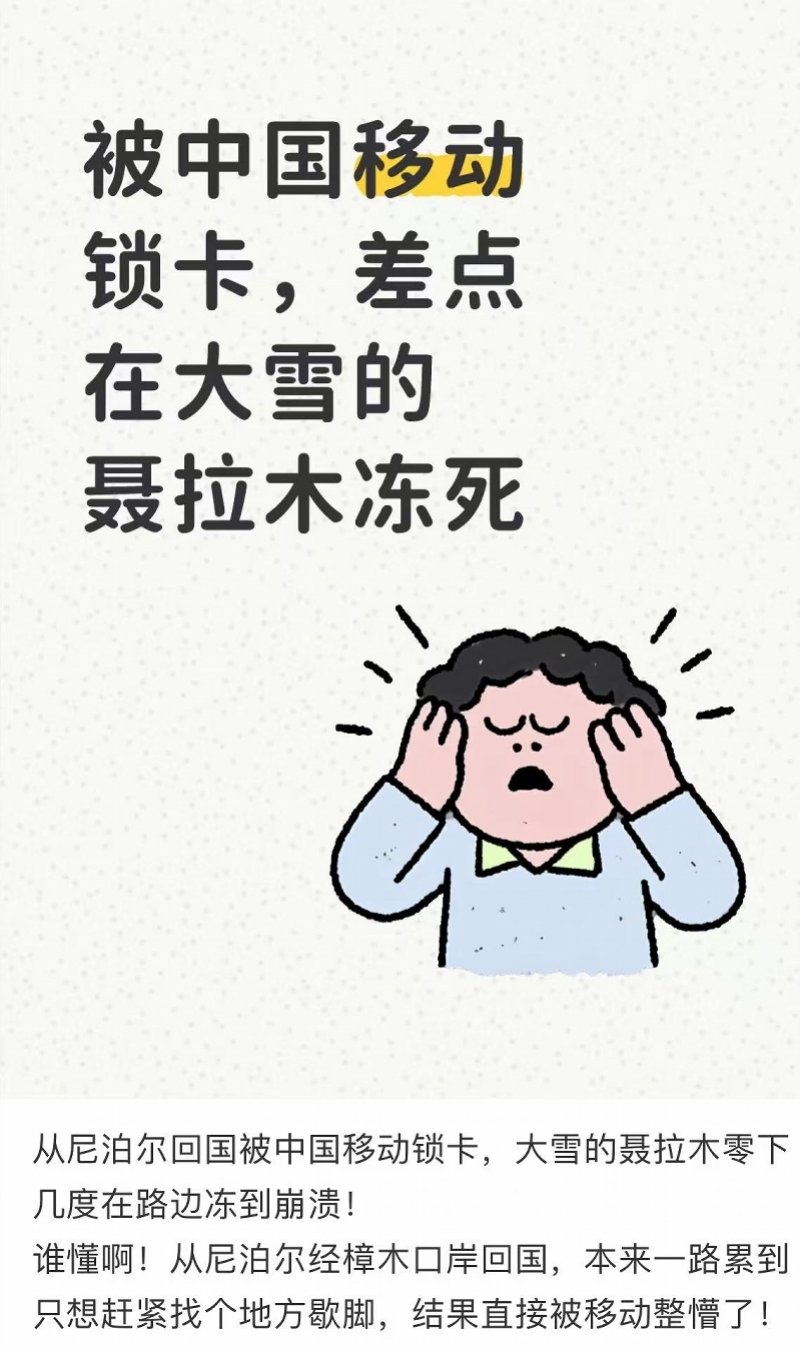
Core Points - A recent incident involving a traveler, Mr. Li, highlighted issues with mobile service provider China Mobile's "protective shutdown" policy, which aims to prevent telecom fraud but can lead to significant inconveniences for users [2] Group 1: Incident Overview - Mr. Li experienced a "protective shutdown" of his mobile phone while returning from Nepal, leaving him unable to make calls or access payment methods [2] - The traveler was in a difficult situation, lacking local currency and minimal supplies, which exacerbated his predicament [2] Group 2: Customer Service Response - Upon contacting China Mobile's customer service, Mr. Li was informed that the shutdown was a precaution against potential telecom fraud [2] - The customer service representative provided three options for restoring service: visiting a nearby service center for identity verification, returning to Xinjiang for processing, or attempting online verification in a well-lit area [2] - Mr. Li's attempts to resolve the issue were unsuccessful due to local conditions, including power outages and darkness, which hindered online verification [2]
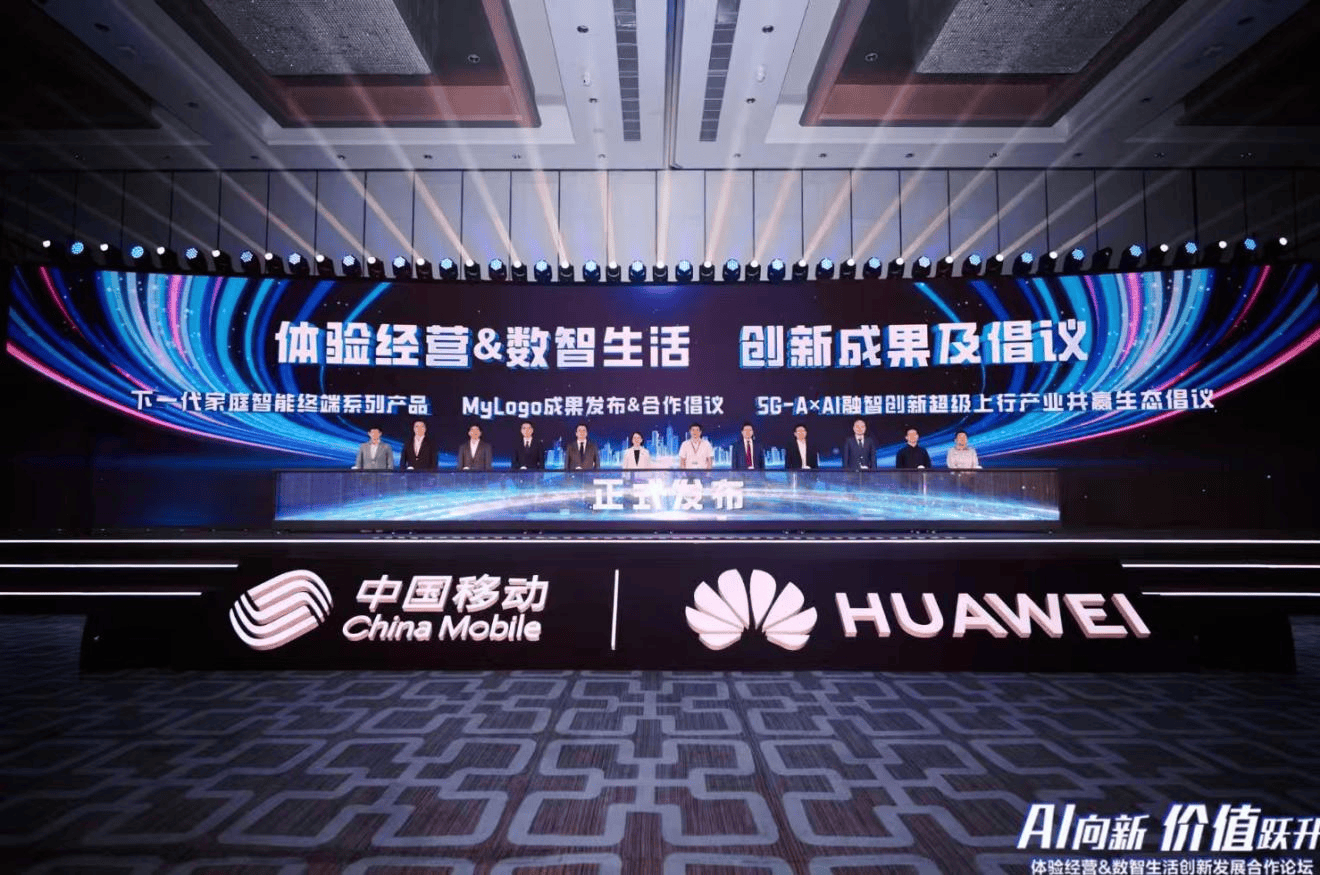
高铁隧道看视频,5G-A这样改变生活
Sou Hu Cai Jing· 2025-10-16 12:49
Core Insights - The article discusses Huawei's launch of next-generation smart home terminal products and the "5G-A × AI" ecosystem initiative, aiming to reshape digital life over the next decade [1][3]. Group 1: Smart Home and User Experience - The new smart home terminals are designed to reconstruct interaction points, making returning home feel like "future living" [3]. - 5G-A's scenario-based services aim to integrate high-quality experiences into everyday mobile usage, enhancing user convenience [3]. Group 2: Infrastructure and Industry Support - The "super uplink" solution is positioned as foundational for AI implementation, supporting the intelligent transformation of industries [3]. - Guangdong Mobile's launch of the first commercial "5G-A high-speed train acceleration package" offers 2GB of targeted data and 24-hour dedicated network acceleration, achieving stable download speeds exceeding 3Gbps [3][4]. Group 3: AI Integration and Technological Advancements - The integration of AI transforms 5G-A from a "high-speed network" to an "intelligent hub," exemplified by the Global通 AI phone that combines various services tailored to high-end users [4]. - The "super uplink" speed of 3Mbps to 20Mbps enhances the efficiency of cloud perception and feedback, enabling applications in industrial monitoring, remote surgery, and high-definition streaming [4]. Group 4: Industry Transformation - The collaboration between 5G-A and AI is reshaping industry dynamics, as seen in the use of AI robots in unmanned restaurants that can process orders in real-time with millisecond latency [5]. - In industrial settings, intelligent devices leverage 5G-A's connectivity to interact with thousands of sensors, optimizing production processes for higher efficiency [5].
eSIM卡来了!移动助你进入手机“无卡”时代
Chang Sha Wan Bao· 2025-10-16 12:26
Core Viewpoint - China Mobile has officially launched the eSIM service reservation page, indicating the imminent arrival of a "cardless" mobile era [1] Group 1: eSIM Technology - eSIM, or embedded SIM card, is integrated directly into the device chip, eliminating the need for physical SIM card insertion or replacement [1] - The technology allows users to enjoy communication functions without the hassle of traditional SIM cards [1] Group 2: User Experience - Users in Changsha can reserve eSIM services through the China Mobile app and visit designated stores for processing [1] - This service aims to provide a more convenient and flexible communication experience for users [1] Group 3: Industry Leadership - China Mobile is committed to leading eSIM standards and building an industry ecosystem, actively participating in the GSMA eSIM international standard formulation [1] - The company is focused on domestic technology development for eSIM chips and operating systems, establishing a self-controlled technical system [1] - The goal is to create a safer, more reliable, and efficient eSIM usage environment, promoting the widespread adoption of eSIM technology [1]
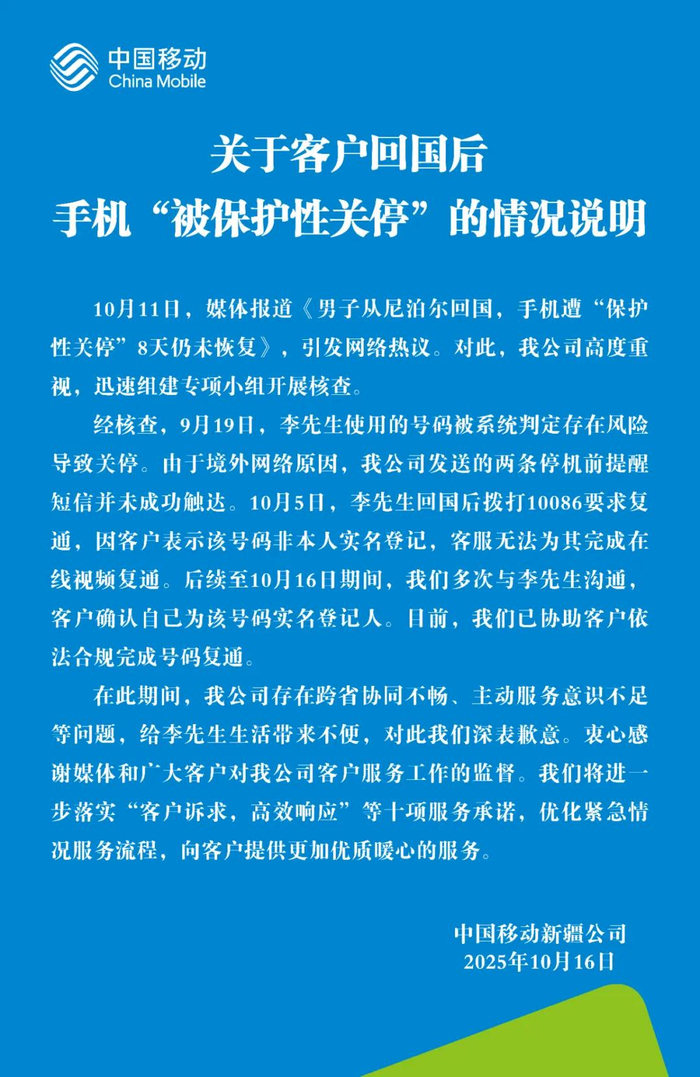
中国移动就客户回国后号码遭保护性关停致歉!称系统判有风险
Nan Fang Du Shi Bao· 2025-10-16 10:19
Core Points - A user reported that their China Mobile phone number was "protectively suspended" after returning from Nepal, causing inconvenience for several days [1][4] - China Mobile Xinjiang Company confirmed that the number was suspended due to a system-detected risk and acknowledged communication issues during the process of reinstating the number [4] Group 1 - The user's phone number was suspended on September 19 due to a risk assessment by the system [4] - The company attempted to send two warning messages before suspension, but they failed to reach the user due to overseas network issues [4] - After the user returned to China on October 5 and requested reinstatement, the customer service could not assist because the number was not registered under the user's name [4] Group 2 - China Mobile Xinjiang Company expressed regret for the inconvenience caused and acknowledged internal issues such as poor cross-province coordination and insufficient proactive service [4] - The company has since assisted the user in legally reinstating the phone number [4]
男子回国后手机被运营商“保护性关停”?中国移动致歉
Guan Cha Zhe Wang· 2025-10-16 10:18
Core Points - A situation arose when a customer, Mr. Li, experienced a "protective shutdown" of his mobile phone upon returning from Nepal, leading to significant inconvenience and public outcry [1][5] - China Mobile acknowledged the issue, stating that the customer's number was flagged for risk on September 19, and due to network issues, the shutdown notifications did not reach him [5] Group 1 - The incident involved Mr. Li, who returned from Nepal on October 5 and found his phone service suspended, which left him unable to make necessary calls or use mobile payments [1] - China Mobile formed a special team to investigate the situation and confirmed that the customer's number was deemed risky by their system [5] - The company apologized for the inconvenience caused to Mr. Li, citing issues with cross-province coordination and a lack of proactive service awareness [5] Group 2 - Following the incident, China Mobile has committed to improving its customer service processes, including implementing ten service commitments to enhance responsiveness to customer needs [5] - The company has taken steps to assist Mr. Li in restoring his phone service in compliance with regulations [5]
中国移动致歉
第一财经· 2025-10-16 09:37
Core Viewpoint - The article discusses a situation involving a customer, Mr. Li, whose mobile phone service was "protectively suspended" by China Mobile after returning from Nepal, highlighting issues in customer service and communication within the company [3][5]. Group 1: Incident Overview - On October 11, media reported that Mr. Li's phone was "protectively suspended" for 8 days after returning from Nepal, which sparked public interest [3]. - China Mobile formed a special team to investigate the incident after the media coverage [3]. - The suspension was triggered on September 19 due to a system risk assessment, and the customer did not receive prior warning messages due to network issues abroad [3]. Group 2: Customer Experience - Mr. Li faced significant difficulties during his return, including being unable to make calls or access funds, which left him in a desperate situation [5][6]. - The customer service informed Mr. Li that the suspension was a preventive measure against telecom fraud, and he was given three options to restore service, including visiting a local store or verifying online [6]. - Mr. Li expressed frustration over the inability to resolve the issue quickly, especially given the circumstances he was in, and requested temporary data access to manage his immediate needs [6]. Group 3: Company Response - China Mobile acknowledged shortcomings in cross-province coordination and proactive service awareness, which contributed to the inconvenience experienced by Mr. Li [3]. - The company has since assisted Mr. Li in restoring his phone service in compliance with regulations [3].

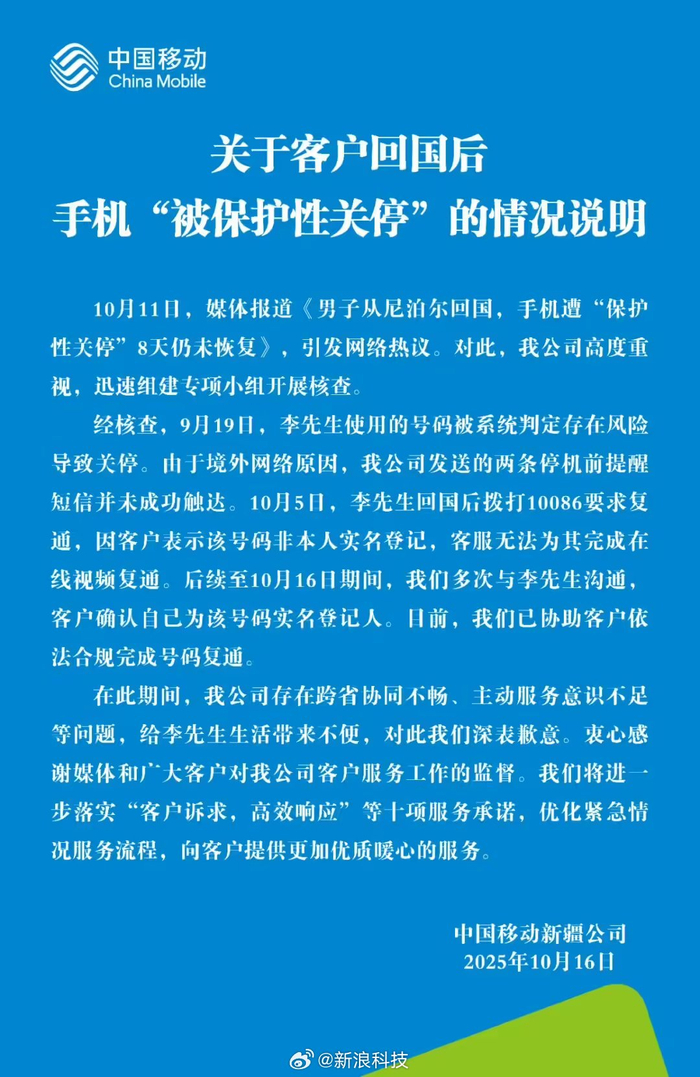
中国移动新疆公司就客户回国后手机被保护性关停致歉
Xin Lang Ke Ji· 2025-10-16 09:15
Core Points - China Mobile Xinjiang Company issued an apology regarding the "protective shutdown" incident involving a customer's phone after returning from abroad [1] - The shutdown was triggered by the system detecting risks associated with the customer's number on September 19 [1] - Due to overseas network issues, two warning messages sent prior to the shutdown did not reach the customer [1] - After the customer returned to China on October 5 and contacted customer service, the request for reactivation was initially denied due to the number not being registered in the customer's name [1] - Following multiple communications, the company confirmed the customer was indeed the registered owner and assisted in the lawful reactivation of the number [1]