CHINA MOBILE(00941)

Search documents
记中国工程院院士王晓云的移动通信创新路
Zhong Guo Fa Zhan Wang· 2025-11-24 06:16
Core Viewpoint - The appointment of Wang Xiaoyun as an academician of the Chinese Academy of Engineering highlights significant contributions to the mobile communication industry, particularly in TDD network development and innovation [1][3]. Group 1: Contributions to Mobile Communication - Wang Xiaoyun has made pioneering contributions in the field of mobile communication network architecture and interaction mechanisms, playing a core role in the development of TDD networks in China [3][4]. - Under Wang's leadership, the team has achieved numerous accolades, including one National Science and Technology Progress Award (Special Prize) and two First Prizes, showcasing the team's high level of innovation and expertise [3][4]. Group 2: Historical Development of Mobile Communication in China - The mobile communication industry in China has evolved through various stages: from "1G blank, 2G following, 3G breakthrough, 4G parallel, to 5G leading," with Wang Xiaoyun representing the innovative spirit of this transformation [4][6]. - During the 2G era, Wang played a crucial role in establishing the GSM system in China, significantly increasing the number of mobile communication numbers by tenfold, which laid a solid foundation for the global dominance of China's GSM network [4][5]. Group 3: Innovations and Breakthroughs - In the 3G era, Wang led efforts to establish TDD technology as a strategic focus, overcoming significant challenges and achieving breakthroughs that positioned China as a leader in mobile communication technology [5][6]. - The transition to 4G saw Wang's team successfully implement TDD-LTE as an international mainstream standard, enhancing China's global influence in the mobile communication sector [6][7]. Group 4: Future Directions and 6G Development - Wang Xiaoyun is currently leading initiatives in 6G technology, focusing on integrating various elements such as sensing and intelligent computing, which are crucial for the future of mobile communication [8]. - The ongoing development of 6G aims to solidify China's position as a global leader in mobile communication, with a focus on innovative network architectures and AI integration [8].



国际电信联盟发布5G/6G交互式物联多媒体通信国际标准
Ge Long Hui· 2025-11-24 04:47
Core Viewpoint - The International Telecommunication Union (ITU) has officially released an international standard for interactive multimedia communication in the 5G/6G era, led by China Mobile, marking it as the first global standard in the field of visual internet [1] Group 1 - The standard focuses on interactive multimedia communication for the 5G/6G era [1] - China Mobile played a leading role in the development of this international standard [1] - This standard is significant for the advancement of the visual internet sector [1]
全国过半用户用上百兆宽带 降费举措年内将全部落实
Mei Ri Jing Ji Xin Wen· 2025-11-24 04:09
Core Insights - The article discusses the significant advancements in China's telecommunications industry, particularly the implementation of policies aimed at reducing costs and increasing internet speeds for users [1][2][3]. Group 1: Policy Implementation - As of July 1, 2023, the three major telecom operators in China have eliminated domestic mobile data "roaming" fees, allowing users to enjoy nationwide data without additional charges [2][3]. - The average mobile data tariff has decreased by 46.2% compared to the end of 2017, reflecting the government's push for lower costs in the telecommunications sector [1][2]. - By the end of June 2023, 53.4% of users had internet speeds of 100 Mbps or higher, an increase of 13.5 percentage points since the beginning of the year [1]. Group 2: User Experience and Feedback - The effectiveness of the cost reduction measures will ultimately be assessed through user bills, which will provide a direct indication of the benefits experienced by consumers [3]. - The Ministry of Industry and Information Technology (MIIT) is closely monitoring user feedback to ensure that the implementation of the new policies meets consumer expectations and addresses any complaints [3]. Group 3: Future Developments - The cancellation of "roaming" fees and other cost-reduction measures are seen as preparatory steps for the upcoming 5G era, which is expected to significantly enhance network speeds and capacity [5]. - The commercial rollout of 5G is anticipated to begin in mid-2019, with expectations of increased data usage and the continuation of data speed limits due to finite network resources [5].

卫星物联网商用试验正式启动!千亿市场规模可期(附概念股)
Zhi Tong Cai Jing· 2025-11-24 01:56
Core Viewpoint - The launch of commercial trials for satellite IoT in China marks a significant step towards enhancing the satellite communication market, stimulating industry growth, and supporting emerging sectors like commercial space and low-altitude economy [1][2][3] Industry Summary - The Ministry of Industry and Information Technology announced the start of a two-year commercial trial for satellite IoT, aimed at enriching market supply and establishing a regulatory framework [1] - The satellite IoT business connects various IoT devices through satellite communication, providing low-speed data services for a wide range of applications, including agriculture and emergency communications [1][2] - The satellite communication market in China is projected to exceed 80 billion yuan in 2023, with an expected annual growth rate of approximately 15% from 2024 to 2029, potentially reaching over 200 billion yuan by 2029 [2] - The commercial trial is expected to create significant demand for satellite launches, driving growth in satellite manufacturing and rocket launch industries [1][3] Company Developments - China Telecom has made advancements in satellite internet technology, enabling mobile devices to connect directly to satellites, with coverage extending to 25 million mobile terminals [4] - China Mobile has received a license to operate satellite mobile communication services, enhancing applications in emergency communication and remote area connectivity [5] - China Unicom successfully launched four low-orbit satellites, including the first domestic satellite with 3GPP narrowband IoT capabilities, marking a significant step in low-orbit satellite IoT development [5]


青鸟消防中标中国移动物联网消防大模型开发项目
Xin Lang Cai Jing· 2025-11-24 01:13
Core Insights - Qingniao Fire Protection has recently won the bid for the development project of a fire safety model for China Mobile Internet of Things Co., Ltd [1] Company Summary - Qingniao Fire Protection successfully secured a significant project with China Mobile, indicating its growing influence and capabilities in the fire safety technology sector [1]

智通港股通持股解析|11月24日





智通财经网· 2025-11-24 00:31
Core Insights - The top three companies by Hong Kong Stock Connect holding ratios are China Telecom (00728) at 72.38%, Green Power Environmental (01330) at 69.48%, and Da Zhong Public Utilities (01635) at 69.45% [1][2] - Alibaba-W (09988), Xiaomi Group-W (01810), and the Tracker Fund of Hong Kong (02800) saw the largest increases in holding amounts over the last five trading days, with increases of +70.62 billion, +33.67 billion, and +15.78 billion respectively [1][2] - WuXi Biologics (02269), China Shenhua (01088), and China Mobile (00941) experienced the largest decreases in holding amounts over the same period, with decreases of -6.43 billion, -3.93 billion, and -3.75 billion respectively [1][3] Group 1: Hong Kong Stock Connect Holding Ratios - China Telecom (00728) has a holding of 100.45 billion shares, representing 72.38% [2] - Green Power Environmental (01330) has a holding of 2.81 billion shares, representing 69.48% [2] - Da Zhong Public Utilities (01635) has a holding of 3.71 billion shares, representing 69.45% [2] Group 2: Recent Increases in Holdings - Alibaba-W (09988) saw an increase of +70.62 billion in holding amount, with a change of +47.84 million shares [2] - Xiaomi Group-W (01810) experienced an increase of +33.67 billion, with a change of +88.41 million shares [2] - The Tracker Fund of Hong Kong (02800) had an increase of +15.78 billion, with a change of +62.24 million shares [2] Group 3: Recent Decreases in Holdings - WuXi Biologics (02269) had a decrease of -6.43 billion in holding amount, with a change of -21.06 million shares [3] - China Shenhua (01088) saw a decrease of -3.93 billion, with a change of -9.94 million shares [3] - China Mobile (00941) experienced a decrease of -3.75 billion, with a change of -4.36 million shares [3]
港股概念追踪 | 卫星物联网商用试验正式启动!千亿市场规模可期(附概念股)
智通财经网· 2025-11-23 23:23
Core Insights - The commercial trial of satellite IoT services in China has officially started, aiming to enhance the satellite communication market and support emerging industries like commercial space and low-altitude economy [1] - The satellite IoT business will create significant demand for satellite launches, driving growth in the satellite manufacturing and rocket launch sectors [1][2] - The satellite communication market in China is projected to exceed 80 billion yuan in 2023, with an expected annual growth rate of approximately 15% from 2024 to 2029, potentially reaching around 200 billion yuan by 2029 [2] Industry Developments - The satellite IoT trial is part of a broader strategy to optimize business access and promote the development of the satellite communication industry, aligning with technological innovation and industrial transformation [1] - The integration of satellite IoT is expected to revolutionize various sectors, including agriculture, energy, emergency communication, and low-altitude economy applications [2] - The satellite IoT will enable real-time tracking and data transmission for low-altitude vehicles, addressing communication gaps in the low-altitude economy [3] Company Activities - China Telecom is actively promoting satellite internet development and has achieved significant technological breakthroughs, enabling mobile devices to connect directly to satellites [4] - China Mobile has received a license to operate satellite mobile communication services, enhancing applications in emergency communication and remote area connectivity [5] - China Unicom has successfully launched low-orbit satellites that support narrowband IoT communication, marking a significant step in China's satellite IoT capabilities [5]
中国启动卫星物联网商用试验,低空经济与商业航天站上新风口
Di Yi Cai Jing· 2025-11-23 13:13
Group 1 - The core viewpoint is that the launch of satellite IoT commercial trials is a key link connecting commercial aerospace and low-altitude economy, aiming to enhance service capabilities and establish a regulatory framework for emerging industries [1][2] - The Ministry of Industry and Information Technology (MIIT) announced the official start of satellite IoT commercial trials, which will last for two years, to stimulate market vitality and support the healthy development of new industries [1][4] - Satellite IoT is expected to enable real-time tracking and data transmission for low-altitude vehicles, addressing communication gaps in the low-altitude economy and fostering deep integration between commercial aerospace and low-altitude sectors [2][3] Group 2 - The satellite IoT business connects various IoT devices through satellite communication technology, providing wide-area IoT connectivity in regions where terrestrial networks are unavailable [3][4] - The MIIT has proposed 19 specific measures to promote the development of the satellite communication industry, including organizing satellite IoT commercial trials and expanding market access for private enterprises [4][5] - Major telecommunications companies like China Telecom, China Mobile, and China Unicom are actively expanding their satellite communication services, enhancing applications in emergency communication and remote area connectivity [5][6] Group 3 - The integration of satellite IoT technology is expected to attract more capital and resources into the low-altitude sector, promoting collaborative development across various industry segments such as drone manufacturing and airspace management [3][5] - The commercial trials are anticipated to create opportunities for upstream and downstream enterprises in the satellite IoT industry chain, leading to a more complete industrial ecosystem [2][5] - The MIIT aims to enhance the synergy between industrial internet and artificial intelligence, promoting the development of smart manufacturing and digital infrastructure [6][7]
2025中国5G+工业互联网大会在武汉开幕
Xin Lang Cai Jing· 2025-11-22 05:41
Core Viewpoint - The 2025 China 5G + Industrial Internet Conference was inaugurated in Wuhan, marking a significant step in the development of satellite IoT business trials, which will enhance the satellite communication market supply and support the growth of emerging industries such as commercial aerospace and low-altitude economy [1] Group 1 - The Ministry of Industry and Information Technology officially launched commercial trials for satellite IoT services during the conference [1] - The commercial trials aim to enrich the supply in the satellite communication market and support the safe and healthy development of new industries [1] - A cooperation memorandum was signed between the Hubei Provincial Government and major telecom companies including China Telecom, China Unicom, China Mobile, China Information Communication Technologies, and China Tower [1] Group 2 - The industrial and information technology departments of Jiangxi, Hubei, and Hunan provinces signed a memorandum for collaborative development of the industrial internet in the Yangtze River Middle Reaches urban agglomeration [1]

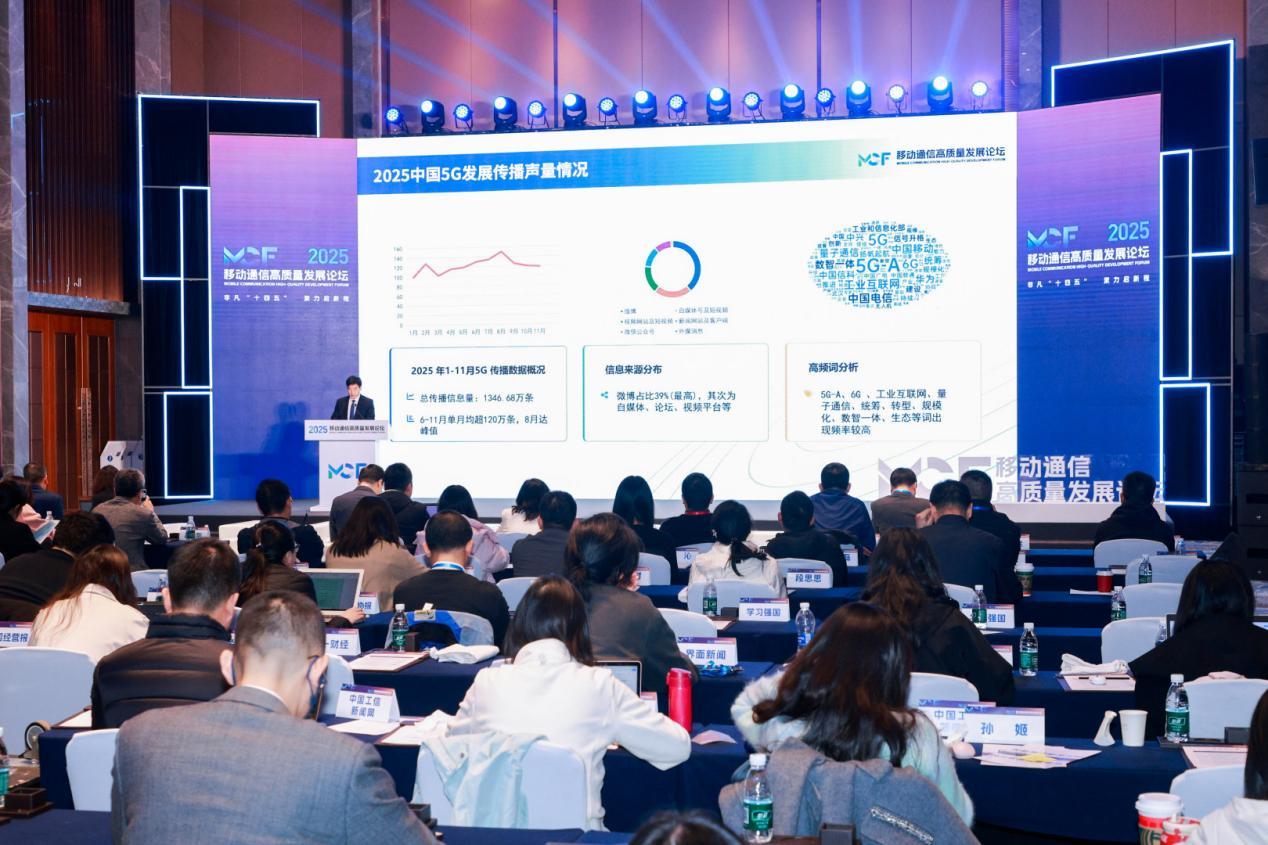
新华网:2025移动通信高质量发展论坛武汉举办 5G-A深耕与6G布局共绘产业新蓝图
Xin Hua Wang· 2025-11-22 04:00
Core Insights - The 2025 Mobile Communication High-Quality Development Forum was held in Wuhan, focusing on 5G applications, 5G-A technology breakthroughs, 6G planning, and integrated network construction [2] - The forum highlighted the transition of China's 5G industry from "technology leadership" to "value empowerment" [2] Group 1: Technological Advancements - 5G-A and 6G are key focal points, with major telecom operators showcasing their technological innovations and breakthroughs [3] - China Mobile is advancing a "hexagonal" technology framework for 6G, focusing on ten innovation areas, including high-performance networks and integrated sensing [3] - China Telecom is conducting outdoor trials for millimeter-wave sensing and has established over 300 low-altitude sensing stations across 18 provinces [4] - China Unicom has achieved full commercial use of 5G-A, with download speeds reaching 5Gbps outdoors and 5.7Gbps indoors [4] Group 2: Industry Applications - 5G applications are now in a phase of large-scale deployment, significantly driving the digital transformation of various industries [6] - China Mobile has integrated 5G into industrial production, while China Unicom has served over 20,000 industry-specific clients with more than 50,000 large-scale application projects [6] - China Telecom's low-altitude economy and satellite internet initiatives are emerging as new growth areas, with direct satellite services covering 25 million mobile devices [6] Group 3: Communication and Public Perception - The "2025 China 5G Development Communication Power Analysis" report indicates a shift in public perception from technical parameters to actual value [8] - From January to November 2025, there were 13.47 million online news reports related to 5G development, with a peak in August [8] - Key provinces leading in 5G communication include Beijing, Shanghai, and Guangdong, with major telecom companies acting as core communicators of 5G value [8] Group 4: Emerging Trends - Five major trends in communication were identified, including the mainstreaming of application results and the economic and social value of large-scale deployments [9] - The integration of 5G with AI is creating a new paradigm for intelligent communication networks [9] - The forum emphasized the importance of collaboration among telecom operators and industry players to build a synergistic ecosystem for innovation and value creation [9]