
LENOVO GROUP(00992)

Search documents
联想与郑州航空港区签署战略合作协议
Zheng Quan Ri Bao· 2025-11-13 11:44
Core Viewpoint - Lenovo Group Limited has signed a strategic cooperation agreement with Zhengzhou Airport Economic Comprehensive Experimental Zone to establish the Lenovo Intelligent Body Factory Central China Headquarters Project, aiming to develop intelligent applications across five key areas: cross-border trade, smart manufacturing, smart energy, smart tourism, and health care [2][4]. Group 1: Strategic Cooperation - The partnership represents a strong collaboration between a national-level aviation economic pilot zone and a leading technology enterprise, highlighting the deep integration of artificial intelligence technology with the real economy [4]. - The project aims to introduce over 100 upstream and downstream enterprises related to large models and register 100 large models, establishing a Chinese intelligent body innovation incubation base [2][6]. Group 2: Technological Framework - Lenovo's 1+N intelligent body technology architecture will be deployed in the Zhengzhou Airport Zone, integrating advanced AI technologies such as deep learning, natural language processing, knowledge graphs, and edge computing [5][6]. - The intelligent body system is designed to possess autonomous perception, intelligent decision-making, and collaborative execution capabilities, forming a city-level intelligent system [5][6]. Group 3: Investment and Development Goals - The project has a planned investment scale of 1.5 billion yuan and aims to become a national-level innovation center for intelligent body industrialization within three years [6]. - Lenovo intends to empower individuals, enterprises, and cities through a hybrid artificial intelligence strategy, providing AI terminals, infrastructure, and solutions [6].


联想集团与郑州航空港区签署战略合作协议,城市超级智能体落地河南
Xin Lang Ke Ji· 2025-11-13 10:23
Core Insights - Lenovo Group signed a strategic cooperation agreement with Zhengzhou Airport Economic Comprehensive Experimental Zone to establish the Lenovo Intelligent Body Factory Central China Headquarters project [1] - The project aims to create the largest intelligent innovation incubation base in China, focusing on five key areas: cross-border trade, intelligent manufacturing, smart energy, smart tourism, and health [1] - The investment scale for the project is set at 1.5 billion yuan, with a goal to attract over 100 upstream and downstream enterprises related to large models and register 100 large models within three years [1] Project Overview - The core of the project is to build an industrial ecosystem consisting of "one digital foundation + five centers," which includes a shared computing power center and a corpus sharing center to support AI cognition and decision-making [2] - The five centers encompass an intelligent body incubation and trading center, an industry-university-research center, and an intelligent body operation center, providing a standardized incubation platform for the entire lifecycle of AI development to commercialization [2] - The deployment of Lenovo's "1+N Intelligent Body" architecture in the Zhengzhou Airport area will leverage the region's unique advantages in air logistics, advanced manufacturing, and openness to promote intelligent transformation across the five targeted sectors [2] Strategic Goals - Lenovo aims to drive the development of the real economy and industrial transformation through AI technology, positioning the Zhengzhou Airport area as a benchmark for intelligent body industry development [2] - The project is intended to serve as a core vehicle for Lenovo's "hybrid artificial intelligence" strategy nationwide, with the goal of establishing a comprehensive and practical intelligent body industry community in China [1][2]
AI散热需求引爆液冷板块 联想成被低估的核心玩家
Ge Long Hui· 2025-11-13 07:07
Core Viewpoint - The liquid cooling server sector in the A-share market has experienced a significant surge, driven by increasing computing power demands and supportive policies, with Lenovo Group emerging as a key player in this field [1][2]. Industry Overview - The explosive growth of the liquid cooling server sector is attributed to the exponential increase in computing power requirements, particularly due to the scaling of generative AI and large model training, which traditional air cooling systems cannot adequately support [1]. - The Chinese government's "dual carbon" goals and digital economy strategies are providing strong momentum for the development of liquid cooling technologies, with specific targets set for increased penetration rates by 2025 [2]. Company Positioning - Lenovo Group has established a comprehensive "full-stack" liquid cooling capability, covering core technology research, complete solution design, and lifecycle services, positioning itself as a leader in the liquid cooling market [2]. - Lenovo's Neptune liquid cooling system has become an industry benchmark, with over 80,000 units deployed globally across various critical sectors, demonstrating its technological maturity and compliance with international standards [2][3]. Competitive Advantages - Lenovo's liquid cooling solutions have been validated through numerous high-profile projects, showcasing their adaptability and efficiency, such as achieving a PUE of 1.1 in automotive data centers and reducing energy consumption by 30% in educational institutions [3]. - Strategic partnerships with leading chip manufacturers like NVIDIA and AMD enhance Lenovo's competitive edge, particularly with the introduction of advanced AI server solutions [3]. Financial Performance - Lenovo's liquid cooling business reported a 68% year-on-year revenue growth in Q1 2025, reflecting strong market demand and performance [4]. - The global server cooling market is projected to experience substantial growth, with estimates indicating a market size of $17.6 billion by 2027, driven by increased AI server shipments and rising liquid cooling penetration rates [4].
从标准制定到全球出海 联想液冷:被低估的核心玩家
Zhi Tong Cai Jing· 2025-11-13 07:01
Core Viewpoint - The liquid cooling server sector in the A-share market has experienced a significant surge, driven by increasing demand for computing power and supportive policies, highlighting the competitive advantages of Lenovo Group in this field [1][2]. Group 1: Market Dynamics - The explosion of the liquid cooling server sector is a result of the exponential increase in computing power demand and policy support, particularly due to the rise of generative AI and large model training [2]. - Traditional air cooling technology is inadequate for high-density computing clusters, with AI servers consuming 10-20 times the power of standard servers, necessitating a shift to liquid cooling technology [2]. - The Chinese government has included "efficient cooling technology" in its list of key low-carbon technologies, aiming for a significant increase in liquid cooling penetration from 15% to 38% by 2025 [2]. Group 2: Lenovo's Competitive Edge - Lenovo Group has developed a comprehensive "full-stack" liquid cooling capability, covering core technology research, complete solution design, and lifecycle services, making it a pioneer in the liquid cooling sector since 2006 [3]. - Lenovo's Neptune liquid cooling system has become an industry benchmark, with over 80,000 units deployed globally across various critical sectors, including AI, supercomputing, and finance [3][4]. - The company has established long-term strategic partnerships with leading chip manufacturers like NVIDIA and AMD, enhancing its competitive position in the liquid cooling market [4]. Group 3: Financial Performance and Growth Outlook - Lenovo's liquid cooling business reported a 68% year-on-year revenue growth in Q1 2025, reflecting strong market demand [5]. - The global server cooling market is projected to grow significantly, with estimates of 111%, 77%, and 26% annual growth from 2025 to 2027, reaching $17.6 billion by 2027 [5]. - Lenovo is well-positioned to increase its market share in this expanding market due to its technological leadership, rich case studies, and robust ecosystem [5].
从标准制定到全球出海 联想(00992)液冷:被低估的核心玩家
智通财经网· 2025-11-13 06:17
Core Viewpoint - The A-share liquid cooling server sector has experienced a significant surge, driven by increasing computing power demands and supportive policies, with Lenovo Group emerging as a key player in the market despite short-term stock price fluctuations [1][2]. Industry Overview - The liquid cooling server sector's growth is attributed to the exponential increase in server computing power density, particularly due to the rise of generative AI and large model training, which traditional air cooling systems cannot adequately support [1]. - The Chinese government's "dual carbon" goals and digital economy strategies are providing strong momentum for the development of liquid cooling technologies, with specific targets set for increased penetration rates by 2025 [2]. Company Positioning - Lenovo Group has established a comprehensive "full-stack" liquid cooling capability, covering core technology research, complete solution design, and lifecycle services, positioning itself as a leader in the liquid cooling space [2]. - Lenovo's Neptune liquid cooling system has become an industry benchmark, with over 80,000 units deployed globally across various critical sectors, demonstrating its technological maturity and compliance with international standards [2][3]. Competitive Advantages - Lenovo's liquid cooling solutions have been validated through numerous successful implementations in major projects, showcasing their adaptability and efficiency in various applications, such as automotive and educational sectors [3]. - Strategic partnerships with leading chip manufacturers like NVIDIA and AMD enhance Lenovo's competitive edge, particularly with the introduction of advanced AI server solutions [3]. Financial Performance - Lenovo's liquid cooling business reported a 68% year-on-year revenue growth in Q1 2025, reflecting strong market demand and performance [4]. - The global server cooling market is projected to experience substantial growth, with estimates indicating a market size of $17.6 billion by 2027, driven by increased AI server shipments and rising liquid cooling penetration rates [4].
别乱叫Air!联想moto内涵友商,「落后者」定义标准遭群嘲 | BUG
Xin Lang Ke Ji· 2025-11-13 02:40
Core Viewpoint - Lenovo Moto is aggressively positioning itself in the lightweight smartphone market, challenging competitors like Huawei and Apple with its "Air" standards, which emphasize thickness under 6mm and weight under 160g, although this strategy may not lead to significant market share growth [1][3][7]. Group 1: Market Positioning and Competition - Lenovo Moto has recently launched the Moto X70 Air, which is 5.99mm thick and weighs 159g, priced starting at 2399 yuan, aiming to capture the lightweight smartphone segment [2]. - Huawei has also entered the lightweight market with the Mate 70 Air, which has a thickness of 6.6mm and weighs 208g, priced from 4199 yuan [2]. - Lenovo Moto's marketing strategy includes a direct challenge to competitors by stating that "not all Airs are true Airs," which has sparked controversy and mixed reactions from consumers [3][4]. Group 2: Market Share and Future Outlook - As of Q1 2023, Lenovo Moto holds nearly 5% of the global smartphone market, ranking ninth, and is far from its goal of being among the top three globally [1][9]. - Experts suggest that the lightweight smartphone segment is unlikely to become mainstream, as consumer preferences are shifting towards a balance of performance, battery life, and camera quality, rather than just thinness [7][10]. - Lenovo's CEO has expressed intentions to increase investment in the smartphone business to regain a stronger market presence within three years, although challenges remain significant [9][10]. Group 3: Consumer Sentiment and Brand Challenges - Consumer feedback indicates skepticism towards Lenovo Moto's claims, with many pointing out that the brand's market presence is weak compared to competitors like Huawei and Xiaomi [6][11]. - Complaints about product quality and after-sales service have been noted, with specific instances of malfunctioning devices reported by users [11]. - Analysts emphasize that while lightweight design can create buzz, it cannot compensate for the fundamental issues of brand recognition and product reliability that Lenovo Moto faces in the competitive landscape [10][11].


行业聚焦:全球多供应商 IT 支持服务行业头部生产商市场份额及排名调查
QYResearch· 2025-11-13 02:07
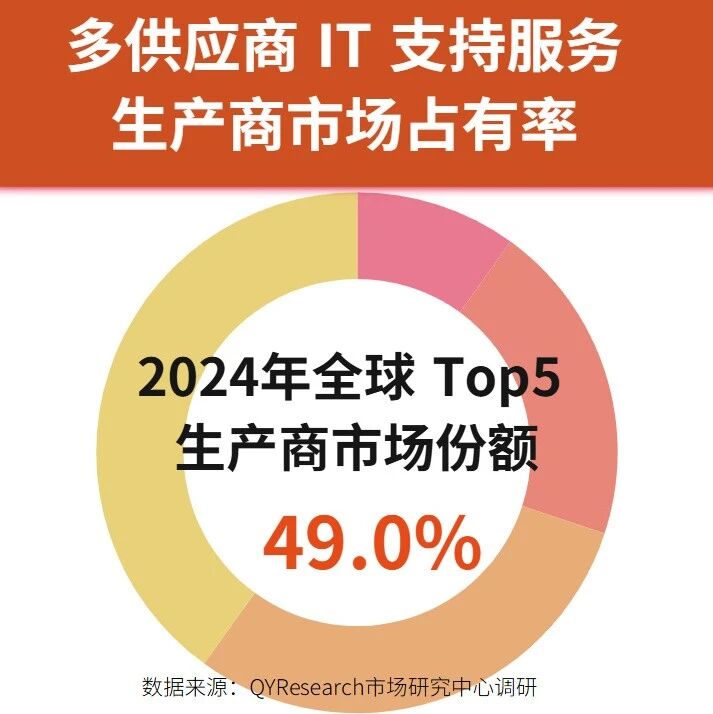
Core Viewpoint - The global multi-vendor IT support services market is projected to reach $18.29 billion by 2030, with a compound annual growth rate (CAGR) of 2.8% in the coming years [2]. Market Overview - Multi-vendor IT support services allow companies to provide support for various products from different manufacturers, including their own [1]. - The market is primarily dominated by hardware support services, which account for approximately 63.0% of the market share [11]. - The main application driving demand is sales and marketing, representing about 25.1% of the market [13]. Key Players - Major players in the global multi-vendor IT support services market include IBM, Fujitsu, Hitachi, NetApp, NEC, Lenovo, Dell, Oracle, and Broadcom [8]. - In 2024, the top five vendors are expected to hold around 49.0% of the market share [8]. Market Drivers - Medical technology support enhances IT support efficiency while complying with regulations [19]. - The complexity of managing IT assets drives the need for one-click IT support, as companies migrate applications and data to cloud environments [20]. - Cost and time savings are significant, with IT support management costs potentially reduced by up to 25% and hardware support time savings reaching 20% [21]. Market Challenges - The integration of advanced analytics and AI is necessary to manage IT issues before they escalate [21]. - The development of the Industrial Internet presents opportunities for multi-vendor IT support services software [22]. - The advent of 5G technology is expected to enhance connectivity and support the growth of IoT technologies [23].


别乱叫Air! 联想moto内涵友商,“落后者”定义标准遭群嘲 | BUG
Xin Lang Ke Ji· 2025-11-13 00:43
Core Viewpoint - Lenovo Moto is aggressively positioning itself in the smartphone market by criticizing competitors' "Air" products, particularly targeting Huawei and Apple, while struggling to achieve significant market share and brand recognition [2][4][16]. Group 1: Market Positioning and Competition - Lenovo Moto has introduced a standard for "Air" phones, claiming that true "Air" devices must be less than 6mm thick and weigh under 160g, which is seen as a direct critique of Huawei's Mate 70 Air and Apple's iPhone Air [2][6][10]. - In Q1 of this year, Lenovo Moto held nearly 5% of the global smartphone market, ranking ninth, and remains far from its goal of being among the top three globally [16][14]. - The introduction of the Moto X70 Air, with a thickness of 5.99mm and weight of 159g, is part of Lenovo's strategy to capture consumer interest in lightweight devices [5][6]. Group 2: Consumer Reception and Expert Opinions - Experts suggest that while the lightweight design may appeal to some consumers, it is unlikely to become mainstream due to the need for a balance between performance, battery life, and user experience [11][13]. - The focus on lightweight phones is seen as a marketing strategy rather than a substantial shift in consumer demand, with predictions that such devices will remain a niche market [11][13]. Group 3: Brand Challenges and Future Outlook - Motorola's brand presence in China has diminished since its acquisition by Lenovo in 2014, with previous attempts to launch various phone brands failing to gain traction [14][16]. - Lenovo aims to increase investment in its smartphone business to regain a competitive position within three years, although challenges remain due to strong competition from established domestic brands [14][16]. - The company faces significant hurdles in improving its market presence, including enhancing product innovation, brand recognition, and effective marketing strategies [16][20].

联想公布“双11”成绩单:全网销售额89亿元
Zheng Quan Ri Bao Wang· 2025-11-12 12:49
Core Insights - Lenovo achieved impressive sales performance during the 2025 "Double 11" shopping season, with total online sales reaching 8.9 billion yuan, securing 19 championships in various categories on JD.com [1][2] - The success reflects Lenovo's effective "AI upgrade" strategy and its successful transformation of technology into enhanced user experiences [2][4] Sales Performance - In the laptop segment, Lenovo led the market by winning the self-operated sales champion and POP sales champion, excelling in various subcategories [1] - Lenovo dominated the gaming laptop category, achieving first place in self-operated sales, POP sales, and JD's selected store sales [1] - The desktop and all-in-one PC categories also performed well, with Lenovo ranking first in cumulative self-operated brand sales and real-time self-operated store sales [1] - In the tablet segment, Lenovo secured the top position in both Android and HarmonyOS tablet sales across multiple rankings [1] - The smartphone category showed strong performance, with significant breakthroughs in sales revenue and market share [1] AI Integration and User Experience - Lenovo's success is attributed to its comprehensive AI empowerment across products and services, moving beyond mere functionality to enhance user experience [3][4] - The Tianxi AI 3.5 has been upgraded to transition from an "assistant" to a "teammate," providing personalized and proactive user engagement [3] - The integration of AI capabilities into the service system has transformed service models from passive responses to proactive anticipations, setting new standards for intelligent services [3][4] Industry Trends - The consumer electronics market is shifting from a price-driven approach to a value-driven one, with users increasingly prioritizing intelligent experiences and long-term brand value [2][4] - Lenovo's approach sets a benchmark for the industry, emphasizing technology-driven and experience-focused strategies, which are essential for healthy market development [4] - The competitive landscape is evolving towards a focus on technology and user experience rather than just price competition, fostering a healthier industry environment [4] Future Outlook - Lenovo plans to deepen the iteration of Tianxi AI and expand its "one body, multiple ends" strategy, aiming to broaden AI applications across various consumer and service scenarios [4] - The company is committed to leading the new era of intelligent consumption by providing smarter, more convenient, and valuable products and services [4]
城市超级智能体落地河南 联想集团与郑州航空港区签署战略合作协议
Zheng Quan Shi Bao Wang· 2025-11-12 11:53
Core Insights - Lenovo Group has signed a strategic cooperation agreement with Zhengzhou Airport Economy Comprehensive Experimental Zone to establish the Lenovo Intelligent Body Factory Central China Headquarters project, aiming to create the largest intelligent innovation incubation base in China [1][2] Group 1: Strategic Cooperation - The partnership will leverage Lenovo's "1+N Intelligent Body" technology architecture to deploy intelligent applications across five key areas: cross-border trade, smart manufacturing, smart energy, smart tourism, and health [1][2] - The goal is to attract over 100 upstream and downstream enterprises related to large models and register 100 large models, referred to as the "one hundred" target [1] Group 2: Regional Development - Zhengzhou Airport Economy Comprehensive Experimental Zone plays a crucial role in China's domestic circulation, connecting various regions and actively promoting the development of the digital economy and artificial intelligence industry [1][2] - Lenovo has been focusing on artificial intelligence since 2017, proposing the "Lenovo Smart China" vision and building a comprehensive AI strategy based on a new IT architecture [1][2] Group 3: Intelligent Body Technology - The Lenovo City Super Intelligent Body integrates advanced AI technologies such as deep learning, natural language processing, knowledge graphs, and edge computing, forming a city-level intelligent system with autonomous perception, intelligent decision-making, and collaborative execution capabilities [3] - The "1" in the architecture represents a unified super intelligent body hub, while "N" signifies multiple specialized intelligent bodies trained on domain-specific large models, capable of complex scene reasoning and multi-task parallel processing [3]