CNCB(00998)

Search documents
中信银行(601998.SH):赎回2020年二级资本债券
Ge Long Hui A P P· 2025-08-14 09:09
截至本公告日,经国家金融监督管理总局认可,本行已行使赎回权,全额赎回了本期债券。 格隆汇8月14日丨中信银行(601998.SH)公布,2020年8月12日至8月14日,公司发行了规模为人民币400 亿元的二级资本债券(以下简称"本期债券"),并于2020年8月15日发布了《中信银行股份有限公司关 于2020年二级资本债券发行完毕的公告》。根据本期债券募集说明书相关条款的规定,本期债券设有发 行人有条件赎回权,发行人有权在本期债券第5个计息年度的最后一日,即2025年8月14日部分或全部赎 回本期债券。 ...

中信银行(00998) - 中信银行股份有限公司关於赎回2020年二级资本债券的公告
2025-08-14 09:06
香港交易及結算所有限公司及香港聯合交易所有限公司對本公告的內容概不負責,對其準確 性或完整性亦不發表任何聲明,並明確表示,概不就因本公告全部或任何部份內容而產 生或 因依賴該等內容而引致的任何損失承擔任何責任。 中信銀行股份有限公司 China CITIC Bank Corporation Limited (在中華人民共和國註冊成立的股份有限公司) (股份代號:998) 於其他市場發佈的公告 本公告乃根據香港聯合交易所有限公司證券上市規則第 13.10B 條刊登。 茲載列該公告(於上海證券交易所網站刊登)如下,僅供參閱。 承董事會命 中信银行股份有限公司 关于赎回 2020 年二级资本债券的公告 中信銀行股份有限公司 方合英 董事長 中國•北京 2025年8月14日 於本公告日期,本行執行董事為方合英先生(董事長)、蘆葦先生(行長)及胡罡先生;非執 行董事為黃芳女士及王彥康先生;及獨立非執行董事為廖子彬先生、周伯文先生、王化成先生 及宋芳秀女士。 证券代码:601998 证券简称:中信银行 公告编号:临 2025-060 本行董事会及全体董事保证本公告内容不存在任何虚假记载、误导性陈述或 者重大遗漏,并对其内 ...
党建引领办实事 拆迁服务获民心——中信银行北京自贸试验区支行党支部圆满完成小红门乡拆迁项目服务工作
Bei Jing Shang Bao· 2025-08-14 08:58
项目期间,自贸试验区支行党支部服务拆迁群众数百户,一张张笑脸、一句句感谢,既是对支行服务的 肯定,也是对全体工作人员的勉励和鞭策。下一步,自贸试验区支行党支部将继续以党建为引领,跟进 政府工作部署、聚焦民生需求,把"群众满意"作为工作的出发点和落脚点,不断创新服务模式、提升服 务质效,在服务首都发展、办好民生实事中展现更多积极作为。 【好】中的人物的一次的人 « 对外国家的人发明 万人所的人才 发展 / 名中版版社 版权 / 10 / 7 / 理的外线机器的 为明 物质量的 16 发表的 从一年始为一起来到原分了我的人的人的人就很好了 25 分级的角 2012年以及服積、19 精通的优势 & M. S & Z & N. 18 # A = 19 & B & B = 1 ward it a nogang x a B Rine River 16年限147年9月17日 1947年1月19日 Mil. 1 & W 903 # # 0 x Mark Way Ma 12 AV. ARKAS RE ARET START 股票/股回收购 发出了 2018/12/19/1 采用/大发网站 3/10 19 6 19 30 18 6 ...


中信银行将依法合规、积极有序推动个人消费贷款财政贴息工作
Jin Tou Wang· 2025-08-14 03:42
Core Viewpoint - China CITIC Bank (601998) announced its initiative to promote personal consumption loan interest subsidies to stimulate domestic demand and enhance consumer spending potential in line with government policies [1] Group 1: Policy Implementation - The bank will implement the personal consumption loan interest subsidy program as per the "Implementation Plan for Personal Consumption Loan Financial Subsidy Policy" (Cai Jin [2025] No. 80) [1] - CITIC Bank will develop specific implementation details and operational guidelines to ensure efficient and convenient access to the subsidy for eligible customers [1] Group 2: Customer Communication - Customers are encouraged to follow CITIC Bank's official online channels and branch announcements for updates regarding the subsidy program [1] - The bank emphasizes that it will not charge any fees for processing personal consumption loan interest subsidies [1] Group 3: Security Measures - To protect customers from potential fraud, the bank advises against trusting communications from individuals outside its official channels regarding the subsidy program [1] - Customers are encouraged to contact CITIC Bank's 24-hour service hotline for any inquiries [1]
中信银行绿色金融 “信”守低碳每一度
Xin Jing Bao· 2025-08-14 03:40
Core Viewpoint - CITIC Bank is committed to promoting green finance and sustainable development, aligning with the philosophy that "lucid waters and lush mountains are invaluable assets" [4][10]. Group 1: Green Finance Initiatives - CITIC Bank has established a comprehensive governance structure for sustainable development, including a green finance development plan for 2024-2026 [4]. - The bank's green credit balance has exceeded 600 billion yuan, actively supporting industries and projects that align with green development trends [5]. - Innovations in green financial products include the issuance of the first overseas green bond and the launch of the first domestic biodiversity-themed bond index [5][6]. Group 2: Regional Contributions - Various branches of CITIC Bank are implementing green finance initiatives, such as: - Beijing branch supporting carbon reduction projects [6]. - Tianjin branch providing 110 million yuan in loans for a major seawater desalination project [6]. - Shanghai branch introducing CCER pledge loans for green low-carbon transitions [6][7]. Group 3: Climate Risk Management - CITIC Bank has developed a robust climate risk management system and is a supporter of TCFD and a member of the "Climate Investment and Financing Alliance" [10]. - The bank has established a management mechanism for climate risk identification, assessment, and response, integrating climate risk into its overall risk management framework [12][13]. Group 4: Low-Carbon Operations - The bank has incorporated low-carbon principles into its operational management, implementing guidelines to manage environmental footprints across various dimensions [14]. - Initiatives include promoting paperless operations and energy-saving renovations, with the Huzhou Deqing branch achieving LEED Gold certification for green building [15].

跟踪指数年内涨超20%,港股通央企红利ETF天弘(159281)即将结募,机构:港股红利资产股息溢价长期更高
2 1 Shi Ji Jing Ji Bao Dao· 2025-08-14 02:47
Core Viewpoint - The Hong Kong stock market is experiencing active performance in dividend-related concepts, with the Hong Kong Stock Connect Central Enterprise Dividend Index showing a year-to-date increase of 20.17% as of August 13 [1][2]. Group 1: Index and ETF Performance - The Hong Kong Stock Connect Central Enterprise Dividend Index (931233) has risen by 0.66% as of the latest report, with significant contributors including New China Life Insurance and China Overseas Grand Oceans Group [1]. - The Hong Kong Stock Connect Central Enterprise Dividend ETF Tianhong (159281) is currently being issued, with a management fee of 0.5% and a custody fee of 0.1% [1][2]. Group 2: Investment Value of the Index - The index reflects stable dividend levels and high dividend yields from centrally controlled enterprises, making it a favorable investment option within the Hong Kong Stock Connect framework [2]. - The investment value of the index is supported by four main factors: 1. High dividend assets are more attractive in a weak recovery market due to stable cash flows [2]. 2. Central enterprises are increasingly focusing on market performance and dividend expectations as part of their value management [2]. 3. The Hong Kong market has a higher emphasis on dividends compared to the A-share market, with significant differences in dividend ratios and yields [3]. 4. The long-term effectiveness of dividend investment strategies in the Chinese market is supported by historical data showing a 10% annualized return over the past decade [3]. Group 3: Market Comparisons - The Hang Seng Index's dividend yield is currently higher than that of the Shanghai Composite Index, with the Hang Seng High Dividend Yield Index at 6% compared to the 4.6% of the A-share market [3]. - The long-term dividend yield premium of Hong Kong dividend assets over long-term government bonds has remained positive since 2019, indicating a stronger performance compared to A-shares [3].

银行理财产品移行提速 资管新规进入过渡期
Bei Jing Shang Bao· 2025-08-13 23:12
Core Viewpoint - The migration of bank wealth management products to wealth management subsidiaries is accelerating as the transition period for asset management regulations approaches its end, with several banks announcing plans to transfer their products [1][4]. Group 1: Migration of Wealth Management Products - China Merchants Bank and CITIC Bank have announced plans to transfer several previously issued wealth management products to their respective wealth management subsidiaries [2][3]. - The migration includes specific products such as "CITIC Wealth Management Growth Strong Bond Daily Open Net Value RMB Wealth Management Product" and others, with a scheduled pause in subscription and redemption transactions [2][3]. - This marks the eighth transfer of wealth management products by China Merchants Bank this year, totaling 59 products transferred to its wealth management subsidiary [4]. Group 2: Reasons for Acceleration - Analysts suggest that the increasing maturity of wealth management subsidiaries in terms of product issuance, sales, operational management, and investment research capabilities necessitates the accelerated migration of wealth management products from parent banks [1][4]. Group 3: Challenges in Migration - The migration process may face challenges such as system compatibility issues, customer acceptance of product name changes, and the management of existing assets, particularly those with flaws or risks [5]. - Wealth management subsidiaries are advised to maintain strict financial separation from parent banks and enhance their product offerings through improved risk control and investment research capabilities [6].

多家银行迅速响应两项贷款贴息政策
Zheng Quan Ri Bao· 2025-08-13 16:43
Core Viewpoint - The implementation of the personal consumption loan interest subsidy policy and the service industry loan interest subsidy policy is expected to optimize and expand service consumption supply, creating new growth points for service consumption [1][2][3] Group 1: Policy Implementation - The personal consumption loan interest subsidy policy will be effective from September 1, 2025, to August 31, 2026, allowing eligible personal consumption loans to enjoy interest subsidies [2] - Major banks, including Industrial and Commercial Bank of China, Agricultural Bank of China, and others, have announced their commitment to implement the personal consumption loan interest subsidy policy in accordance with market-oriented and legal principles [2][3] - The service industry loan interest subsidy policy will support eight categories of service sectors, including catering, health, and tourism, from March 16, 2025, to December 31, 2025 [3] Group 2: Impact on Banking Sector - The interest subsidy policies are expected to positively impact credit, particularly operational loans, and enhance the market share of state-owned and joint-stock banks [4] - The policies are anticipated to drive structural growth in consumer finance and inclusive finance, with an increase in the proportion of retail and inclusive loans [4] - The policies will create new growth opportunities for banks in three dimensions: structural expansion of consumer credit, solidifying the client base for corporate clients, and synergizing retail and corporate business [4] Group 3: Challenges and Risk Management - The implementation of the subsidy policies presents challenges for banks, necessitating enhanced risk management throughout the loan process, particularly regarding the use of loans [5] - Banks are advised to strengthen system support, optimize business processes, and enhance risk prevention measures to ensure asset quality remains stable [5][6] - The need for digital risk management and improved comprehensive financial service capabilities is emphasized for achieving high-quality development [6]



个人消费贷贴息下月来了!国有大行、股份行“入围”,最高补多少?
Sou Hu Cai Jing· 2025-08-13 11:57
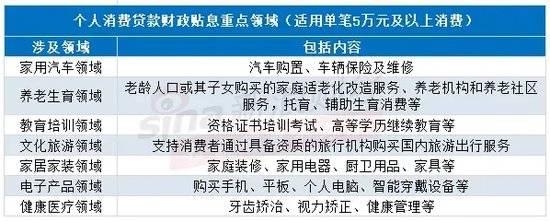
Core Viewpoint - The Ministry of Finance, the Central Bank, and the Banking Regulatory Commission have released a personal consumption loan interest subsidy policy aimed at stimulating consumer spending from September 1, 2025, to August 31, 2026, with a maximum subsidy of 3,000 yuan per borrower [1][4]. Summary by Relevant Sections Policy Details - The subsidy applies to personal consumption loans used for various categories, including household vehicles, elderly care, education, cultural tourism, home decoration, electronics, and healthcare [2][3]. - The annual subsidy rate is set at 1%, with a maximum of 50% of the loan contract interest rate, funded by central and provincial finances [3][4]. Eligible Institutions - A total of 23 lending institutions have been selected, including 6 state-owned banks and 12 joint-stock banks, while local banks such as city commercial banks and rural commercial banks are notably absent [5][7]. Borrower Guidelines - Borrowers must authorize lending institutions to access transaction information to qualify for the subsidy, which will not affect their ability to apply for loans or repay them [6][9]. Market Impact - The policy is expected to increase market concentration towards larger banks, with analysts predicting a potential recovery in credit demand, particularly for operational loans [9][10]. - The subsidy is anticipated to significantly boost consumer demand, with estimates suggesting that every 100 billion yuan in fiscal spending could leverage 1 trillion yuan in consumption [10][11].


信用卡用卡新规:场景单一化触发系统风控,多元化消费成持卡人必修课!
Sou Hu Cai Jing· 2025-08-13 08:51
Core Viewpoint - Recent reports indicate that credit card holders are facing temporary suspensions due to abnormal transaction scenarios, particularly "same-name merchant transactions" and "high-frequency transactions at a single merchant" [1][3]. Group 1: Same-name Merchant Transactions - Transactions at POS terminals with merchant names containing the cardholder's name trigger immediate alerts from banks, leading to temporary suspensions due to suspected identity association [3]. - The bank's risk control system flags these transactions as potential "closed-loop fund flow" suspicions, requiring cardholders to provide proof of payment purpose and settle any outstanding debts to lift restrictions [3]. Group 2: High-frequency Transactions at a Single Merchant - Data from the payment industry shows a 37% year-on-year increase in credit card risk control cases due to "concentrated transactions at a single merchant" over the past six months [5]. - Several banks, including China Construction Bank, have implemented measures such as reducing credit limits and freezing cards for high-value, frequent transactions at the same merchant [5]. Group 3: Risk Control Measures by Banks - Minsheng Bank has implemented transaction permission controls to precisely intercept and restrict credit card transactions at specific merchants [7]. - Citic Bank sends warning messages to users when frequent transactions at the same merchant trigger abnormal monitoring [7]. Group 4: Compliance and Transaction Patterns - Credit cards are primarily intended for daily consumption; thus, high-frequency transactions at the same terminal, especially large round-number transactions, may resemble "cash-out transaction characteristics" [8]. - Transactions that do not align with the merchant's actual business scale or daily consumption patterns are closely monitored by banks' risk control systems [8]. Group 5: Recommendations for Cardholders - Experts suggest cardholders diversify their transaction habits by using 2-3 different POS terminals and merchant payment codes to cover various industries, avoiding the risk of transaction scenario solidification [9]. - Cardholders should increase the proportion of genuine consumption across different platforms and ensure a transaction structure of "small frequent + large dispersed" to pass risk control checks more easily [11]. - It is advised to avoid frequent transactions at the same terminal within short time frames and ensure large transactions match the merchant's business type [11]. Group 6: Building a Diverse Transaction Ecosystem - Cardholders should align their transaction behaviors with real-life spending patterns by utilizing different merchant codes, consumption scenarios, and payment channels to create transaction data that reflects "normal consumption logic" [12]. - Combining traditional POS machines with merchant payment codes can generate varied merchant codes, breaking the single-entity transaction pattern [13]. - Incorporating daily high-frequency spending scenarios, such as dining and shopping, along with covering utility payments and educational expenses, can enhance transaction diversity [13].