
KUAISHOU(01024)

Search documents
港股收盘:恒生科技指数跌2.13%,机器人概念股跌幅居前,卧安机器人跌约12%
Jin Rong Jie· 2026-02-24 08:24
Market Performance - The Hong Kong stock market saw a decline, with the Hang Seng Index dropping by 1.82% to 26,590.32 points, the Hang Seng Tech Index falling by 2.13% to 5,270.7 points, and the National Enterprises Index decreasing by 2.06% to 9,007.86 points [1] - Notable declines were observed in major tech stocks, including Alibaba (-2.76%), Tencent (-3.35%), and Meituan (-4.24%) [1] Company News - CK Hutchison Holdings expressed opposition to the Panamanian government's forceful takeover of the Panama Ports Company's assets, employees, and operations, which has led to the cessation of operations at Balboa and Cristobal ports [2] - The company plans to explore all possible legal avenues against the Panamanian government and related parties due to the illegality of the government's actions [2] Industry Insights - China Galaxy Securities highlighted that the technology sector remains a long-term investment focus, with expectations of a rebound following recent corrections, driven by advancements in AI models and applications [2] - The firm also noted that the consumer sector is positioned for potential growth as consumer policies increase, while geopolitical risks and U.S. tariff adjustments may benefit precious metals and energy sectors [2]






38家单位签署自律公约:保障微短剧行业演职人员合法权益,按时足额付薪酬
Xin Lang Cai Jing· 2026-02-24 08:00
Core Viewpoint - The China Network Audio-Visual Association's Micro-Short Drama Working Committee has released a self-discipline convention aimed at safeguarding the legal rights of personnel in the micro-short drama industry, emphasizing the importance of clear agreements and timely payment of wages [1][3]. Group 1: Key Provisions of the Self-Discipline Convention - Parties must negotiate and clearly define work content, duration, salary standards, payment cycles, and responsibilities before employment, ensuring traceability [1][2]. - Employers are required to pay wages on time and in full, with encouragement for measures like salary escrow accounts and advance payment mechanisms to prevent wage arrears [2][3]. - Safety measures must be established for filming activities, including emergency plans and supervision for high-risk tasks [2]. Group 2: Protection of Minors - Strict regulations are in place to protect the rights of child actors, ensuring their rest, health, and education, with mandatory guardian supervision during filming [2]. Group 3: Industry Collaboration - The micro-short drama production bases are encouraged to collaborate with industry associations to establish rights protection mechanisms and provide legal training and consultation services for personnel [2][3]. Group 4: Signatory Companies - The first batch of signatory companies includes major players such as iQIYI, Baidu, Bilibili, and Kuaishou, totaling 38 companies committed to the self-discipline convention [1][4][5].



最高2026元、随机“加油包”,互联网大厂“花式”发开工红包
Bei Ke Cai Jing· 2026-02-24 06:45
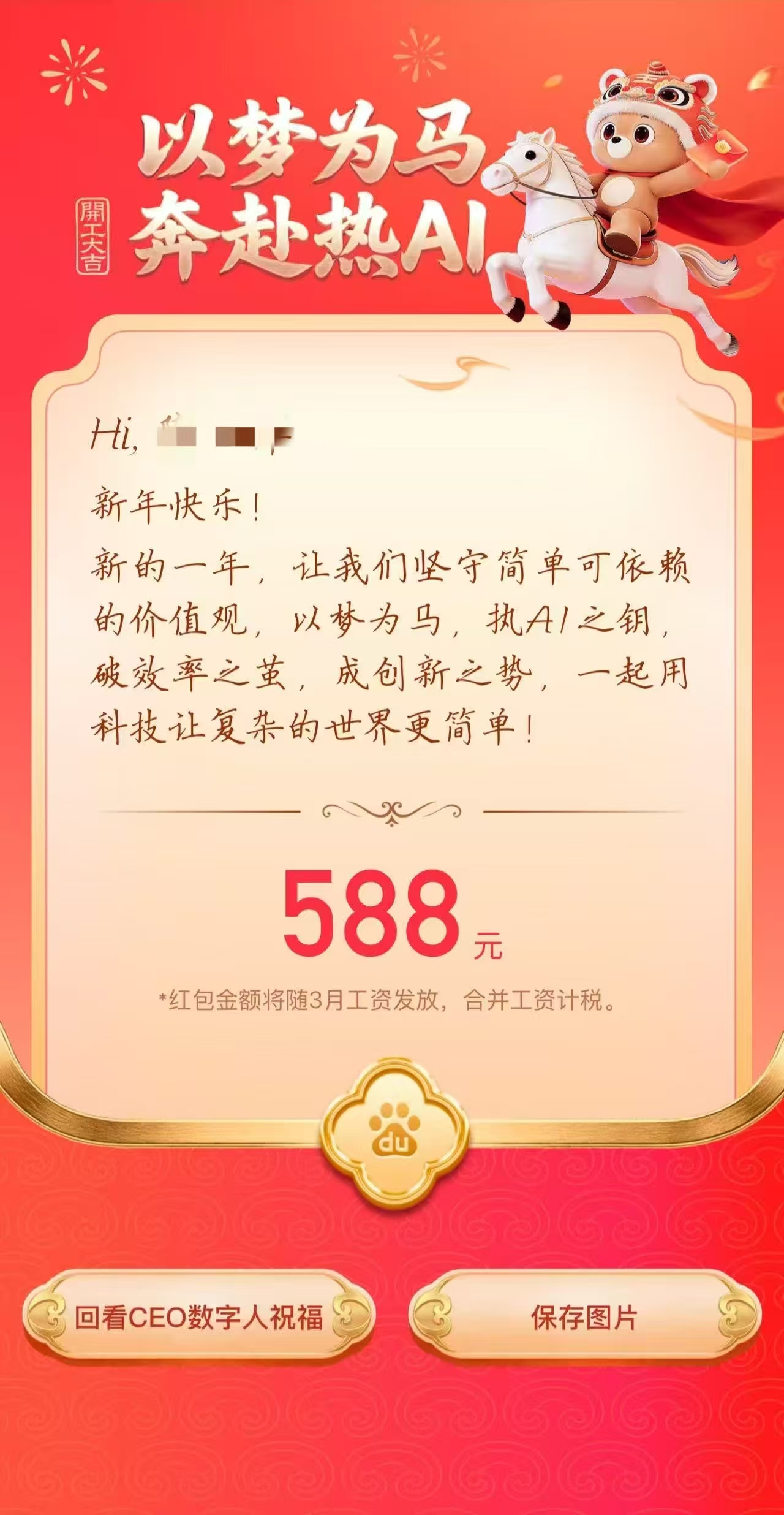
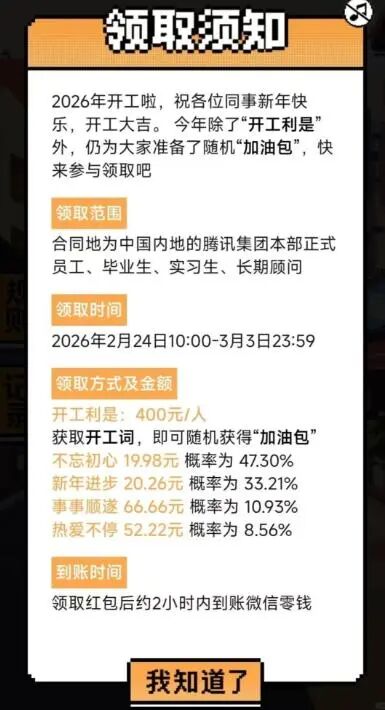
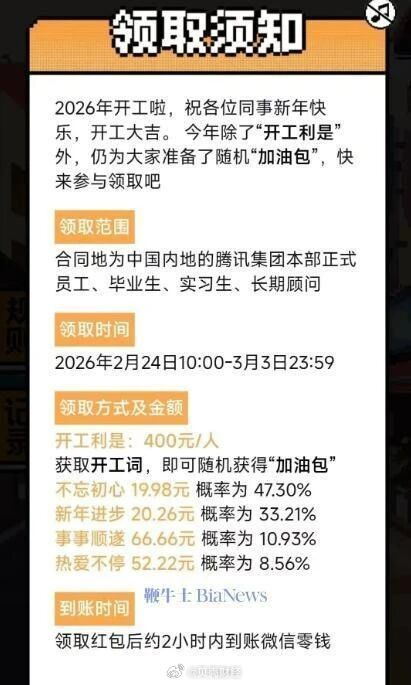
新京报贝壳财经讯 "最高2026元超大额红包""每人400元开工利是外还有随机'加油包'"……2月24日,马年首个开工日,多家互联网大厂给员工发开工红包。 百度创始人李彦宏的数字人,通过工作软件"如流"的服务号,向全体员工发送定制祝福及开工红包。据透露,百度这次发放开工红包的金额,在365元、588 元、666元、888元、2026元不等,员工最高可以获得2026元的超大额开工红包,实习生也可获得188元的开工红包。 百度员工收到的开工红包截图。 雷军和小米高管团队一起,给小米员工发开工红包,并祝福大家新一年红红火火,万事大吉。 腾讯除"开工利是"每人400元外,还准备了随机"加油包",共分为"不忘初心19.98元""新年进步20.26元""事事顺遂66.66元""热爱不停52.22元"四档,概率分别 为47.30%、33.21%、10.93%、8.56%。 腾讯的开工红包领取通知。 此外,快手也在马年首个工作日准备了开工红包,员工和实习生分别可以收到366元和200元的红包;OPPO也为所有员工发放了现金100元的开工红包。 快手实习生收到的开工红包截图。 编辑 杨娟娟 校对 杨利 图/受访者供图 ...

瑞银:今年人工智能代理采用率加速 看好腾讯控股等
Zhi Tong Cai Jing· 2026-02-24 06:15
Group 1 - UBS report indicates that 2026 may be a pivotal year for the large-scale adoption of AI agents, transitioning from dialogue to action [1] - The report highlights a divergence in application scenarios, with the US focusing on enterprise-level applications while China invests more in consumer-facing services [1] - Major Chinese internet companies launched red envelope activities during the Spring Festival to drive traffic to their AI services, including Tencent's 1 billion RMB, Alibaba's 3 billion RMB, Baidu's 500 million RMB, and ByteDance's offerings [1] - This initiative is expected to accelerate AI adoption among users, particularly in lower-tier cities, enhancing the use of AI and intelligent agent features [1] - Long-term expectations suggest a consolidation trend in China's AI chatbot market, similar to the market landscape of ChatGPT in the US, leveraging the existing user base and ecosystems of internet giants [1] Group 2 - UBS recently initiated coverage on MiniMax-WP, believing the company is well-positioned to benefit from the AI tailwinds in China and globally [2] - The firm assesses that the disruption risk of AI in China is likely lower than in the US [2] - Among internet giants, Alibaba and Baidu are favored for their full-stack AI capabilities, while Tencent and Kuaishou are seen as having potential in AI application fields [2]
互联网大厂花式发开工红包:腾讯除每人400元外,还准备了随机“加油包”;百度为首次发放,最高可得2026元;还有京东、快手、淘天……
Mei Ri Jing Ji Xin Wen· 2026-02-24 06:13
Group 1 - Companies are distributing "opening red envelopes" to employees after the New Year holiday, with Tencent giving 400 yuan per person and additional random "boost packages" [1] - Kuaishou is providing opening red envelopes of 366 yuan for full-time employees and 200 yuan for interns [3] - Baidu's founder, Li Yanhong, sent customized blessings and opening red envelopes through the work software "Ruliu," with amounts ranging from 365 yuan to 2026 yuan for employees, while interns receive 188 yuan [5] - Xiaomi's CEO Lei Jun announced that he and the company's executives are distributing opening red envelopes to employees [7] - JD.com is reported to have given out lollipop red envelopes [9] - Taotian Group is providing scratch cards and plush toys as opening gifts for employees [11]
瑞银:今年人工智能代理采用率加速 看好腾讯控股(00700)等
智通财经网· 2026-02-24 05:57
Group 1 - UBS reports that 2026 may be a pivotal year for the large-scale adoption of AI agents, with applications shifting from dialogue to action [1] - The report highlights a divergence in application scenarios, with the US focusing on enterprise-level applications while China invests more in consumer-facing services [1] - Major Chinese internet companies launched red envelope activities during the Spring Festival to drive traffic to their AI services, including Tencent's 1 billion RMB, Alibaba's 3 billion RMB, Baidu's 500 million RMB, and ByteDance's offerings [1] Group 2 - The report anticipates that the AI chatbot market in China may experience a consolidation trend similar to the market landscape of ChatGPT in the US [1] - The existing large user base and complete ecosystems of internet giants in China will help foster consumer-facing AI super applications, becoming new traffic entry points in the market [1] - UBS has initiated coverage on MiniMax-WP, believing the company is well-positioned to benefit from the AI tailwinds in both China and global markets [2]
互联网大厂花式发开工红包:腾讯除每人400元外,还准备了随机“加油包”;雷军和小米高管团队一起亲自发;百度为首次发放最高可得2026元
Sou Hu Cai Jing· 2026-02-24 05:35
新闻荐读 2月24日,新年假期后的开工日,多家公司给员工发开工红包。腾讯除"开工利是"每人400元外,还准备了随机"加油包"。 根据截图,红包中写到:新年快乐!新的一年,让我们坚守简单可依赖的价值观,以梦为马,执AI之钥,破效率之茧,成创新之势,一起用科技让复杂 的世界更简单!值得注意的是,此前,百度并没有在春节假期结束后发放开工红包的习惯。 来源:东方财经 编辑:余敏 审定:金官 核发:邹建宾 雷军和小米高管团队一起,给小米员工发开工红包,并祝福大家新一年红红火火,万事大吉。 快手给全员发开工红包,据了解正式员工366元,实习生200元。 百度创始人李彦宏的数字人,通过工作软件"如流"的服务号,向全体员工发送定制祝福及开工红包,实习生同学也有份。 据透露,百度这次发放开工红包的金额,在365元、588元、666元、888元、2026元不等,员工最高可以获得2026元的超大额开工红包,实习生则可获得 188元的开工红包。百度此次开工红包金额跟在职年限无关,而是系统随机分配。 点亮 ...
腾讯小米快手百度开工日发红包,百度最高2026元
Bei Ke Cai Jing· 2026-02-24 05:12
【#互联网大厂花式发开工红包# [拜托]#是谁开工第一天被狠狠宠到# [doge]】 据透露,百度这次发放开工红包的金额,在365元、588元、666元、888元、2026元不等,员工最高可以 获得2026元的超大额开工红包,实习生则可获得188元的开工红包。百度此次开工红包金额跟在职年限 无关,而是系统随机分配。 根据截图,红包中写到:新年快乐!新的一年,让我们坚守简单可依赖的价值观,以梦为马,执AI之 钥,破效率之茧,成创新之势,一起用科技让复杂的世界更简单!值得注意的是,此前,百度并没有在 春节假期结束后发放开工红包的习惯。 (东方财经) 2026年开工啦,祝各位同事新年快 乐, 开工大吉。 今年除了"开工利是" 外,仍为大家准备了随机"加油包",快 来参与领取吧 2月24日,新年假期后的开工日,多家公司给员工发开工红包。腾讯除"开工利是"每人400元外,还准备 了随机"加油包"。 雷军和小米高管团队一起,给小米员工发开工红包,并祝福大家新一年红红火火,万事大吉。 快手给全员发开工红包,据了解正式员工366元,实习生200元。 百度创始人李彦宏的数字人,通过工作软件"如流"的服务号,向全体员工发送定制祝 ...
瑞银:看好中国AI成本优势 偏好阿里(09988)、百度(09888)、腾讯(00700)及快手
智通财经网· 2026-02-24 04:18
Group 1 - UBS report indicates that by 2026, AI agents are expected to achieve large-scale applications, shifting from dialogue to action scenarios [1] - There is a divergence in application scenarios between the US and China, with the US focusing more on enterprise applications while China invests heavily in consumer services [1] - Leading AI labs globally, such as Anthropic and OpenAI, will prioritize enterprise development and monetization by 2026 [1] Group 2 - Chinese AI models, including MiniMax, Kimi, and GLM, have significantly increased their share in emerging agent products like OpenClaw [1] - UBS is optimistic about the long-term market share growth of Chinese AI models in the global enterprise API market due to their improving intelligence and cost-effectiveness [1] - Major Chinese internet companies launched red envelope activities during the Spring Festival to drive AI product traffic, with Tencent's Yuanbao (1 billion RMB), Alibaba's Tongyi Qianwen (3 billion RMB), and Baidu's Wenxin Yiyan (500 million RMB) [1] Group 3 - A wave of model releases occurred during the Spring Festival, narrowing the capability gap with leading global AI labs [2] - UBS believes that the ongoing disruptive narrative around AI has boosted investment sentiment among model providers, but investors remain cautious about vertical platforms and application companies [2] - UBS has initiated a positive investment rating for MiniMax and is optimistic about Alibaba and Baidu's full-stack AI capabilities, as well as Tencent and Kuaishou's potential in AI applications [2]
瑞银:看好中国AI成本优势 偏好阿里(09988)、百度(09888)、腾讯(00700)及快手(01024)
Zhi Tong Cai Jing· 2026-02-24 04:00
Core Insights - UBS reports that by 2026, AI agents are expected to achieve large-scale applications, shifting from dialogue to action [1] - There is a divergence in application scenarios between the US and China, with the US focusing on enterprise applications while China invests more in consumer services [1] - Leading AI labs globally, such as Anthropic and OpenAI, will prioritize enterprise development and monetization by 2026 [1] - Chinese AI models like MiniMax, Kimi, and GLM are gaining significant market share in emerging products like OpenClaw [1] - UBS is optimistic about the long-term growth of Chinese AI models in the global enterprise API market due to their improving intelligence and cost-effectiveness [1] Company Activities - Major Chinese internet companies launched red envelope activities during the Spring Festival to drive AI product traffic, including Tencent's 1 billion RMB, Alibaba's 3 billion RMB, and Baidu's 500 million RMB initiatives [1] - UBS believes these activities will accelerate AI penetration among users in lower-tier cities and promote the use of AI functionalities such as image and video generation and real-time commerce [1] Model Development - A wave of model releases occurred during the Spring Festival, narrowing the capability gap with leading global AI labs [2] - UBS notes that the ongoing disruptive narrative around AI has boosted investment sentiment among model providers, but investors remain cautious about vertical platforms and application companies [2] - UBS has initiated a positive investment rating for MiniMax and is optimistic about Alibaba and Baidu's full-stack AI capabilities, as well as Tencent and Kuaishou's potential in AI applications [2]