
KUAISHOU(01024)

Search documents
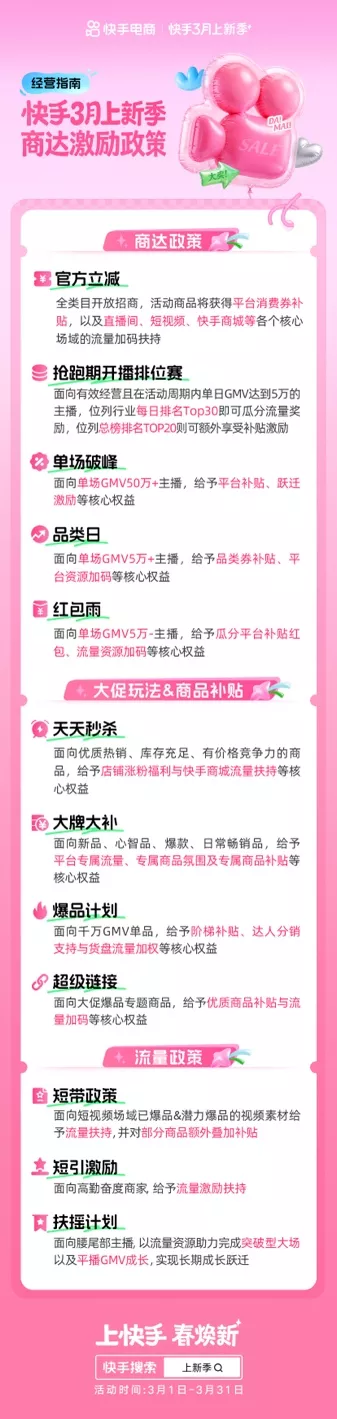
快手3月上新季发布商达政策 全域资源助推商家焕新好生意
Cai Jing Wang· 2026-02-25 04:50
Core Insights - The article discusses the launch of Kuaishou's March New Product Season, which aims to stimulate consumer demand through various promotional policies and incentives for merchants [1][4]. Group 1: Merchant Policies - The merchant policy is open to all categories, providing platform consumption coupon subsidies and increased traffic support across key areas such as live streaming and short videos [4]. - A ranking competition is available for effective operators achieving a daily GMV of 50,000, with top performers eligible for traffic rewards and additional subsidies [4]. - Special incentives are provided for high-performing live streams, including subsidies and resource boosts for those achieving GMV of 500,000 or more in a single session [4]. Group 2: Promotional Strategies and Subsidies - Daily flash sales are targeted at high-demand, competitively priced products, offering benefits such as increased store followers and traffic support [4]. - Special support is available for new products and bestsellers, including exclusive traffic and product subsidies [4]. - The "Super Link" initiative focuses on promotional products, providing quality product subsidies and traffic boosts [4]. Group 3: Traffic Policies - Short video policies offer traffic support for existing and potential best-selling products, with additional subsidies for select items [5]. - High-engagement merchants receive traffic incentives to enhance their visibility [5]. - The "Fuyou Plan" aims to assist mid-tier and lower-tier streamers in achieving significant growth in GMV through resource allocation [5]. Group 4: Overall Strategy - Kuaishou's March New Product Season has commenced, focusing on comprehensive merchant support through subsidies, traffic incentives, and promotional strategies to capitalize on renewed consumer demand [5].

春节假期AI、大模型迭代及游戏观点梳理更新
2026-02-25 04:12
Summary of Conference Call Notes Industry Overview - The focus is on the AI application industry, particularly during the Spring Festival period, which is expected to see significant growth in AI applications, especially "super assistants" [1][2] - Major players in the industry include ByteDance, Tencent, and Alibaba, all of which are embedding their core model capabilities into various applications, including program production and social interactions [1][3] Key Insights and Arguments - **AI Application Growth**: There is strong confidence in the explosive growth of AI applications, particularly "super assistants," which are expected to become a benchmark for investment and industry observation this year [1] - **User Engagement**: During the Spring Festival, user engagement metrics for AI applications showed significant increases, with ByteDance's AI interaction reaching 1.9 billion times and generating over 50 million themed avatars [3] - **Tencent's Strategy**: Tencent focused on cash activities during the Spring Festival, investing 1 billion yuan in red envelope activities, achieving over 500 million daily active users (DAU) and 1.14 billion monthly active users (MAU) [4] - **Alibaba's Differentiation**: Alibaba's strategy involved validating AI agents' task execution capabilities in real consumption scenarios, launching significant promotional activities during the Spring Festival [4] Additional Important Points - **User Demographics**: Notably, 49% of users engaging in red envelope activities during the Spring Festival came from third- and fourth-tier cities, indicating a trend of user engagement expanding into lower-tier markets [5] - **Game Industry Performance**: The gaming sector also showed robust performance, with games like "Peace Elite" achieving DAU of over 90 million during the Spring Festival [6] - **Emerging Trends**: There is a notable trend of user engagement in AI applications among older demographics, with nearly 400,000 users aged 60 and above experiencing AI services for the first time [5] - **Market Dynamics**: The competition among AI models is intensifying, with new models being released frequently, and the performance of domestic models is rapidly catching up to international counterparts [31][32] Financial Performance and Market Sentiment - **Stock Performance**: Companies like Zhiyu and Minmax have seen strong stock performance due to high growth rates and the release of new models that exceeded market expectations [31][32] - **Valuation Framework**: The valuation of large model companies in the secondary market is influenced by model advancements and commercialization progress, with a focus on reasonable valuation ranges [33][34] - **Investment Opportunities**: There are significant investment opportunities in AI applications and software stocks, particularly as models are commercialized and integrated into various applications [36][37] Conclusion - The AI application industry is poised for significant growth, driven by user engagement, innovative strategies from major players, and the rapid advancement of AI models. Investors are encouraged to monitor developments closely, particularly in the context of emerging trends and market dynamics.
2026年春节“AI红包”派发超45亿元 “脉冲式流量”后用户黏性成关键
Xin Hua Cai Jing· 2026-02-25 03:27
Core Insights - The 2026 Spring Festival AI "ecological battle" marked a significant shift in the domestic AI industry from technical competition to a focus on consumer scenarios, with major players investing over 4.5 billion yuan during the holiday [1] - Different strategies were employed by major companies: Doubao leveraged exclusive AI collaboration with the Spring Festival Gala, Alibaba's Qianwen combined "free orders + consumption" to drive real transactions, while Tencent's Yuanbao utilized social interactions within the WeChat ecosystem to maintain user engagement [1][2] Investment and Market Dynamics - The competition is increasingly concentrated among leading platforms, creating significant barriers for smaller players, as the focus shifts from model parameters to integrating AI into daily consumption, social, and entertainment scenarios [2] - The ability to convert short-term user engagement into long-term value will be crucial for success in the AI market, with key factors including addressing real user pain points, continuous model iteration based on user data, and seamless integration into existing ecosystems [2][3] User Retention and Experience - Retaining users post-campaign will depend more on the core value and experience of AI products rather than the size of the red envelopes offered, emphasizing the importance of integrating AI assistants into real-life scenarios [3] - Historical context suggests that successful integration of payment behaviors into social interactions, as seen with WeChat red envelopes, is essential for transforming short-term traffic into lasting user engagement [3]


智通港股沽空统计|2月25日
智通财经网· 2026-02-25 00:24
Group 1 - Anta Sports-R (82020), JD Health-R (86618), and Geely Automobile-R (80175) have the highest short-selling ratios at 100.00%, 100.00%, and 95.46% respectively [1] - Tencent Holdings (00700), Alibaba-W (09988), and Meituan-W (03690) lead in short-selling amounts, with 2.193 billion, 1.867 billion, and 1.658 billion respectively [1] - Geely Automobile-R (80175), Tencent Holdings-R (80700), and Blue Moon Group (06993) have the highest deviation values at 56.09%, 35.57%, and 33.29% respectively [1] Group 2 - The top short-selling ratio rankings show Anta Sports-R (82020) at 100.00% with a short-selling amount of 29.79 thousand, followed by JD Health-R (86618) at 100.00% with 9.88 thousand, and Geely Automobile-R (80175) at 95.46% with 31.09 thousand [2] - The top short-selling amounts are led by Tencent Holdings (00700) at 2.193 billion, Alibaba-W (09988) at 1.867 billion, and Meituan-W (03690) at 1.658 billion [2] - The highest short-selling deviation values are led by Geely Automobile-R (80175) at 56.09%, followed by Tencent Holdings-R (80700) at 35.57%, and Blue Moon Group (06993) at 33.29% [2]



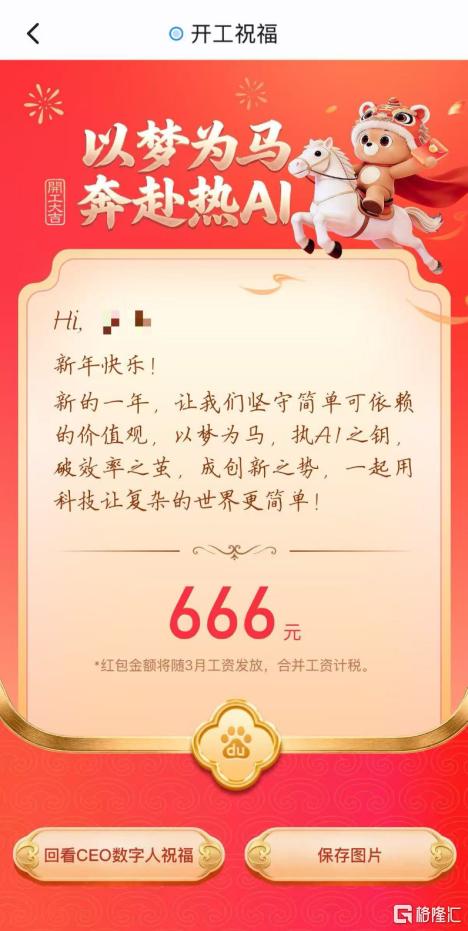
腾讯百度小米等互联网大厂发开工红包,最高金额达2026元
Ge Long Hui· 2026-02-24 13:10
Group 1 - Major technology and internet companies such as Tencent, Kuaishou, Baidu, and Xiaomi distributed "opening work" red envelopes to employees, with the highest amount reaching 2026 yuan [1][3] - Baidu's red envelope amounts varied from 365 yuan to 2026 yuan, with interns receiving a uniform amount of 188 yuan; Tencent provided 400 yuan to all employees and additional random amounts between 19.98 yuan and 66.66 yuan; Kuaishou distributed 366 yuan to full-time employees and 200 yuan to interns; Xiaomi's founder and CEO Lei Jun personally handed out red envelopes [3] - The red envelope amounts were primarily based on auspicious numbers, reflecting the festive atmosphere of the Year of the Horse and demonstrating the companies' care for employees, thereby enhancing their sense of belonging and team cohesion [4]
“烧钱”80亿发红包,四款AI轮流登顶榜首,背后公司股价却集体走低,靠“撒钱”能留住用户吗?
Xin Lang Cai Jing· 2026-02-24 12:30
Core Insights - The "AI Red Packet War" among internet companies has concluded following the Spring Festival holiday, with significant financial investments made in AI tools and related apps [1][11] - A total of over 8 billion yuan was reportedly spent by multiple internet companies during this period, raising questions about user retention beyond the monetary incentives [3][13] Investment and User Engagement - Alibaba's Qianwen invested 3 billion yuan, Tencent's Yuanbao distributed 1 billion yuan, and ByteDance's Doubao offered tech gifts during the campaign [3][13] - Yuanbao reported over 50 million daily active users (DAU) and 114 million monthly active users (MAU) during the event, with users participating in over 36 billion lottery draws and completing over 1 billion AI creations [14] - Qianwen facilitated nearly 200 million orders during the Spring Festival, with significant sales in beverage categories [14] App Performance - Four apps, Yuanbao, Qianwen, Antifortune, and Doubao, dominated the iOS free app rankings, with varying durations at the top [4][14] - Post-campaign, Yuanbao's ranking dropped significantly, indicating potential challenges in maintaining user engagement [18] Market Reaction - The capital market showed skepticism towards the "AI Red Packet War," with the Hang Seng Technology Index experiencing declines, and major companies like Alibaba and Tencent seeing their stock prices fall [6][16] User Retention Challenges - Experts suggest that user retention will depend more on the core value and experience of the products rather than the size of the red packets [8][19] - Successful AI tools must integrate into real-life scenarios and provide personalized services to maintain user interest [19][20] Future Outlook - The "AI Red Packet War" may signify a pivotal shift from mobile internet to AI internet in China, similar to how WeChat red packets transformed payment landscapes [19] - The AI assistant market is expected to evolve into a competitive landscape with differentiated offerings, where leading players leverage ecosystems and scale [20]
智通港股通活跃成交|2月24日





智通财经网· 2026-02-24 11:04
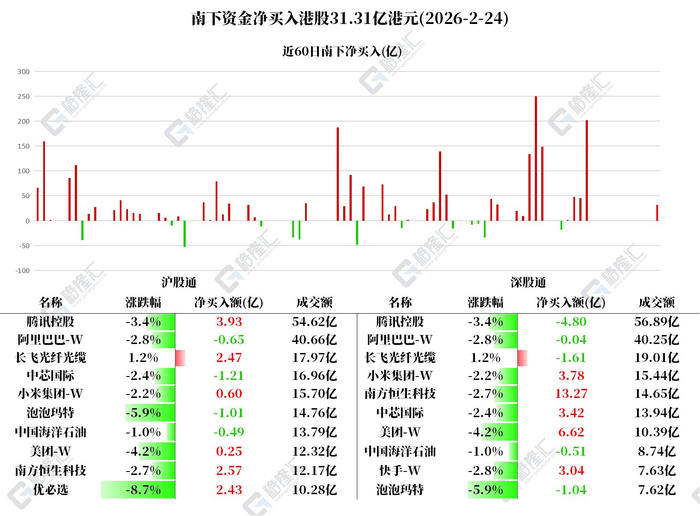
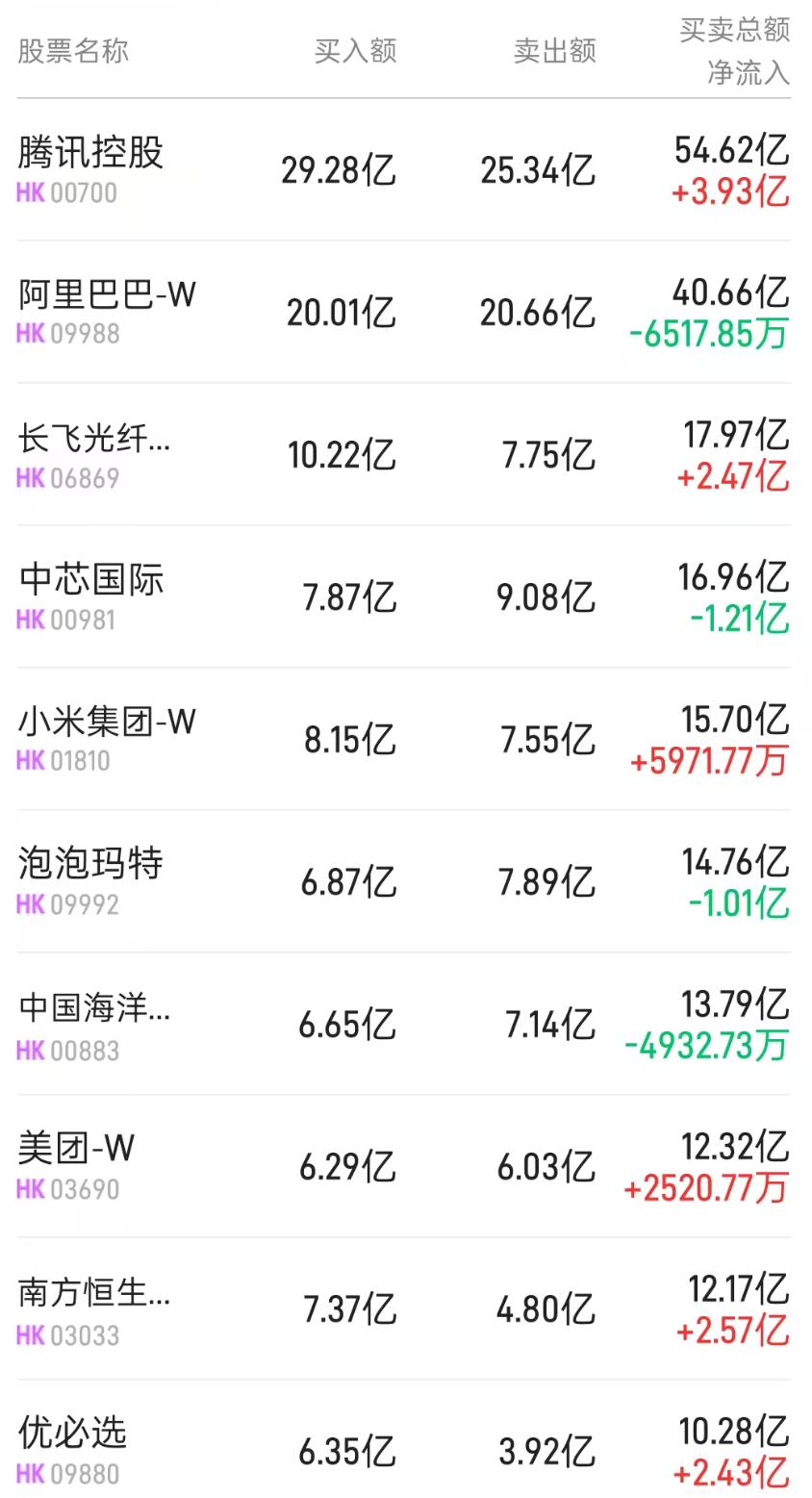
Core Insights - On February 24, 2026, Tencent Holdings (00700), Alibaba-W (09988), and Yangtze Optical Fibre and Cable (06869) were the top three companies by trading volume in the Southbound Stock Connect, with trading amounts of 5.462 billion, 4.066 billion, and 1.797 billion respectively [1] - Tencent Holdings (00700), Alibaba-W (09988), and Yangtze Optical Fibre and Cable (06869) also led in trading volume in the Shenzhen-Hong Kong Stock Connect, with trading amounts of 5.689 billion, 4.025 billion, and 1.901 billion respectively [1] Southbound Stock Connect Trading Activity - **Top Active Companies in Southbound Stock Connect:** - Tencent Holdings (00700): Trading amount of 5.462 billion, net buying of +0.393 billion [2] - Alibaba-W (09988): Trading amount of 4.066 billion, net selling of -0.065 billion [2] - Yangtze Optical Fibre and Cable (06869): Trading amount of 1.797 billion, net buying of +0.247 billion [2] - SMIC (00981): Trading amount of 1.696 billion, net selling of -0.121 billion [2] - Xiaomi Group-W (01810): Trading amount of 1.570 billion, net buying of +0.059 billion [2] - Pop Mart (09992): Trading amount of 1.476 billion, net selling of -0.101 billion [2] - CNOOC (00883): Trading amount of 1.379 billion, net selling of -0.049 billion [2] - Meituan-W (03690): Trading amount of 1.232 billion, net buying of +0.025 billion [2] - Southern Hang Seng Technology (03033): Trading amount of 1.217 billion, net buying of +0.026 billion [2] - UBTECH (09880): Trading amount of 1.028 billion, net buying of +0.024 billion [2] Shenzhen-Hong Kong Stock Connect Trading Activity - **Top Active Companies in Shenzhen-Hong Kong Stock Connect:** - Tencent Holdings (00700): Trading amount of 5.689 billion, net selling of -0.480 billion [2] - Alibaba-W (09988): Trading amount of 4.025 billion, net selling of -0.000384 billion [2] - Yangtze Optical Fibre and Cable (06869): Trading amount of 1.901 billion, net selling of -0.161 billion [2] - Xiaomi Group-W (01810): Trading amount of 1.544 billion, net buying of +0.378 billion [2] - Southern Hang Seng Technology (03033): Trading amount of 1.465 billion, net buying of +1.327 billion [2] - SMIC (00981): Trading amount of 1.394 billion, net buying of +0.342 billion [2] - Meituan-W (03690): Trading amount of 1.039 billion, net buying of +0.066 billion [2] - CNOOC (00883): Trading amount of 0.874 billion, net selling of -0.05057 billion [2] - Kuaishou-W (01024): Trading amount of 0.763 billion, net buying of +0.0304 billion [2] - Pop Mart (09992): Trading amount of 0.762 billion, net selling of -0.0104 billion [2]
图解丨南下资金净买入美团、小米和快手
Ge Long Hui A P P· 2026-02-24 10:24
Group 1 - Southbound funds net bought Hong Kong stocks worth HKD 3.131 billion today [1] - The largest net purchases were in Southern Hang Seng Technology (HKD 1.585 billion), Meituan-W (HKD 0.687 billion), Xiaomi Group-W (HKD 0.437 billion), Kuaishou-W (HKD 0.304 billion), UBTECH (HKD 0.242 billion), and SMIC (HKD 0.22 billion) [1] - Southbound funds have net bought Meituan for five consecutive days, totaling HKD 2.62343 billion, and Xiaomi for three consecutive days, totaling HKD 2.66892 billion [1] Group 2 - Tencent Holdings experienced a decline of 3.4% with a net buy of HKD 0.393 billion [3] - Alibaba-W also saw a drop of 2.8% with a net sell of HKD 0.065 billion [3] - Longi Green Energy had a slight increase of 1.2% with a net buy of HKD 0.247 billion [3] - Bubble Mart faced a significant decline of 5.9% with a net sell of HKD 1.01 billion [3] - Meituan-W declined by 4.2% with a net buy of HKD 0.25 billion [3]


北水动向|北水成交净买入31.31亿 内资全天抢筹南方恒生科技近16亿港元
智通财经网· 2026-02-24 10:09
Group 1: Market Overview - The Hong Kong stock market saw a net inflow of 31.31 billion HKD from northbound trading, with 9.6 billion HKD from Shanghai and 21.7 billion HKD from Shenzhen [1] - The most bought stocks included Southern Hang Seng Technology (03033), Meituan-W (03690), and Xiaomi Group-W (01810) [1] - The most sold stocks were CNOOC (00883), Tencent (00700), and Alibaba-W (09988) [1] Group 2: Stock Performance - Southern Hang Seng Technology (03033) received a net inflow of 15.84 billion HKD, supported by positive sentiment in the tech sector [5] - Meituan-W (03690) saw a net inflow of 6.87 billion HKD, with a report indicating a 79% year-on-year increase in travel spending during the Spring Festival [5] - Xiaomi Group-W (01810) had a net inflow of 4.37 billion HKD, with plans to focus on core technologies like chips and AI over the next five years [5] Group 3: Individual Stock Insights - Tencent Holdings (00700) had a total trading volume of 54.62 billion HKD, with a net inflow of 3.93 billion HKD [2] - Alibaba-W (09988) experienced a net outflow of 651.785 million HKD, with total trading of 40.66 billion HKD [2] - SMIC (00981) received a net inflow of 2.2 billion HKD, with expectations of sales growth exceeding industry averages by 2026 [6][7]

北水动向|北水成交净买入31.31亿 内资全天抢筹南方恒生科技(03033)近16亿港元
智通财经网· 2026-02-24 09:57
Group 1: Market Overview - The Hong Kong stock market saw a net inflow of 31.31 billion HKD from northbound trading, with 9.6 billion HKD from Shanghai and 21.7 billion HKD from Shenzhen [1] - The most bought stocks included Southern Hang Seng Technology (03033), Meituan-W (03690), and Xiaomi Group-W (01810) [1] - The most sold stocks were CNOOC (00883), Tencent (00700), and Alibaba-W (09988) [1] Group 2: Individual Stock Performance - Southern Hang Seng Technology (03033) received a net inflow of 15.84 billion HKD, with analysts suggesting that the tech sector remains a long-term investment focus due to reduced valuation pressure and accelerating AI applications [4] - Meituan-W (03690) saw a net inflow of 6.87 billion HKD, with a report indicating a 79% year-on-year increase in tourism spending during the Spring Festival [5] - Xiaomi Group-W (01810) had a net inflow of 4.37 billion HKD, with plans to focus on core technologies like chips and AI over the next five years [5] - SMIC (00981) received a net inflow of 2.2 billion HKD, with positive signals for 2026 sales growth expected to exceed industry averages [6] - CNOOC (00883) faced a net outflow of 998.9 million HKD amid geopolitical risks affecting the oil market [6] - Tencent (00700) and Alibaba-W (09988) experienced net outflows of 867.7 million HKD and 690.1 million HKD, respectively [6]