
CSEC,China Shenhua(01088)

Search documents
中国神华拟千亿收购国家能源集团13家公司资产
Mei Ri Jing Ji Xin Wen· 2025-08-03 02:17
Core Viewpoint - China Shenhua is planning to acquire assets from its controlling shareholder, China Energy Investment Corporation, involving 13 companies, aiming to enhance the quality of the listed company and consolidate high-quality resources into a leading global integrated energy company based on coal [1] Group 1: Acquisition Details - The acquisition will involve issuing shares and cash payments for coal, coal power, coal-to-oil, coal-to-gas, and coal chemical assets [1] - The transaction is expected to be significant, potentially ranking among the top mergers and acquisitions in the market [1] Group 2: Market Impact - Following the announcement, China Shenhua's stock will be suspended from trading starting August 4, with an expected suspension period of no more than 10 trading days [1] - This acquisition is anticipated to add to the recent trend of large-scale mergers in the Shanghai market, with three other transactions exceeding 100 billion yuan since the introduction of the "merger guidelines" [1]

601088,拟一次性收购13家公司!7000亿市值央企巨头大规模重组
Hua Xia Shi Bao· 2025-08-03 00:33
Core Viewpoint - China Shenhua Energy Co., Ltd. plans to acquire 13 companies under its controlling shareholder, China Energy Group, through a share issuance and cash payment, aiming to enhance its asset portfolio and competitive edge in the energy sector [1][2]. Group 1: Acquisition Details - The acquisition involves notable assets, including China Shenhua Coal-to-Oil Chemical Co., which focuses on clean and efficient coal conversion and has established several significant demonstration projects [1][2]. - The targeted companies for acquisition include various subsidiaries of China Energy Group, such as power generation, coal mining, and logistics companies [1][2]. Group 2: Market Context - The acquisition is part of a broader trend among state-owned enterprises (SOEs) in China, with several companies announcing major acquisition plans since September 2024, indicating a shift towards industry consolidation and upgrading [3]. - The establishment of the China Energy Group Port Co., which consolidates various port operations, reflects the ongoing professional integration of SOEs to enhance operational efficiency [2]. Group 3: Financial Implications - China Shenhua's forecast for the first half of 2025 indicates a potential decline in net profit due to decreased coal sales volume and average selling prices, projecting a net profit of 23.6 billion to 25.6 billion yuan, a decrease of 13.2% to 20.0% compared to the previous year [3]. - As of August 1, 2023, China Shenhua's A-share price was 37.56 yuan, with a total market capitalization of 722.5 billion yuan [3].
中国神华启动千亿级资产收购,避免同业竞争承诺进入履约关键阶段
Feng Huang Wang· 2025-08-02 08:44
Core Viewpoint - China Shenhua (601088.SH) is initiating a significant asset injection plan from its controlling shareholder, the State Energy Investment Group, to address competition issues within the industry, which is expected to enhance its coal resource reserves and integrated operational capabilities [1] Group 1: Asset Acquisition and Integration - The transaction involves the acquisition of core assets including coal, pithead coal power, and coal chemical assets from the State Energy Group, corresponding to equity stakes in 13 target companies [1][2] - The acquisition is anticipated to position China Shenhua among the top in current merger and acquisition transactions, with a substantial financial scale [1] - The integration of these assets is expected to significantly increase China Shenhua's coal production capacity and enhance its market influence [3] Group 2: Operational Enhancements - China Shenhua's coal production capacity is currently 350 million tons per year, with a projected production of 327 million tons in 2024, leading the industry [2] - The company has a total installed power capacity of 46.264 million kilowatts, primarily from coal-fired power, which will be further strengthened through the acquisition of pithead coal power assets [3] - The logistics and sales capabilities will be improved through the acquisition of coal transportation, port, and shipping companies, creating a comprehensive supply chain from coal mines to end-users [4] Group 3: Strategic Importance and Policy Support - This acquisition marks a critical step in fulfilling the commitment to avoid competition between the State Energy Group and China Shenhua, as outlined in agreements dating back to 2005 [5] - The transaction aligns with recent policy initiatives aimed at enhancing the quality of state-owned enterprises and facilitating professional integration within the industry [6] - The completion of this acquisition is expected to significantly boost China Shenhua's overall competitiveness in the energy sector [6]
中国神华拟收购国家能源集团13家能源资产股权
Mei Ri Jing Ji Xin Wen· 2025-08-02 07:14
Core Viewpoint - China Shenhua Energy Co., Ltd. is planning a large-scale restructuring by acquiring equity stakes in 13 energy assets from its controlling shareholder, China Energy Investment Corporation, to enhance its coal industry chain coverage [1] Group 1: Acquisition Details - The proposed acquisition includes coal mining, pithead coal power, coal-to-oil, coal-to-gas, coal chemical, and related logistics transportation systems [1] - The restructuring aims to systematically integrate key coal and related industry entities such as Xinjiang Energy, Wuhai Energy, and Shenyang Coal [1] Group 2: Strategic Rationale - This move is part of a series of agreements signed between China Energy Group and China Shenhua to address competition issues within the same industry [1] - The restructuring is expected to consolidate major coal industry chain assets from the controlling shareholder into China Shenhua [1]

中国神华回应大规模资产重组:化解同业竞争,优化资源配置
Bei Ke Cai Jing· 2025-08-02 06:56
Core Viewpoint - China Shenhua Energy Co., Ltd. is initiating a significant restructuring to address industry competition issues by integrating 13 key coal and related industry entities, enhancing resource allocation efficiency and increasing free cash flow for better investor returns [1] Group 1: Restructuring Announcement - On August 1, China Shenhua announced a suspension of trading for its A-shares starting August 4, 2025, due to plans for a major asset acquisition and fundraising related to the restructuring [1] - The restructuring involves the integration of assets from Xinjiang Energy, Wuhai Energy, and Shenyan Coal, among others, under the control of the State Energy Group [1] Group 2: Strategic Importance - This move follows a previous acquisition in January 2025, where China Shenhua acquired 100% of the equity of Hanjin Energy, marking a continued effort to resolve competition issues with its controlling shareholder [1] - The restructuring aims to optimize the entire coal industry chain, improving operational efficiency and creating synergies across production, transportation, and conversion processes [1] Group 3: Financial Implications - The unified planning and operation of the coal industry chain are expected to significantly enhance resource allocation efficiency and increase the company's free cash flow, ultimately benefiting investors [1]
中国神华筹划大规模重组,拟一次性收购13家公司
Di Yi Cai Jing Zi Xun· 2025-08-02 06:46
Group 1 - The core point of the article is that China Shenhua Energy Co., Ltd. announced a significant restructuring plan to acquire 13 energy assets from its controlling shareholder, China Energy Investment Corporation, which will enhance its coal resource strategic reserves and integrated operational capabilities [2][3]. - The acquisition will cover key segments of the coal industry chain, including coal mining, coal power generation, coal-to-oil, coal-to-gas, coal chemical, and related logistics transportation systems [2][3]. - This restructuring aims to resolve business overlap issues between the controlling shareholder and the listed company in coal resource development, which is crucial for China's energy system reform and the establishment of a new coal production, supply, storage, and sales system [2][4]. Group 2 - The restructuring will optimize resource allocation across the entire coal industry chain, enhancing operational efficiency and creating synergistic benefits in production, transportation, and conversion processes [3]. - Post-restructuring, upstream coal mining entities will provide stable resource supply, while downstream coal-to-oil and chemical technology platforms will improve clean and efficient conversion levels [3][4]. - The logistics segment will establish a self-controlled transportation network, significantly improving the efficiency of the "West Coal East Transport" strategy [3][4]. Group 3 - From a strategic resource layout perspective, the coal assets involved in the restructuring will complement China Shenhua's existing coal resources geographically, enhancing the functionality of the "West Coal East Transport" corridor [4]. - The establishment of a cross-regional capacity coordination mechanism will enhance China Shenhua's ability to respond to seasonal and structural supply-demand fluctuations in key energy consumption areas [4]. - This unified management platform will enable efficient responses to national macro-control demands during critical energy supply periods, thereby strengthening energy security [4]. Group 4 - As of August 1, the closing price of China Shenhua's A-shares was 37.56 yuan per share, with a total market capitalization of 722.5 billion yuan [6].
中国神华拟打包收购国家能源集团13家公司资产 沪市千亿级并购有望再添一例
Zhong Guo Jing Ying Bao· 2025-08-02 05:17
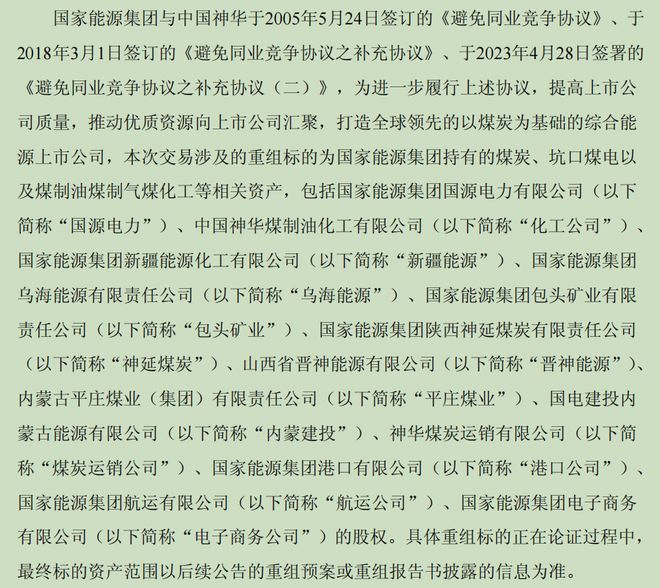
公告显示,此举旨在提高上市公司质量,推动优质资源向上市公司汇聚,打造全球领先的以煤炭为基础 的综合能源上市公司。根据安排,中国神华股票自8月4日开市起开始停牌,预计停牌时间不超过10个交 易日。 8月1日晚,中国神华(601088.SH)公告,当日收到控股股东国家能源投资集团有限责任公司(以下简 称"国家能源集团")通知,初步考虑拟由中国神华发行股份及支付现金购买国家能源集团持有的煤炭、 坑口煤电以及煤制油煤制气煤化工等相关资产并募集配套资金,前述资产涉及13家公司股权。 中经实习记者 孙汝祥 记者 夏欣 北京报道 激发央企转型升级、产业整合活力 分析人士表示,从停牌公告看,此次交易涉及的标的为国家能源集团持有的煤炭、坑口煤电以及煤制油 煤制气煤化工等相关资产,对应10多家公司相关股权。据此推测,此次交易金额有望跻身目前并购交易 的前列。 自"并购六条"发布以来,沪市大额并购频现。截至目前,已出现3单千亿级并购:已经实施完毕的国泰 君安吸收合并海通证券、已获得注册批文的中国船舶吸收合并中国重工、6月10日披露预案的海光信息 吸收合并中科曙光,对应的交易金额分别为976亿元、1152亿元、1160亿元。 分析人 ...
中国神华启动大规模资产重组,拟一次性整合13家企业
Xin Lang Cai Jing· 2025-08-02 04:20
Core Viewpoint - China Shenhua Energy Co., Ltd. plans to acquire 13 enterprises under its controlling shareholder, China Energy Investment Corporation, to enhance the quality of the listed company and consolidate resources in the coal-based energy sector [1][2]. Group 1: Transaction Details - The acquisition will involve issuing shares and cash payments for assets related to coal, coal power, and coal chemical industries [1]. - The specific assets and transaction amount are still under evaluation, with the final details to be disclosed in future announcements [2]. - This transaction is part of a strategy to resolve competition issues with the controlling shareholder and improve operational efficiency [2]. Group 2: Company Background - As of the end of 2024, China Shenhua has total assets of 658.1 billion yuan and a market capitalization of 822.1 billion yuan [2]. - The company was established on November 8, 2004, and is a flagship A+H share listed company under China Energy Group [2]. - The controlling shareholder, China Energy Group, was formed in November 2017 and has total assets of 2.1 trillion yuan and approximately 310,000 employees [3]. Group 3: Market Context - The acquisition aligns with the broader trend of state-owned enterprises enhancing resource allocation to improve competitiveness and promote industrial upgrades [3]. - Other state-owned enterprises, such as Huaihe Energy and China Power Investment, have also initiated asset restructuring this year [3].
中国神华筹划重大资产重组,实现煤炭全产业链优化配置
Di Yi Cai Jing Zi Xun· 2025-08-02 03:56
Core Viewpoint - China Shenhua Energy Co., Ltd. is planning to acquire equity stakes in 13 energy assets held by its controlling shareholder, China Energy Investment Corporation, which will enhance its coal resource strategic reserves and integrated operational capabilities [1][3]. Group 1: Transaction Overview - The transaction involves the acquisition of coal mining, coal power, coal-to-oil, coal-to-gas, coal chemical, and related logistics transportation assets [1]. - This restructuring aims to address business overlap issues between the controlling shareholder and the listed company in the coal resource development sector [1][3]. Group 2: Strategic Importance - The restructuring is significant for China's energy system reform and the establishment of a new coal production, supply, storage, and sales system [1]. - It will optimize the resource allocation across the entire coal industry chain, enhancing operational efficiency and creating synergies in production, transportation, and conversion processes [3]. Group 3: Operational Enhancements - Post-restructuring, upstream coal mining entities will provide stable resource supply, while downstream coal-to-oil and chemical technology platforms will improve clean and efficient conversion [3]. - The integration of logistics assets will create a self-controlled logistics network, significantly enhancing the efficiency of the "West Coal East Transport" strategy [3][4]. Group 4: Capacity Coordination - The establishment of a cross-regional capacity coordination mechanism will enhance China Shenhua's ability to respond to seasonal and structural supply-demand fluctuations in key energy consumption areas [4]. - This will provide robust support for energy security during critical periods such as summer peak and winter heating seasons [5].
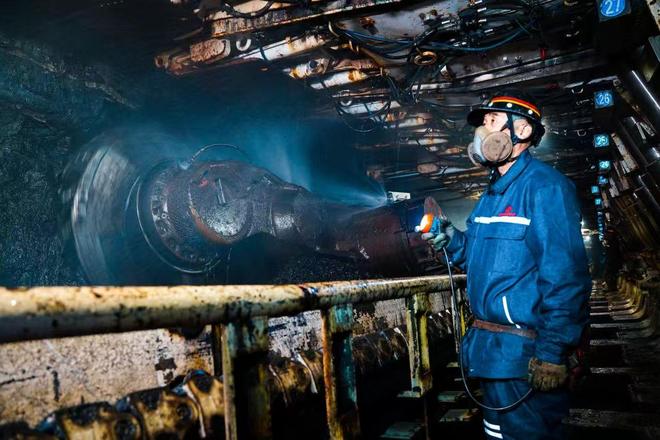
中国神华启动大规模资产重组 核心竞争力战略升级
Zheng Quan Ri Bao Wang· 2025-08-02 02:47
Core Viewpoint - China Shenhua Energy Co., Ltd. is planning a significant acquisition of 13 energy assets from its controlling shareholder, China Energy Investment Corporation, to enhance its coal resource strategic reserves and integrated operational capabilities [1][2]. Group 1: Acquisition Details - The acquisition will cover key segments of the coal industry, including coal mining, coal power generation, coal-to-oil, coal-to-gas, and related logistics transportation systems [1]. - This move is part of a broader strategy to address the overlapping business issues between the controlling shareholder and the listed company in coal resource development [2]. Group 2: Strategic Importance - The restructuring is expected to significantly improve China Shenhua's coal asset strategic reserves and facilitate a leap in the total resource volume of the listed company, reinforcing its market position as a leading player in the domestic coal industry [2]. - The geographical complementarity of the acquired coal assets with existing resources will enhance the logistics capabilities, particularly the "West Coal East Transport" initiative, and strengthen the integrated coal power projects [2][3]. Group 3: Operational Efficiency - The restructuring aims to optimize resource allocation across the entire coal industry chain, enhancing operational efficiency and creating synergies in production, transportation, and conversion processes [3]. - Post-restructuring, the upstream coal mining entities will ensure stable resource supply, while downstream coal-to-oil and chemical technology platforms will improve clean and efficient conversion levels [3].